
Via Real Agriculture.
The world needs more Canada, Suez section
Try to find Mr Pearson inventing peacekeeping:
Book review: ‘Eisenhower 1956: The President’s Year of Crisis — Suez and the Brink of War’ by David A. Nichols
Less here. Via Spotlight on Military News and International Affairs.
Meanwhile the NY Times finds Mickey I. trying to get noticed:
Looking to Lead Canada, and for a Little Name Recognition
At least Mike succeeded in becoming prime minister.
“It makes you think that Richard Nixon may have been innocent.”
There are known unknowns. And then there is Bob Woodward.
February 28, 2001: The Nisqually Earthquake
When the recent earthquake in Christchurch, NZ occurred I immediately contacted a friend of mine whose husband is a Kiwi and still has lots of family down there. At the tail end of our conversation she reminded me of the earthquake that occurred 10 years ago on the West Coast of North America.
The Nisqually Earthquake hit at 10:54am on Feb. 28, 2001. In the minutes before I happened to be in my 12th Floor Vancouver apartment, talking on the phone with one of my colleagues, who was over at our office in Victoria. The shock wave hit there first so I had about 10 seconds to prepare before it arrived in Vancouver. That was the LONGEST 10 SECONDS of my life!!!
Here are some more personal stories from that day, here is what it looked like inside of Microsoft in Redmond, WA when the quake hit, and here’s a fairly comprehensive video about the event and its after effects.
If you’ve ever been in the midst of a large scale natural event, please do share your story!
What is Toronto?????
I’m not sure how many Jeopardy fans there are in the SDA community but I found this very interesting:
Here’s a detailed explanation of the middle contestant. Lots of people are talking about the event here and here.
How long will it be before someone proposes that computers replace our politicians?!
Interesting Insight into the Situation in Egypt
Marshall Stocker is a most interesting and extremely well spoken American who runs a company called Freedom Economics. He has been living in Egypt but just returned to the U.S. a few days ago. Yesterday he was on Dennis Miller’s radio program and elucidated the audience with a first hand account of what has been happening in Egypt. It’s well worth a listen.
Related: It’s not easy being a journalist in Egypt these days.
Live video feed from BBC News
Update: I received a link to the following Facebook group from an Egyptian friend. Some of the photos & videos are quite disturbing but most interesting to see nonetheless.
The slow death of Canada as some of us knew it
Do read all of this from Publius, a firm believer in traditional British freedoms (the abuse of which by the royal government is said to have led to the American Revolution):
Cult of Multicult
Back in 1965, the Tory philosopher George Grant wrote Lament for a Nation, prophesying the eventual absorption of Canada into a technocratic, corporatized and American led continental super state. Grant came from an older Victorian tradition of Toryism, one essentially alien to what most Canadians think of as conservative today. In modern terms he might be described as a British-Canadian paleoconservative.
Ironically, the book – with its famous blue binding – became a totem for the Canadian nationalist Left in the 1960s and 1970s, much to Grant’s annoyance. While the Left picked up on Grant’s suspicion of Americanism – a far cry from the adolescent anti-Americanism we see emanating from the MSM today – and capitalism, it rather conveniently missed the philosopher’s defence of traditional British values and customs, including Christianity.
With four and a half decades of hindsight, we can see that Grant was correct that Canada and Canadianism was under grave threat. Sadly, he failed to correctly identify the enemy…
At the same moment the wider West was tearing itself apart [in the latter 60s], Canada was quietly undergoing a major identity crisis. After a century and a half of being solidly British – with some New World variations and anxieties – Canada found itself lost with the collapse of the British Empire. The generation passing through Grant’s classes was left asking in the wake, if Canada is not British, then what are we?
Multiculturalism provided a convenient answer, or more correctly a non-answer. What is Canada? We are everyone and anything that happens to show up here…
Opposition to a multi-ethnic society was regarded – correctly – as bigoted. By insisting that multi-ethnic was the same thing as multicultural, opposition to this transformation of Canadian society could be silenced as racist. Beginning with the monarchy – traditional English speaking Canada’s legal and cultural lynchpin – a slow campaign of hollowing out our institutions was conducted. The rationale provided was that our institutions needed to become relevant to these New Canadians.
This was – and remains – a patent absurdity. It is not the job of Canadian institutions to become relevant to the immigrants, it is the immigrants who must make themselves relevant to the institutions and what they represent…
Sikhs had worn turbans in the service of the Crown for centuries, including fighting alongside Canadian forces in Italy during the Second World War [emphasis added, a Royal Canadian Sikh Regiment might not be a bad idea for this martial race (encourage Gurkha immigration?)–after all we have a Canadian Scottish Regiment (Princess Mary’s), with their own dress]. Religious tolerance has been a hallmark of Canadian identity since at least the time of Baldwin-Laftontaine. It would have been perfectly consonant with our traditions and customs to have allowed turban wearing Sikhs in the RCMP, so long as reasonable precautions were taken for public and personal safety. Another part of the gradual, peaceful evolution of a multi-ethnic society.
Instead, for the advocates of multiculturalism, it was a test case, which they won handily. The allowing of turbans was not a victory for religious tolerance, but was instead framed as a victory for cultural relativism. We were not simply allowing other people to practice their beliefs peacefully, even while wearing the uniform of our national police force, we were instead proudly asserting that our values, our traditions and customs were no better than anyone else’s values, traditions and customs. The demand was not for tolerance alone. It was for tolerance to the point of suicide.
To. The. Point. Of. Suicide.
More from Lorne Gunter on Canada and former British liberties:
…
there’s no need to copy the Americans. Canadians already have the right to use force — even deadly force — to protect themselves. We need simply to return to our legal roots.
When Canada became independent at Confederation in 1867, Canadians retained the rights they had at the time as British subjects. These included three “absolute rights”: the right to personal liberty, the right to private property and the right to self-defence, up to and including the right to kill an attacker or burglar.
William Blackstone, Britain’s famous constitutional expert, argued the right to self-defence included the right to kill even an agent of the king found on one’s property after dark, uninvited…
Even in Upper Canada [now the province of Ontario, for American readers] for much of the 19th century, it was the law that all adult males be armed, at their own expense. In part, this was so a militia could be formed quickly for defence of the colony and in part so individuals were prepared to defend themselves and their property.
These rights have not been extinguished just because Canada has become modernized and urbanized, or because our officials would rather pretend they don’t exist and never have…
And note this about Britain:
…
Fully automatic firearms were almost completely banned from private ownership by the 1937 Act, which took its inspiration from the US 1934 National Firearms Act…
Update thought: The Aussies, once generally considered much more tied to the “mother country” (“home”) than Canadians, have now forged a strong and independent identity. Whilst English Canada–as it once was, now simply the Rest of Canada (RoC) other than Québec–led by academic, political and media elites, just gave up the ghost and abolished itself. Suicide indeed.
A Tale of Two Sheriffs: What Do The Numbers Say?
I was intrigued to see this article in Time magazine about two prominent sheriffs in Arizona: Maricopa County Sheriff Joe Arpaio and Pima County Sheriff Clarence Dupnik.

As Time has long been a de facto PR mouthpiece for the Democrat Party, I understood from the start that the article would be biased against [Republican] Arpaio and for [Democrat] Dupnik. But the notion of comparing two nearby sheriffs with widely differing political views got me wondering how the crime statistics in their two counties compared. After a little research and some compilation the difference in their crime stats is rather startling:
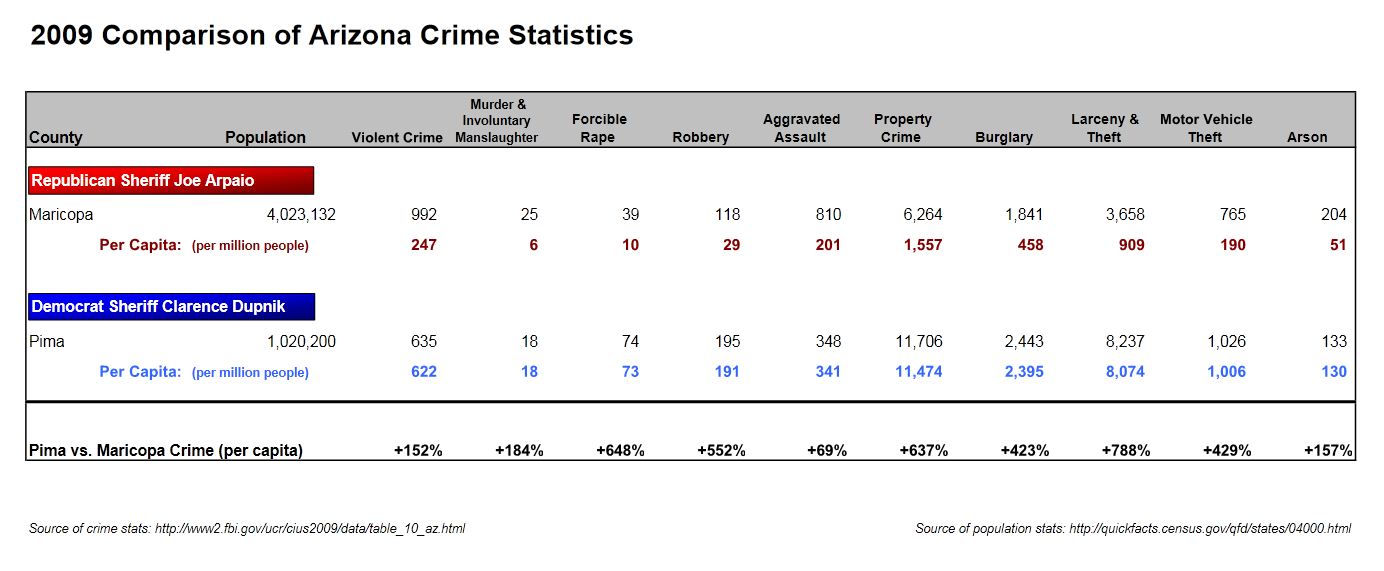
Please click on the image above to see it full-size or you can download the original spreadsheet. In the Time piece, there’s not a word of Arpaio’s success and Dupnik’s relative failure to combat crime but as we’ve seen in the disgraceful, unprofessional “reporting” of the Tucson massacre, the mainstream media has clearly shown that they have no interest in facts that don’t support how they wish to spin a news story.
Free Bill Whatcott!
Global Saskatoon – The Supreme Court of Canada says a man who distributed anti-gay pamphlets can challenge the constitutionality of the Saskatchewan Human Rights Code.
How’s That Hopey-Changey Thing Working Out For Ya?
While today’s unemployment number came at a low 9.4%, well below expectations, the one and only reason for this is that the labor force in America has plunged to a fresh 25 year low. Assuming a reversion to the mean in the long-term average participation rate back to 66%, means that the civilian labor force, which in December came at 153,690, a drop of 260,000 from November, is in reality 157.6 million, a delta of 3.91 million currently unaccounted for. Maybe someone can ask Bernanke during his imminent presentation before Congress what happened to the unemployed population, which would have been 18.4 million if this labor force delta was incorporated, resulting in an unemployment rate of 11.7%.
Still, it’s Bush’s fault.
Once Upon A Time In Afghanistan

h/t EBD
We Don’t Need No Stinking Giant Fans
Just as the rest of the world begins to realize that SDA is Canada’s greatest untapped source for investment advice on alternative energy…
After 30 months, countless TV appearances, and $80 million spent on an extravagant PR campaign, T. Boone Pickens has finally admitted the obvious: The wind energy business isn’t a very good one.
The Dallas-based entrepreneur, who has relentlessly promoted his “Pickens Plan” since July 4, 2008, announced earlier this month that he’s abandoning the wind business to focus on natural gas.
It’s too late for T. Boone Pickens – but is there time to save Sask Power?
Guess Where?
“…prices for food went up by 11.7 percent.”
Are you worthy to be Canadian?
What do Malcolm Gladwell, Steven Pinker and Louise Arbour have in common?
Give your answer (there are two correct ones) and then see here:
The world needs more Canada? Hardly
Part 2) of the post might also elicit some comment, cf. Kate’s post immediately below.
“I love Ricky Bobby too. Shake and bake!”
“As for capitalism with Bear characteristics, does anyone ever buy anything made in Russia other than…”
Going back a ways:
I’ll bet you didn’t know…
…the AK-47’s German background……
MP 43 assault rifle, the first production variant of the Sturmgewehr, left side……And, as commenter sdc notes, of course there’s more to it regarding the Kalashnikov.

Mark
I Remember The Day They Closed The Landfill In Delisle
It was the day before the rats moved into town.
This video looks at the current situation in Saskatoon SK. where an artificial scarcity is being used as justification to propose the spending of hundreds of millions of dollars.
36 Organizations Paid By The US Tides Foundation/Tides Canada
Vivian Krause shares the Tides Foundation details in the Financial Post;
Like most protests, the one against oil tankers has all the look and feel of a Canadian grassroots movement. The campaign against Alberta’s oil sands also seems to rise out of the people, but the interesting thing is that there are very few roots under that grass. Money comes in from a small core of U.S. charitable groups. One of those groups — the U.S. Tides Foundation of California (Tides U.S.) and its Canadian counterpart have paid millions to at least 36 campaign organizations. (See list at right.)
All the money, at least US$6-million, comes from a single, foreign charity. The Tides U.S. campaign against Alberta oil is a campaign against one of Canada’s most important industries. It’s fair for Canadians to inquire about who’s funding this campaign and why. The trouble is, nobody knows.

The Center Rock Drill Bit
If those miners had been trapped a half-mile down like this 25 years ago anywhere on earth, they would be dead. What happened over the past 25 years that meant the difference between life and death for those men?