
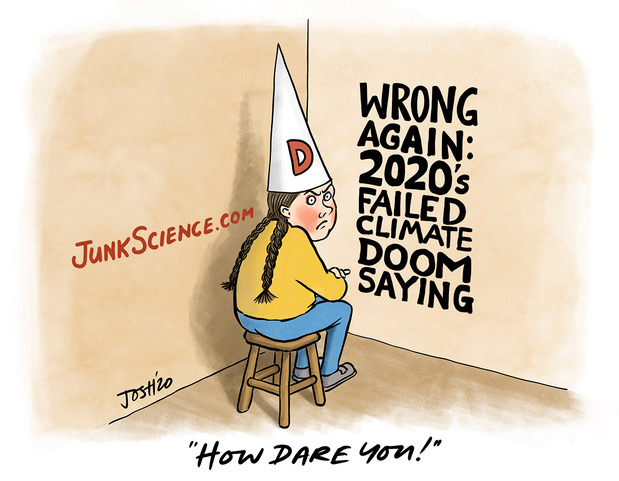
I Want A New Country
Anne Phair was having some coffee with some friends one day, back when you could still do that. They were talking about the federal carbon tax. Anne said, “I was talking to some friends, most of which don’t actually own their own businesses, and one was talking about how her grandma got some money back and she doesn’t ever get money back. And she was so surprised and I’m like, ‘Yeah, that was my money.’”
The Great Reset
I’ll believe there’s no conspiracy when the people who say there’s no conspiracy stop acting like conspirators: According to Forbes contributor and clean tech entrepreneur Wal van Lierop, climate change is such an emergency that Covid-19 lockdowns should continue indefinitely as climate change lockdowns.
Unexpectedly
Oh, look: The federal environment department says that Prime Minister Justin Trudeau's new carbon tax combined with his looming clean fuel standard will disproportionately hit low-income earners, the middle class, seniors, single moms and contribute to energy poverty.
— Lorrie Goldstein (@sunlorrie) December 21, 2020
Report here.
Rants From The Road
Y2Kyoto: Meltland
Modern Iceland’s Climate Is Colder With More Ice Than Any Other Time In The Last 8000 Years Except The 1800s
h/t Y. Knott
Y2Kyoto: State Of Anorexia Envirosa
“We are threatened by a dramatic loss of prosperity”
Related.
After destabilizing the grid by installing GE wind turbines everywhere, GE now to supply German power utility RWE with 11 gas turbines in order to help stabilize Germany's destabilized grid. https://t.co/VWVTPlpuFj
— Pierre L. Gosselin (@NoTricksZone) December 14, 2020
Y2Kyoto: End Of Snow

The Sound Of Settled Science
Y2Kyoto: They Tried To Warn Us

(link fixed, sorry!)
Y2Kyoto: Your Shrinking Brain
h/t PaulHarveyPage2
Y2Kyoto: Half The Water, Twice As Often
I’m surprised the kitchen sink escaped scrutiny;
Plus, like so many environmental rules, the old regulations made people’s lives worse without delivering improvements: “The tighter rules didn’t lead to energy savings for customers. The Association of Home Appliance Manufacturers estimated that they actually increased water consumption by 63 billion gallons, as households would have to run their dishwashers multiple cycles, or pre-rinse their dishes by hand, in order to get dishes actually clean.”
The Sound Of Settled Science
Absolutely massive error in a new Nature paper
Says it shows hurricanes decaying slower over land post-landfall (more damaging)
But they forgot to remove storms that landfall & then go back over the ocean
L=orig data
R= minus ocean stormsHT @RyanMauehttps://t.co/lEpeOppYED https://t.co/YztrxnwCko pic.twitter.com/kX0o8Dl5Vd
— Roger Pielke Jr. (@RogerPielkeJr) November 11, 2020
Honey, I Finished The Climate Emergency
Ten fat polar bears filmed raiding a stalled Russian garbage truck.
Unexpectedly
Carbon taxes have been a massive failure, Fraser report study finds
We Don’t Need No Stinking Giant Fans
Instead of talking about a trivial increase of a couple of dollars, Ontarians should be paying attention to the $4.7 billion the provincial government is borrowing this year to keep power bills artificially low. Ontarians are getting a rebate of 33 per cent off their real power costs. Pretending that power rates are far lower than they really are is a trifecta of political stupidity that the Liberals started, the PCs continued, and the NDP promises to make worse.
Ford defended the increase this week by saying that’s it’s rising at the rate of inflation. It is, but the increase has little to do with inflation. Instead, as the OEB pointed out, prices are going up because of declining demand.
But wait, wouldn’t decreasing demand in a market that already has a large supply surplus tend to lower prices, not increase them? Unfortunately, not in Ontario.
During the 15-year Liberal reign, the supply of wind, solar and natural gas generation increased to well beyond what the province required. For example, gas-fired generation makes up 25 per cent of provincial capacity but produces only six per cent of power output. In a free market, that kind of surplus would have driven prices down and pushed inefficient competitors out, but the Liberals had a solution for that. They guaranteed to pay for that new power, even if it was not needed or generated.
That’s the root cause of this week’s power increase. Guaranteed contracts have left Ontario with huge fixed power costs. As the volume of power used declined steadily for more than a decade, fixed costs rose to 18 times what they were back in 2008. Just over one-quarter of fixed costs now are attributed to wind and solar power.
Related: The Liberals are becoming a climate cult
We Don’t Need No Stinking Giant Fans
Study: Renewable Energy does Nothing to Reduce CO2 Emissions
According to these reports, US$3660 billion has been spent on global climate change projects over the period 2011–2018. Fifty-five percent of this expenditure has gone to wind and solar energy. According to world energy reports, the contribution of wind and solar to world energy consumption has increased from 0.5% to 3% over this period. Meanwhile, coal, oil, and gas continue to supply 85% of the world’s energy consumption, with hydroelectricity and nuclear providing most of the remainder. With this in mind, we consider the potential engineering challenges and environmental and socioeconomic impacts of the main energy sources (old and new). We find that the literature raises many concerns about the engineering feasibility as well as environmental impacts of wind and solar.
h/t PaulHarveyPage2
Y2Kyoto: There’s No Such Thing As Clean Energy
In short: The world spend $3.6 trillion dollars over eight years, mostly trying to change the weather. Only a pitiful 5% of this was spent trying to adapt to the inevitable bad weather which is coming one way or another. Both solar and wind power are perversely useless at reducing CO2, which is their only reason for existing in large otherwise efficient grids. Wind farms raise the temperature of local area around them which causes more CO2 to be released from the soil. Solar and wind farms waste 100 times the wilderness land area of fossil fuels, and need ten times as many minerals mined from the earth. Biomass razes forests, but protects underground coal deposits.
The role of large wind and solar power in national grids is to produce redundant surges of electricity at random or low need times, they are surplus infrastructure designed in a religious quest to generate nicer weather. They always make electricity more expensive because the minor fuel savings are vastly overrun by the extra costs of misusing and abusing perfectly good infrastructure, which has to be there to provide baseload and backup, and yet is forced to run on and off, sitting around consuming capital, investments, labor and maintenance. It is simply impossible to imagine a situation where unreliable generators have some productive purpose on major grids other than to generate profits for shareholders or their mostly Chinese manufacturers.
Despite the extortionate, futile mountain-of-money paid to wind and solar parasites, they produced a pitiful 3% of all the energy needed on Earth, while fossil fuels produced 85%.
h/t Another Ian
Y2Kyoto: ‘If it moves, tax it. If it keeps moving, regulate it.’
…we have ended up with the worst of both worlds. None of the inefficient policies was repealed, carbon taxes were layered on top of them and now the government is charging ahead with even more misguided climate regulations. The recent throne speech brings back for the millionth time home energy retrofit subsidies, despite ample evidence (going back to the old CHIP grants in the 1970s) that most of the money is wasted, paying people to do things they were planning to do anyway. Even worse is the proposed Clean Fuels Standard, a high-cost boondoggle that aims to bring the carbon intensity of fuels down by a small amount, at what will be an exorbitant cost per tonne that far exceeds the carbon tax rate.
So if, as the government insists, carbon taxes “work,” why all the regulations? The reality is the government never understood or endorsed the economic theory of carbon taxes, they just liked the virtue signalling and the revenue.
The Sound Of Settled Science
Revisiting the surface stations;
A new study published in the ISPRS Journal of Photogrammetry and Remote Sensing presents clear-sky surface UHI (SUHI) intensities for 497 urbanized areas in the United States by combining remotely-sensed data products with multiple US census-defined urban areas.
The SUHI intensity is the difference in surface temperature between the built-up and non-built up pixels of an urbanized area.
The study reported that the daytime summer SUHI was 1.91 °C higher and the daytime winter SUHI was 0.87 °C higher.