
Alberta’s electrical grid, with 3,618 megawatts of installed wind generation, was getting just 19 megawatts from wind at 7:26 a.m. on Wednesday. This is after several grid alerts in late November and throughout December.
Year End with Premier Scott Moe, Part 4: Lithium, helium, rare earth elements, oil

Lithium and rare earth elements may be a big deal in Saskatchewan over the next ten years, according to Premier Scott Moe.
Year End with Premier Scott Moe, Part 3: Investment reluctance, LNG and Germany, nuclear

Remember the “no business case for LNG” that Prime Minister Justin Trudeau said in front of a German chancellor desperate for LNG? Premier Scott Moe talks about that, as well as making a decision on whether to go ahead with nuclear sooner than later. Right now, Saskatchewan is not planning on deciding to go nuclear until 2029.
Year End with Premier Scott Moe, Part 2: oil prices, differentials, federal issues, pipelines and immigration

Premier Scott Moe thinks the reason we didn’t see a spike in drilling when oil prices spiked is a federal government scaring off investment. Part 2 talks about oil prices, differentials, federal issues, pipelines and immigration
Year end with Premier Scott Moe, Part 1: energy security, war, wind, solar and coal

There’s no fluff questions in this year-end interview with Premier Scott Moe. Part one focuses on energy security, the war in Ukraine, wind, solar and coal power.
There are four parts to this interview, to be published this week. Watch for them.
And here’s why we need all that lithium
Because we’re all going to drive electric cars, starting real soon. Didn’t you know?
Wonder where they’re going to get all the power from? Wind?
Alberta electrical grid in peril for the third time in 24 hours

The Alberta Electric System Operator issued a grid alert for the second time in one day, third time in 24 hours, and fifth time in three weeks. And at 5:27, demand hit another all-time peak.
Alberta electrical grid alert second time in less than 24 hours, fourth time this month
For the second time in 2 days, 4th time in December, Alberta Electric System Operator declares a “grid alert” as the power system can’t keep up with demand. It’s too cold for the wind turbines. -31C at Lethbridge, -35 C at Pincher Creek
How the Grinch tried to steal the oilpatch
Everyone’s got a Grinch story at this time of year. This is how the Grinch tried to steal the oilpatch.
Those giant stinking fans failed Saskatchewan, again, on Tuesday

SaskPower delays its reporting of power output by two days. But it turns out that on Tuesday, Dec. 13, wind power production in Saskatchewan all but collapsed. Again. You’d think in winter, having reliable power might be a thing? But we are intent on building more, a lot more, wind and solar.
Recently retired SaskEnergy CEO has a thing or two to say about energy transition
Recently retired CEO of SaskEnergy Ken From is a new columnist with Pipeline Online, and he’s got a thing or two to say about this supposed energy transition.
Subsidies for oil and gas? Really?
Some people think the oilpatch is blessed with all sorts of federal subsidies. Here’s Pipeline Online’s brief to the House of Commons Natural Resources Committee on the topic, which the committee is working on right now.
Alarm bells, not sleigh bells, should be ringing in Alberta. Saskatchewan, too.
Pipeline Online column on Alberta’s two electrical grid alerts this past week. And it’s not even really cold there yet.
As evidenced twice this past week, the electrical grid can barely handle the demand we have, now, before we switch most of our transportation system to electric vehicles. What happens when half our cars and trucks are EVs? Then three-quarters? What happens when the wind doesn’t blow then? No one goes to work?
When will the other media take notice? When will they start to question this mad rush to wind and solar, and total adoption of electric vehicles? When will someone else in the Saskatchewan media declare “The emperor has no clothes?”
Are we blind?

Alberta issues second grid alert in three days, as wind power generation collapses utterly, yet again, at suppertime.
The dawn of a new industry in Saskatchewan: Lithium

Pretty much anything with a rechargeable battery in it these days, from a cellphone to an electric vehicle, uses lithium (except for the lead-acid battery in your conventional car or truck). As the lightest metal, there’s no beating the periodic table.
It turns out, Saskatchewan has lithium beneath its southern soil. And now five companies are in a race to explore it, develop it, commercialize it bring it to market.
Pipeline Online just launched an in-depth series on what’s happening in Saskatchewan, a series over a year in the making. You can read Part 1, the introduction, and Part 2, recently released Saskatchewan incentives.
It’s the birth of an entirely new industry for this province, one that, if it pans out, could be worth many billions. And it’s all being done with oilfield companies and workers, as seen above.
What the other side is thinking: no more fossil fuels, period

In the interest of publishing what the true believers of climate change think, Pipeline Online published this op-ed from two university professors, one from Concordia, the other from McGill. They want to shut down all fossil fuels – coal, oil, natural gas, now. Period. The article came from The Canadian Press.
If we don’t end the use of fossil fuels, all of the rest adds up to little more than branches piled on the tracks in front of a runaway train. They might slow the train temporarily, but until we get inside the engine and shut off the throttle, the train will keep accelerating.
– Eric Galbraith, H. Damon Matthews
And, in a related note: the assault on art continues, this time in Vienna, in the name of saving the planet from fossil fuels.
As Alberta’s wind power generation collapsed this week, so, too did Saskatchewan’s giant stinkin’ fans

On Tuesday going into Wednesday, Wind power production in Alberta dropped to 0.1 per cent of nameplate capacity. And it stayed at 2% or less for about 24 hours. Well, now we know Saskatchewan saw a substantial drop as well.
To hell with that

Premier Scott Moe quoted a Pipeline Online story regarding shutting down coal and natural gas for our power production, as well as possible federal limits on nitrogen fertilizer emissions. “To hell with that!” he said in his throne speech on Nov. 3. This is the energy portion of his speech.
On Halloween, 81% of SaskPower’s electricity came from coal and natural gas, a nearly even split.
We don’t need no giant stinking fans. But we’re going to build a lot of them.
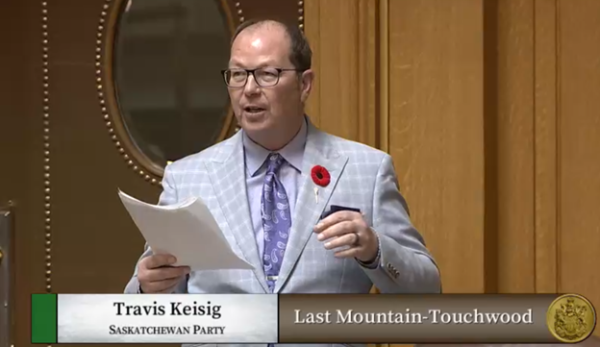
The Saskatchewan Party government sure seems to have some mixed messages when it comes to wind and solar power. We keep building more, and will build a lot more, but it turns out they don’t produce as advertised.
In two throne speeches on Nov. 2, one MLA spoke praises of SaskPower’s buildout. But another pointed out that you don’t get anywhere close to what the nameplate capacity is.
Our solar capacity is 20 and we were getting 2. You cannot run a province, you cannot run business, you cannot run industry, you cannot run people’s homes on that unreliability
Saskatchewan First Act is about keeping the lights on and letting farmers keep using fertilizer
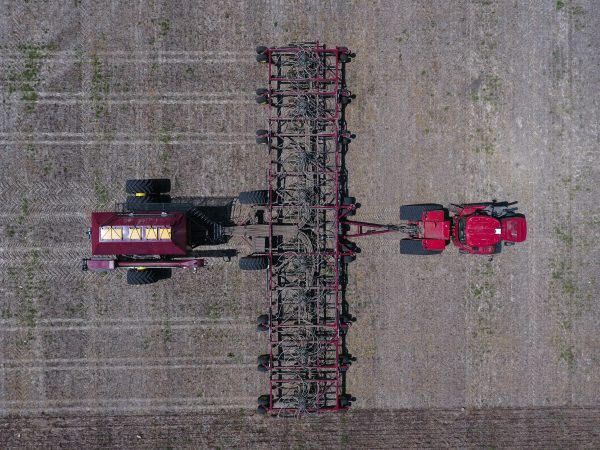
The other media simply didn’t get it, or didn’t read the full text of the Saskatchewan First Act, introduced on Nov. 1. It’s all about Saskatchewan imposing its own veto on federal initiatives that, if carried out to their fullest extent, by 2035 will literally mean cutting off up to 84 per cent of our power production on any given day. Those rules will also mean less fertilizer usage meaning less food.
This is Saskatchewan swinging for the fences, constitutionally. Here’s Pipeline Online’s take on the Saskatchewan First Act.
Thou shalt not use coal for power generation post-2030, the federal government hath said. And it’s moving to do the same with natural gas by 2035. It also wants to limit farmers’ fertilizer usage, all in the name of climate change policies.
On Nov. 1, the Province of Saskatchewan said, “To hell with that,” but in a more sophisticated, legal manner.
Saskatchewan threw down the gauntlet with the federal government on Nov. 1, introducing Bill No. 88, The Saskatchewan First Act. If implemented in its current form, the Act basically says Saskatchewan will make its own decisions and rules on environmental standards, particularly those applying to greenhouse gas emissions and power generation.
And here is Zinchuk’s column interpreting it. His daughter wonders if we’ll be reduced to kerosene lamps.