Again and again and again, Alberta’s wind power totally collapses to effectively zero. It got really low at supper on Tuesday, dropping to around 15 megawatts, which is pretty much nothing since their nameplate capacity has grown, again, now to 3,076 megawatts.
But by 12:30 a.m., it dropped to just 3 megawatts. That’s out of hundreds of turbines costing many billions of dollars.
Oh, and you have to look at how much the $100 million or so worth of batteries have contributed in the last month. Take a guess.
“So let’s take let’s take the power thing first of all,” Eyre said, noting the proposed Clean Electricity Standard, if adopted in its current form, would mean no fossil fueled power generation in this province by 2035.
According to SaskPower’s Where Your Power Comes From website, on any given day, coal and natural gas combined provide 65 to 84 per cent of the power in Saskatchewan. On Nov. 6, it was 77 per cent.
Eyre said, “That’s a federal policy which we hope will never see the light of day, but which is moving along. We will freeze in the dark. And we know that. Saskatoon (is) powered by the Queen Elizabeth, a natural gas-powered power station. The entire City of Saskatoon (would be) in huge trouble.”
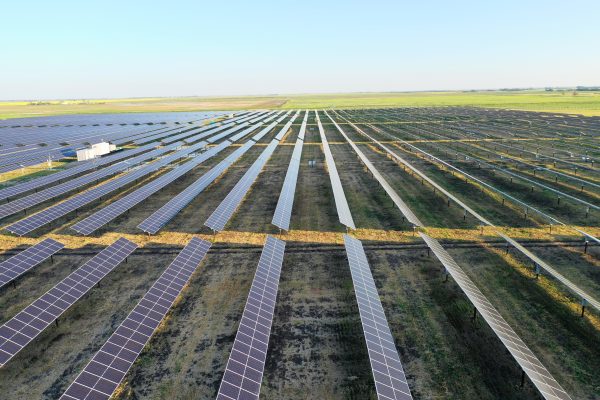
ESTEVAN – SaskPower held a two day open-house regarding at proposed 100 megawatt solar facility on Oct-26-27 at the Estevan Legion Hall.
In actuality, it’s not just a single project of 100 megawatts, but two projects – a 100 megawatt solar facility and a secondary, up to 10 megawatt pilot project.
The 100 megawatt facility is to be built on seven quarters of land approximately 10 kilometres southwest of the Boundary Dam Power Station. While SaskPower has large swaths of reclaimed mine land in the area, this block of farmland was chosen because it was undisturbed. Building on disturbed land would mean the foundations would be more costly.
It’s seven quarters of land in total, 1,120 acres or 453 hectares. The land has been optioned, but has not yet been purchased. It falls within the southwest corner of the RM of Estevan, Township 1, Range 9, west of the second meridian.
And, of course
As for Estevan, when asked “What do you do when the sun goes down?” the SaskPower official said, “You don’t generate any solar power.”
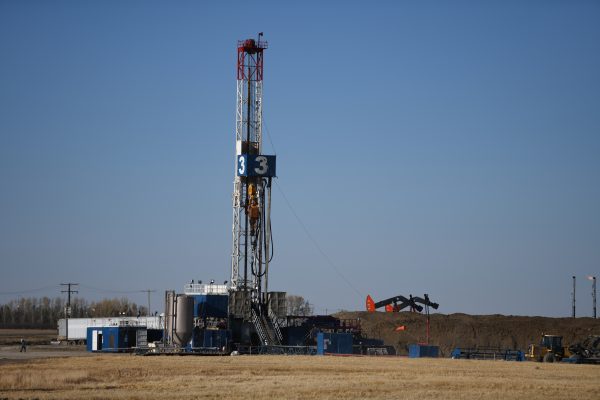
If you truly give a frac, this is what it looks like.
A huge reason behind Saskatchewan’s growth as a ‘have’ province was the advent of horizontal oil wells with multi-stage fracking, which had a substantial impact on oil production. And Crescent Point ended up with most of the fracked oil plays in Saskatchewan – the Bakken, Torquay and Shaunavon. But in what can only be considered a stunning move, Crescent Point announced on Wednesday that it’s trying to drill wells in the Bakken but not frac them.
If Saskatchewan can’t get out of a carbon tax, it looks like it’s going to try to reduce that overall carbon tax burden. The throne speech indicates that carbon offset credits from zero till farming will be available to lower other industries’ carbon tax burden.
This is an exceptionally rare occurrence where the 617 megawatts of wind power generation in Saskatchewan actually put out somewhere close to nameplate capacity. Who’d thunk it?
It’s 6 a.m. and after pulling an all-nighter I am finally finishing writing these three pieces. Huge impact on energy policy in Saskatchewan, affecting oil, coal, nukes, farming, fertilizer, even manure. Moe even mentions possibility of carbon capture on Shand. But feds want to kill off all fossil fuel power generation by 2035. On Oct. 9, 82% of Saskatchewan’s power came from coal or natural gas.
For months, Pipeline Online has been pointing out that Alberta puts out detailed data on its power grid, but SaskPower did not. Apparently others have been asking for the same information as well. Now, @SaskPower has responded. What does a day of power production look like in SK? Wind put out 6% of its capacity, and 2% of total generation. Coal provided 42% of total power
REGINA – While it’s not the same minute-by-minute data provided by the Alberta Electric System Operator for their grid, SaskPower has begun breaking down where its power is coming from on a daily basis. And the data from Oct. 3 and 4 showed wind generated an average of just 7.3 per cent and 6 per cent of its rated capacity of 615 megawatts. And while the Crown corporation often points out that “conventional coal accounts for approximately 24 per cent of SaskPower’s total generation capacity,” on those days, coal was providing an average of 42 per cent of the power in this province.
Jason LeBlanc, now reeve of the RM of Estevan, speaking on Parliament Hill in 2019.
In PipelineOnline.ca’s continuing series on the apparent end of additional carbon capture implementation on this province’s coal-fired power plants, leading to the eventual death of the coal industry, today’s story is reaction from the reeve of the RM of Estevan, Jason LeBlanc.
Back in 2019, before he became reeve of the Rural Municipality of Estevan No. 5, Jason LeBlanc was standing in deep snow on Parliament Hill, protesting the carbon tax imposed by the Liberal federal government. And now the largest industry in his RM will likely be largely shut down by the end of this decade, due to that government’s policies against coal-fired power.
And
“The government is knocking on our own people,” he said, speaking of Saskatchewan. “The government is who’s buying into this? And they need to just stand up and say, ‘No.’
“The pendulum always swings. Our ancestors looked for any way to heat the house and to do stuff. And they figured out a way, and it was coal.”
“Other parts of the world are starting to go back. They know it’s not sustainable. It can’t be done. And we have it here. It’s already producing,” he said.
An eclectic mix of energy and climate news stories from around the world compiled by Roger Andrews.
This week’s lead story features the growing number of cracks in Scotland’s Hunterston reactor, which according to some requires an immediate shutdown to avoid a second Chernobyl. Then on to our usual mix of energy and energy-related stories: Low oil prices to mandate an OPEC production cut; the Turk Stream gas pipeline: coal in Germany, Hungary, Japan and China; nuclear in Poland, France, Spain and the EU; renewables in Australia and Puerto Rico; batteries in California; tidal power in France; Solheim quits; hydrogen; foldable capacitors for energy storage and how Houston’s high-rises halted Hurricane Harvey.
Note that there is some informed commentary on the gravity of the Huntertson situation. If you don’t hear from me again it will be because I’ve been vaporised 🙁
An eclectic mix of energy and climate news stories from around the world compiled by Roger Andrews.
This week’s lead story features Cuadrilla’s attempts to frack the Bowland Shale in UK, where its operations are routinely halted by barely detectable microseisms – “a major threat to UK fracking”, as the Guardian puts it. We follow with our usual mix of stories: OPEC either to boost or cut production; record profits for BP; natural gas in the US, Argentina and Chile; coal in the US, Australia, Germany and Spain; nuclear in Japan and China; the IPCC’s anti-nuclear bias; Germany plans more wind & solar tenders; EVs as energy storage batteries; renewables and the UK budget: Scottish Power goes 100% wind; an energy-saving cooling system, solid fuel from sewage and what climate change will do to Glasgow.
An eclectic mix of energy and climate news stories from around the world compiled by Roger Andrews.
We are told that the cost of Li-ion storage batteries is decreasing. Not so with Tesla, which has just increased the price of its 13.5 kWh Powerwall unit plus supporting hardware from $US6,600 ($489/kWh) to $7,800 ($578/kWh). The $100/kWh “holy grail” price considered necessary to support mass deployment of battery storage is obviously still some way off. To follow we have our usual mix – the latest doings of OPEC; natural gas in California; coal in the US, Germany and Finland; nuclear in Japan, Ontario, India, Belgium and Germany; hydro and pot in Canada; 100% renewables in Puerto Rico and Scotland; the Ireland-Wales Greenlink; the UK backs off EVs; car bodies made from carbon fiber batteries and what climate change is going to do to beer.
An eclectic mix of energy and climate news stories from around the world compiled by Roger Andrews:
This week’s feature story exposes the mess Germany’s Energiewende has become, and in the follow-up story how it’s torpedoing Europe’s carbon emissions goals. Coming after we have the Trump-OPEC war of words; Saudi Arabia abandons its $200 billion solar project; Shell’s $12 billion Canadian LNG project; the world’s “coal binge”; Australia’s Liddell coal plant to close; the Belgian reactor shutdown; UK SMR companies ask for billions in government support; the EU to cut vehicle emissions, Denmark to ban petrol and diesel vehicles; power-to-gas energy storage in UK; wind turbines cause warming; Elon Musk defies the SEC and how California Gov. Jerry Brown will make the sun shine at night.
An eclectic mix of energy and climate news from around the world compiled by Roger Andrews.
In this week’s Blowout we feature China, where the central government’s edict to cancel over 100 planned coal plants is being ignored by local authorities who are continuing to build them anyway (the follow-up story shows satellite photos). Elsewhere in the world: Trump and OPEC go head-to-head; Nord Stream 2 and Germany; coal and hydro in the US; a last-minute reprieve for the Vogtle nuclear plant; possible blackouts in Belgium; the Puerto Rico grid; solar in France; Australia’s emissions increase; a “major” UK gas discovery; Corbyn to resurrect Swansea Bay tidal; US SEC sues Elon Musk for fraud; zinc-air batteries; Faraday exchangers and how global warming makes pigs thin and lethargic.
An eclectic mix of energy and climate news stories from around the world compiled by Roger Andrews.
Our lead story this week features Australia, where the federal government has declared victory in meeting its 2020 renewables goal and will fix no new emissions targets after then. The mix to follow includes another oil price tweet from Trump; record oil production from Russia; the US-China trade war; natural gas and the coal phase-out in Germany; the coal crisis in South Africa; France and India to build world’s largest (9.6GW) nuclear plant; US court upholds nuclear subsidies; Ontario to scrap its Green Energy Act; the EU wants more hydrogen; the British Gas “unlimited tariff” and Gov. Jerry Brown (aka Gov. Moonbeam) sends California into space.
An eclectic mix of energy and climate news stories from around the world compiled by Roger Andrews.
Featured in this week’s Blowout is the Paris Climate Agreement, where the big issue is no longer how to cut emissions but why the developing countries aren’t getting the $100 billion/year the developed countries promised to give them. Coming later we have global oil demand to hit 100 million bpd; oil & gas in the North Sea and Norway; the Russia-China gas pipeline; coal in North Carolina, South Africa, Poland, Queensland and the EU; Fukushima’s first radiation fatality; Austria appeals Hinkley Point verdict; melting glaciers and Swiss hydro; France names new energy minister; Alberta pulls out of Canada’s climate plan; Australia declares climate ‘single greatest’ security threat; EVs in the EU; solar companies consider leaving UK; Brexit to drive up energy bills and whether global warming caused Roger Federer to lose a tennis match.