Harper Fires Staffers!

I thought I’d use that subject line to underscore a Canadian media that has become so politicized that they are virtually useless as an information portal.
Yesterday, while our national and regional news services were breathlessly reporting that Harper had laid off between 5 and 15 office staff (no one seemed sure) as one of their lead items, yet another development in the investigation of United Nations corruption went virtually unreported.
As Adscam was to overall government “spending” by the Chretien/Martin Liberals, the Oil-For-Food scandal is simply a canary in a rotting coal mine of bribery, theft and kickbacks at the United Nations.
FoxNews;

Now the issue is becoming the scale of corruption in the U.N.’s normal operations and which individuals and corporations are reaping the benefits of a network of bribery and conspiracy that investigators have just begun to uncover. So far, those identities are still a mystery – but perhaps not for much longer.
Last Friday, federal prosecutors in Manhattan indicted the head of the U.N.’s own budget oversight committee, a Russian named Vladimir Kuznetsov (search), on charges of laundering hundreds of thousands of dollars worth of bribes paid by companies seeking contracts with the United Nations.

Prior to the Katrina disaster, the Martin Liberals are already at work ramping up anti-American rhetoric in preparation for the next federal election. That tactic is temporarily stalled, but by no means abandoned.
The Conservatives might be wise to serve them up a little of their own medicine. For months, there has been ample evidence uncovered of corruption at the UN on a multitude of fronts – evidence that most Canadians are virtually unaware of.

The Yakovlev-Kuznetsov scandal joins a growing list of cases of U.N. misconduct, waste, theft and abuse. They include bribe-taking under Oil-for- Food, sexual abuse of minors by peacekeepers in West Africa, sexual and financial misconduct – including outright larceny – at U.N. offices in Geneva, and business ties between the son of Secretary-General Kofi Annan (search) and one of the Oil-for-Food inspection firms hired with Yakovlev’s input, Swiss-based Cotecna Inspection (Cotecna has denied any wrongdoing).
In yet another scandal that emerged just last week, the United Nations disclosed that its Ukrainian peacekeeping contingent in Lebanon, including the commanding officer, has engaged in “significant financial misconduct” – though the world body has refused to provide details of what was done wrong or how much money was involved.

The Liberals have been able to depend on the United Nations to protect them from tricky foreign policy issues (and inaction) because Canadians by and large, have come to believe in the myth that the UN represents a form of democratic international concensus.
funding.jpg

Source (PDF)
By publicly challenging the government to investigate Canadian involvement in Oil-For-Food, demanding that they ensure Canadian taxdollars are not being siphoned into private offshore bank accounts or used to produce child porn, the Conservatives could begin chipping away (and rightfully so) at the confidence of Canadians in the UN as a form of international “moral authority” and undermine the Liberal/NDP dependancy on this favoured foreign policy crutch.
The Canadian media has no interest in pushing the issue into the public debate – the default setting of both private and public media in this country is overtly liberal, pro-United Nations, and anti-Republican. Unpleasant details about UN corruption don’t sit well with editorial boards who understand the political implications. They simply prefer not to look. It’s time that the Conservatives worked harder at forcing them to.

An Appreciation For Scale, Redux

More context in one post by a Saskatchewan blogger than Charles Adler, Pierre Bourque and Stirling Faux combined were able to scrape together over an entire week;

Now imagine the British trying to cope with their entire Island in shambles, and having to evacuate an entire city under horrific conditions and provide housing and care for the flood of displaced people.
Or, imagine the entire bottom third of the province of Saskatchewan being without infrastructure; in other words all the roads in the populous part of the province being either blocked by trees or under water, with power and most utilities out. And then, imagine having to evacuate a million plus people� and then some.
Another way of looking at the scope of things might be to imagine the coastal countries of Belgium, Holland, and Denmark, with all coastal regions of Germany being either destroyed or compromised to the point where most infrastructure was unusable. How well could the EU respond, and how quickly?

Dispatches From The “Circle Of Death”

It was a bad week to be out on the streets.

I hate placing blame and finger-pointing. But for this fiasco I have to place the blame squarely, unequivocally, and soundly on the shoulders of the president. His job is to keep this place running […] There is nothing necessarily wrong with a bureaucrat. As long as he does his job. But this one is so creatively bankrupt, so mistrusted, so disconnected, and so discounted by his own people that he is dead weight. We needed a leader, but they gave us luggage.

I do not own a house. I do not own a car.

On the other hand four hours on parade is still better than four hours on the Circle of Death. It was also good to see that everyone seemed to be having a good time. That spirits are still high. That we are more united than ever. That we aren’t alone.

Rise To The Occasion

A couple of days ago, I wrote that “In former times entire nations found the strength to rise to the occasion, ordinary people understood that survival depended on their shared common decency and respect for their fellow citizen.”
When I wrote that, I could not help but think of the starving people of Holland, welcoming their liberators after five years of German occupation.

This year the Dutch flooded the streets yet again, with their grandchildren and great-granchildren beside them, to applaud a few old soldiers for what is likely to be the final time, 60 years after the fact.
I wonder if, in the year 2065, the people of New Orleans will turn out in the thousands to celebrate the return of those who came for them or their grandparents, to bring fresh water and food, to drive back the criminals, to help them to safety?
I wonder if there will be a monument erected in a reborn City of New Orleans to the good people of Texas who took them in on moment’s notice, and by the thousands…
For those of you who checked in this morning expecting to read the first of several items, as is the usual custom here – you’re not getting that today. Instead, I have a single link for you. It’s long, but unlike most long essays, there is not a word wasted.
In it there are scenes of sheep, wolves and sheepdogs, wet shoes, shades of pink and grey, and the mayor of New York City running towards a burning building.
Tribes.
I’ll be back tomorrow.

Reader Tips

I’ll be out much of the day. Here’s an invitation to send a trackback to your own stuff, or post links to breaking news items in the comments.
Later.
Update – I see you folks outdid yourselves. There are some very good items in the comments.
Also, this via Nealenews;
CNN’s Soledad O’Brien interviewing New Orleans Mayor Ray Nagin this morning (Sept.5);

Nagin>> I got promises too.� I can’t stand any more promises. I don’t want to hear any more promises. I want to see stuff done. That’s why I’m so happy the president came down here because I think they were feeding him a line of bull also. They were telling him things weren’t as bad as it was, he came down and saw it and he put a general on the field. His name is general Honore. When he hit the field, we started to see action. What the state was doing, I don’t friggin’ know but I tell you, I am pissed. It wasn’t adequate. The president and the governor sat down. Air force one, I said, Mr. President, Madam governor, you two have to get in sync. If you don’t get in sync, more people are going to die.
O’Brien>> What date was this?
N>> I don’t know.
O>> When did you say that?
N>> Whenever air force one was here.
O>> Okay.
N>> And this is after I called him on the telephone two days earlier. And I said, Mr. President, madam governor, you two need to get together on the same page because the lack of coordination people are dying in my city.
That’s two days ago? Easement I don’t know the exact date. They both shook their head, said yeah. I said great. I said everybody in this room is getting ready to leave. There was senators and his cabinet people, you name it, they were there. Generals. I said everybody right now, we’re leaving. These two people need to sit in a room together and make a doggone decision right now.
O>> Was that done?
N>> The president looked at me. I think he was a little surprised. He said, no, you guys stay here. We’re going to another section of the plane and we’re going to make a decision. He called me in that office after that and he said, Mr. Mayor, I offered two options to the governor. I said — I don’t remember exactly what — two options. I was ready to move today. The governor said she needed 24 hours to make a decision.
O>> You told me the president told you the governor said she needed 24 hours to make a decision?
N>> Yes.
O>> Regarding what? Bringing troops?
N>> Whatever they had discussed. As far as what the — I was advocating a clear chain of command. So that we could get resources flowing in the right places.
O>> The governor said no?
N>> She said she needed 24 hours to make a decision. It would have been great if we could of left air force one, walked outside, and told the world that we had this all worked out. It didn’t happen. And more people died.

It was an early morning and a long day, so I’m going to take it easy this evening. See you tomrrow.

Happy Birthday, Saskatchewan

I recall when I was little seeing my grandfather’s birth certificate. It indicated his place of birth as “District of Assiniboia”. Our own family farm turned the century mark a couple of years ago.
Not many folks live to be 100, much less older, so while he was there for the birth of the province, he’s missing the birthday celebrations today.

Recruits of the 46th Battalion leaving Arcola, 1916
I drank my first illicit beer on the platform of that station. The photo is from a collection taken in the southeast of the province during that time. Be sure to check out the Buchanan photos – gathered (from as far away as the British Isles) by local historian Adrian Paton of Arcola, the history they record is matchless. These small internet files don’t do justice his work – the quality of the original photographs on display at the local museum is superb.

William Jefferson barn, built on NW-24-7-4-W2 1906. In his later years, Bill Jefferson used to stop in for supper on Sundays, unannounced.
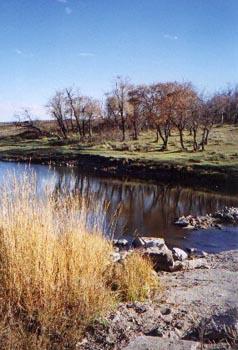
One of the drawbacks of these old photos is that they leave a mistaken impression of a monochromatic, dry and dusty past. However, consider the one below – which I took about hundred yards from the ruins of the Jefferson barn (Moose Mountain Creek in October). The scene will have changed little from the day Buchanan was there.

The farmhouse lasted longer.

There is a co-ordinated fireworks display planned for this evening in Saskatoon, (with identical programs scheduled for 15 locations in the province). I’ll be firing up the bike in a while to go in. I’ll try to take some photos, though no promises.
In the meantime, I do have my own small photo gallery, most of which have been taken here in the province, many of them within a few miles of my home. Enter here

The Battle For New Orleans

Via Maz2 in the comments, this Washington Post article reveals something that was hinted at in news items prior to the hurricane’s landing.

Behind the scenes, a power struggle emerged, as federal officials tried to wrest authority from Louisiana Gov. Kathleen Babineaux Blanco (D). Shortly before midnight Friday, the Bush administration sent her a proposed legal memorandum asking her to request a federal takeover of the evacuation of New Orleans, a source within the state’s emergency operations center said Saturday.
The administration sought unified control over all local police and state National Guard units reporting to the governor. Louisiana officials rejected the request after talks throughout the night, concerned that such a move would be comparable to a federal declaration of martial law. Some officials in the state suspected a political motive behind the request. “Quite frankly, if they’d been able to pull off taking it away from the locals, they then could have blamed everything on the locals,” said the source, who does not have the authority to speak publicly.
A senior administration official said that Bush has clear legal authority to federalize National Guard units to quell civil disturbances under the Insurrection Act and will continue to try to unify the chains of command that are split among the president, the Louisiana governor and the New Orleans mayor.
Louisiana did not reach out to a multi-state mutual aid compact for assistance until Wednesday, three state and federal officials said. As of Saturday, Blanco still had not declared a state of emergency, the senior Bush official said.
“The federal government stands ready to work with state and local officials to secure New Orleans and the state of Louisiana,” White House spokesman Dan Bartlett said. “The president will not let any form of bureaucracy get in the way of protecting the citizens of Louisiana.”
Blanco made two moves Saturday that protected her independence from the federal government: She created a philanthropic fund for the state’s victims and hired James Lee Witt, Federal Emergency Management Agency director in the Clinton administration, to advise her on the relief effort.

At LGF something else is noticed: after the original story appeared, WaPo later added a sub-heading reading “White House Shifts Blame”.

An Appreciation For Scale

This is sobering. The opening page is a graphic map of areas affected by Katrina. Clicking on the boxes brings up a breakdown showing smaller boxes, each of which represents a satellite photo. The detail is more than adequate to see individual buildings. (For even more detail, simply increase the text size of your browser.)
A small section of one of the aerial views of New Orleans. (Note to self – if warned of flooding in an urban area, move vehicle to top floor of parking garage.)
flooding.jpg
They are large images, so if you’re on dialup, be patient.
This should be a very valuable site for those who were safely evacuated to view their homes to get a rough idea of the state of flooding, etc. For those of us who have the good fortune to be mere observers, I suggest you spend some time with it to get a sense of scale.
As someone who has transversed the continent on several occasions by road, I have come to believe that many in politics, government and media fly too much. Like the “destination oriented” urban business or leisure traveller who generally lives and works within a relatively confined geographical area, their excursions to far flung locales are experienced almost exclusively through airport terminals.
Flying distorts one’s sense of scale. There is an unreality about the little images on the ground and the vast distances they represent. Imagine the experience becoming so routine that the window seat ceases to be your first preference. Imagine not looking down from a cloudless sky to try to identify geographical features and places you once stopped for coffee in. Imagine napping over the vastness of South Dakota, Nebraska and Iowa – and awaking a couple of hours later to ready your tray for landing.
Of course, many of you don’t have to imagine anything of the sort. It’s your normal flying experience.
Flying from Saskatoon into Los Angeles for the first time, there is a sense of astonishment at the endlessness of the great, smoggy city and her suburbs. Landing at night, the sense is even greater, as the lights of the city flood out into the Pacific, carried by boats.
Yet, make the same journey by road (ideally, with windows open and air-conditioning off) and the City of Angels appears as a mere oasis at the edge of a dry, rolling ocean of emptiness.
The second perception is accurate and appropriate, while the first is a distortion created by a sudden burst of speed.
So many people have so little appreciation for how large their country is, no realization that their great metropolitan areas are just miniscule dots on the map when placed within the great expanse of the continent. They have little understanding that there are hundreds of thousands of miles of infrastructure that connect us to each other in fragile threads of asphalt and cable and that their very urban lives depend on them.
As capsulized as the world becomes to the habitual air traveller, even more so is that of those who seldom travel at all. I know of Canadians who have never been south of Minot who can tell you with utter authority all about that great country – based on the flickering images that come over their television sets.
Returning to Katrina – some of the unthinking and uninformed criticism by media punditry of relief efforts may be due, in part, to this phenomenon. The size of the area devastated by Katrina and the subsequent flooding, relative to the size of those assets that are struggling to respond, is difficult for them to scale.
And virtually impossible for those whose view is contained within a 36″ screen.

Finally, Arrests

The Indian Posse is not a “youth gang”. It’s full-fledged organized crime that recruits aboriginal youth to exploit a youth justice system that grants virtual immunity from prosecution and incarceration. In turn, the Canadian justice system affords more lenient sentences for aboriginals by dictate of the Supreme Court. It’s no wonder that so many destroy their lives and others in the conviction that crime pays.
19-year-old Elizabeth Halkett was a crown witness in a case involving the murder of her brother. On March of 2004 her body was discovered in her burned out home. She was already dead when the fire was set. Yesterday, charges were finally laid.

Twenty-two-year-old James Slippery, who was already charged with arson in the case, appeared in a Saskatoon court today to face charges of being an accessory after the slaying and committing an offence for a criminal organization. Two other men, Elwood Poorman and Gerald Littlecrow, were also in court to face similar charges.
All have been remanded in custody until their next court appearance October 7th.
Halkett was to testify against a 16-year-old alleged member of the Indian Posse in the stabbing death of her brother, Joel, last year. Police say she was slain before she could testify at a preliminary hearing.

The three were also charged with committing an indictable offense in association with a criminal organization.

Reporting From The Astrodome

I just finished watching CTV news, and a segment that was busy playing up problems for refugees arriving in Texas.
Rightwingsparkle is volunteering at the Houston Astrodome. Her report is far more hopeful;

The whole thing was, of course, heartwrenching. People were packed cot to cot and with their supplies next to them. The really hard thing to see were the children. So small and with so little to keep them busy. The citizens and Churches of Houston came through in a BIG way and there was plenty of food, water, and clothes for everyone. The only thing I really had to dig for were toys. I plan to bring a bunch tomorrow. That seemed to be the only real need that wasn’t being meet. There were also plenty of volunteers.
As you might imagine I wanted to hear what it was like being in the Superdome. One teenage girl told me that it was terrifying when the shooting started. “It was the gangs,” she said. Her mother said, “The people found the guy who was shooting and beat his ass and his ass needed beating.” I found over and over again that people were as disgusted with the behavior of the thugs as the rest of us. I asked them if they were angry at the government. Not one I spoke to said they were. They were angry at the people who behaved badly. They were angry at the thugs with guns. They were angry with the people who threw trash everywhere and went to bathroom in public places.
In other words, they were mad at the right people, unlike our friends on the left.

There’s more – and you won’t get any of it from CNN.

Postcard From Afghanistan

kabul3.jpg
From a friend in the Canadian Armed Forces, just returned to Afghanistan.

It is September 1 here, we had a scorching day. Temps I believe were in the 45C range. Tonight, the sky darkened and it was hard to tell if it was the dust or a storm brewing. At about 1930, I got my answer. The light show was spectacular. A bit of thunder and lots of lightning, but no rain. The clouds may have dumped the rain in the mountains. It still has a very dusty smell outside.
A few things have happened since I wrote last. I have made it out of the camp. That in itself was quite a production. I went with the transport guys to pickup some cargo from KIA (Kabul International Airport). We took the BIG trucks. It is hard enough for me to get my short leg up into the step and pull myself up. Add on a flack vest, tack vest, helmet, water, camera, and rifle to that mix. I think the guys were taking bets as to whether I would fall back or not. I made it.
On our way out of the camp, we just happened to pick the precise moment that the India President Karzi was passing by. He had made a stop at the King’s Palace to dedicate a monument or something. He and his ‘groupies’ were just leaving the dedication when we were trying to leave. It was like the parade.
There were police on motorcycles, limousines, trucks of soldiers, SUVs with snipers hanging out the window, US Hummers with weapons, and a few dozen black sedans. While we were sitting there, I took out my camera to take a picture. One of the Afghanistan guards saw me and came running up to the PLS I was in. He wanted his picture taken too. LOL So he stood at attention and I took his photo.

Continue reading →

Trudeaupiate

The President of the Czech Republic V�clav Klaus has a blunt, and timely message for Europe, and by extension, for all western governments and those who elect them.

The question is what kind of ideas is favoured by the intellectuals. The question is whether the intellectuals are neutral in their choice of ideas with which they are ready to deal with. Hayek argued that they are not. They do not hold or try to spread all kinds of ideas. They have very clear and, in some respect, very understandable preferences for some of them. They prefer ideas, which give them jobs and income and which enhance their power and prestige.
They, therefore, look for ideas with specific characteristics. They look for ideas, which enhance the role of the state because the state is usually their main employer, sponsor or donator. That is not all. According to Hayek “the power of ideas grows in proportion to their generality, abstractness, and even vagueness”. Hence it is not surprising that the intellectuals are mostly interested in abstract, not directly implementable ideas. This is also the way of thinking, in which they have comparative advantage. They are not good at details. They do not have ambitions to solve a problem. They are not interested in dealing with the everyday’s affairs of common citizens. Hayek put it clearly: “the intellectual, by his whole disposition, is uninterested in technical details or practical difficulties.” He is interested in visions and utopias and because “socialist thought owes its appeal largely to its visionary character” (and I would add lack of realism and utopian nature), the intellectual tends to become a socialist.
In a similar way, Raymond Aron, in his famous essay “The Opium of Intellectuals”, analyzed not only the well-known difference between the revolutionary and reformist way of thinking but also – and this is more relevant in this context – the difference between “prosaic” and “poetry”. Whereas “the prosaic model of thinking lacks the grandeur of utopia” (Roger Kimball), the socialist approach is – in the words of Aron – based “on the poetry of the unknown, of the future, of the absolute”. As I understand it, this is exactly the realm of intellectuals. Some of us want to immediately add that “the poetry of the absolute is an inhuman poetry”.
[…]
Fifteen years after the collapse of communism I am afraid, more than at the beginning of its softer (or weaker) version, of social-democratism, which has become – under different names, e.g. the welfare state or the soziale Marktwirtschaft – the dominant model of the economic and social system of current Western civilization. It is based on big and patronizing government, on extensive regulating of human behavior, and on large-scale income redistribution.

In Canada, the “poets of soziale Trudeapia” are running amok.

Health Canada is calling for a change to the law that prevents peers and nurses in the city’s sanctioned safe injection site from helping people inject.
Health care workers can only supervise and offer medical assistance if a user hurts themselves and gets sick or overdoses.
If nurses help an addict shoot up, they could be charged with possession or trafficking.
“We need them to help,” said Ms. Tobin.
“And we need more places like the safe injection site. It’s so busy now, it’s being used all the time and people are sitting on the street, getting people who don’t know what they’re doing to inject them.”

In today’s modern, increasingly socialist democracies, nanny-state legislation (if it saves one life!) and cradle-to-grave “social safety nets” are the opiate of the middle class, while the politics of race and identity, envy, and “social justice” are the stock and trade of the economic underclass.
The net result is a society of entitlement that absolves the individual of personal responsibility and creates an illusion that consequences are made to be avoided. There is always “failure of society”, a previous generation, or corporate dynasty at whose feet the blame for personal failure lies, always someone else with more “ability to pay” to pick up the tab.
“They owe you” .
Consider a city built, unwisely, below sea level, protected by massive levies and powerful pumps provided by the state, maintained by the state, with all the apparent permanence of the state.
In the unthinkable event that those fail, experts and engineers plot strategies for worst case scenerios. They conduct disaster drills, with fake victims and fake blood. The state provides modern highways and mass transit, and communications systems and weather satellites.
Then, when the day comes that the unthinkable becomes possible, the planning and technology move into high gear. Government officials, with the assistance of private and public media, warn of a tremendous hurricane as it grows in strength. The images are available world wide as satellites track its path, and local TV records the destruction of those it has already battered.
Government officials and elected leaders urge the citizens to evacuate to save their lives. They warn of the scope of the impending storm and the potential of devastation. They mobilize and priorize. Hospital staff stay on duty to care for the sick and infirm. The doors to the largest facility available that may withstand the storm are opened in hopes that those who had no way of escaping, or somehow learned of them too late, can find refuge.
And tens of thousands ignore them and remain in their homes.
Many of them have cars parked in their driveways. Many who don’t are able-bodied and capable of walking. They ignore the warning and simply remain where they are, though they have children and elderly in their care.
With the storm passed, the waters rising faster than the heat, electricity failed and supplies running out, when the truth begins to dawn on the survivors – that the state is not all-powerful, that the mere human beings charged with coming to their aid,are, in fact, mere human beings who cannot come sweeping to their rescue like the cavalry over a Hollywood hill, that there are so many to rescue, because like they, so many have ignored the warnings – do they pool their resources?
Do they find strength in human dignity and sanctity of life? Do the strong come to the aid of the weak? Do they summon patience and resolve in the knowledge that help is on the way, if only they can find the courage to help themselves a little longer?
What is their response to this consequence that has befallen them, a consequence largely of their own making?
“You owe us” .
They take what others have failed to provide, those things required to sustain life – jewelry and television sets. And when taking isn’t enough (it never is), they devolve into predation and anarchy, abandon the weak, turn upon the innocent and each other – and all in a matter of days.
In former times entire nations found the strength to rise to the occasion, ordinary people understood that survival depended on their shared common decency and respect for their fellow citizen. That, by co-operating and persevering, they might create coping mechanisms through pooling skills and resources, and to be sure, the majority of those trapped in New Orleans will have done just that.
But, in former times, whole nations were not living in a time of entitlement, where all and any are provided for by an all-encompassing “social safety net”, funded by those faceless others with more, who have life easier, whom we have been trained to envy.
Those human failings, irresponsible and anti-social behaviors that once brought consequences in the community – shame, ostracization, and deserved personal deprivation – are today excused, assigned new and neutral nomenclature (all the better for medical diagnosis), prescribed “tolerance”, and if possible, assigned the politics of race or class, so that collective guilt may be mined to ensure that self-destructive behavior gains not only acceptance, but state funding.
The predatory violence and anarchy befalling New Orleans is not the result of a freak convergence of forces brought on by unnatural disaster.
It’s a warning.
(See also: American Spectator: Masques of Death)

Where Are The Buses?

In a parking lot, in New Orleans.
buses.jpg
Via Drudge who seems to be the first one asking how many of the poor, the very young and disabled, could have been moved out of New Orleans with that fleet, while the highways were still open and the streets dry and unobstructed?
I’ve been listening to Charles Adler and others today while I work, and I have to say, the lack of attention on cases of negligence of those civic officials charged with the first line of defense, is predictable. In their world, the only politician alive in America is George W. Bush.
But, by all means – you know-it-all media pundits, whine about how America is the wealthiest country in the world, whine about the delay in federal assets getting to the storm victims, raise the opportunistic hot button of racism, but while you’re at it – please share with the rest of us watching which fingers you’d snap.
And before you answer, here’s another question for you, if you believe the only factor lacking is will and organization.
Where are the lawyers?
Heard of any class-action suits?
Me either. That – more than any shortage of personnel carriers or rescue helicopters – should tell us everything we need to know about how difficult it is to access New Orleans.
Update Debris Trail delves into the logistics that the majority of the finger-snapping media experts seem incapable of comprehending.

Crime Watch

It’s the first day of school in Saskatoon. Police are reminding drivers to watch for youngsters crossing streets and parents to double check that their kids aren’t inadvertantly wearing gang colours.
Community outrage is growing over the release of three teenage girls accused of having kicked and beaten a 60 year old Florence Frenchman to death in her North Battleford home. In the words of their defence lawyer Ron Piche (who succeeded in getting a publication ban, so of course, no one is allowed to know who, or where they are.)

“If there is a trial, it could take a year or more before it begins, Piche noted. “I don’t see (their release) as undermining confidence in the justice system,” he said. “Are you going to keep an accused in custody that long?” Piche said.

Uh. Yes?
Or, if that isn’t possible, may I propose a compromise? Let’s share this societal responsibility for youth crime – place one out of every three or so of these anonymous young offenders charged with violent offenses in the guardianship of the judge who has done the releasing. That is, they must live in their home. Board a few with the Justice Minister, too.
Oh, and defense lawyers. Don’t let them off the hook for arguing for their release.
Of course, Saskatchewan isn’t the only place with these problems – in Toronto they’ve begun to crack down hard on their Jamaican gang gun violence, with plans to slap them with Victim Impact Statements.
Speaking of gangs and street violence – the good Reverand and civil rights leader Al Sharpton was last seen fleeing the scene of Cindy Sheehan’s vigil near Crawford, TX.
In a hurry to get to New Orleans, no doubt.

“We have to redistribute the wealth”

Greg Staples has a translation from a reader on remarks that needs to get some legs in the western Canadian media. FAST.

…”I don’t think anyone can transform Quebec’s economy without government help,” stated Jean Lapierre. “I think the government will have to be extremely active.” Alberta’s prosperity could even be called upon, suggested the minister.”The federal government has the duty to be a real partner, especially since as a government we benefit from the West’s wealth,”he stressed.”So we have to redistribute the wealth. After all, the good fortune of the West could become a disaster for the East. That is why we need a pact that will allow us to even things out.”

This is the latest of a series of similar news stories and opinions published in the past few days.
If they keep this up, the Separation Party of Alberta will need to make twice daily runs to deposit the membership cheques.

Florence Frenchman’s Alleged Killers Released

Police and officials cautioned the public last week that the beating of Florence Frenchman and her husband last week wasn’t “gang related”, and that residents shouldn’t feel unsafe. Saskatoon SP from earlier today;

A Saskatchewan family mourned for a slain woman while three teenaged girls appeared in court charged with second-degree murder.
Sixty-year-old Florence Frenchman was beaten to death Saturday in North Battleford. Her daughter says she feels sorry for the people who committed the crime.
Donna Frenchman says they will have to live with what they did for the rest of their lives.

Don’t feel too sorry for them. The three accused have just been released from police custody, with their next court date scheduled for Oct 27.

Navigation