
ZeroHedge- Shanghai Disneyland Sparks Chaos As 33,000 Visitors Locked-Down, Forced To Undergo COVID Testing
The “Hesitant”
Grab a beverage (or two) this is a long read but a very good one. You can read it either as webpages or a single pdf. (my preference is with the webpages)
If you’re a politician, public health official or member of the media this is the world you’ve created over the past couple of years.
Am I Infectious?
It’s a crime against Canadians that these tests weren’t in wide distribution a year and a half ago. Why did that not happen? Because control freak public health officials across the country, top to bottom, refused to allow a home test that didn’t include mandatory reporting.
There should be a reckoning for that, and it needs to start at the top and work down until every last one of the desk doctors who prevented it is escorted to the street.
When that’s finished, we can turn our attention to a Canada Health Act that imprisoned us in a socialized health care system with 1/3 the ICU capacity of our neighbors to the south. Tommy Douglas is not dead enough.
Dr. Infomercial
Safe And Effective ®
Sask Health did a funny thing the other day.
This is how their Covid dashboard looked on October 21st. (Image is from a previous post.)

And this is how it looks today.
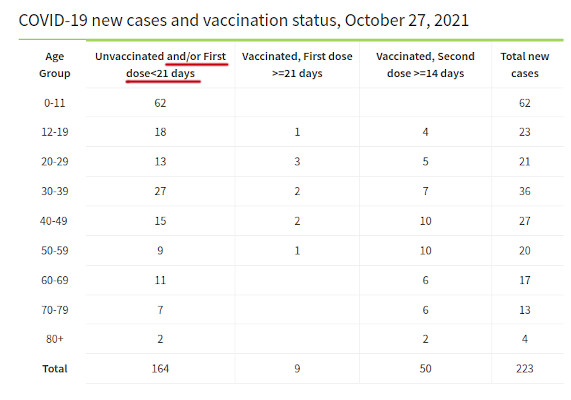
The “unvaccinated” now share a category with the newly vaccinated. Why would they do such a thing?
(I’ll let you finish yesterday’s math on your own.)
Related: This is what a real breakthrough infection report should look like.
Central planners gotta centrally plan…
Rather than admit that failures are a feature, not a bug, of centrally planned systems, some Saskatchewan doctors are talking about putting their careers on the line for socialized medicine.
She says she’s heard from a lot of other people in her profession who share her frustration over ignored recommendations from doctors.
Would those “recommendations” involve near-permanent dictatorial powers for medical professionals to manage vast sectors of the economy for which they have neither understanding nor expertise? Only someone with a god-complex would be surprised that such measures garner at least some pushback.
Safe And Effective ®
I have a question.
It’s about the upcoming approval (which is both inevitable and predetermined) of Covid-19 vaccines for children under 12.
My question is specifically addressed to our governing MLA’s, Cabinet, and health officials, along with the yapping jackals in opposition.
Should it come to pass – say in a five years time – that there’s a spike in leukemia, rare cancers, autoimmune disease or other long term side effects in these children that no one could have foreseen (because no one did long term trials) — what’s the game plan?
I mean, surely there’s a game plan?
Surely there has been discussion around the table at Cabinet, at Sask Health and elsewhere about how governments and health officials of the future will manage the fallout.
I mean, it’s not as though there aren’t precedents for the catastrophic failure of public health policy resulting from the advice and decisions of an expert medical class whose confidence was surpassed only by incompetence. One in particular comes to mind.
Parsons argues that the tragedy might have been contained, if not avoided, earlier than it was. That much is evident in testimony spilling each week from the federal inquiry into Canada’s blood supply, a multimillion-dollar exercise led by Justice Horace Krever of Ontario’s Court of Appeal. A veteran Ottawa journalist, Parsons builds a dry but unflinching case against a top-heavy blood bureaucracy – at its pinnacle, the Canadian Red Cross Society and the federal regulatory Bureau of Biologics – that operated a system riddled with flaws and false economies.
Safety was second to budget trimming, Parsons contends. Turf wars buried scientific data that alerted blood agencies to potential dangers. Hemophiliacs, who became the miners’ canaries of the blood system, were themselves self-destructively passive. At every turn, writes Parsons, “eyes were shut to mounting evidence, until it was too late.”
Because if you think that parents of injured children who were coerced by mandates won’t come looking for blood — think again.
It will be tainted blood scandal times 10,000.
Or — is the game plan the same as it always is? That being: “Sure, we’re spitballing. We have no fucking idea. Throw other peoples money at them, we assume. But, we have to get the media off our back. And I’ll be out of government by then, so that’s someone else’s problem”.
Because if that’s your game plan, I wouldn’t bet the house on it.
Not this time.
One last thing. Why is no one out there asking this question?
Reminder: Josef Mengele Was The Government Doctor

Fernandez: The Thing from the NIH
Let Them Eat Taser
It could have been out six months ago: New antiviral COVID treatment developed by Merck, was held back for 6 months due to political & media bias..
How To End Vaccine Hesitancy
The podcast by the formidable James Lindsay. recorded in May of this year: a must listen for every politician, government health official, and Saskatchewan radio talk show host.
“If you want me to get this vaccine you have to make the argument, you can’t merely coerce me into it. […] You could (and probably will) coerce or force me it it but you didn’t win the argument to do that. I didn’t, in that case, volunteer for it and I’m going to resent everyone who was involved: every industry who was involved, every individual, every politician who didn’t stand up for my right to make a choice in this. I’m going to resent every single one of them for the rest of my life.”
It’s an hour. Make the time.
They Lie. About Everything.
Four calls. That’s what led to an avalanche of hyped-up media reports on ivermectin.
The story behind the tweet that went ’round the world shows how a myth was born about a safe, if now controversial, human drug that was FDA-approved for parasitic disease in 1996 and bestowed the Nobel Prize in Medicine in 2015. It is a story in which the barest grain of truth morphed into an anything-goes media firestorm.
It began with one sentence in a Mississippi health alert on reports to the state’s poison control center: “At least 70% of the recent calls have been related to ingestion of livestock or animal formulations of ivermectin purchased at livestock supply centers.” In the thick of a fierce covid wave in the American South, no official at the FDA, or reporter for that matter, seemed to ask: 70 percent of what? Instead, government and media joined forces against a public health threat that, in retrospect, was vastly exaggerated.
Amid dozens of articles that ensued, Rolling Stone told of Oklahoma hospitals so jammed with ivermectin overdoses that gunshot victims had to wait for care — except it wasn’t true. Twice, The New York Times printed corrections of the same false information from Mississippi, which it described in one article and later removed, as “a staggering number of calls.” The Associated Press, Washington Post and, twice, the The Guardian in London also corrected its reporting on the alert.
The Times’ correction summed it up: “This article misstated the percentage of recent calls to the Mississippi poison control center related to ivermectin. It was 2 percent, not 70 percent.” (The Times and Post both made corrections in direct response to our reporting for this article.)
In real numbers, six calls were received for ingestion of ivermectin. Four were for the antiparasitic drug given to livestock.
Now Is The Time At SDA When We Synchronize!
“Public Health Inspectors and police, once the Medical Health Officer has signed a form for secure isolation, will be involved in assisting and transporting and moving people into the secure isolation site.”
This site, expected to be ready in the next three weeks, is going to be located at the Saskatchewan Hospital in North Battleford.
They refer to those sent to the secure isolation site as clients, not detainees. However they will be there under a detention order.

Scott Moe has forgotten that pleasing your enemies does not turn them into friends. (But it can turn your friends into enemies).
Passport To Nowhere
We’re From The Government And We’re Here To Help
How many people must the governor murder for NY health care workers to get the message? Via CTH;
Upstate University Hospital in Syracuse will temporarily close 22 of its 35 operating rooms starting Monday in anticipation of a growing staff shortage due to New York’s Covid-19 vaccine mandate.
The hospital had already postponed elective surgeries as a result of chronic staff shortages during the coronavirus pandemic. Now, priority will be given to surgeries that are medically necessary, time sensitive or involve critical-care trauma cases, the hospital announced Friday. Those surgeries will be consolidated into the 13 open operating rooms.
Never Let A Pandemic Go To Waste
Can we be finished with these people now?
Canadian military leaders saw the pandemic as a unique opportunity to test out propaganda techniques on an unsuspecting public, a newly released Canadian Forces report concludes.
The federal government never asked for the so-called information operations campaign, nor did cabinet authorize the initiative developed during the COVID-19 pandemic by the Canadian Joint Operations Command, then headed by Lt.-Gen. Mike Rouleau.
But military commanders believed they didn’t need to get approval from higher authorities to develop and proceed with their plan, retired Maj.-Gen. Daniel Gosselin, who was brought in to investigate the scheme, concluded in his report.
[…]
The plan devised by the Canadian Joint Operations Command, also known as CJOC, relied on propaganda techniques similar to those employed during the Afghanistan war. The campaign called for “shaping” and “exploiting” information. CJOC claimed the information operations scheme was needed to head off civil disobedience by Canadians during the coronavirus pandemic and to bolster government messages about the pandemic.
A separate initiative, not linked to the CJOC plan, but overseen by Canadian Forces intelligence officers, culled information from public social media accounts in Ontario. Data was also compiled on peaceful Black Lives Matter gatherings and BLM leaders. Senior military officers claimed that information was needed to ensure the success of Operation Laser, the Canadian Forces mission to help out in long-term care homes hit by COVID-19 and to aid in the distribution of vaccines in some northern communities.
Let Them Eat Lightsaber
Someone buy this man a beer 😂😂 pic.twitter.com/zLJeQ00Yqr
— Evelyn Rae (@_evelynrae) September 26, 2021
Wuhan Flu: Put Your Trust In The Experts
The new certificate with digital QR code supports proof of vaccination at border entry if travelling internationally, and is aligned with work the federal government is undertaking on a national solution.
“This is the next, improved, version of Saskatchewan’s COVID-19 vaccination record,” Health Minister Paul Merriman said in a news release.
QR codes are being temporarily removed from Saskatchewan COVID-19 vaccination records due a privacy breach.
The Government of Saskatchewan said the vaccination records of up to 19 residents have the potential to display another person’s QR code.
Expert: QR codes can be safe for vaccine certificates, if done correctly: expert
Someone Needs To Say It
It may as well be me.
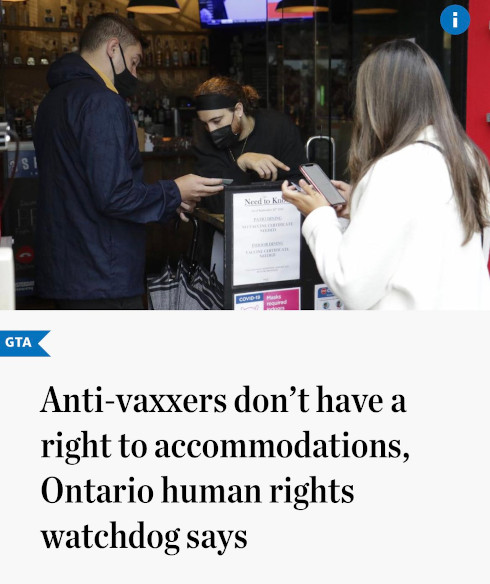
If the politicians and health officials and faceless bureaucrats across western democracies don’t shake off this mass psychosis and walk back their obscene, insane power grab soon, someone’s going to get hurt. And I don’t mean “thrown to the street by riot police” hurt. I mean School Book Depository window hurt.
There are broken people all around us, people who have nothing to lose. They number in the thousands, yet our untouchable elites seem unaware of how brittle the line can be between quiet desperation and suicidal retaliation. They’re lighting fuses in places they don’t even know exist.
I hope I’m wrong. I won’t be surprised if I’m right.
Wuhan Flu: Everyone Who Disagrees With Me Is A Nazi
Canada Starts Cracking Down on Fringe Medical Groups
“To be quite honest, we’ve never really dealt with medical professionals until the pandemic,” said Elizabeth Simons, deputy director of the Canadian Anti-Hate Network. “Typically they will keep a distance from the hate angle, but they’re still standing shoulder to shoulder with hate-promoting groups and individuals.”
If I recall correctly, Josef Mengele was the government doctor.
More from the fringe: “Officials at Northwell Health, New York’s largest provider of health care, estimate that they might have to fire thousands of people who have refused to get vaccinated.” – NYT
My Police State
h/t Chris east