
Okay, this is preliminary, highly context dependent, and the initial experiment isn’t even over yet. But it’s still darn interesting.
British Exceptionalism
Unlike Canada, there are still some nations in the world, such as the UK and America, where doctors are not automatically driven from their careers for disagreeing with Covid policy. Dr. John Campbell brings us this engaging interview with Dr. Clare Craig about the myths and reality of virus spread, masking and scientific modeling in the Covid era. Her book is available on Amazon UK.
“There is a problem that we have that modelers… first of all, their entire career is about this sort of event, so they want to spin it and out and exaggerate it….the worse they can make it, the better it is for them so they become the heros…So they’ve got all the wrong motivations and on top of that, if they say 85% are going to be susceptible and they’ve got it wrong, there doesn’t seem to be any consequence for them….They have this massive incentive to always be over-calling it.”
The Sound Of Settled Science
BVA Journals: Neutering is no longer the hallmark of responsible ownership
She is especially keen for vets to understand the breadth of ways in which research has shown the reproductive system contributes to an animals physiology. Take for instance the role of luteinising hormone (LH), which is responsible for triggering ovulation in females and production of testosterone in males — and is a key research focus for Kutzler and colleagues at her lab.
“When we first started looking at it, we found luteinising hormone had receptors on lymphocytes, so these immune cells that are floating around and involved in everything from fighting off viruses, fighting off bacteria, to making antibodies. When we started to review the literature, ‘we found that other people before us had demonstrated there were these receptors in humans, laboratory animals and even in dogs.’
In itself, that didn’t necessarily mean a great deal. Just because a cell has a receptor for a certain hormone doesn’t mean that it actually does anything. If you think of a receptor asa lock and the hormone as the key, you could unlock the door and theres nothing behind it,” she explains.
Indeed, Kutzler suspects the general assumption had been that there was nothing behind the LH receptor lock on the lymphocyte door. ‘Not that there was any science behind it, but it was just: “Why would there be reproductive hormone receptors on lymphocytes? They must not be functional.”
To test the assumption, Kutzler and colleagues collected lymphocytes from both neutered and intact dogs. ‘We grew those lymphocytes in cultures and added increasing levels of LH to see what happened. Did it unlock the door and there was something behind there? Sure enough, what happens is LH induces neoplastic changes in lymphocytes. Among them are cell proliferation, cell adhesion and cell ‘migration into tissue.”
For Kutzler, this provides an explanation for a finding seen in research studies – that lymphoma, along with certain other cancers, occurs in much higher rates in neutered dogs.
“We know that there are a number of serious neoplastic diseases such as lymphoma, haemangiosarcoma, osteosarcoma that can develop after gonadectomy,” says Stefano Romagnoli, professor of small animal reproduction at the University of Padova; president of the Italian Society for Animal Reproduction; and chair of the World Small Animal Veterinary Association reproduction control committee.
“And we also know that some castrated dogs develop prostatic carcinoma. It’s strange; counterintuitive.
I’ve been recommending (with rare exceptions) against routine neutering of my male puppies for at least 25 years, because we knew it was bullshit.
Y2Kyoto: Dry Is Wet
Roger Pielke Jr: We know that as climate changes, the impacts are getting worse. We’re seeing more and more flooding going on as a result.
Everybody knows this — it is conventional wisdom.
Not only is the conventional wisdom on flooding wrong, data show that flood impacts as measured by direct economic losses have actually decreased by about 90% since 1940 as a proportion of U.S. GDP. The United States is in fact more resilient to flooding than it has ever been. The reduction in flood impacts is an incredible story of success sitting out in plain sight that is completely ignored, in favor of stories that instead tell us that down is up.
The figure below shows U.S. annual flood damage as a proportion of GDP. In 1940 flood losses amounted to a 2023 equivalent of about $50 billion per year, and in 2022 they totaled about $5 billion, a reduction of over 90%.1
The Sound Of Settled Science
The “cycle of abuse” gets a stick in the spokes.
The sexually abused-sexual abuser hypothesis posits that persons, especially males, who are sexually abused as children are at particular risk of sexually abusing others later in life. We tested this hypothesis by prospectively examining associations between maltreatment and offending in a birth cohort of 38,282 males with a maltreatment history and/or at least one finalized offense. We examined these associations within the context of the wider birth population. Proportionally few boys were the subject of official notifications for sexual abuse (14.8% of maltreated boys, and 1.4% of the birth population); proportionally very few of these sexually abused boys (3%) went on to become sexual offenders; and, contrary to findings typically reported in retrospective clinical studies, proportionally few sexual offenders (4%) had a confirmed history of sexual abuse.
Tunnel vision
Interesting to note that the mainstream media professes this much angst over a drug whose effectiveness and side effects might be problematic, while the safety and effectiveness of another drug that we’ve heard so much about over the past two years warrants little else besides relentless cheerleading.
With limited research on its effectiveness against pain, some experts worry the U.S. may be repeating mistakes that gave rise to the opioid crisis: overprescribing a questionable drug that carries significant safety and abuse risks.
“There’s a paucity of options for pain and so there’s a tendency to just grab the next thing that can make a difference,” said Dr. Padma Gulur, a Duke University pain specialist who is studying ketamine’s use. “A medical journal will publish a few papers saying, `Oh, look, this is doing good things,’ and then there’s rampant off-label use, without necessarily the science behind it.”
The Sound Of Settled Science
Paleontologists in South Africa said they have found the oldest known burial site in the world, containing remains of a small-brained distant relative of humans previously thought incapable of complex behavior.
Led by renowned paleoanthropologist Lee Berger, researchers said in June they had discovered several specimens of Homo naledi – a tree-climbing, Stone Age hominid – buried about 30 meters (100 feet) underground in a cave system within the Cradle of Humankind, a UNESCO world heritage site near Johannesburg.
“These are the most ancient interments yet recorded in the hominin record, earlier than evidence of Homo sapiens interments by at least 100,000 years,” the scientists wrote in a series of preprint papers published in eLife.
The findings challenge the current understanding of human evolution, as it is normally held that the development of bigger brains allowed for the performing of complex, “meaning-making” activities such as burying the dead.
The oldest burials previously unearthed, found in the Middle East and Africa, contained the remains of Homo sapiens – and were around 100,000 years old.
Paleontology Youtube will be very, very angry.
Where’s The Beef?
Debunking of the latest anti-meat “study”. This one comes out of Harvard. Can be summed up in two words -confounding factors-.
Video is time stamped and includes a transcription.
Climate Of Doom

What Would We Do Without Models?
Morning update: Scenes of significant damage are beginning to come in.
Morning devastation.
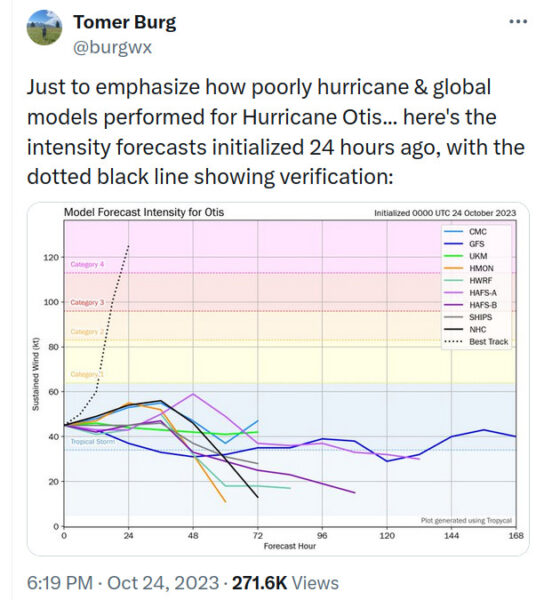
If you’re anywhere near Acapulco, take cover.
In a shocking turn of events, Hurricane #Otis in the Eastern Pacific has unexpectedly, explosively intensified from a tropical storm to a Category 4 hurricane in just 12 hours.
Even worse, the storm is expected to make a catastrophic landfall tonight as a Category 5 hurricane near Acapulco, Mexico, home to 1 million people.
Only 18 hours ago, people were expecting a tropical storm at landfall, and now a devastating Category 5 storm is likely.
This is pretty much a worst-case scenario, as residents have little time to find a safe shelter and protect life and property from this life-threatening storm.
A major hurricane (Category 3+) has never made landfall within 50 miles of Acapulco, let alone a Category 5 hurricane.
Otis could become the first Eastern Pacific hurricane ever recorded to make landfall as a Category 5 in Mexico.
Anyone in or near Acapulco should rush storm preparations to completion as their is little time left to shelter from #Otis.
Ryan Maue – “Nightmare scenario” for coastal Mexico…
The Sound Of Settled Science
How Could the IPCC Make an Error this Large?
Earlier this week I discussed the mystifying continued prioritization of the outdated and implausible RCP8.5 scenario by the Royal Netherlands Meteorological Institute (KNMI) in its scenarios expected to guide Dutch climate policies for the next decade. Since then I have heard from many friends and colleagues in the Netherlands offering a wide range of perspectives on what happened and what should happen next.
These exchanges have prompted me to summarize how the Intergovernmental Panel on Climate Change (IPCC) has treated climate scenarios in its most recent assessment reports. Today I document a major error made by the IPCC in its fifth assessment report (AR5) which has had profound consequences for climate research and policy in the decade since.
Settle in, this one is a doozy.
The Sound Of Settled Science
In 2011, the United States experienced more than 500 deaths and over $30 billion in losses from tornadoes. As is now common, climate activists were quick to claim that the destructive tornadoes that year were due to climate change. The National Oceanic and Atmospheric Administration (NOAA) rejected such claims, advising: [A]pplying a scientific process is essential if one is to overcome the lack of rigor inherent in attribution claims that are all too often based on mere coincidental associations.
The 2011 tornado season motivated us — Kevin Simmons, Daniel Sutter and I — to take a close look at trends in tornadoes and their impacts across the United States. The result was a peer-reviewed paper with the first comprehensive normalization of U.S. tornado losses, for 1950 to 2011.
Our results surprised even us — U.S. tornado damage and tornado incidence appeared to have decreased dramatically, contrary to conventional wisdom…
The Sound Of Settled Science
Safe and Effective®
It goes in the arm.
Then it goes to your liver, it goes to your heart, it goes into breast milk.
The Lancet: Biodistribution of mRNA COVID-19 vaccines in human breast milk
The Sound Of Settled Science
A climate change scientist has claimed the world’s leading academic journals reject papers which don’t ‘support certain narratives’ about the issue and instead favor ‘distorted’ research which hypes up dangers rather than solutions.
Patrick T. Brown, a lecturer at Johns Hopkins University and doctor of earth and climate sciences, said editors at Nature and Science – two of the most prestigious scientific journals – select ‘climate papers that support certain preapproved narratives’.
In an article for The Free Press, Brown likened the approach to the way ‘the press focus so intently on climate change as the root cause’ of wildfires, including the recent devastating fires in Hawaii. He pointed out research that said 80 percent of wildfires are ignited by humans.
Brown gave the example of a paper he recently authored titled ‘Climate warming increases extreme daily wildfire growth risk in California’. Brown said the paper, published in Nature last week, ‘focuses exclusively on how climate change has affected extreme wildfire behavior’ and ignored other key factors.
Brown laid out his claims in an article titled ‘I Left Out the Full Truth to Get My Climate Change Paper Published‘. ‘I just got published in Nature because I stuck to a narrative I knew the editors would like. That’s not the way science should work,’ the article begins.
Good for him.
The Sound Of Settled Science
The Story of Our Universe May Be Starting to Unravel
Not long after the James Webb Space Telescope began beaming back from outer space its stunning images of planets and nebulae last year, astronomers, though dazzled, had to admit that something was amiss. Eight months later, based in part on what the telescope has revealed, it’s beginning to look as if we may need to rethink key features of the origin and development of the universe.
Launched at the end of 2021 as a joint project of NASA, the European Space Agency and the Canadian Space Agency, the Webb, a tool with unmatched powers of observation, is on an exciting mission to look back in time, in effect, at the first stars and galaxies. But one of the Webb’s first major findings was exciting in an uncomfortable sense: It discovered the existence of fully formed galaxies far earlier than should have been possible according to the so-called standard model of cosmology.
According to the standard model, which is the basis for essentially all research in the field, there is a fixed and precise sequence of events that followed the Big Bang: First, the force of gravity pulled together denser regions in the cooling cosmic gas, which grew to become stars and black holes; then, the force of gravity pulled together the stars into galaxies.
The Webb data, though, revealed that some very large galaxies formed really fast, in too short a time, at least according to the standard model. This was no minor discrepancy. The finding is akin to parents and their children appearing in a story when the grandparents are still children themselves.
What Would We Do Without Experts?
Robert Graboyes: Experts Agree! Scholars Don’t.
Let’s Check In On California’s Permanent Drought

Via Brian Sullivan: 16 of California’s 17 reservoirs are now above historical average. 3 are close to capacity.
Y2Kyoto: The Science Police
This post is inspired by the successful efforts last week of climate activists — including three widely-cited scientists — to enforce misinformation by the legacy media. In a nutshell, ABC News wrote an accurate story about how climate was not a major or even significant factor in the Lahaina, Maui fire and disaster. After being mobbed by the enforcers, the story was changed to emphasize the role of climate. These sort of activist scientists who seek to enforce preferred public narratives have been called the “science police.”
Today’s post pushes back against this narrative enforcement with some actual science. Have a look at the panel below. It shows three versions of a climate time series for annual counts of North Atlantic major hurricanes from 1995 to 2050. Two of the graphs include a large change in climate, one of them does not.
The Sound Of Settled Science
Everything keeps getting older.
Archaeologists have new evidence suggesting that humans occupied Oregon more than 18,000 years ago. This makes it one of the oldest known sites of human occupation in North America.
A 2023 radiocarbon dating analysis was made based on findings at the Rimrock Draw Rockshelter near Burns, Oregon. The University of Oregon Archaeological Field School has been excavating at the site, which features a shallow overhang in an otherwise open environment. The field school has been working in partnership with the Bureau of Land Management since 2011.
Archaeologists have been studying how and when people migrated to the Americas for over a century. While researchers used to assume that no humans were on the continent until about 13,000 years ago — when they walked over the Bering Land Bridge during the last ice age — both genetic and archaeological evidence have been pushing that date back further and further. However, these dates have spurred controversy.
The time has come to have a conversation on a name change. (link fixed)