Hear my prayer: Repaving crew abandons Oakland neighborhood citing safety concerns
Pickton On Life Support
He deserved the death penalty.
Notorious B.C. serial killer Robert (Willie) Pickton was on life support Monday after a brutal attack by another prisoner in Quebec’s maximum Port-Cartier Institution.
Pickton was airlifted to hospital after the assault, which sources say took place just before 2 p.m. local time on Sunday, May 19.
One source said the attacker had earlier assaulted other inmates at the prison before being moved to segregation. The attack on Pickton allegedly happened after the prisoner was then released back onto the same unit as the serial killer, Postmedia has learned.
But no one deserves to live at the mercy of prisons run by incompetents.
Riding Mass Transit Is Like Giving 30 Municipal Politicians The Keys To Your Bank Account
The Alberta government sends a “Dear Jyoti” letter;
“Any cost increases or escalations will be the responsibility of the city and no additional funding will be available for this project under any circumstances,” reads the letter.
We’re talking about Phase 1 of the Green Line LRT.
That’s the 18-kilometre stretch from Shepard in the city’s southeast to Eau Claire downtown.
It is a far cry from the original dream of having the Green Line LRT going from the far north of the city to the deep southeast of the city down in Seton.
We’re just talking about one phase and there is already chatter of cost overruns.
The Smith government is clearly not going to play in that sandbox.
We Don’t Need No Flaming Sparky Cars
Ford’s electric vehicle unit reported that losses soared in the first quarter to $1.3 billion, or $132,000 for each of the 10,000 vehicles it sold in the first three months of the year, helping to drag down earnings for the company overall.
Ford, like most automakers, has announced plans to shift from traditional gas-powered vehicles to EVs in coming years. But it is the only traditional automaker to break out results of its retail EV sales. And the results it reported Wednesday show another sign of the profit pressures on the EV business at Ford and other automakers.
We Don’t Need No Flaming Sparky Cars
Spectator: Desperate manufacturers are struggling to shift electric cars
The real reason for hefty discounts on electric cars is desperation. Since 1 January, manufacturers have been under the zero emissions mandate (ZEV), which demands that 22 per cent of the cars they sell in 2024 are pure electric cars. Should they fail to reach this target, they will be fined £15,000 for every vehicle by which they fall short.
How are they doing? Not very well, it seems. In the first three months of 2024, according to the Society of Motor Manufacturers and Traders (SMMT) electric cars accounted for only 15.5 per cent of the market – virtually unchanged from the same period in 2023. Moreover, the target is not going to stay at 22 per cent. In 2025 it will rise to 28 per cent, then in stages to 80 per cent by 2030 and 100 per cent by 2035. Unless electric car sales pick up dramatically in the next few months, manufacturers are going to find themselves with an enormous bill at the end of the year. The situation is worse for many carmakers than the above figures suggest because some carmakers, like Tesla, are already electric-only. That means that the sales being achieved by others must be well below 15 per cent.
It wasn’t supposed to turn out this way. Analysts were not expecting manufacturers to miss the 22 per cent target. Just last December, S&P forecast that sales of electric cars would surge by 41 per cent in Europe in 2024, and by 66 per cent in the US. In Europe, it was believed, EVs would be accounting for 22 per cent of the market across 2024.
We Don’t Need No Flaming Sparky Cars
GM killing it on big trucks and SUVs and is showing it off.
Sold only 16,400 EVs in Q1.
Who could’ve seen this coming ..
More: Talk to any dealer … resale is so horrendous most wont keep the cars on the lot (they immediately wholesale a trade in if they can).
We Don’t Need No Flaming Sparky Cars
Where, oh where, did the stupid rich people go?
As automakers continue to delay their electric-vehicle plans and report lower-than-expected sales, Canada’s goal of ensuring that at least 20 per cent of new vehicles sold by 2026 are electric seems to be in jeopardy.
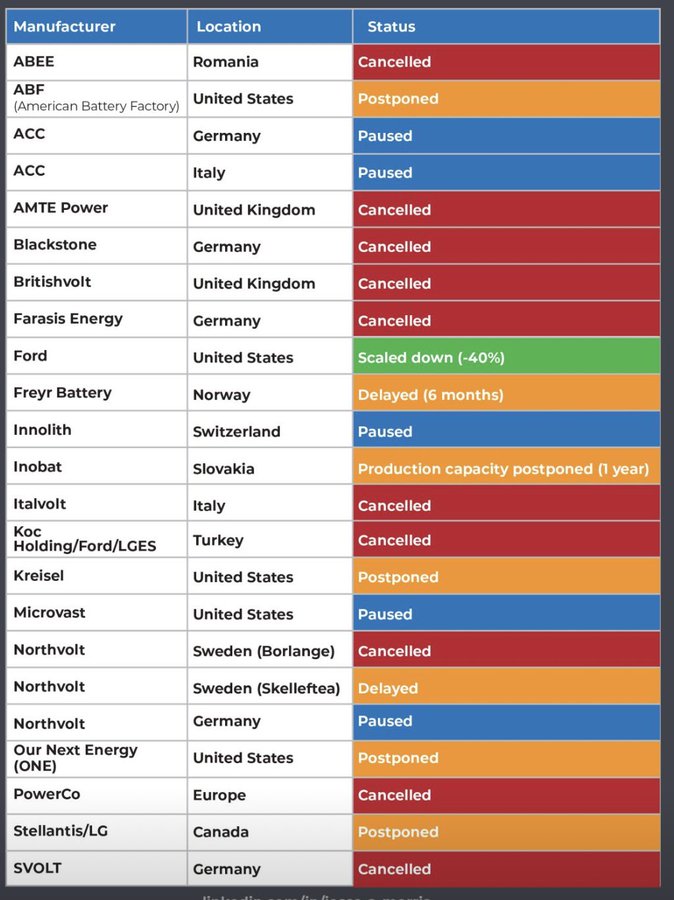
Ford Motor Co. last week said it was going to delay EV production at its assembly plant in Oakville, Ont., by two years to 2027 from 2025. The additional time will allow the company to take advantage of an emerging battery technology and let the number of consumers grow.
Earlier this month, Tesla Inc. reported a decline in quarterly deliveries for the first time in nearly four years. The Elon Musk-led company attributed the fall to logistical issues, but analysts say that slowing demand for EVs also played a role.
General Motors Co.’s chief executive Mary Barra referred to this slowdown as well on an earnings call in January, when she said the slowing pace of EV growth had created some uncertainty. She still expects EV sales in 2024 to improve, but said “if demand conditions change, we’ll take advantage of our manufacturing flexibility … to build more internal combustion engine models and fewer EVs.”
Emphasis mine.
Confessions of a Freight Broker
Podcast: If you want to find out about the ‘Wolf of Wall Street’ shenanigans that go in the offices of those who help move our economy around, Cameron is your guy.
DEI The Friendly Skies
What Boeing did to all the guys who remember how to build a plane.
“John is very knowledgeable almost to a fault, as it gets in the way at times when issues arise,” the boss wrote in one of his withering performance reviews, downgrading Barnett’s rating from a 40 all the way to a 15 in an assessment that cast the 26-year quality manager, who was known as “Swampy” for his easy Louisiana drawl, as an anal-retentive prick whose pedantry was antagonizing his colleagues. The truth, by contrast, was self-evident to anyone who spent five minutes in his presence: John Barnett, who raced cars in his spare time and seemed “high on life” according to one former colleague, was a “great, fun boss that loved Boeing and was willing to share his knowledge with everyone,” as one of his former quality technicians would later recall.
But Swampy was mired in an institution that was in a perpetual state of unlearning all the lessons it had absorbed over a 90-year ascent to the pinnacle of global manufacturing. Like most neoliberal institutions, Boeing had come under the spell of a seductive new theory of “knowledge” that essentially reduced the whole concept to a combination of intellectual property, trade secrets, and data, discarding “thought” and “understanding” and “complex reasoning” possessed by a skilled and experienced workforce as essentially not worth the increased health care costs. CEO Jim McNerney, who joined Boeing in 2005, had last helmed 3M, where management as he saw it had “overvalued experience and undervalued leadership” before he purged the veterans into early retirement.
We Don’t Need No Flaming Sparky Cars
We just don’t have the stupid rich people necessary to support the industry.
Ford Motor Company delaying retooling of it’s EV plant for 3 years after Ford and Trudeau gave them $600 million of your money. What does this say about the $30 billion handout to fund EV battery manufacturing?
We Don’t Need No Flaming Sparky Cars
… paid $1.7 million for CEO Tony Aquila’s private jet bills, twice its total revenue last year. According to its earnings report released this week, Canoo lost $302 million in 2023 – but it’s apparently been champagne and caviar for its top executive.
Canoo, which hasn’t turned a profit as a public company, brought in $886,000 last year in revenue, according to its full-year earnings report filed Monday. But, as TechCrunch first cited, Aquila’s hefty travel bill included “air travel expenses for either, at our option, first-class airfare or the business use of his private jet,” the company said in the filing.”
Related: HAHAHAHAHA
God Save The King
Key Bridge Collapse
First, goods that would normally arrive there and be distributed will not. This is going to impact logistics and supplies in the mid-Atlantic region rather significantly. Second, Baltimore is on the ropes financially and otherwise. Right now, I sure don’t have a clue how bad the impact will be to a city already teetering on the brink, other than to say it’s going to be very, very bad.
We Don’t Need No Flaming Sparky Cars
They ran out of stupid rich people faster than forecast.
A new study is claiming that automakers lose an average of $6,000 for every $50,000 electric vehicle they sell. Boston Consulting Group, an American-based global management consulting firm that issued the report, said the figure accounts for customer tax credits — painting a rather bleak picture for the future of EVs.
However, this was attributed largely to the fact that automakers had spent so much upfront developing electrification. Assuming production continues and the public ends up buying them in meaningful numbers, EV profitability should improve over time. Of course, we’ve been hearing that for well over a decade at this point.
While segment growth has improved, it’s not happening at the pace industry leaders expected. Five years ago, automakers assumed electric vehicles would reach parity with combustion vehicles by roughly 2025. But none of the major markets are on pace to hit those targets.
We Don’t Need No Flaming Sparky Cars
Vancouver’s all-electric vehicle was unveiled Dec. 4, with VFRS Chief Karen Fry referring to it as a “reinvention of the fire truck.”
The department said the truck is smaller and more maneuverable than a traditional truck, and can go 100 kilometres on a single charge.
At a cost of $1.8 million, it’s $300,000 to $500,000 more than a new diesel engine, but Fry said there are huge environmental and health benefits to an electric truck, as diesel fumes are a known carcinogen.
We Don’t Need No Flaming Sparky Cars
Hertz swaps out its CEO as it looks to revitalize business after failed EV push.
Hertz’s stock has struggled recently, falling 27% to start the year and 53% over a 12-month basis. The rental-car company recently made a pivot, saying it would downside its electric-vehicle fleet by about a third as customer demand didn’t live up to expectations and the vehicles were proving too costly to repair. Hertz emerged from bankruptcy in 2021.
Shares were down about 3% in Friday’s late trading.
We Don’t Need No Flaming Sparky Buses
BC Transit’s plan to buy 10 electric buses falls through after supplier goes bankrupt.
Sorry Seems to Be the Hardest Word
Yes, Please
Baby, you can drive my iPhone: Why car safety experts want to bring back buttons.
We Don’t Need No Flaming Sparky Cars
Fisker may not make it through 2024;
Fisker said that there is “substantial doubt” that it will have enough money to make it through the year, the company said in filings with the Securities and Exchange Commission yesterday. As such, it’s embarked on a cost-cutting spree, laying off 15 percent of employees, while casting around for more investment. Fisker said it’s “in discussions with an existing noteholder about potentially making an additional investment in the company.”
“We are aware that the industry has entered a turbulent, and unpredictable period,” Fisker CEO Henrik Fisker said in a statement. “With that understanding and taking the lessons learned from 2023, we have put a plan in place to streamline the company as we prepare for another difficult year.”