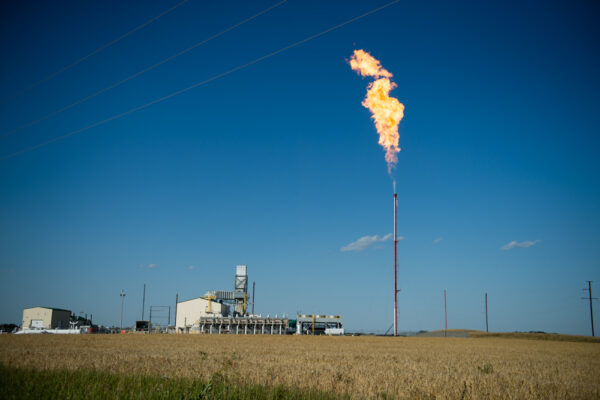
I’ve been writing about the phenomenal growth of the North Dakota Bakken for the better part of 15 years. In 2008, the state produced around 90,000 barrels per day. By 2014, it was something like 1.2 million. Currently it’s around a million or so. A major player was Hess Corporation, which currently produces about 175,000 barrels of oil equivalent in North Dakota. But curiously, none of the supermajor oil companies were involved in North Dakota. Well, that changed, as Hess is being bought by Chevron.
Oil and agriculture trucks rolled through Regina to rally in 2019 to rally against the carbon tax, Bills C-69 and C-48, and in support of pipelines. Photo by Brian Zinchuk
Here’s Alberta Premier Danielle Smith’s response, verbatim. I like doing these verbatim pieces because it allows the reader to hear the full-throated discussion, without a filter. It’s interesting how she talks about how the $20.6 billion Teck Frontier oilsands mine was killed by the No More Pipelines Act. That’s not chump change. Anyone think they might reconsider it? (That’s a trick question – Teck has since abandoned and sold off its oilsands interests – for obvious reasons.)
Also, after nearly three years of work since it drilled its first well near Climax, Saskatchewan, Royal Helium has entered into production with its first helium facility near Brooks, Alberta. This is transformational for the company, as it turns Royal from an explorer with no revenue to a helium producer, with revenue. Indeed, its production is already locked up in sales, so strong is the demand. And expect their next focus to likely be in Saskatchewan.
I’ll have another significant helium story posted for Tuesday morning. Exciting times, this.
In Pipeline Online’s neverending quest to let the public know exactly what our federal government & Steven Guilbeault is telling us about climate change, here is a verbatim, unfiltered press release from Oct. 12 regarding the carbon tax in New Brunswick.
And our favourite minister, Steven Guilbeault, announced “Canada’s Circular Economy month in October.” Except instead of doing so on the 1st of the month, he did it on the 12. Maybe circular months have no beginning, no end. Think of Groundhog Day, with Steven Guilbeault telling us every day, forever, how we are horrible people…
It’s almost as if he’s making a business case for LNG. Imagine that. You know, the same thing the prime minister said there was no business case for? This is the verbatim speech he gave on Friday in Toronto.
There’s an election today in Manitoba, so all bets are off if the NDP forms government. But on the off chance that the Conservatives hold power, here goes. The conservative premiers of Alberta, Saskatchewan and Manitoba have been talking about building a new port at Port Nelson, Manitoba, on Hudson Bay. They would build a corridor of pipelines running oil and natural gas to said port, as well as rail, allowing potash exports. Maybe grain, too? And Power from Manitoba could run west. Anyhow, here’s an alternative way to look at it, probably for a lot cheaper than building over 1,000 km of pipeline through some of the hardest rock on the planet.
Cenovus calls Trans Mountain’s desire for a blank cheque on cost overruns “commercially absurd” It turns out when you run a project something like 4 to 6 times the original budget (depending on what you consider the start and the original budget) the people expected to pay for it might balk a bit. In the letter quoted in the story, Cenovus basically tells Trans Mountain to, well, you figure it out.
Conservative Leader Pierre Poilievre took some time to speak about energy during his keynote speech to the Conservative national policy convention in Quebec City on Sept. 8. In those comments, he spoke about natural liquefaction extensively, as well as small modular reactors, hydroelectricity, tidal power and oil production. He mentioned more wind power, but did not speak of solar power generation. He also referred to producing minerals for electrification in Canada instead of China. This was an oblique reference to lithium, without actually mentioning lithium.
Steven Guilbeault. Screenshot from CPAC
If you didn’t catch it – Steven Guilbeault crashed the Conservative policy convention in Quebec City. He wondered if Pierre Poilievre believed in climate change. Here’s some of what he had to say.
Alberta’s E3 Lithium might be first out of the gate with a pilot lithium plant, but several are in the works for Saskatchewan. And E3’s stated lithium concentration is 74.5 mg/L, while at Coleville, SK, Grounded Lithium also reports 74 mg/L. Arizona Lithium says they have up to 172 mg/L at Torquay. Hub City Lithium says it has concentrations of up to 259 mg/L at Viewfield (Stoughton). From Canadian Press: Alberta enters global lithium race with opening of first extraction pilot project.
A geologist I know once told me “All things being equal, Alberta has better rocks (than Saskatchewan).” Perhaps that’s true for oil, but it could be the inverse for lithium. Time will tell.
And from the Associated Press – Apparently the Germans figure they can get rid of fossil fuel heating. This, in a nation that doesn’t get much sun or wind, but had been building solar and wind facilities like crazy while shutting down all its nuclear plants. To quote C-3P0, “This is madness!”
I was searching for the best metaphor. “Like hot garbage,” kept coming to mind. I settled on dumping an ex-wife. My column on this: TC Energy dumping Keystone Pipeline like a despised, soon-to-be-ex-wife. The Keystone name is so verboten, it is barely mentioned in the press release or slide deck.
This is entirely because the anti-pipeline, anti-oil movement won on Keystone XL and Energy East. Can’tada and BANANAS USA won, and this is the result. (Build Absolutely Nothing Anywhere Near Anyone, Seriously, U Stup1d A@#$#@#)
Pipeline supporter? NDP Leader Carla Beck booted from Saskatchewan legislative assembly after saying minister had lied about NDP‘s support for pipelines and opposition to carbon tax.
The cost of the Trans Mountain Expansion pipeline has shot up another 44%, to $30.9 billion. Project managers say it’ll be finished this year (from what I hear, not so much). And yet Indigenous groups are seeking a 30% stake in the project. Where’s that money coming from?
And on the topic of pipelines, it turns out Repsol said it would be too much money to pipeline natural gas from Western Canada to Saint John, New Brunswick, modify an existing LNG import terminal to export, and ship LNG to Europe. Would that be because the pipeline would have to go through Quebec, by chance? So there really wasn’t a business case, or there wasn’t a business case because of a.) Quebec and b.) the federal government? Would this have worked under a Harper or Poilievre government?
Wait, didn’t First Nations protests dramatically hold up the Coastal GasLink pipeline? And yet another BC First Nation wants to use that very same pipeline to supply its own liquefied natural gas terminal at Kitimat? How can this be? And the BC government just gave that LNG terminal the environmental go ahead?
So, if you didn’t see this news come out on Friday, because all horrible news is released on Friday, the Trans Mountain Pipeline just went up something like 44 per cent in cost. That’ll be paid for by us, by the way. The cost is now $30.9 billion. But wait! In 2013, Kinder Morgan figured they could build it for $6.8 billion. The current cost is only 4.5x what Kinder Morgan had planned.
By the way, this clip from the first season of The West Wing is the absolute best nugget of political knowledge you can sum up in one minute (the first minute of this clip). Fridays are “Take out the Trash Day.”
A similar thing happened the Friday of the Family Day long weekend, when the feds released their just transition plan. Watch for upcoming stories on that.
Oilwell battery construction in southeast Saskatchewan, fall of 2022. Photo by Brian Zinchuk
Back in the lofty, pre-Trudeau government days of 2014, back when oil was booming, pipelines were planned to east and west coasts, and Alberta and Saskatchewan were swimming in money, around $81 billion was spent in capital expenditures (CAPEX) in the Canadian petroleum industry. On Wednesday, the Canadian Association of Petroleum Producers (CAPP) forecast CAPEX of $40 billion, which is just about double the disaster year of 2020, but half of 2014. And that’s before #justinflation. What would it be if we had a federal government supportive of the industry, instead of trying to make it disappear?