Tag: climate change

Scope 3 emissions? What on earth is that?

Dr. Tammy Nemeth has been warning about this in her recent podcasts, and now the head of the TSX is doing the same. Small-cap companies not ready for climate disclosure rules: TMX Group CEO. Start counting those Scope 3 emissions, folks.

Along those lines, if they can’t protest you to extinction, they’ll litigate you. Greenpeace files securities complaint against Suncor over climate risk disclosures. 

If I take part in #protests, can I claim some sort of journalist protection, too? RCMP dispute photojournalist’s account of arrest while covering pipeline protest  

Hey, wasn’t this the guy behind the Kesytone Pipeline projects in the first place? TC Energy names former CEO Hal Kvisle as chair of new liquids pipeline spinoff.

And from the day before, Exxon buys Pioneer Natural for $59.5 billion. And here’s what it could mean for Canada. Isn’t that something like three times Canada’s entire defence budget?

Oh, and a University of Calgary prof is taking tactics out of a U of R prof’s handbook (I don’t think it’s the Communist Manifesto, but I could be wrong). Academic report calls for public inquiry into Alberta Energy Regulator. (The U of R prof sued her own university a while back, and yet is still employed.)

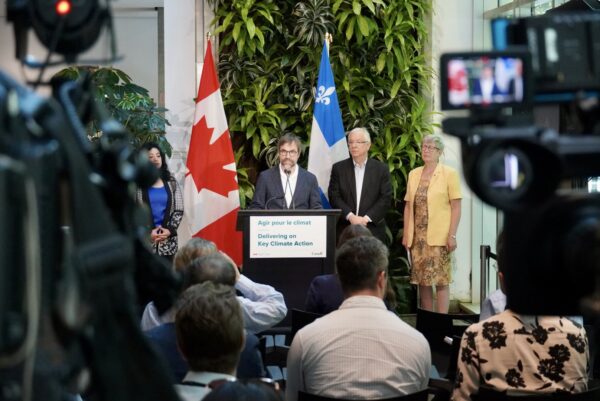
In Pipeline Online’s neverending quest to let the public know exactly what our federal government & Steven Guilbeault is telling us about climate change, here is a verbatim, unfiltered press release from Oct. 12 regarding the carbon tax in New Brunswick.

And our favourite minister, Steven Guilbeault, announced “Canada’s Circular Economy month in October.” Except instead of doing so on the 1st of the month, he did it on the 12. Maybe circular months have no beginning, no end. Think of Groundhog Day, with Steven Guilbeault telling us every day, forever, how we are horrible people…

Enbridge’s CEO has a lot to say about Canada’s lack of LNG development

It’s almost as if he’s making a business case for LNG. Imagine that. You know, the same thing the prime minister said there was no business case for? This is the verbatim speech he gave on Friday in Toronto.

Energy Transition Podcast Ep. 84: Coal is back – in fact, it was never gone.

Here’s something new – the Kindersley area took over half the dollars in the Crown petroleum right land sale last week. That’s highly unusual.

And, of course the Just about but not quite complete TMX pipeline will desecrate a sacred site.

A farmer, a pump shop manager and a superintendent walk into a liquor store …

Getting caught up on some energy items from Pipeline Online:

Letter to the editor on why activity levels are so low in the Saskatchewan oilpatch

“How low?” you ask. Just 29 drilling rigs working in Saskatchewan Oct. 3 (10 years ago, that number would have been around 90. During the depths of the downturn, it would have been 40-50.)

Tammy Nemeth’s podcast talks about net-zero red tape for small and medium enterprises in Canada. You think you have paperwork now…

Enbridge’s CEO had a lot to say this week:

Enbridge CEO op-ed on delivering LNG to global markets, reducing global CO2 emissions and supporting energy security. (He did a long speech, which I’ll be posting verbatim, if I have a chance).

Enbridge CEO calls for national Indigenous loan guarantee program so they can buy into energy projects, like pipelines.

And what do we need pipelines for when rail works so well? Except for when it doesn’t. Undetected broken rail causes fiery crude-by-rail derailment.

And for something completely different: A farmer, a pump shop manager and a superintendent walk into a liquor store … and buy it. No joke.

Eco zealots and going big into nuclear

All the hacking issues last week means there’s a lot to catch up on in the world of energy.

First, a column this morning from U of R professor Jim Warren: Guess what happens when eco-zealots are put in charge of making climate policy?

Here’s another verbatim press release from Steven Guilbeault about cutting oil and gas emissions by 75%.

If you didn’t catch it last week, Sask Polytechnic is getting a brand spanking new campus. Too bad it won’t be anywhere close to finished before my daughter finishes her journeyman heavy duty mechanic ticket. (She just started her 4 year apprenticeship, if that give you a hint.) Maybe my 16-year old son will get to attend the new site in his fourth year of apprenticeship?

Did you know Manitoba has an oilpatch? Often their own politicians don’t really clue in on it, including former Premier Brian Pallister. I can’t find it now, but when he flip-flopped on fighting the carbon tax, he made accusations against “oil producing provinces.” Manitoba produces around 38,000 barrels per day.  Anyhow, the largest oilfield in Manitoba is now 19 years old.

Oil prices look like they’re heading for $100/ barrel US.

Dams aren’t so green, after all.

And the big one for last week: my column on how Saskatchewan goes big into nuclear. Funny thing is I’ll be speaking to the SaskPower CEO on Monday. We’ll see if I’m on the mark or not.


Poilievre will push LNG, SMRs, hydro dams and continued oil production

Pierre Poilievre. Screenshot from YouTube

Conservative Leader Pierre Poilievre took some time to speak about energy during his keynote speech to the Conservative national policy convention in Quebec City on Sept. 8. In those comments, he spoke about natural liquefaction extensively, as well as small modular reactors, hydroelectricity, tidal power and oil production. He mentioned more wind power, but did not speak of solar power generation. He also referred to producing minerals for electrification in Canada instead of China. This was an oblique reference to lithium, without actually mentioning lithium.

Steven Guilbeault. Screenshot from CPAC


If you didn’t catch it – Steven Guilbeault crashed the Conservative policy convention in Quebec City. He wondered if Pierre Poilievre believed in climate change. Here’s some of what he had to say.

Alberta’s E3 Lithium might be first out of the gate with a pilot lithium plant, but several are in the works for Saskatchewan. And E3’s stated lithium concentration is 74.5 mg/L, while at Coleville, SK, Grounded Lithium also reports 74 mg/L. Arizona Lithium says they have up to 172 mg/L at Torquay. Hub City Lithium says it has concentrations of up to 259 mg/L at Viewfield (Stoughton). From Canadian Press: Alberta enters global lithium race with opening of first extraction pilot project.

A geologist I know once told me “All things being equal, Alberta has better rocks (than Saskatchewan).” Perhaps that’s true for oil, but it could be the inverse for lithium. Time will tell.

And from the Associated Press – Apparently the Germans figure they can get rid of fossil fuel heating. This, in a nation that doesn’t get much sun or wind, but had been building solar and wind facilities like crazy while shutting down all its nuclear plants. To quote C-3P0, “This is madness!”


The energy transition in real time: brownouts threaten at suppertime

With brownouts a possibility, Texas issues another electrical grid alert on Tuesday, its second in three days. Alberta issued one yesterday. These are the most energy-rich places on earth. What is going on?

UPDATE: 3:08 p.m. Aug. 29.

At 2:25 p.m, the Alberta Electric System Operator has not yet issued a grid alert on this date, but put out a tweet alluding to one, imploring Alberta citizens to reduce power consumption.

A small drop in a very large nuclear bucket

Jonathan Wilkinson. Photo by Brian Zinchuk


Four reactors could cost Saskatchewan $12 to $20 billion. The feds just gave us $74 million. But don’t worry, the money came from Guilbeault and Wilkinson. At least, those were the ministers quoted.

In the above, you will see that in 26 years, four months and 10 days, Saskatchewan could need as many as 27.5 nuclear reactors. At $3 to $5 billion a crack. Good luck, with that.

Also, Yukon might connect to the BC, and thereby national, electrical grid.

And Ford just milked the federal and Quebec EV cow for $1.2 billion

Demanding the impossible on power generation

Boundary Dam Unit 3 capture plant. Photo by Brian Zinchuk

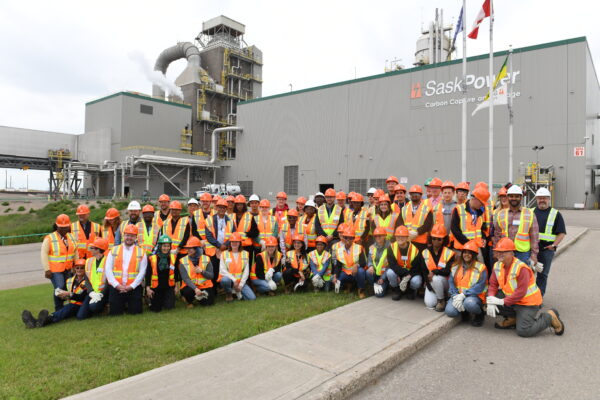
Are the federal Clean Electricity Standards, brought in by Steven Guilbeault and Jonathan Wilkinson, impossible to meet? Pipeline Online asked SaskPower.

“The CER would require SaskPower to effectively rebuild our entire power system, through retiring the majority of our existing generating units and replacing them with new, ultra-low emitting units or non-emitting energy sources, while also growing the system to support expanding electricity needs that are expected to support growing demand for clean electricity for industrial needs, transportation, increased customer participation and other needs.”

Clean Electricity Regulations released: carbon capture or bust

Steven Guilbeault, Minister of Environment and Climate Change, Julie Dabrusin, Parliamentary Secretary to the Minister of Natural Resources and the Minister of Environment and Climate Change, Luke Barber, Chief Operating Officer, University of Toronto and Scott Hendershot, Senior Manager, Sustainability Office, University of Toronto, standing together on a rooftop covered in solar panels. Government of Canada handout

Clean Electricity Regulations released: carbon capture needed for continued fossil fuel power generation. #Saskatchewan will not “defy the laws of thermodynamics,” says Premier Scott Moe.

I still need to dig deep into this. I’ve sent a list of questions to SaskPower and the provincial government seeking response next week, as this dropped just as we’re packing to head to the cabin. Because of course they would release it during the dog days of August.

Note: these regulations expect the electrical grid demand to grow by 2.5x in 26 years, three months and 21 days. Good luck with that. Expect a column next week.

Seeing the other side’s playbook – Project of the Century

Ever want to see the other team’s playbook? Project of the Century (report link)– the most comprehensive discussion of energy transition we’ve seen to date, was published by the Public Policy Forum. It’s principally about doubling the electrical grid, or more, but doing so without increasing fossil fuel emissions. The dollar figure is up to $1.7 trillion – with a ‘t’ – mostly from federal taxpayer dollars.

Here’s the story on it:  https://pipelineonline.ca/project-of-the-century-the-most-comprehensive-discussion-of-energy-transition-weve-seen-to-date/

This is the closest I’ve seen to what the federal Liberal government is trying to accomplish with the “energy transition.” Some of Natural Resources Minister Jonathan Wilkinson’s speech and discussion in Regina and Kipling at the end of June was almost word for word from this paper, before the paper was published.

This has huge implications for Saskatchewan and Alberta. Part of the interview focuses on how net zero by 2035 is impossible.

I spoke to the CEO and one of the authors on July 26. Here’s the in-depth interview. I’ll next be posting an analysis by Jim Warren on this, then likely one of my own.

Editor’s note: Pipeline Online has requested permission from the Public Policy Forum to publish the entire Project of the Century report, in serial form. That permission has not yet been granted, despite the Public Policy Forum’s webpage copyright notice stating, “The Public Policy Forum encourages interested parties to use, in whole or in part, its publications, data, images and other content to further dialogue on public policy in Canada. We require that the PPF is properly cited and acknowledged. In all instances, the PPF would like to be notified of the use of its publications and data.”  

They won’t give me a straight answer as to why they won’t let me publish it, when that is clearly their policy. Wonder why that is?

Update Aug. 8, 2023, 10:30 a.m. Since Pipeline Online made the above request, Public Policy Forum has updated its copyright notice. It now states, “Copyright – The Public Policy Forum retains copyright of our publications. For permission to publish a report excerpt, please contact us at: ppforum@ppforum.ca

About those electric tractors the minister was talking of…

This scythe is probably around 90 years old. Still works. Photo by Brian Zinchuk

A few minutes with a 90 year old scythe reminded me why diesel won’t be so easily replaced with electricity on the farm. This stems from a question federal Minister of Natural Resources Jonathan Wilkinson was asked while at Kipling, Saskatchewan, on June 29. While there he announced a $50 million federal contribution to a wind project tied with a local First Nation. (Is that an “inefficient subsidy” for wind? The morning before, wind in Alberta flatlined, again.)

Who’s the real villain here?

Steven Guilbeault’s most recent announcement villainizing oil and gas. Twitter

Federal government’s latest villainization of oil and gas: ‘Phasing out inefficient fossil fuel subsidies.’ Isn’t it curious how Steven Guilbeault decided not to make the announcement in Calgary, say at the Calgary Petroleum Club? Wonder why?

And, across the pond, Greta just won’t stop. Now fighting fossil fuels is “self defence.”

Project of the Century?

There was a very significant think tank report issued by the Public Policy Forum think tank on July 19. I was up until 2 am reading it, because it’s that significant. It’s called Project of the Century. It’s about this whole net zero path and doubling the grid. While I do not agree with much of it, it is the most comprehensive discussion paper I’ve seen on energy transition to date. I’m seeking permission to serialize it and republish all of it, but hitting some roadblocks. Their stated policy is “The Public Policy Forum encourages interested parties to use, in whole or in part, its publications, data, images and other content to further dialogue on public policy in Canada. We require that the PPF is properly cited and acknowledged. In all instances, the PPF would like to be notified of the use of its publications and data.” But when I asked about serializing it and publishing the entire report, I was told no, they do not give permission.

We’ll see what next week brings.

However, the report got significant attention from the government of Alberta.

Danielle Smith critical of $1.7 trillion (with a “t”) cost to build out net zero grid, responding to Public Policy Forum report

Also, supposed fossil fuel subsidies are in the headlines, with the feds saying they are going to get rid of them. I’m not really sure what subsidies they’re talking about, and neither are the Conservatives.  Conservative energy critic Shannon Stubbs targets federal plan to end subsidies for fossil fuel


How about more carbon capture?

That’s a whole lot of PhD students at Boundary Dam. Photo by Brian Zinchuk

Open letter: CCS is needed and ready to address climate change. This is from the Regina-based International CCS Knowledge Centre.

In response to some of the comments yesterday – carbon capture, as practiced in Saskatchewan, actually has a substantial benefit besides whatever climate issues one might be concerned about. The Weyburn Unit, one of the largest and most prolific oil plays in this country, has been in operation for 65 years. If it had no CO2 injection, it would probably be producing around 6,000 barrels per day. It’s currently doing around 24,000 as a direct result of CO2-enhanced oil recovery. That’s a gain of around 18,000 bpd. At $75/bbl., that’s about $1.3 million per day in gross revenue. It means hundreds of jobs in Weyburn, including my daughter, who started working as a heavy duty mechanic apprentice for an oilfield service company which has been working in the Unit for 62 years. If the CO2 continues to flow, that oilfield is expected to continue on likely for her entire career, if she stays there.

This can be applied on a much broader scale, dramatically extending the life of any oilfield it is applied to. CO2 increases recovery factors from around 20% to 40%+.

Just pumping CO2 into the ground – that’s another story.

Those carbon capture people keep coming back to Saskatchewan

That’s a whole lot of PhD students at Boundary Dam. Photo by Brian Zinchuk

Why? Because we are the leaders, worldwide. Every second year the IEAGHG summer school returns to Regina and Estevan, because we’ve got the most significant, commercial-scale carbon capture facility on a coal plant in the world, and we’ve learned a lot from it. That’s from the general manager of the IEAGHG.

Say what you want about carbon capture and storage, but Saskatchewan’s a big deal in this field.

I also asked him about when the glaciers covered Canada, and it wasn’t my SUV or the two coal fire power plants near my house that caused them to melt.

Kipling wind project gets $50 million in fed money, kinda

Photo by Brian Zinchuk

Kipling area Bekevar Yōtin Wind Facility turns sod, gets $50 million from feds, money that came from Saskatchewan businesses via output based pricing

Basically, Saskatchewan large GHG emitters are forced to pay a form of carbon tax called “Output Based Pricing”. Some of the money from that is what was provided, from the feds, to Cowessess, for their investment equity into this project which cost hundreds of millions of dollars.

Also, Enbridge doesn’t build a lot of pipelines in Canada anymore. But they are building wind turbines off the coast of France.


Navigation