
Dog show weekend, so posting will be minimal (unless one of troupe of guest bloggers chooses to drop by). Use this thread for today’s tips.
Bridge Collapse
I have friends in Burnsville, MN, and I can’t count the times I’ve crossed this span. No point in duplicating what is readily available in the mainstream, but if you’re interested in blog coverage, my recommendations are Powerline and Captain’s Quarters, both based out of Minneapolis.
More from Minneapolis: Captain Capitalism is alive and has the pie charts to prove it.
Adapt Or Die
Not waiting for the asteroid, a dinosaur evolves;
Linda Parker has a memo for professional journalists: Contrary to the fear rippling through newsrooms, citizens don’t want your job. They don’t want to interview obscure officials to write boring stories about arcane changes in local zoning laws. As online communities editor, Parker should know. A GetPublished! button features prominently on many Enquirer Web pages, and the submissions land in Parker’s queue. They almost never resemble anything commonly considered journalism.
“It used to read, ‘Be a Citizen Journalist,'” Parker says. “And no one ever clicked on it. Then we called it ‘Neighbor to Neighbor,’ and still nothing. For some reason, ‘Get Published’ was the magic phrase.” Parker, a cheerful woman in her mid-fifties, will pore over several dozen submissions from readers today. These will range from a local custom-car builder trumpeting his upcoming appearance on the BET show Spring Bling to an emotional notice about a play being staged to raise funds for a fifth-grader’s bone marrow transplant. Contributors submit to one of 233 neighborhood Web sites, each aimed at a town or community in the Cincinnati area. Parker approves the submission (“I almost never reject one,” she says), scans it for “the F-word,” and posts it to the site. “A few years ago, these would have come across the transom as press releases and been ignored.”
There’s a valuable lesson here — and not just for newspapers. Citizens are desperate to broadcast their message to their communities; they just aren’t going to employ the conventions of journalism to do so. “One of our most popular categories is called First-Person,” Parker says. “People really love to reminisce about the 1937 flood. We got great stories on that.” The reader submissions do more than provide the Enquirer with additional content to sell ads against. “Our 27 suburban papers could never fill their pages without this material.” One of the common criticisms levied against Gannett is that it is crowdsourcing content in order to cut staff, but this charge misses the point. Crowdsourcing enables the publisher to expand: more Web pages, more niche publications, more ads.
While much of the citizen-produced writing is about church picnics and school sports, readers are also contributing to serious journalistic investigations, breathing new life into a genre that is increasingly considered an endangered species at metropolitan newspapers. Last spring, The News-Press, a Gannett paper in Fort Myers, Florida, heard that readers from a new housing development were being charged up to $45,000 to connect to the water and sewer system. Rather than assign a conventional investigative reporter to the story, “we asked our readers to help us find out why the cost was so exorbitant,” says Kate Marymont, News-Press executive editor.
The response overwhelmed the paper, which had to assign additional staff just to deal with the volume of tips, phone calls, and emails. The News-Press posted hundreds of pages of documents to its site, and readers organized their own investigations: Retired engineers analyzed blueprints, accountants examined balance sheets, and an inside whistle-blower leaked evidence of possible bid-rigging. “We had people from all over the world helping us,” Marymont says.
The information firehose illustrated.
If mainstream journalists and their editors would pause to absorb that first sentence quoted, the relationship with news consumers might mature into something useful. Allow the channel of communication to flow both ways, and the quality, accuracy and authoritativeness of journalism can only improve. How do we know? See here.
They may even coax back some former readers.
Contrary to popular media mythology, bloggers don’t want your jobs.
We’d just like you to do yours.
Signs Of Self-Sufficiency
Emerging in an unlikely place;
The recent rains and flooding took a toll on a by-pass road to the East of Kandahar City and caused severe damage. The dyke that protects the road failed and allowed fast flowing water to erode the road itself and many places along the side of the road as well. In total, a 15 metre gap was made when the water washed away a culvert and the road on top of it, and 300-400 metres of the road and its shoulders were also damaged.
A soldier’s first hand report that you won’t read in the Globe and Mail.
Reader Tips
Tips thread.
Court Rules Prairie Barley Producers Still Wards Of The State: Market Reacts
Barley prices are dropping on the Winnipeg Commodity Exchange in light of a court ruling that upholds for the time being the Canadian Wheat Board’s barley monopoly.
Cash prices for western barley dropped this morning by about 70 cents a bushel, while futures prices were down $7.50 a tonne.
The price movement comes one day after a Federal Court judge ruled that the Conservative government overstepped its authority with its plan to strip the wheat board of its monopoly on barley sales.
Don Bousquet, a commodity analyst and commentator, says prices were higher because sellers were counting on selling more than a half-million tonnes of barley on the world market without having to go through the wheat board.
Bousquet says that barley will now come from other countries, so the price of Canadian barley is dropping.
Feed wheat is following suit.
Winnipeg Commodity Exchange
Previous.
What Media Bias? Updated
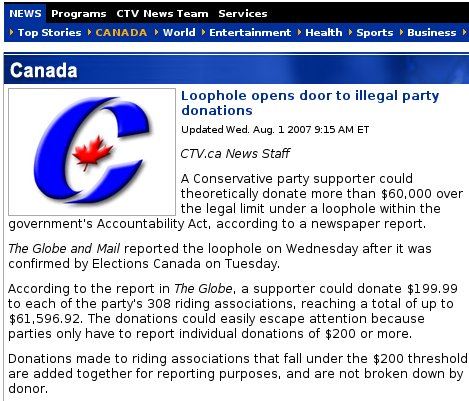
Catch this little gem at CTV;
(h/t reader Rob)
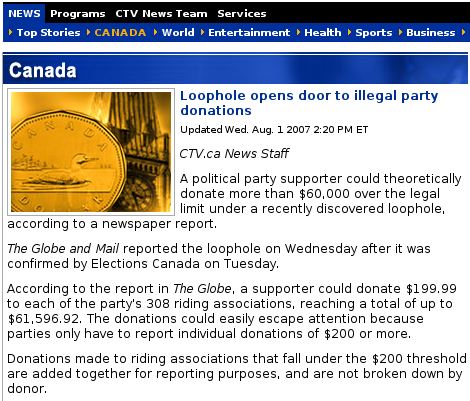
Update – SDA gets results!
Court Rules Prairie Barley Producers Still Wards Of The State
(Bumped – scroll down for newer entries)
Ugh.
You, the Saskatchewan taxpayer, had a dog in this fight. Despite the fact that the majority of Saskatchewan barley producers voted in favour of marketing choice, Calvert & Co saw fit to shovel your money into a third party court challenge.
In the comments, Larry Weber has a good question: “Now we get to see if this “New Government” and the CWB will throw farmers in jail for honoring their sales contracts tomorrow.”
Or maybe they should just shut down the CN rail line.
More discussion at Agriville.
For those of the “premium price persuasion”, local radio this morning had a brief response from a barley grower. The decision cost him $40,000.00. He had a contract with a malting company at $4 a bushel. The decision forces him to sell to the CWB for more than a dollar lower.
Search SDA for previous entries.
Today’s Economic Snapshots
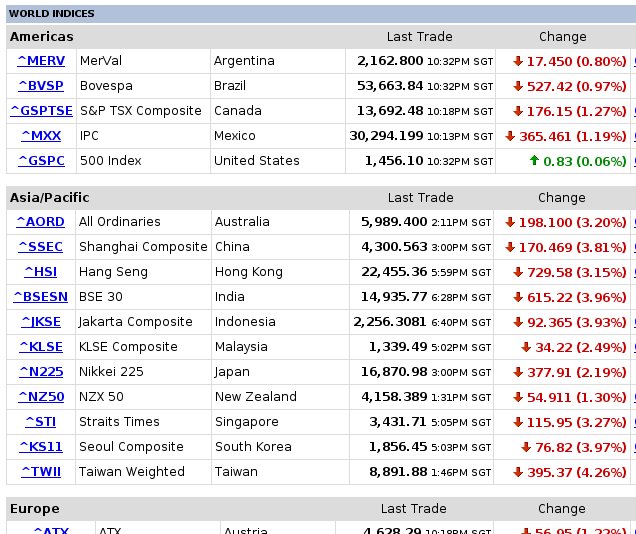
And what of this? – a “chart has just got to anger the living patoots out of the left.”
That ought to start some discussion. If you need more help with your pessimism, there’s lots of commentary at Maxed Out Mama.
“carry more flowers, chocolates and perfume”
Are Administrators and other government officials now entitled to token gifts before they rubber stamp our building permits? It appears to me that the Supreme Court of Canada has ruled that this is the case, even though it’s still on the books as being illegal.
I wonder if it extends to developers who “carry more game tickets, vacation junkets and Chivas”.
At a meeting on April 29th 2004 the Hon Len Taylor ignored the Amendment to section 14(1) of the Urban Municipalites act by Jack Hillson and the order by Ron Osika that the Argues find a Village to annex their development out of the RM of Edenwold and the Minister ruled that the Village of Wood Mountain should not be allowed to exist and that the Village would not be allowed to annex the Argues 160 lot subdivision out of the R.M. of Edenwold.
The Hon Len Taylor then ruled that my only option, as the Argues agent, was to “carry more flowers, chocolates and perfume” to Strudwick so as to be “ more successful with the zoning issue”.
The rest of the curious story is here.
Any Resemblance To Edmonton Centre Is Purely Coincidental
John Fund lists several cases of significant voter fraud in the US, and wonders where the outrage of Democrats went;
[T]he most interesting news came out of Seattle, where on Thursday local prosecutors indicted seven workers for Acorn, a union-backed activist group that last year registered more than 540,000 low-income and minority voters nationwide and deployed more than 4,000 get-out-the-vote workers. The Acorn defendants stand accused of submitting phony forms in what Secretary of State Sam Reed says is the “worst case of voter-registration fraud in the history” of the state.
The list of “voters” registered in Washington state included former House Speaker Dennis Hastert, New York Times columnists Frank Rich and Tom Friedman, actress Katie Holmes and nonexistent people with nonsensical names such as Stormi Bays and Fruto Boy. The addresses used for the fake names were local homeless shelters. Given that the state doesn’t require the showing of any identification before voting, it is entirely possible people could have illegally voted using those names.
Local officials refused to accept the registrations because they had been delivered after last year’s Oct. 7 registration deadline. Initially, Acorn officials demanded the registrations be accepted and threatened to sue King County (Seattle) officials if they were tossed out. But just after four Acorn registration workers were indicted in Kansas City, Mo., on similar charges of fraud, the group reversed its position and said the registrations should be rejected. But by then, local election workers had had a reason to carefully scrutinize the forms and uncovered the fraud. Of the 1,805 names submitted by Acorn, only nine have been confirmed as valid, and another 34 are still being investigated. The rest–over 97%–were fake.
Speaking of which – where is Landslide Annie these days?
Y2Kyoto: Don’t Leave Without Your Jacket
“Clearly, the wrong horses have been backed.”
For many years now, human-caused climate change has been viewed as a large and urgent problem. In truth, however, the biggest part of the problem is neither environmental nor scientific, but a self-created political fiasco. Consider the simple fact, drawn from the official temperature records of the Climate Research Unit at the University of East Anglia, that for the years 1998-2005 global average temperature did not increase (there was actually a slight decrease, though not at a rate that differs significantly from zero).
Yes, you did read that right. And also, yes, this eight-year period of temperature stasis did coincide with society’s continued power station and SUV-inspired pumping of yet more carbon dioxide into the atmosphere.
In response to these facts, a global warming devotee will chuckle and say “how silly to judge climate change over such a short period”. Yet in the next breath, the same person will assure you that the 28-year-long period of warming which occurred between 1970 and 1998 constitutes a dangerous (and man-made) warming. Tosh. Our devotee will also pass by the curious additional facts that a period of similar warming occurred between 1918 and 1940, well prior to the greatest phase of world industrialisation, and that cooling occurred between 1940 and 1965, at precisely the time that human emissions were increasing at their greatest rate.
Climate denier, Prof Bob Carter “is a geologist at James Cook University, Queensland, engaged in paleoclimate research.”
Reader Tips
Your tips here.
An Image That Raises A Profound Question For All Mankind

How do all those UFO’s get in and out without being noticed?
It’s Not Often That They’re This Honest
Not anti-war. On the other side;
Many Democrats have anticipated that, at best, Petraeus and U.S. ambassador to Iraq Ryan Crocker would present a mixed analysis of the success of the current troop surge strategy, given continued violence in Baghdad. But of late there have been signs that the commander of U.S. forces might be preparing something more generally positive. [House Majority Whip James] Clyburn said that would be “a real big problem for us.”
Discussion at NRO;
The New York Times ran a piece Monday by two non-“neoconservatives” Michael O’Hanlon and Kenneth Pollack arguing that the war in Iraq can be won. Is this indicative of some kind of mood change afoot? Could we really win this war? Could the rhetoric in Washington really change? National Review Online asked a group of experts.
Bonus read: another dispatch from Michael Yon.
An Inconvenient Pond Scum
On his presidential campaign trail late in 1999 and in serious need of at least some farm votes, Al Gore boasted to a Midwest audience that it was he who had cast a tie-breaking vote in 1994 against a proposal by New Jersey Democrat Sen. Bill Bradley which would have cut tax incentives for ethanol fuel. “It’s well known that I’ve always supported ethanol. And I have not ducked when votes for … agricultural interests were on the floor.”
[…]
Now, we discover that, thanks to increased ethanol production, something else is turning “Green” — the Gulf of Mexico. A huge 8,543-square-mile dead zone, roughly the size of New Jersey, is growing off the coast of Mississippi and Louisiana. It is the result of a huge algae growth, fueled by nutrients flushed from the farmlands in the Midwest watershed.
We Are Currently Experiencing Audio Difficulties
Please do not adjust your sets. The source of the high-pitched whining you may hear in the blog background this morning appears to be coming from a leak in this link.
Our engineers are working to rectify the problem. We thank you for your patience.
Reader Tips
Your Tuesday reader tips thread.
Keith Ellison liberal, democrat, muslim congressman is begged by Iraqis to help fight al-Qaeda.
They needed to make room for the Watersports programming;
Concerns about the “sinister uses” of guns in society have prompted
University of Toronto officials to rid the campus of its 88-year-old sport shooting range, despite its continued popularity and spotless safety record.
The only thing missing from this story is a crop sprayer.
Time to pull out of Toronto. (scroll down)
In a socialist paradise, imagine the showpiece that the premier’s own riding must be.
Add yours in the comments.
You Don’t Tug On Superman’s Cape
… you don’t piss into the wind, you don’t pull the mask off the Lone Ranger and you don’t go to Daily Kos for your public policy advice;
A backlash quickly emerged after the Telluride Town Council adopted a resolution last week calling for the impeachment of President George W. Bush and Vice President Dick Cheney.
“It’s huge, unbelievable,” said Telluride Mayor John Pryor. “Ski groups are canceling for the winter. Hundreds of people are bailing. The (town) Web site is flooded with people saying they’re canceling their vacations here.”
Just because they share your hill, dude – doesn’t mean they share your politics.
I Hope You’re Sitting Down
“A War We Just Might Win”
VIEWED from Iraq, where we just spent eight days meeting with American and Iraqi military and civilian personnel, the political debate in Washington is surreal. The Bush administration has over four years lost essentially all credibility. Yet now the administration’s critics, in part as a result, seem unaware of the significant changes taking place.
Here is the most important thing Americans need to understand: We are finally getting somewhere in Iraq, at least in military terms. As two analysts who have harshly criticized the Bush administration’s miserable handling of Iraq, we were surprised by the gains we saw and the potential to produce not necessarily “victory” but a sustainable stability that both we and the Iraqis could live with.
After the furnace-like heat, the first thing you notice when you land in Baghdad is the morale of our troops. In previous trips to Iraq we often found American troops angry and frustrated — many sensed they had the wrong strategy, were using the wrong tactics and were risking their lives in pursuit of an approach that could not work.
Today, morale is high. The soldiers and marines told us they feel that they now have a superb commander in Gen. David Petraeus; they are confident in his strategy, they see real results, and they feel now they have the numbers needed to make a real difference.
That was from the New York Times.
SDA readers won’t find this surprising at all – Yon and others have been reporting it for weeks;
The most important and best-known example of this is in Anbar Province, which in less than six months has gone from the worst part of Iraq to the best (outside the Kurdish areas). Today the Sunni sheiks there are close to crippling Al Qaeda and its Salafist allies. Just a few months ago, American marines were fighting for every yard of Ramadi; last week we strolled down its streets without body armor.
RTWT.
Update – Discussion at NRO.
(Speaking of “others”, Michael Totten has another Baghdad dispatch.)