
Ontario Premier Doug Ford has topped the Canadian Taxpayer Federation’s annual Naughty List, which ranks the country’s worst “grifting politicians.”
Ford earned the top spot for ensuring Ontario’s political welfare remained permanent by reinstating taxpayer-funded pensions for provincial politicians. This year also saw Ontario politicians giving themselves a 35 per cent pay raise.
“Ford took a pay raise that would make even Ebenezer Scrooge blush: A $73,000 hike in one year. But Ford isn’t the only one with coal in his stocking,” said Franco Terrazzano, CTF Federal Director…
Can Canada’s Post-Secondary Institutions Get Past Their Foreign Money Addiction?
Natasha Mrkic Subotic, employed at Capilano University in B.C., has written an op-ed about the new state of post-secondary education:
With new global attraction strategies, Canada is trying to draw talent from abroad but neglecting the systems that nurture our own youth.
B.C.’s institutions, and their counterparts across the country, are confronting a financial reckoning more than a decade in the making.
What comes next may reshape how Canadians learn, work and access opportunities for decades.
The seeds of today’s crisis were planted as far back as 2011, when the federal government signalled a bold new direction. Economic plan 2011 called for a comprehensive International education strategy. This direction was amplified in 2013 when the global markets plan identified international education as one of 22 priority sectors where Canada held a competitive advantage.
Of course, given her own biases, she spins things in a very particular way. There is an entirely different point of view on this subject.
Why Would Any Western Canadian Want to Stay Part of Canada?
The Federal government gave next year’s equalization amounts to provincial finance ministers.
This map is a clear indication of which provinces are driving Canada’s economy and how the equalization formula disincentivizes economic growth. pic.twitter.com/rX5CHZSOKG
— Scott Moe (@PremierScottMoe) December 12, 2025
From Marc in Calgary:
Manitoba is now collecting above $5 Billion from welfare in a $25 Billion budget and in the same range of dependency as 3 of the Atlantic provinces at 20% of gov’t revenue coming from intergenerational interprovincial welfare payments.
I think there may be some adjustments to this file late in 2026 after the Alberta Separation Referendum.
Perhaps they’ll plant “Victory Gardens” so they don’t starve to death in the cold winters to come…
Canada’s Food Price Problem
When you compare Canada (Left) and the U.S. (Right), the story jumps off the charts. ⬇️
In the U.S., food prices have tracked almost perfectly with overall inflation for more than 30 years. In Canada, food starts breaking away from the rest of CPI around 2008–2010 and never… pic.twitter.com/sOpX7kzDcI
— The Food Professor (@FoodProfessor) December 6, 2025
Coulda Had a Tesla
If U.S. taxpayers are wondering where their hard earned money is going, they don’t need to look any further than the U.S. Postal Service, spending $4.9 Million per electric truck:
The US Postal Service has spent more than $3 billion in tax dollars on a brand-new all-electric fleet of mail trucks — and gotten just 612 vehicles for its money, according to a letter sent to Sen. Joni Ernst (R-Iowa) and obtained by The Post.
Former President Joe Biden’s 2022 Inflation Reduction Act set aside billions for what Ernst has since ripped as a green “boondoggle” that saw almost all of that amount paid to Wisconsin-based defense contractor Oshkosh to design and build 35,000 new environmentally friendly mail trucks.
But as of Nov. 10, only 612 of the battery-electric powered vehicles are on the road.
Have Restaurants Gone Too Far with Price Hikes?
Be it in Canada or America, I’ve sensed that restaurant prices have skyrocketed over the past few years. But have they exceeded the basic rules of supply & demand? This fellow thinks so. Do you feel that restaurant prices where you live are reasonable?
Public Art
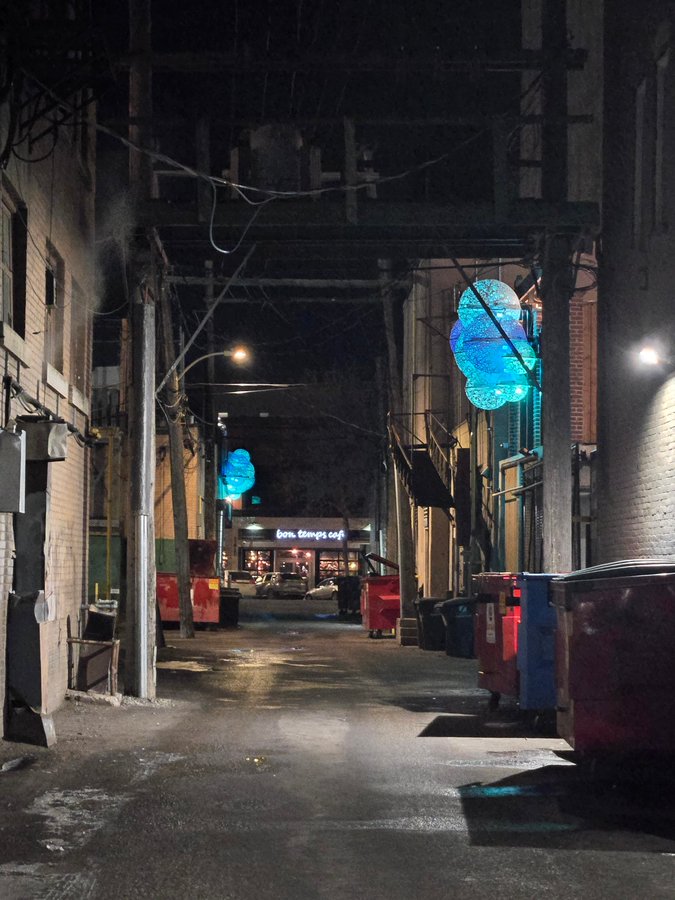
The City of Saskatoon spent $8,202 to paint art on doors in a downtown back-alley in 2024, according to documents obtained by the Canadian Taxpayers Federation.
“It’s absurd the city has kept on wasting taxpayer money on these ridiculous back-alley decorations,” said Gage Haubrich, CTF Prairie Director. “Why does city hall insist on spending money prettying-up this alley? Are the resident rats and alley cats demanding it? If local businesses want artistic back doors, they should buy a pail of paint instead of filling out a grant application.”
The project called “Alley Gallery 2024” was paid for by city taxpayers and the downtown business improvement district. The city also contributed $4,500 for a similar project called “Door Décor” with the Broadway business improvement district in 2025.
The downtown business improvement district is currently asking the city for $15,000 to paint art on doors in a different back-alley, according to the documents.
The city previously wasted nearly $100,000 of taxpayers’ money putting up colour-changing light balls in a back alley in 2023.
The City of Saskatoon is currently forecasting a 7.43 per cent property tax hike for 2026 and a 5.92 per cent hike in 2027.
Taxpayers Federation has the receipts.
Canadian vs. American Housing Costs
Exorbitant Dairy Farm Debt: Why Canadians will always face high American tariffs
Ian Cumming, writing in the upcoming edition of Ontario Dairy Farmer magazine, describes in detail the insane debt levels of Canadian dairy farmers, ensuring that Canadian consumers will be on the getting screwed hook forever…and ensuring that Trump’s favourite sore spot – Canada’s protectionist dairy market – will remain in place for just as long.
THE U.S. NORTHEAST Dairy Farm Survey released in July 2025 by CoBank and Farm Credit East (US) had some concerns about the increasing debt per cow in New York and New England. It uses data from the year before and projects it into the present. It took 29 years to go from $2,000 (US) to $3,000 debt per cow, then eight years to go to $4,000 average debt per cow, and then another six years to reach $6,000 debt a cow in 2021. The 2024 survey is at $6,514 debt per cow. Intermediate and long-term debt on these farms averaged $5,526 per cow.
A recently published report in Canada on the Australian dairy industry, based on an average size per farm of over 500 cows and total debt per farm as cited, showed an average $1,522 debt per cow. Australian currency is roughly equal in value to the Canadian dollar. It is a country where cattle housing is not required.
In late August, 2024, in St Liborie, Quebec at the Outdoor Farm Show, three respected bankers standing side by side, lending from Ormstown to St Hyacinthe, were asked by Ontario Farmer what their average debt per cow was, with a cow’s production being 1.5 kilos of quota. They all agreed after a brief internal discussion that their average debt was $55,000 per cow…A 2024 dairy farm management club report, which comes out annually, detailing voluntary herd numbers in eastern Ontario and western Quebec, put their average debt at $33,000 per kilo of quota. Translated to the American level of production, that comes to an average of $52,800/cow debt, no matter the herd size.
B.C. MLAs: Perks for Me, But Not for Thee
In these tough economic times, this is truly terrible:
Money is tight for most British Columbians these days. But you wouldn’t know it from the way some politicians are burning through your cash over at the B.C. legislature.
Double dipping on housing allowances, using public money to film faux-documentaries, and big pay packages for superfluous new special advisors are just a few of the most recent examples of your tax dollars getting flushed down the proverbial toilet.
MLAs from all parties quietly voted this week to let themselves rent out rooms in their taxpayer-funded Victoria condos—to each other. The move clears the way to double dip on housing allowances to the tune of almost $52,000 annually.
The policy changes, made at the Legislative Assembly Management Committee, will permit an MLA who owns a residence in Victoria and is already receiving up to $25,983 per year in an allowed “capital city living allowance” to cover their mortgage, to also rent a room in their unit to another MLA, and then draw up to $25,983 in rental allowances from that same colleague.
The double-dip scenario means the MLA would walk away with up to $51,966, depending on the rental agreement and what is determined to be “fair market rent” at the moment.
Fake Faux PM
It appears that Dear Justin staged a fake Vancouver gift wrapping event which actually occurred in Ottawa.
Troubled Times on Canada’s Left Coast
I’ve long said that I’m open to hearing about any alternative political system, as long as it doesn’t diminish the incentive to work hard. The moment I sense it does this, I’m out, because it’s doomed to failure.
The B.C. NDP Party has clearly never learned this simple lesson. The founder of Lululemon, Chip Wilson, recently wrote an op-ed about this:
The NDP’s hidden “wealth” taxes are so burdensome that these people, ready to risk again, don’t. The short-term tax on the successful kills the incentive for middle-class entrepreneurs in B.C.
If a flat tax for all were implemented, of the 30 failed entrepreneurs who are given the incentive to try again, five would succeed, creating businesses, employing thousands, and forming a strong tax base.
The NDP will, of course, find an academic — who has never run a business — to refute this.
Don’t Blame Us for Your Kids Being So Stupid!
Remember the good old days when teaching was a noble profession and teachers excelled at teaching children the 3 R’s: Reading, wRiting, and aRithmetic? In recent years, it seems that children are getting dumber and dumber. Well, it turns out that in Ontario, this isn’t possibly the fault of the teachers. Nope:
Four of Ontario’s largest school boards are suing the parent companies of Facebook, Instagram, Snapchat and TikTok, alleging the social media platforms are disrupting student learning, contributing to a mental health crisis and leaving educators to manage the fallout.
The Toronto District School Board, the Peel District School Board, the Toronto Catholic District School Board and the Ottawa-Carleton District School Board filed four separate but similar cases in Ontario’s Superior Court of Justice on Wednesday.
The lawsuits claim the social media platforms are negligently designed for compulsive use and have rewired the way children think, behave and learn, leaving teachers and schools to deal with the consequences.
Interesting take. One can only wonder how so many students have successfully learned:
- How to be a good communist.
- That all white people carry the stain of original sin.
- That the Liberals and NDP are the benevolent angels and anyone else is a right-wing Nazi bigot.
- That Mother Earth is soon to die any day now.
- That Communist China are the U.S. Democrats are just swell and Trump is the Orange Hitler.
h/t James MacMaster
Old MacDonald . . . Got a Grant
If you’ve ever wondered why your taxes are so high and where all of that money goes, here’s an example.
h/t James MacMaster
Trudeau vs. the Prosperity of Canadians
Justin Trudeau has really wrecked Canada. So much overspending in such a little time has severely damaged the fortunes from coast to coast:
Canada’s economic productivity has trailed the U.S. for decades. This isn’t news and has numerous possible causes. What is particularly troubling for all Canadians, though, is that the gap is getting wider.
According to the latest data from Statistics Canada, which was released last week, Canada’s labour productivity—that is, how much stuff each hour of work produces on average—fell for the fourth consecutive quarter. As a result, Canadian productivity is now about 2 percent lower at the beginning of 2023 than it was one year earlier. Worse, this has reversed several years of gains. We’re now back to mid-2017 levels.
Ontario Public Sector Workers: More Money for Me, More Taxes for Thee
It appears that “conservative” Ontario Premier Doug Ford has caved and will be opening up taxpayer wallets to his unionized public sector workers:
An ill-fated attempt by Premier Doug Ford to cap the wages of public sector workers has been wiped off the books.
His government has followed through with a promise to repeal its controversial Bill 124 public sector wage restraint legislation, cementing a win for thousands of unionized workers.
Twice struck down by the courts as unconstitutional for restricting collective bargaining rights, the 2019 law limited pay increases for most public sector workers — including hospital nurses, teachers and civil servants — to one per cent annually for three years.
h/t James MacMaster
Chinada
The corruption revelations are getting worse:
In September 2020, as Ontario’s real estate rocketed higher, a Toronto realtor with ties to Beijing claimed a fake Chinese income of $763,689 in order to secure HSBC mortgages for two properties, bringing her personal portfolio in Greater Toronto up to five homes.
What makes this realtor’s case politically explosive is not just that her network allegedly laundered money from China into Toronto real estate, nor the forged Chinese employment records they used to obtain massive mortgages from Canadian banks, or that they became Ontario landlords by leveraging criminal underground banks servicing Chinese diasporas in Vancouver and Toronto.
h/t James MacMaster
Vancouver, 2024 Edition
A longtime Vancouver friend shared this story, adding “pretty constant now”:
Two suspects now face criminal charges after allegedly setting off bear spray inside the Kitsilano Arc’teryx store, grabbing $25,000 worth of jackets and clothing, and fleeing in a cab.
According to police, a man and a woman entered the store, located near West 4th and Arbutus in Vancouver, on Monday evening at around 6:30 p.m. Bear spray was used and, in the ensuing melee, the pair allegedly gathered $25,000 worth of Arc’teryx merchandise and fled the area after hailing a cab.
One wonders if they’re learning lessons from down the Left Coast in San Francisco, where most any criminal activity is tolerated.
Wee Foo Yoo: Ottawa insider warns about immigrant-investor programs
Something fishy is going on in Juthin’s Corrupt Canada:
After initially transferring their money out of their country of origin, typically somewhere in East Asia, Hiebert wrote, most purchased a house “along with a Mercedes, Audi or whatever. And then life is lived quite simply, on a small budget and with little owing in terms of income tax. The kids get to go to UBC or SFU while paying domestic fees, which is a big bonus.
h/t James MacMaster
Canada’s Crazy Housing Bubble
Inflation has been a big problem the world over the past few years. But nowhere is it so apparent as in Canada’s housing market:

New data from the world’s largest central bank serves a reminder of just how batsh*t crazy Canada’s real estate bubble is. Housing bubble experts from the US Federal Reserve Bank of Dallas (Dallas Fed) released its latest update of global home prices in Q3 2023. Most G7 countries moved in a similar fashion, rising with 2020 rate cuts and have shown recent moderation. However, zooming out reveals Canada’s real estate bubble is nothing like any other G7 country. It puts the peaks seen in US and Japanese bubbles to shame, predating its recent population boom narrative.
h/t David Murrell