Category: Alternative Subsidy

We Don’t Need No Flaming Sparky Cars

TNC;

Ownership costs for electric vehicles will have to come down by at least 31% if the government wants to reach its sales target of 60% EVs by 2030, according to the latest report from the Parliamentary Budget Officer.

“Assuming that preferences, technology and policies remain unchanged from a baseline scenario without the standard, PBO estimates that the relative ownership cost of battery-electric vehicles (BEVs) would need to decrease by 31% to meet the ZEV sales target of 60% in 2030,” reads the PBO report released on Thursday.

“That is, the ownership cost of ZEVs relative to internal combustion engine (ICE) vehicles in 2030 under the standard would need to be 31% lower compared to the baseline scenario without the standard in 2030.”

We Don’t Need No Flaming Sparky Cars

As EV sales slump, Volkswagen scales back battery factories

Volkswagen will wait to see what electric car demand is like before building out all six of its previously planned battery factories. Thomas Schmall, VW’s board member in charge of technology, told a German newspaper that “building battery cell factories is not an end to itself” and that a goal of 200 GWh of lithium-ion cells by 2030 was not set in stone.

It’s a bit too simplistic to say that all new technologies conform to the now-infamous Gartner hype cycle, but it’s hard not to think of that squiggly line when discussing EVs. After years of hearing lofty goals of all-electric lineups and an end to internal combustion engines from OEMs, Tesla’s skyrocketing valuation got investors interested in electrification, and for a while, things just went mad.

But the promised fall in battery costs never really materialized, and in the US, EVs still command a price premium, at least for the first owner. The initial hype, coupled with the limited availability of new models, saw dealers load the cars and trucks they could get with hefty markups, further alienating potential customers. And now, when those markups and inventory shortages are mostly a thing of the past, interest rates have soared.

We Don’t Need No Stinking Giant Fans

Bloomberg;

Just when things were starting to look up for wind power, new troubles are pulling it back down.

In recent years, soaring inflation, supply-chain chaos and rapidly rising interest rates shocked turbine manufacturers and their customers, upending a business model that depended on cheap financing to compete with fossil fuels.

Companies across the industry suffered steep losses and saw investors flee, despite the promise of huge growth as governments try to deliver on pledges to prevent a climate calamity.

This year appeared to promise a return to stability and profitability, with turbines’ main input — steel — getting cheaper, inflation cooling and interest rates starting to fall.

But a recovery is proving elusive. The bad news started in recent weeks just off the coast of Nantucket, Massachusetts, when a turbine blade plunged into the sea, sending debris onto the beaches of the billionaire-inhabited island.

Y2Kyoto: State Of Anorexia Envirosa

Financial Post;

In its monthly update on energy trends, Statistics Canada reported this week that this year, for the first time ever, Canada has become a net importer of electricity. The switchover in our electricity trade balance reveals the shortcomings of an energy strategy that now emphasizes decarbonization over energy security, leaving customers vulnerable to supply shortfalls and higher prices.

We Don’t Need No Flaming Sparky Cars

But others disagree.

Firefighters said they received a call about a fire at an unoccupied home on Monday, but upon arriving at the scene, they found that a Tesla was the cause of the fire. They then realized that the Tesla was hooked directly to the nearby powerlines. The illegal connections are a significant problem in the area. People connect directly to the power line or splice into electrical meter wiring to get free electricity, but the resulting power flow is unpredictable and largely unsafe.

No injuries were reported, but EV fires are a big problem for first responders. The firefighters in Tijuana had to build dirt berms around the car to hold enough water to keep it submerged. They estimated that the car could take a few days to completely burn out and said that it couldn’t be moved until they were certain the flames were out.

We Don’t Need No Flaming Sparky Cars

@LasVegasLocally;

A crisis situation is unfolding in the California desert. Thousands of people headed to Las Vegas have been stuck on the I-40 for many hours, running out of gas and water. This is all due to the lithium battery truck fire that closed down I-15 yesterday.

@SLCScanner 5:04 PM

#Baker #California I-15 closed near #Baker after a semi-truck carrying lithium batteries caught fire Friday morning. The fire was reported at approx 6:30am. I-15 was closed in both directions by 8:30am.

#CaliforniaHighwayPatrol and the #SanBernadinoFireDept advised the semi-truck overturned while hauling a “connex of lithium ion batteries.”

As of this moment the freeway remains #closed and thousands of people are stuck between #California and #LasVegas. With the current temperature at 108° and all vehicles stopped, people have their pets, elderly family members and they are running out of fuel, battery charge, food, water, medications etc. Some have been stuck since the 0830 closure yesterday morning. They have no update on when it will reopen. I-15 closure and I-40 is at a stand still. The last pic is a screenshot of traffic minutes ago.

Video: KTNV Channel 13

We Don’t Need No Stinking Giant Fans

It couldn’t happen to a nicer set of Democrats; *

As additional debris from a damaged offshore wind turbine washes ashore on Nantucket, the town is considering other methods of dealing with the aftermath, including litigation.

Last weekend, a damaged Vineyard Wind turbine sent floating debris and sharp fiberglass across the south shore of Nantucket, angering residents.

In response to the ongoing crisis on the island, the Nantucket Select Board will meet in executive session on Tuesday to discuss “potential litigation in connection with Vineyard Wind” regarding recovery costs associated with the blade failure, according to an online meeting notice.

We Don’t Need No Flaming Sparky Cars

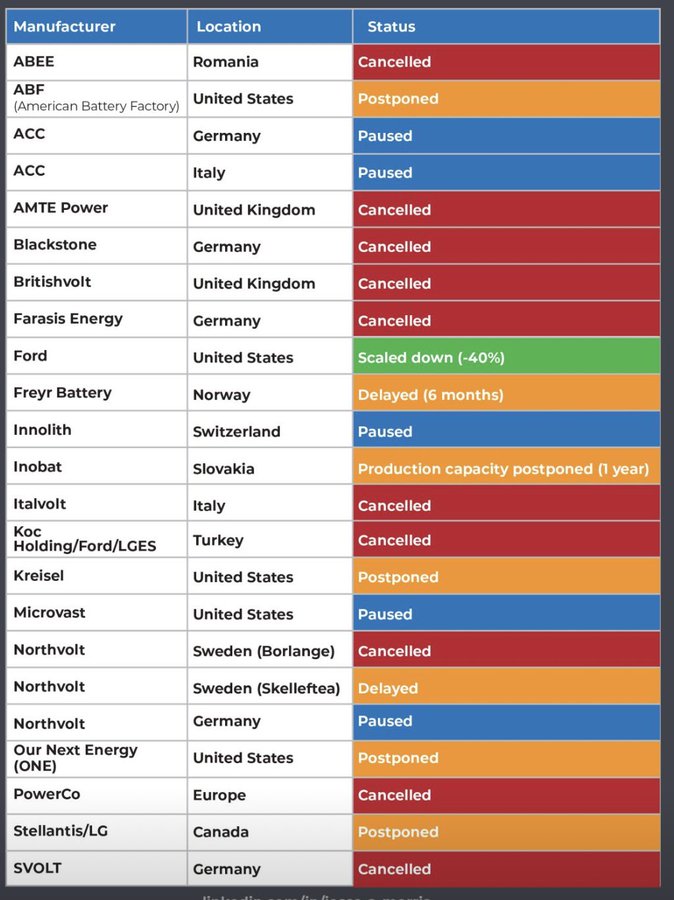
The retreat is everywhere…

“But in the past 12 months, the growth rate of electric vehicle sales has slowed sharply as some car buyers have balked at the high prices of electric cars and trucks and the hassles of charging them, especially on long trips.

The shift in consumer sentiment is now forcing many automakers to pull back on aggressive investment plans, and pivot, at least partly, back to the internal-combustion engine vehicles that still account for most new car sales and a large share of corporate profits.”

Ford pivots from EV plans to heavy-duty trucks at Canada facility

Trump:
“I will end the electric vehicle mandate on day one, thereby saving the auto industry from complete obliteration; and savings US customers thousands and thousands of dollars per car.

We Don’t Need No Stinking Giant Fans

Robert Bryce;

Two of Europe’s biggest energy companies are abandoning the SS Offshore Wind.

In May, Shell, the UK-based oil and gas giant (2023 revenue: $317 billion), announced that it was cutting staff from its offshore wind business because, according to Bloomberg, the company has decided to focus on markets that “deliver the most value for our investors and customers.” Bloomberg also reported that the staff cuts were made after the departures of top executives in the company’s offshore wind and renewable power businesses.

Last month, Murray Auchincloss, the CEO of oil and gas giant BP, imposed a “hiring freeze and paused new offshore wind projects.” According to Reuters, the new CEO is putting more “emphasis on oil and gas amid investor discontent over its energy transition strategy” and that BP (2023 revenue: $208 billion) was cutting investments in “big budget, low-carbon projects, particularly in offshore wind, that are not expected to generate cash for years.”

The moves by BP and Shell are only the latest examples of the troubles facing the offshore wind sector, which has been foundering on the shoals of higher interest rates, citizen opposition, and ballooning costs. Over the past year, numerous projects on the Eastern Seaboard, including Skipjack Wind in Maryland, Park City Wind in Connecticut, and South Coast Wind in Massachusetts, have been canceled due to bad economics. In all, according to data compiled by Ed O’Donnell, a nuclear engineer and a principal at New Jersey-based Whitestrand Consulting, about 14,700 megawatts of offshore wind capacity has been canceled. For comparison, about 15,500 megawatts of capacity is now in development, under construction, or operational.

Of course, those figures don’t jibe with the tsunami of hype about offshore wind energy that has appeared in major media outlets. But the hard reality is that America’s offshore wind sector is a subsidy-dependent industry that is dominated by foreign companies who are in bed with some of America’s biggest climate NGOs, including the NRDC (gross receipts: $555 million) and Sierra Club (Gross receipts: $184 million).

Wir Brauchen Keine Brennenden, Funkelnden Autos

Via WUWT;

Volkswagen is planning to cut another 1,000 jobs by the end of 2024 at its factory in Zwickau, Germany. The demand for electric vehicles (EVs) remains weak and turbulent.

The news is another blow to a region already gripped by economic and political uncertainty, and underscores how Germany’s green master plan remains an illusion.

The Zwickau plant still employs about 9,400 workers and exclusively produces vehicles with electric drives.

“The move is a result of slow sales of EVs,” reports Blackout News. “The automotive industry is currently experiencing a turbulent phase. Many companies are increasingly focusing on electro-mobility, but consumers remain hesitant. High purchase costs, limited range and an inadequate charging infrastructure are some of the reasons that are deterring potential buyers.”

We Don’t Need No Frozen Sparky Sleds

Juxtapose!

Government of Canada, July 2021;

The Government of Quebec confirms a $30-million loan for Taiga Motors, while the Government of Canada plans to grant a loan of up to $10 million to the business. These financial contributions will support Taiga Motors’ project to industrialize the manufacture of personal watercraft, snowmobiles, electric motorization systems and battery packs. This initiative valued at $125.17 million will lead to the creation, by the end of 2023, of at least 370 well-paying jobs in Montréal and Shawinigan.

CBC, July 2024;

Taiga Motors Corp. says it has obtained an interim court order for creditor protection as well as one authorizing the company to launch a formal sale and investment solicitation process.

The Montreal-based electric snowmobile maker also says it has secured a line of credit from Export Development Canada — already a creditor — for up to $4.4 million.

The company says the money will be used to finance it and its subsidiaries’ capital requirements for restructuring under the Companies’ Creditors Arrangement Act.

The company says it expects it will be placed under delisting review on the Toronto Stock Exchange.

We Don’t Need No Stinking French Fry Grease

Shell pauses construction at one of Europe’s biggest biofuels plants

Shell has paused construction at one of its biggest energy transition projects, a huge plant in Rotterdam that was intended to convert waste into jet fuel and biodiesel.

The plant, which was given the green light in 2021, was already behind schedule because of technical difficulties. Originally slated to start production in April, Shell said earlier this year it would be operational “in the latter part of the decade”.

On Tuesday, Shell said it needed to “temporarily pause” work “to address project delivery and ensure future competitiveness given current market conditions”. The company declined to comment on how long the delay would be.

“Committed to building battery plant in Quebec”

Battery maker to review growth plan;

Northvolt is examining its long-term strategy “both from a capital allocation point of view” as well as working out “realistic time plans for these projects between the customers,” Carlsson said in an interview.

Slower-than-expected demand for electric cars has prompted automakers to tweak model rollout plans and walk back ambitious goals for electrification. The ripple effect from these changes is starting to spread, with battery projects being pushed out and material suppliers Umicore SA and BASF SE cancelling projects.

Additional hurdles have also gone up for Northvolt, Europe’s most advanced homegrown battery maker. Long-standing battery rivals in Asia, such as China’s BYD Co., have made strides on improving cheaper lithium-iron-phosphate batteries, broadening the types of vehicles they can be used for, undermining Europe’s own battery industry efforts.

Northvolt is also dealing with internal problems in the transition to full-scale production. Customers like Volkswagen AG’s Scania have complained of delivery delays, while BMW AG has backed out of a €2 billion (US$2.1 billion) battery order because of quality concerns, dealing a blow to the region’s efforts to establish an independent EV supply chain.

The manufacturer’s operating loss more than tripled to US$1.03 billion last year, Northvolt said, as the company dealt with “multiple challenges and setbacks” while seeking to scale up output at its Ett battery gigafactory, Carlsson said in a statement.

They probably just need more of our money.

Update: The Canada Pension Plan Investment Board put more than $600 million in China’s electric vehicle sector accused by cabinet of unfair trade practices.

Navigation