
On Tuesday, we didn’t get much in the way of wind power generation, again.
Alberta coffee makers were not powered by wind Wednesday morning, as wind power collapsed, again
Alberta’s electrical grid, with 3,618 megawatts of installed wind generation, was getting just 19 megawatts from wind at 7:26 a.m. on Wednesday. This is after several grid alerts in late November and throughout December.
Year end with Premier Scott Moe, Part 1: energy security, war, wind, solar and coal

There’s no fluff questions in this year-end interview with Premier Scott Moe. Part one focuses on energy security, the war in Ukraine, wind, solar and coal power.
There are four parts to this interview, to be published this week. Watch for them.
Cold means less wind, more power demand in Sask
Alberta’s seen its power grid struggle in recent days as cold weather has meant substantially less wind production while demand has spiked.
Well, Saskatchewan is also seeing demand climb, and wind power drop. No grid alerts here, at least yet.
Alberta electrical grid in peril for the third time in 24 hours

The Alberta Electric System Operator issued a grid alert for the second time in one day, third time in 24 hours, and fifth time in three weeks. And at 5:27, demand hit another all-time peak.
Alberta electrical grid alert second time in less than 24 hours, fourth time this month
For the second time in 2 days, 4th time in December, Alberta Electric System Operator declares a “grid alert” as the power system can’t keep up with demand. It’s too cold for the wind turbines. -31C at Lethbridge, -35 C at Pincher Creek
Alarm bells, not sleigh bells, should be ringing in Alberta. Saskatchewan, too.
Pipeline Online column on Alberta’s two electrical grid alerts this past week. And it’s not even really cold there yet.
As evidenced twice this past week, the electrical grid can barely handle the demand we have, now, before we switch most of our transportation system to electric vehicles. What happens when half our cars and trucks are EVs? Then three-quarters? What happens when the wind doesn’t blow then? No one goes to work?
When will the other media take notice? When will they start to question this mad rush to wind and solar, and total adoption of electric vehicles? When will someone else in the Saskatchewan media declare “The emperor has no clothes?”
As Alberta’s wind power generation collapsed this week, so, too did Saskatchewan’s giant stinkin’ fans

On Tuesday going into Wednesday, Wind power production in Alberta dropped to 0.1 per cent of nameplate capacity. And it stayed at 2% or less for about 24 hours. Well, now we know Saskatchewan saw a substantial drop as well.
At 12:30 a.m. this morning, Alberta got just 3 megawatts out of its 3,076 megawatts of wind. Again
Again and again and again, Alberta’s wind power totally collapses to effectively zero. It got really low at supper on Tuesday, dropping to around 15 megawatts, which is pretty much nothing since their nameplate capacity has grown, again, now to 3,076 megawatts.
But by 12:30 a.m., it dropped to just 3 megawatts. That’s out of hundreds of turbines costing many billions of dollars.
Oh, and you have to look at how much the $100 million or so worth of batteries have contributed in the last month. Take a guess.
But hey, Microsoft just signed on to buy a whole schwack of wind power. Does your Azure server rely on Alberta wind?
What the minister has to say about the Sask First Act, and not freezing in the dark

Here’s a deep dive interview with the minister behind the Saskatchewan First Act.
“So let’s take let’s take the power thing first of all,” Eyre said, noting the proposed Clean Electricity Standard, if adopted in its current form, would mean no fossil fueled power generation in this province by 2035.
According to SaskPower’s Where Your Power Comes From website, on any given day, coal and natural gas combined provide 65 to 84 per cent of the power in Saskatchewan. On Nov. 6, it was 77 per cent.
Eyre said, “That’s a federal policy which we hope will never see the light of day, but which is moving along. We will freeze in the dark. And we know that. Saskatoon (is) powered by the Queen Elizabeth, a natural gas-powered power station. The entire City of Saskatoon (would be) in huge trouble.”
SaskPower is literally doubling down on wind and solar power production. Expect lots of giant stinking fans and shiny panels to come

They’re going to double wind and solar capacity. But on Oct. 3, all our wind produced just 7% of its capacity.
We don’t need no giant stinking fans. But we’re going to build a lot of them.
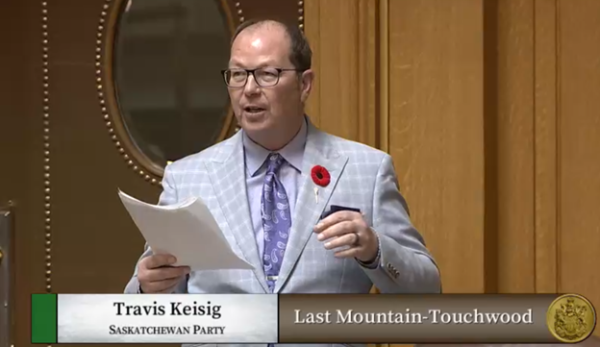
The Saskatchewan Party government sure seems to have some mixed messages when it comes to wind and solar power. We keep building more, and will build a lot more, but it turns out they don’t produce as advertised.
In two throne speeches on Nov. 2, one MLA spoke praises of SaskPower’s buildout. But another pointed out that you don’t get anywhere close to what the nameplate capacity is.
Our solar capacity is 20 and we were getting 2. You cannot run a province, you cannot run business, you cannot run industry, you cannot run people’s homes on that unreliability
Throne speech includes of talk about power generation, and using farming to offset carbon burden for other industries

If Saskatchewan can’t get out of a carbon tax, it looks like it’s going to try to reduce that overall carbon tax burden. The throne speech indicates that carbon offset credits from zero till farming will be available to lower other industries’ carbon tax burden.
Believe it or not, those giant stinkin’ fans actually did run near full capacity, for a day, in Saskatchewan
What do you know? Some days the wind does actually blow in Saskatchewan. And not from politicians talking, either.
This is an exceptionally rare occurrence where the 617 megawatts of wind power generation in Saskatchewan actually put out somewhere close to nameplate capacity. Who’d thunk it?
Spinny things don’t work for over 200 hours a month, says retired engineer from Alberta
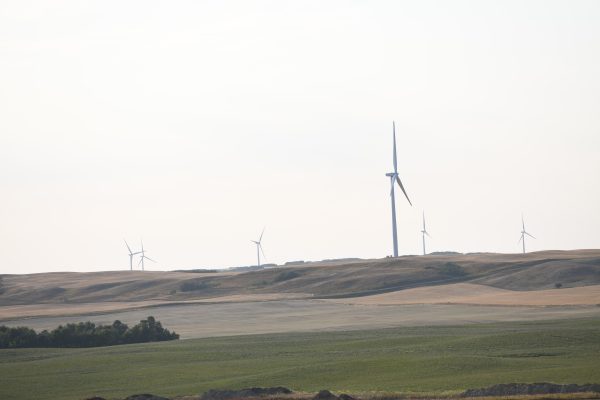
Perhaps of most concern is that there were 257 hrs (over 10 days in total) when the wind power output was zero – and the months of most ZERO hours are the coldest months when freezing temperatures are happening. So the 2017 data confirms the earlier 2012 data – meaning that no matter how many wind farms are built, there will always be over 200 hours of ZERO wind power. From an atmospheric viewpoint, whenever there are recurring periods of prolonged stable high pressure (such as frigid winter weather or summer heat waves) when there is also next to no wind – leading to no (or very low) wind power.
Ivan Purdy, P.eng, (retired)
Without coal, the lights would have gone out in Saskatchewan this week. The spinny things only put out 6% of their capacity

For months, Pipeline Online has been pointing out that Alberta puts out detailed data on its power grid, but SaskPower did not. Apparently others have been asking for the same information as well. Now, @SaskPower has responded. What does a day of power production look like in SK? Wind put out 6% of its capacity, and 2% of total generation. Coal provided 42% of total power
REGINA – While it’s not the same minute-by-minute data provided by the Alberta Electric System Operator for their grid, SaskPower has begun breaking down where its power is coming from on a daily basis. And the data from Oct. 3 and 4 showed wind generated an average of just 7.3 per cent and 6 per cent of its rated capacity of 615 megawatts. And while the Crown corporation often points out that “conventional coal accounts for approximately 24 per cent of SaskPower’s total generation capacity,” on those days, coal was providing an average of 42 per cent of the power in this province.
Fool me once, shame on you. Fool me 29 times, shame on me. We don’t need these spinny things
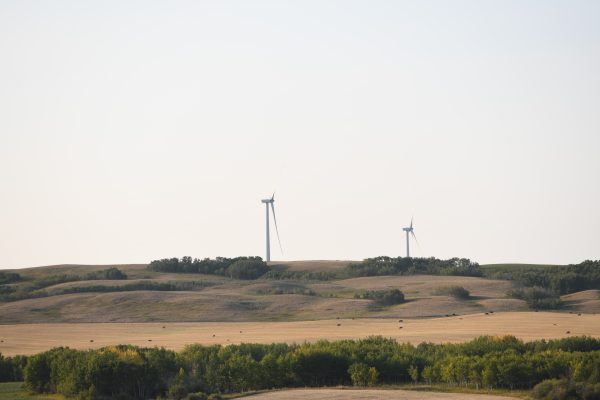
Alberta has now built 29 wind farms connected to its grid, and on Saturday, they were collectively putting out 8 megawatts out of a total of 2,734 megawatts capacity.
One of the arguments for wind has been if it’s not blowing here, it’s got to be blowing somewhere. We just need to spread it out of a large enough area.
Well, the area of southern Alberta populated by wind farms is larger than the area of the BENELUX countries (Belgium, Netherlands, Luxemburg) combined. Alternatively, it’s about the size of all of Austria.
So apparently, Alberta is not spread out enough.
The saying goes, “Fool me once, shame on you. Fool me twice, shame on me.”
What happens when you get fooled 29 times?
Because that’s what’s happening in Alberta. The denominator in the wind power equation has grown as well, as another wind farm was added onto the grid. The new total is now 29, an increase of one from the previous week. (You have to be sharp about this, because new facilities are continually being added.)
That was Saturday. And today, on Monday, for the third day in a row, and four days out of the last six, Alberta’s wind turbines crapped out again. At noon, their total output dropped to just 6 megawatts. Only one wind farm was contributing to the grid, out of hundreds of wind turbines.
Coal will soon be gone, and nuclear is a long ways away for Estevan, and spinny things are not the answer
Boundary Dam Power Station. On the left is the carbon capture unit.
The reality that coal-fired power in Saskatchewan is being forced to an end, despite the possibility of carbon capture technology, is now weighing heavily on Estevan, as reported by PipelineOnline.ca.
Estevan Mayor Roy Ludwig:
“And we’re not getting any answers. I mean, we’ve been meeting now with the province a few times and we said, ‘Listen, we want to know. We have to start meeting. 2030 is coming very quickly. What are we going to do? We need the federal government involvement. They don’t even answer our emails. We have to get them to the table.
“They want to shut down coal, which is a great baseload power. The only option to that would be close to that would be nuclear. And that won’t be coming (soon). Once we make a decision toward the end of this decade, it probably won’t be built till 2035-2036, something like that.”
And
“It’s weighing on the employees already. We have people saying, ‘You know, I don’t know for sure what’s going to happen, come 2030, so I’m bailing now. I’m going to where the jobs are now.’
“And it’s this sense of frustration, this sense of not knowing, you know, it’s a killer. And the closer we get without any good answers by 2030, the harder it is for everyone in our community. We deserve some answers. And the federal government owes us some answers. And the province, well, we’re starting to talk with them. SaskPower, we have a pretty good relationship with them, but it’s, you know, the final decisions with SaskPower are made by the provincial government, not SaskPower.”
This is a follow up to Further carbon capture on coal “not an option,” according to CIC Minister Don Morgan
We don’t need no stinking giant fans
3,295,492 stinking giant fans won’t save us