Clean Electricity Regulations proposed by the federal government mean to totally change our nation and its economy. And nuclear power is really the only option Saskatchewan has for large-scale, baseload power that does not emit greenhouse gasses.
Part 3 discusses the Clean Electricity Regulations and their impact, and widespread adoption of nuclear power
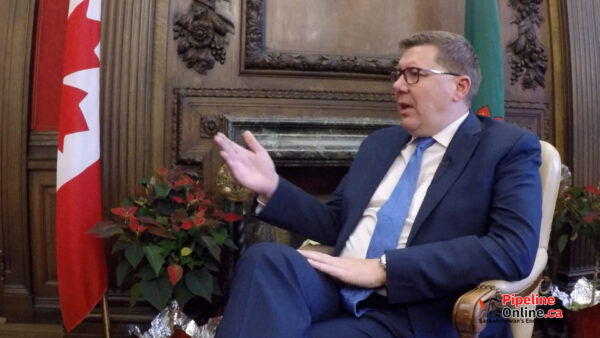
Pipeline Online speaks with Premier Scott Moe at conclusion of Dubai COP28 trip. (Another reporter asked questions, too, like do you believe the planet is warming…?
Later this morning, there will be a press conference where Saskatchewan lays out its case against the Clean Electricity Regulations. Watch for extensive coverage from Pipeline Online.
Also: Senator Pamela Wallin was doing video interviews decades before Zoom existing. Last week she spoke to Pipeline Online editor and owner Brian Zinchuk regarding electrification, EVs, fuel economy, nuclear power, heat pumps, carbon tax and whole lot more.
Speaking of which, the Epoch Times picked up Zinchuk’s recent column on five year plans for the “Just Transition.” Since that publication’s driving purpose is to fight against the Chinese Communist Party, they might know a thing or two about how five year plans went there.
If you didn’t catch it last week, Sask Polytechnic is getting a brand spanking new campus. Too bad it won’t be anywhere close to finished before my daughter finishes her journeyman heavy duty mechanic ticket. (She just started her 4 year apprenticeship, if that give you a hint.) Maybe my 16-year old son will get to attend the new site in his fourth year of apprenticeship?
Did you know Manitoba has an oilpatch? Often their own politicians don’t really clue in on it, including former Premier Brian Pallister. I can’t find it now, but when he flip-flopped on fighting the carbon tax, he made accusations against “oil producing provinces.” Manitoba produces around 38,000 barrels per day. Anyhow, the largest oilfield in Manitoba is now 19 years old.
And the big one for last week: my column on how Saskatchewan goes big into nuclear. Funny thing is I’ll be speaking to the SaskPower CEO on Monday. We’ll see if I’m on the mark or not.
Supper in Texas on Wednesday: for the 9th time in 3 weeks, the lights are in danger of going out due to high temperatures and low wind power generation.
Well, that’s what I initially wrote. Then the Texas grid literally went into “red alert,” as the frequency started to drop and reserves fell perilously low. If the frequency goes too low, generating plants would start to trip off in cascading failures, leading to massive blackouts. Thankfully, they got it under control.
Also: Pipeline Online editor Brian Zinchuk on John Gormley Live talking about oil prices, drilling activity, carbon capture, grid alerts, and dramatically more nuclear power generation possible in Saskatchewan.
And the province just coughed up some money to help develop a domestic nuclear supply chain within Saskatchewan.
Also, Crescent Point Energy grew up in the Bakken, and at one point was briefly Saskatchewan’s largest oil producer. Well, they just sold all their North Dakota Bakken assets. Anyone want to start a pool as to when they will sell off remaining assets in Saskatchewan?
Four reactors could cost Saskatchewan $12 to $20 billion. The feds just gave us $74 million. But don’t worry, the money came from Guilbeault and Wilkinson. At least, those were the ministers quoted.
In the above, you will see that in 26 years, four months and 10 days, Saskatchewan could need as many as 27.5 nuclear reactors. At $3 to $5 billion a crack. Good luck, with that.
Steven Guilbeault, Minister of Environment and Climate Change, Julie Dabrusin, Parliamentary Secretary to the Minister of Natural Resources and the Minister of Environment and Climate Change, Luke Barber, Chief Operating Officer, University of Toronto and Scott Hendershot, Senior Manager, Sustainability Office, University of Toronto, standing together on a rooftop covered in solar panels. Government of Canada handout
Clean Electricity Regulations released: carbon capture needed for continued fossil fuel power generation. #Saskatchewan will not “defy the laws of thermodynamics,” says Premier Scott Moe.
I still need to dig deep into this. I’ve sent a list of questions to SaskPower and the provincial government seeking response next week, as this dropped just as we’re packing to head to the cabin. Because of course they would release it during the dog days of August.
Note: these regulations expect the electrical grid demand to grow by 2.5x in 26 years, three months and 21 days. Good luck with that. Expect a column next week.
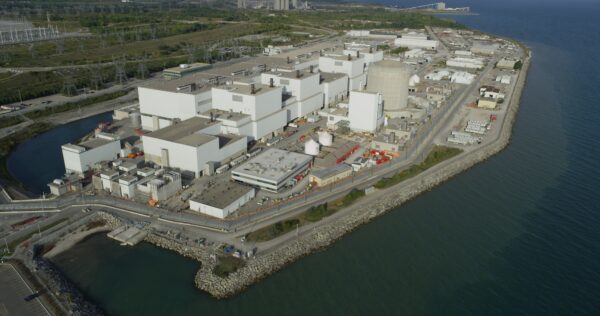
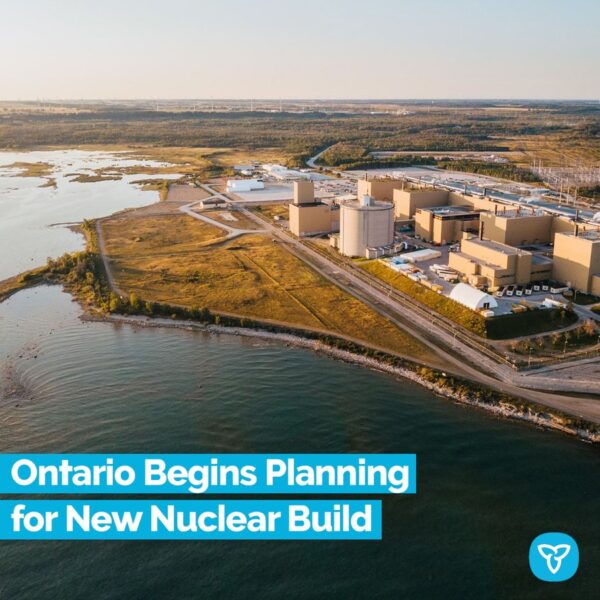
On Wednesday morning, the Province of Ontario and Bruce Power announced they were beginning planning for a massive expansion of “large nuclear” in that province. How big? One quarter more than Saskatchewan has ever produced on its highest usage day. Just one of these reactors would be as large as the four SaskPower is currently considering, combined.
Oh, and while he was here, Jonathan Wilkinson announced federal money for four Indigenous renewable energy projects, plus one at Carrot River. Here’s the first four, and here’s the last one.
Also, natural resources minister has faith electric tractors are coming. The local Kipling reporter asked about this, and it’s awesome. I wonder where, and when they will charge said tractors? Maybe some booster cables at the nearest power pole in the middle of a field?
Entitled “Creating a Fair and Equitable Energy Transformation,” The 56 page report outlines nothing short of the utter transformation of Canada, its economy and workforce, by way of transitioning away from fossil fuels to a largely electric economy, with the possibility of hydrogen usage as well. In doing so it means to largely do away with the fossil fuel industry which is one of Canada’s largest industries and contributors to GDP, exports and wealth. The report provides recommendations as to what to do with the people involved in that industry, but not so much the companies who employ them, create those jobs or that wealth.
On Thursday, I’ll have the detailed Conservative response from MP Shannon Stubbs.
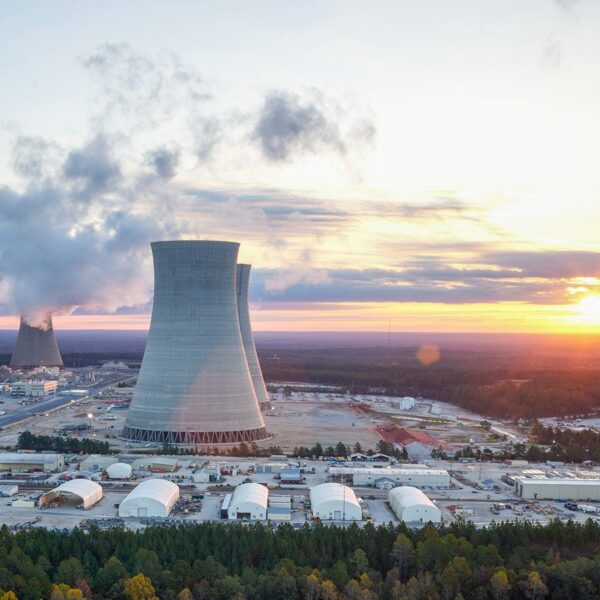
This model is currently being built in China and being considered for substantial deployment in Poland. Three of these reactors, alone, at the highest rating, could make up almost the entire generation needs of Saskatchewan on most winter days. But if one went down, it would take down a third of our grid, which is why we never built big reactors.
The Saskatchewan Legislature ended its 2022-23 session on Thursday. The very first bill was about keeping the lights on, and the very last debate was also about keeping the lights on. This was the keeping the lights on session.
This past week the Saskatchewan government spent a lot of time on power generation and this “Net Zero by 2035” idea the federal government is trying to force upon the provinces.
This is the “energy transition” decision making in real time, folks. The impacts are enormous for this province, which is why I’ve been hammering these stories so hard.
The week summed up with Premier Scott Moe coming to Estevan to explain to local officials what the provincial government’s plans are for power production. For generations, Estevan has been home of the highest concentration of power generation in this province. However, the addition of multiple gas plants and wind facilities has largely diluted the percentage of power from Estevan. But as the province is clearly indicating a move towards nuclear, Moe all but said that Estevan will be home to some of the first small modular reactors. Pay attention to how he corrects himself from saying “nuclear” to “small modular reactors.” In this video, Moe addresses many of the concerns I’ve been raising over the last 17 months. As for adoption of nuclear – if future Saskatchewan governments follow Moe’s lead, this won’t be a small thing. Twenty years from now, as all our coal is retired and as older natural gas plants also reach retirement age, it looks like Saskatchewan will be moving to a largely nuclear grid for baseload power. And when Moe says baseload, he repeatedly refers to 80 per cent of the grid. That’s a lot more than four reactors down the road. That’s a sea change.
It turns out Steven Guilbeault has an answer for that: He said burning coal would be a violation of Canada’s Criminal Code. So will the feds be arresting the premier, SaskPower minister, SaskPower CEO, coal miners or power plant operators? All the above? And will they be arrested the same way Guilbeault was, when as a Greenpeace protestor, he scaled the CN Tower?