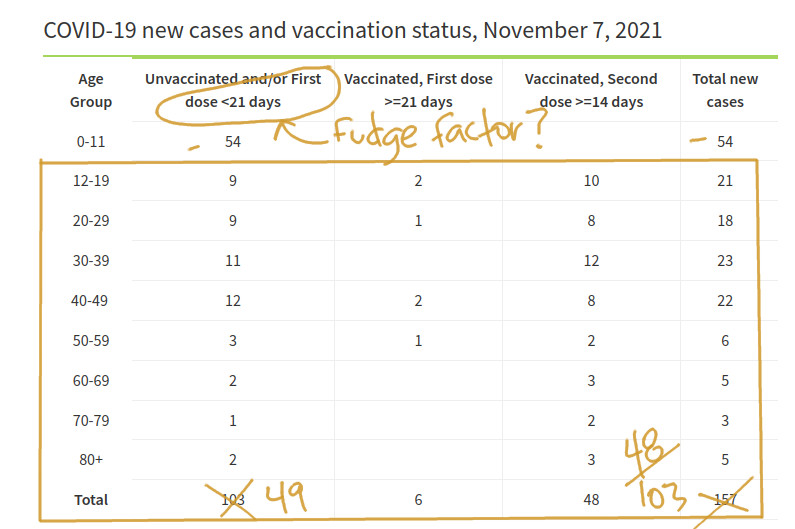
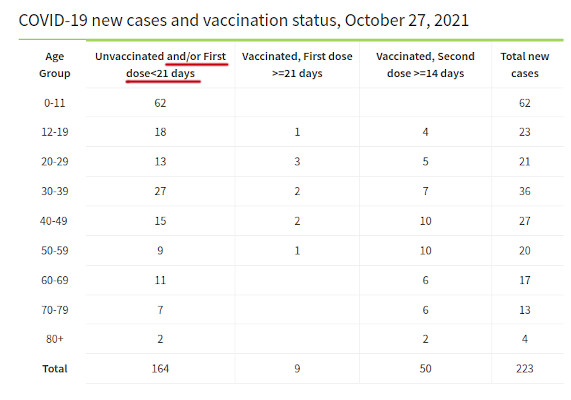
Let’s return once again to the manner in which SaskHealth is doing public reporting of new cases of Covid-19, (which thankfully seem to be in steady decline).
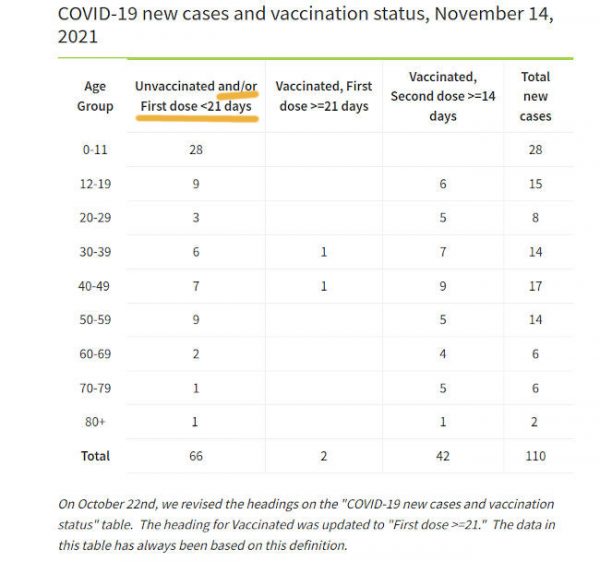
The problem here should be self-evident: the unvaccinated and newly-vaccinated do not have the same immune status — that’s just a statistical and immunological fact. It’s inexplicable that they’ve been grouped as one. They are not the same, and data from the two groups should not be combined. Why not? Because, if a recent vaccination promotes a behavioral or immune response that makes newly vaccinated more susceptible to infection, (as discussed here), that data is being suppressed.
Here’s Dr Clare Craig, in the British Medical Journal, to explain:
Thinking beyond behavioural change as an explanation for increased COVID post vaccination.
Dear Editor,
As well as the papers cited by the authors, other studies have shown a similar effect. A Danish study showed a 40% increase in infections in the first two weeks after Pfizer-BioNTech vaccination, despite not vaccinating in homes with recent outbreaks.[1] Indeed, the original Pfizer trial demonstrated a statistically significant 40% increase in ‘suspected COVID’, with 409 cases in the vaccination arm in the first week of the trial, compared with 287 in the placebo arm.[2] Other publications have omitted mention of the period immediately after vaccination.[3] [4] There is substantial anecdotal evidence of people who had tested negative prior to vaccination, becoming infected shortly afterwards, invariably attributed to exposure just before vaccination.[5] Others have raised concerns about this.[6]
The REACT study of prevalence in January showed that the odds ratio of having a positive swab was 1.48 in healthcare and care home workers and 1.38 in other key workers (when compared to all workers).[7] It seems highly unlikely that behavioural change alone (in the over 80s) could account for an increase in the risk of infection of a similar magnitude to that assumed by being in high-risk employment. […]
The Pfizer vaccination causes a transient fall in lymphocytes for the first three days after vaccination.[12], The phase 2 trials of AstraZeneca similarly showed a fall in neutrophils.[13] Post vaccination neutrophil depletion[14] and lymphocyte depletion[15] has been shown for other vaccines and the latter has been known about since 1981.[16] There is conflicting literature on whether this effect results in susceptibility to viral infections but there is certainly evidence suggesting that is the case in children.[17] Given the evidence of white cell depletion after COVID vaccination and the evidence of increased COVID infection rates shortly after vaccination, the possibility that the two are causally related needs urgent investigation.
This response is only referring to susceptibility to COVID in the first two weeks of vaccination; it is not commenting on the efficacy of vaccines after this period.
And yes, the double-vaxxed have surpassed the (so-called) “unvaccinated” as a percentage of new cases for the first time.