Author: Brian Zinchuk

With oil prices at $94 a barrel, why is industry activity akin to when it was half of that?

In the last week I’ve spoke to some of the most knowledgeable people I know in the Saskatchewan oilpatch, business owners all, from Weyburn, Lloydminster and several from Estevan. There’s a rising chorus of dissatisfaction amongst them. Things should be booming in this province’s oilpatch, but they aren’t. And this disquiet could threaten the governing Saskatchewan Party with the potential loss of a key portion of its base.

Watch for a Part 2 to this tomorrow.

How many nukes SaskPower is looking at, and switching from coal to natural gas

SaskPower president and CEO Rupen Pandya was in Estevan on Monday, and there’s a lot to unpack from that. He told city council how many reactors are being considered at Estevan and Elbow (SaskPower is currently planning for their first 2). And converting Estevan area power stations to natural gas could allow us to test carbon capture on natural gas exhaust. But that would mean the end of coal at Estevan.

Eco zealots and going big into nuclear

All the hacking issues last week means there’s a lot to catch up on in the world of energy.

First, a column this morning from U of R professor Jim Warren: Guess what happens when eco-zealots are put in charge of making climate policy?

Here’s another verbatim press release from Steven Guilbeault about cutting oil and gas emissions by 75%.

If you didn’t catch it last week, Sask Polytechnic is getting a brand spanking new campus. Too bad it won’t be anywhere close to finished before my daughter finishes her journeyman heavy duty mechanic ticket. (She just started her 4 year apprenticeship, if that give you a hint.) Maybe my 16-year old son will get to attend the new site in his fourth year of apprenticeship?

Did you know Manitoba has an oilpatch? Often their own politicians don’t really clue in on it, including former Premier Brian Pallister. I can’t find it now, but when he flip-flopped on fighting the carbon tax, he made accusations against “oil producing provinces.” Manitoba produces around 38,000 barrels per day.  Anyhow, the largest oilfield in Manitoba is now 19 years old.

Oil prices look like they’re heading for $100/ barrel US.

Dams aren’t so green, after all.

And the big one for last week: my column on how Saskatchewan goes big into nuclear. Funny thing is I’ll be speaking to the SaskPower CEO on Monday. We’ll see if I’m on the mark or not.


The death spiral of newspapers continues

Two years ago, I made the prediction there wouldn’t be a print newspaper in Canada in four years. Well, here we are, where Metroland, sister company to the Toronto Star filed for bankruptcy, laid off 2/3 of its staff, and ceased printing. What’s left will be strickly online. Hmmm, wonder why?

Here’s the Globe and Mail’s story (paywall). It notes more than 70 papers are done print. Here’s Metroland’s link to their brands.

In a related note, Pipeline Online is just two weeks shy of its second anniversary. Working in newspapers was like being a crewmember of the Titanic. It was just a matter of time before the thing went under. And thus, going on my own, being master of my own destiny, was necessary.

(From Kate: You need to add a “Support Pipeline Online” link to your website header, Brian. And you folks with ties to the energy industry, especially in SE Sask, should consider advertising. Use it or lose it!)

The impact of CO2-enhanced oil recovery is huge

It turns out that carbon dioxide-enhanced oil recovery is more significant than even I thought, and I’ve been writing about if for 15 years. It accounts for a huge number of the top 100 conventional oil wells in Saskatchewan. Huge. And it proves out the significance and importance of CO2-EOR. Imagine what we could do across Saskatchewan with access to a lot more CO2? That’s going to have to be a column, methinks. 

Also, oil is over US$90/barrel for the first time in quite a while. That’s going to be pretty important for Saskatchewan, as I was made aware today that potash prices have tanked. They are down by half year over year.

Explaining the “inside baseball” on Crescent Point

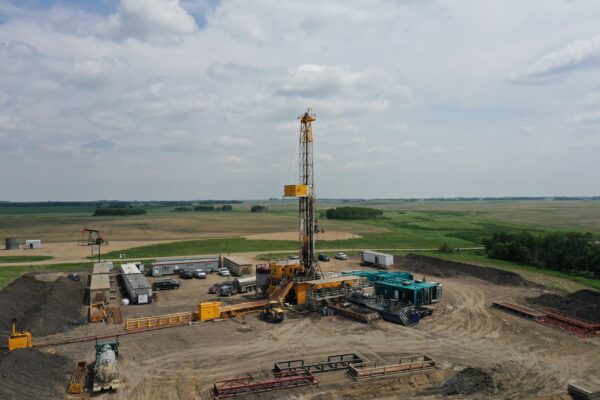
This yellow rig, originally Eagle Drilling Rig 1, was built in large part because of the activity Crescent Point was doing. It often worked for Crescent Point. Dozens of people made a lot of money over the years off of this one rig alone. Photo by Brian Zinchuk

One commenter wondered what the post about Crescent Point yesterday was all about, and seeing by the lack of comments, he was right to suggest it might be a bit of “inside baseball.” So let me lay out some context for the average Saskatchewan resident:

  • The “Bakken Boom” of 2008-2014, which included over a billion dollars of land sales in 2008, was largely driven by Crescent Point. Most of that billion dollars in land sales that year, the year Saskatchewan paid off a huge chunk of debt, was directly from Crescent Point. Remember when the provincial government had that huge surplus in 2008? Crescent Point was a huge factor in that.
  • Their prodigious activity drove thousands of high paying jobs in Estevan, Weyburn, Carlyle, Carnduff, Midale, Stoughton, Torquay, Lampman, Benson, Arcola, Redvers, Gainsborough, Oungre and more, literally spending billions per year, mostly with oilfield service companies, who in turn paid wages. See, in Saskatchewan, the oilpatch isn’t really about the oil companies, but the hundreds of oilfield services companies who employ thousands of people that work for those oil companies. And those people then bought trucks, quads, boats, RVs, houses, Riders tickets, restaurant meals and more.
  • Millions of people across Canada, through mutual funds or direct stock ownership, or pension plans or other institutional investors, made billions off Crescent Point.
  • At one point, Crescent Point accounted for roughly one out of every four barrels of oil produced in Saskatchewan. And at that time, oil royalties were paying up to 20 per cent of the provincial budget’s revenues, while health care was consuming about 39 per cent of the budget’s expenses. That meant that oil was paying for roughly every single doctor, nurse, hospital, old folks home, Xray, MRI and more south of Lumsden – including Regina – and Crescent Point was paying for roughly one quarter of that.
  • On health care – it was Crescent Point that got the ball over the line in leading the fundraising to get STARS air ambulance finally going in Saskatchewan. While Potash Corp eventually donated more money, Crescent Point was the leader in that endeavor. If they hadn’t done that, it might have been several more years before getting a helicopter air ambulance here. If we had STARS in 1997 when my grandfather had a stroke, maybe he wouldn’t have turned into a vegetable and died a slow death. STARS responded the night my sister died. It matters.
  • Before they started selling off land in 2018, Crescent Point controlled huge swaths of land across southeast and southwest Saskatchewan. Over the course of something like 30 acquisitions, almost every one of those made the sellers rich, and those sellers often went on and reinvested a large portion of that money back into Saskatchewan.
  • They were really hard on oilfield service providers to cut costs when the 7-year downturn hit around Christmas of 2014. But when nearly all other oil companies pulled their horns in and stopped spending money, Crescent Point did not. They kept going, even if they were paying less. That kept a huge portion of the industry afloat for several years, even if begrudgingly. For several of those years, Crescent Point employed more drilling rigs in Canada then the No. 2 and No. 3 oil companies combined. They may have been lean times, but lean was better than starvation, which is what most of the rest of the oil business was doing. In February, 2018, Crescent Point employed 29 drilling rigs, 27 of which were in Saskatchewan. They kept the industry afloat when no one else was.
  • Despite being based in Calgary, Crescent Point, along with Husky, were our oil industry corporate champions – Crescent Point for a decade, Husky for decades.
  • And now, Crescent Point’s activity and involvement in Saskatchewan is a shadow of its former self. While Whitecap Resources has in a small way picked up where Crescent Point left off, at this point it’s nowhere close. And as a result, all those towns listed above, and the province as a whole, are feeling the difference.
  • You may not realize it, but without Crescent Point from 2008-2018, almost everyone in Saskatchewan, and Saskatchewan itself, would have been poorer as a result.

I hope that explains it a bit more.

Crescent Point is spending 70% of its CAPEX in Alberta. Not that long ago, it was more like 80+% in Saskatchewan

I’ve been saying for a long time now, Crescent Point has been increasingly losing interest in Saskatchewan. Monday’s CAPEX budget solidifies that, as they’re spending 70 per cent of a billion dollar budget in Alberta. They used to easily spend a billion in Saskatchewan per year, and often a lot more. So anyone who relies on Crescent Point should take note, including the province of Saskatchewan.

As recently has February, 2018, Crescent Point had 27 rigs drilling in Saskatchewan. Today that number is 4.

If you want to know why things are slower in Saskatchewan, even with higher oil prices, here’s your first clue.

Crown corporation Trans Mountain wants a blank cheque from shippers for pipeline cost overruns

Cenovus calls Trans Mountain’s desire for a blank cheque on cost overruns “commercially absurd” It turns out when you run a project something like 4 to 6 times the original budget (depending on what you consider the start and the original budget) the people expected to pay for it might balk a bit. In the letter quoted in the story, Cenovus basically tells Trans Mountain to, well, you figure it out.

Poilievre will push LNG, SMRs, hydro dams and continued oil production

Pierre Poilievre. Screenshot from YouTube

Conservative Leader Pierre Poilievre took some time to speak about energy during his keynote speech to the Conservative national policy convention in Quebec City on Sept. 8. In those comments, he spoke about natural liquefaction extensively, as well as small modular reactors, hydroelectricity, tidal power and oil production. He mentioned more wind power, but did not speak of solar power generation. He also referred to producing minerals for electrification in Canada instead of China. This was an oblique reference to lithium, without actually mentioning lithium.

Steven Guilbeault. Screenshot from CPAC


If you didn’t catch it – Steven Guilbeault crashed the Conservative policy convention in Quebec City. He wondered if Pierre Poilievre believed in climate change. Here’s some of what he had to say.

Alberta’s E3 Lithium might be first out of the gate with a pilot lithium plant, but several are in the works for Saskatchewan. And E3’s stated lithium concentration is 74.5 mg/L, while at Coleville, SK, Grounded Lithium also reports 74 mg/L. Arizona Lithium says they have up to 172 mg/L at Torquay. Hub City Lithium says it has concentrations of up to 259 mg/L at Viewfield (Stoughton). From Canadian Press: Alberta enters global lithium race with opening of first extraction pilot project.

A geologist I know once told me “All things being equal, Alberta has better rocks (than Saskatchewan).” Perhaps that’s true for oil, but it could be the inverse for lithium. Time will tell.

And from the Associated Press – Apparently the Germans figure they can get rid of fossil fuel heating. This, in a nation that doesn’t get much sun or wind, but had been building solar and wind facilities like crazy while shutting down all its nuclear plants. To quote C-3P0, “This is madness!”


9 times in 3 weeks: how many times Texans have been warned the lights might go out

Supper in Texas on Wednesday: for the 9th time in 3 weeks, the lights are in danger of going out due to high temperatures and low wind power generation.

Well, that’s what I initially wrote. Then the Texas grid literally went into “red alert,” as the frequency started to drop and reserves fell perilously low. If the frequency goes too low, generating plants would start to trip off in cascading failures, leading to massive blackouts. Thankfully, they got it under control.

Also: Pipeline Online editor Brian Zinchuk on John Gormley Live talking about oil prices, drilling activity, carbon capture, grid alerts, and dramatically more nuclear power generation possible in Saskatchewan.

And if you missed it, Enbridge snapped up three natural gas utilities in the US. Funny how they’re spending big money in the US, but not Canada…


SaskPower and Whitecap strike deal on CO2 sale and purchase

Good news for Weyburn Unit, Whitecap, SaskPower, Weyburn and Estevan:

Whitecap Resources to buy CO2 from SaskPower until 2035, providing market for SaskPower’s BD3.

I did some in-depth analysis on the broader picture on all this, especially how carbon pricing in the US and Canada affect the economics.

Remember, the CO2 is used for enhanced oil recovery, dramatically extending the life of an oilfield that has now been producing over 65 years. And FYI, my kid found work with a oilfield company that’s worked in the Weyburn Unit for 62 years, give or take. I hope she can make a career there as a heavy duty mechanic.

A while ago I pointed out on Gormley that lower oil prices were definitely going to have an impact on Saskatchewan’s finances. I was right, as finances are down a half billion from budget.

Also, the feds just dished out $30 million for 1500 EV chargers in Quebec. Because of course they did.

So let’s see here, the federal government, with our tax dollars, have dished out money for EV manufacturers, battery plants, rebates on the EVs themselves, and now chargers. Is there anything they’ve missed? Maybe you get a car! And you get a car! Might have to do a column on this.

And, on the topic of the feds, after slow walking its construction for years, all of a sudden there’s a serious panic to get the Trans Mountain Pipeline complete and operating. Well, from what I understand, good luck with that.

Rolling blackouts again threaten Alberta and Texas on Tuesday

The energy transition continues: Alberta issues second electrical grid alert in two days. Texas also issued a grid alert on the same day. Funny, that. The two most energy-rich jurisdictions in the hemisphere, and perhaps the planet, are struggling to keep the lights on. Again.

Oh, and Texans have been warned: expect the same on Wednesday.

Why do I keep writing about this? Because people need it beat into their heads “The emperor has no clothes!”

The energy transition in real time: brownouts threaten at suppertime

With brownouts a possibility, Texas issues another electrical grid alert on Tuesday, its second in three days. Alberta issued one yesterday. These are the most energy-rich places on earth. What is going on?

UPDATE: 3:08 p.m. Aug. 29.

At 2:25 p.m, the Alberta Electric System Operator has not yet issued a grid alert on this date, but put out a tweet alluding to one, imploring Alberta citizens to reduce power consumption.

Saskatchewan sees 87% power from coal and natural gas as wind fails in SK, AB and Texas

Wind turbine. Photo by Brian Zinchuk

In Saskatchewan, Poplar River Power Station is now fully online again, which is good, because on Aug. 22, when wind generation fell to less than 1 per cent capacity, natural gas and coal made up 87 per cent of power generation. And of course, Alberta saw its wind production fall below 1 per cent, again.

Texas and Alberta have more oil, gas and coal than God, because God gave all his to Texas and Alberta. And yet “grid alerts” are becoming the norm in both, as they’ve both built out tremendous amounts of  wind power, and the wind doesn’t blow. On Sunday, Texas issued its form of grid alert.

But remember, the Canadian government says we must abandon coal and natural gas for wind and solar.

Saskatchewan could be going nuclear in a big way

First, Saskatchewan was considering four small modular reactors. Then the SaskPower minister said maybe as many as nine. Now Premier Scott Moe is floating the idea of large scale, 1000 megawatt reactors.

And the province just coughed up some money to help develop a domestic nuclear supply chain within Saskatchewan.

Also, Crescent Point Energy grew up in the Bakken, and at one point was briefly Saskatchewan’s largest oil producer. Well, they just sold all their North Dakota Bakken assets. Anyone want to start a pool as to when they will sell off remaining assets in Saskatchewan?

What do you call one-third of one per cent?

Ding ding ding! The amount of power output Alberta’s wind farms were putting out at noon on Tuesday. But the feds want us to get rid of all coal and natural gas power generation! And it was like that for around 10 hours! Whoo hoo, more wind!

And from the other side of the spectrum, the development of lithium into a potential multi-billion dollar industry in Saskatchewan continues apace, as Hub City Lithium announced test results from its second well north of Estevan which confirmed numbers from the first – and that one had the highest concentrations reported in Canada for lithium brines. But there’s a curious wild card here – it’s right beside the Viewfield Crater, an astrobleme from 190 million years ago. There’s only a handful of known craters in Canada, and this is one. Discussion in the story.

A small drop in a very large nuclear bucket

Jonathan Wilkinson. Photo by Brian Zinchuk


Four reactors could cost Saskatchewan $12 to $20 billion. The feds just gave us $74 million. But don’t worry, the money came from Guilbeault and Wilkinson. At least, those were the ministers quoted.

In the above, you will see that in 26 years, four months and 10 days, Saskatchewan could need as many as 27.5 nuclear reactors. At $3 to $5 billion a crack. Good luck, with that.

Also, Yukon might connect to the BC, and thereby national, electrical grid.

And Ford just milked the federal and Quebec EV cow for $1.2 billion

Navigation