Why this blog?
Until this moment I have been forced to listen while media and politicians alike have told me "what Canadians think". In all that time they never once asked.
This is just the voice of an ordinary Canadian yelling back at the radio -
"You don't speak for me."
email Kate
Goes to a private
mailserver in Europe.
I can't answer or use every tip, but all are appreciated!

Katewerk Art
Support SDA
Paypal:
Etransfers:
katewerk(at)sasktel.net
Not a registered charity.
I cannot issue tax receipts
Favourites/Resources
Instapundit
The Federalist
Powerline Blog
Babylon Bee
American Thinker
Legal Insurrection
Mark Steyn
American Greatness
Google Newspaper Archive
Pipeline Online
David Thompson
Podcasts
Steve Bannon's War Room
Scott Adams
Dark Horse
Michael Malice
Timcast
@Social
@Andy Ngo
@Cernovich
@Jack Posobeic
@IanMilesCheong
@AlinaChan
@YuriDeigin
@GlenGreenwald
@MattTaibbi
Support Our Advertisers

Sweetwater
Don't Run

Polar Bear Evolution
Email the Author
Wind Rain Temp

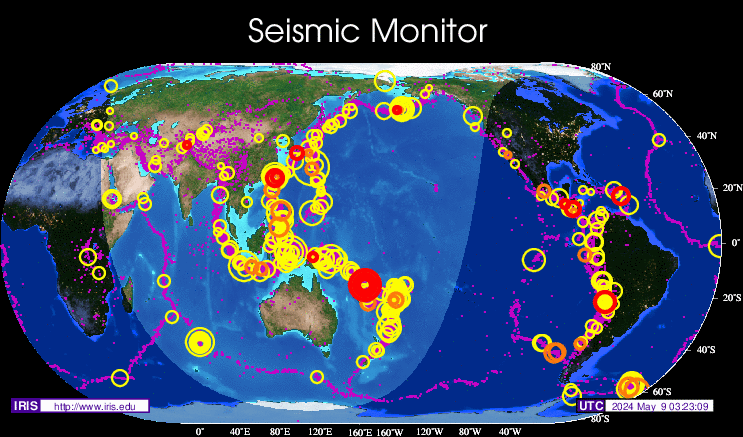
Seismic Map
What They Say About SDA
"Smalldeadanimals doesn't speak for the people of Saskatchewan" - Former Sask Premier Lorne Calvert
"I got so much traffic after your post my web host asked me to buy a larger traffic allowance." - Dr.Ross McKitrick
Holy hell, woman. When you send someone traffic, you send someone TRAFFIC.My hosting provider thought I was being DDoSed. - Sean McCormick
"The New York Times link to me yesterday [...] generated one-fifth of the traffic I normally get from a link from Small Dead Animals." - Kathy Shaidle
"You may be a nasty right winger, but you're not nasty all the time!" - Warren Kinsella
"Go back to collecting your welfare livelihood." - Michael E. Zilkowsky

“Tankers who actually used the Tiger called it the “Furniture Truck”.”
OMG seriously you need to verify your sources. Mobelvagen was not the Tiger but a 37mm AA gun mounted on Panzer IV chassis. It earned the name because of the tall vertical sides of the superstructure that were to be folded before action to form a platform for the gun crew.
“Except that Germans would have won Kursk had it not been for Hitler calling the offensive off following Sicily landings.”
The Enigma machine breaking the German codes also helped as Stalin knew when the Germans were attacking and where the Schwerpunkt was. In fact, by this time, the allies knew every offensive move the Germans were planning.
The Panther also copied the wide tracks to enable more flotation in mud and snow conditions.
You are right about the Russians deliberately stopping their offensive before Warsaw to allow the Germans to demolish the Polish insurgents. They could have easily kept the offensive going.
Good point about wide tracks on the panther forgot about that.
Re Enigma, well I seem to recall quite a few were surprised about that certain armoured divisions were stationed in a little town called Arnhem. Similarly allies weren’t exactly laying in ambush when panzers yet again rolled though the Ardennes.
Right. Fog of war. 😉 The reading of the Enigma failed on those few occasions.
Sorry mistake in calculations above should be 2.3 millions not 23 millions. Point still stands.
Moody’s reviewing, more downgrades to come.
Putin is very unstable, dangerous, he’s nuckin’ futz.
Jailed or driven out opposition, all news is state run, talk of implenting new law that any blogger with more than 3,000 regulars will have to fall under their restrictive news organization law.
“By 1945 T-34 was obsolete and updates were not keeping up with the requirements.”
I see. So the T-34 85 was purely mythical and never existed?
“…a certain lengthy engagement called Battle of Atlantic.”
Whiich was one long tale of disaster until 1943, nearly two years AFTER Germany invaded the USSR.
“Do German allies count?”
No. My statement was about the Wehrmacht. Remind me what happened when that British army in Libya encountered the Germans.
“Right, have you heard of a place called El Alamein maybe?”
More basic reading comprehension and troubles with dates. Alamein was in November 42, about 18 months AFTER the invasion of the USSR.
“They had plenty of reserves in the summer of 1944 when Bargation was launched.”
There’s a significant time difference and a lot of miles between Bagration and January 1945 and the fall of Warsaw.
Moody’s reviewing Ruusia for downgrade;
http://www.reuters.com/article/2014/03/28/moodys-russia-idUSL4N0MP4IF20140328
“I see. So the T-34 85 was purely mythical and never existed?”
I am the one who mentions it first. And yes by 1945 it was barely competitive. There is a reason why soviets deployed T-44 and T-54 was being developed. T-34/85 was stop gap measure barely addressing shortcoming of the earlier versions. They decided to put it in production instead of T-43 because it was cheaper and at that time adequate.
“Whiich was one long tale of disaster until 1943, nearly two years AFTER Germany invaded the USSR.”
Battle of Atlantic was going on and the life line to British Isles was maintained. It was not a disaster it was a struggle that tied a lot of German resources and made development of surface navy impossible. Again, Soviets were not winning anything alone.
“No. My statement was about the Wehrmacht. “
Then it was pointless since we were discussing the overall war effort. Focus please. When Axis lost ten divisions, 130 thousand men and close to 400 tanks most consider it a decisive allied victory. Hence Soviets did not win alone. Which again, I remind you, was the original claim. Nor did they score first victories, more on that below.
“More basic reading comprehension and troubles with dates.”
Seriously, after the “facts” you have pulled out of your rear end few post above you’re the last one to complain about others. Don’t let your fame and your fanboys get to your head.
“Alamein was in November 42, about 18 months AFTER the invasion of the USSR.”
El-Alamein was before Stalingrad. And it was the first major defeat of German land forces. The first overall defeat was Battle of Britain. The second was El-Alamein. December 1941 was not a German defeat it was a stalemate.
“There’s a significant time difference and a lot of miles between Bagration and January 1945 and the fall of Warsaw.”
They could have entered Warsaw in august 1944, but decided not to. They could have ended the war months earlier had they not decided to wait until Polish home army bleeds out.
You can stop embarrassing yourself any time.
Cherry-pick all you want and misstate whatever you want, re December 1941. Fact remains that your original post rebutting Slapshot was crap.
“Again, Soviets were not winning anything alone.”
No one said they did, bonehead. What was said was that the Soviets confronted the bulk of the German land army. And without that, the war could not have been won.
In case your attention span is lower than that of retarded amoeba here is the statement that started the whole discussion:
“Russians who are still under the delusion that they alone won against Germany”
This is the very statement that you have addressed.
Do you now understand why I said?
“Again, Soviets were not winning anything alone.”
To which you replied:
“No one said they did, bonehead.”
Does this needs further elaboration? Even for you it should be pretty clear.
Ok then, so to conclude, after every attempt you made to cough up a coherent argument has been soundly refuted, after you have embarrassed yourself with a complete lack of knowledge about lend lease, WWII armour, Eastern Front etc you fall back on personal insults. Oh how the mighty have fallen.
I was exactly right in every statement I made, you were exactly wrong when you challenged them. I understand that you feel empowered because others ask you for analysis but next time you may want to quit while not completely behind. In the meantime you can go over the above discussion and point out a single example where I or anyone else argues against the following words: “What was said was that the Soviets confronted the bulk of the German land army.”. After you conclude your search you may apologize for embarrassing yourself and disappointing your fanboys.
What you’ve been doing here reminds me of shoveling shit in the barn. And since tone can be difficult to discern digitally, please read mine as earnest if a bit envious of your grit. I was going to keep with the WWII theme and write something clever along the lines of “never before have so many been so wrong about so much … ” but couldn’t quite work “few” into there well enough to make it work. Anyway, I was coincidentally reading something lend-lease related today and have decided to share.
Moderator: It’s long, but in the comradely spirit of cultural enrichment please let this post stand!
Varlan Shalamov, Kolyma Tales, Lend Lease Chapter
The fresh tractor prints in the marsh were tracks of some prehistoric beast that bore little resemblance to an article of American technology delivered under the terms of Lend-Lease.
We convicts had heard of these gifts from beyond the sea and the emotional confusion they had introduced into the minds of the camp bigwigs. Worn knit suits and second-hand pullovers collected for the convicts of Kolyma were snapped up in near-fistfights by the wives of the Magadan generals.
As for the magical jars of sausage sent by Lend-Lease, we saw them only at a distance. What we knew and knew well were the chubby tins of Spam. Counted, measured by a very complex table of replacement, stolen by the greedy hands of the camp authorities, counted again and measured a second time before introduction to the kettle, boiled there till transformed into mysterious fibers that smelled like anything in the world except meat – this Spam excited the eye, but not the taste buds. Once tossed in the pot, Spam from Lend-Lease had no taste at all. Convict stomachs preferred something domestic such as old, rotten venison that couldn’t be boiled down even in seven camp kettles. Venison doesn’t disappear, doesn’t become ephemeral like Spam.
Oatmeal from Lend-Lease we relished, but we never got more than two tablespoons per portion. But the fruits of technology also came from Lend-Lease – fruits that could not be eaten: clumsy tomahawk-like hatchets, handy shovels with un-Russian work-saving handles. The shovel blades were instantaneously affixed to long Russian handles and flattened to make them more capacious.
Barrels of glycerin! Glycerin! The guard dipped out a bucketful with a kitchen pot on the very first night and got rich selling it to the convicts as ‘American honey’.
From Lend-Lease also came enormous black fifty-ton Diamond trucks with trailers and iron sides and five-ton Studebakers that could easily manage any hill. There were no better trucks in all of Kolyma. Day and night, Studebakers and Diamonds hauled American wheat along the thousand-mile road. The wheat was in pretty white linen sacks stamped with the American eagle, and chubby, tasteless bread rations were baked from this flour. Bread from Lend-Lease flour possessed an amazing quality: anyone who ate it stopped visiting the toilet; once in five days a bowel movement would be produced that wasn’t even worth the name. The stomach and intestines of the convict absorbed without remainder this magnificent white bread with its mixture of corn, bone-meal, and something else in addition – perhaps hope. And the time has not yet come to count the lives saved by this wheat from beyond the sea.
The Studebakers and Diamonds ate a lot of gas, but the gas also came from Lend-Lease, a light aviation gas. Russian trucks were adapted to be heated with wood: two stoves set near the motor were heated with split logs. There arose several wood supply centers headed by party members working on contract. Technical leadership at these wood supply centers was provided by a chief engineer, a plain engineer, a rate setter, a planner, and bookkeepers. I don’t remember whether two or three laborers ran the circular saw at the wood-processing plant. There may have been as many as three. The equipment was from Lend-Lease, and when a tractor came to the camp, a new word appeared in our language: ‘bulldozer’.
The prehistoric beast was freed from its chain: an American bulldozer with caterpillar tracks and a wide blade. The vertical metal shield gleamed like a mirror reflecting the sky, the trees, the stars, and the dirty faces of the convicts. Even the guard walked up to the foreign monster and said a man could shave himself before such a mirror. But there was no shaving for us; even the thought couldn’t have entered our heads.
The sighs and groans of the new American beast could be heard for a long time in the frosty air. The bulldozer coughed angrily in the frost, puffed, and then suddenly roared and moved boldly forward, crushing the shrubbery and passing easily over the stumps; this then was the help from beyond the sea.
Everywhere on the slope of the mountain were scattered construction-quality logs and firewood. Now we would not have the unbearable task of hauling and stacking the iron logs of Daurian larch by hand. To drag the logs over the shrubbery, down the narrow paths of the mountain slope, was an impossible job. Before 1938 they used to send horses for the job, but horses could not tolerate the north as well as people, were weaker than people, died under the strain of the hauling. Now the vertical knife of the foreign bulldozer had come to help us (us?).
None of us ever imagined that we would be given some light work instead of the unendurable log-hauling that was hated by all. They would simply increase our norms and we would be forced to do something else – just as degrading and contemptible as any camp labor. Our frostbitten toes and fingers would not be cured by the American bulldozer. But there was the American machine grease! Ah yes, the machine grease! The barrel was immediately attacked by a crowd of starving men who knocked out the bottom right on the spot with a stone.
In their hunger, they claimed the machine grease was butter sent by Lend-Lease and there remained less than half a barrel by the time a sentry was sent to guard it and the camp administration drove off the crowd of starving, exhausted men with rifle-shots. The fortunate ones gulped down this Lend-Lease butter, not believing it was simply machine grease. After all, the healing American bread was also tasteless and also had that same metallic flavor. And everyone who had been lucky enough to touch the grease licked his fingers hours later, gulping down the minutest amounts of the foreign joy that tasted like young stone. After all, a stone is not born a stone, but a soft oily creature. A creature, and not a thing. A stone becomes a thing in old age. Young wet limestone tuffs in the mountains enchanted the eyes of escaped convicts and workers from the geological surveys. A man had to exert his will to tear himself away from these honeyed shores, these milky rivers of flowing young stone. But that was a mountain, a valley, stone; and this was a delivery from Lend-Lease, the creation of human hands…
Nothing terrible happened to those who had dipped their hands into the barrel. Trained in Kolyma, stomach and bowels proved themselves capable of coping with machine grease. A sentry was placed to guard the remainder, for this was food for machines – creatures infinitely more important to the state than people.
And thus from beyond the ocean there had arrived one of those creatures as a symbol of victory, friendship, and something else.
Three hundred men felt boundless envy toward the prisoner sitting at the wheel of the American tractor – Grinka Lebedev. There were better tractor operators than Lebedev among the convicts, but they had all been convicted according to Article 58 of the Criminal Code (political prisoners). Grinka Lebedev was a common criminal, a parricide to be precise. Each of the three hundred witnessed his earthly joy: to roar over to the logging area sitting at the wheel of a well-lubricated tractor.
The logging area kept moving back. Felling the taller trees suitable for building materials in Kolyma takes place along the stream banks where deep ravines force the trees to reach upward from their wind-protected havens toward the sun. In windy spots, in bright light, on marshy mountain slopes stand dwarfs – broken, twisted, tormented from eternally turning after the sun, from their constant struggle for a piece of thawed ground. The trees on the mountain slopes don’t look like trees, but like monsters fit for a sideshow. Felling trees is similar to mining gold in those same streams in that it is just as rushed: the stream, the pan, the launder, the temporary barracks, the hurried predatory leap that leaves the stream and area without forest for three hundred years and without gold – for ever.
Somewhere there exists the science of forestry, but what kind of forestry can there be in a three-hundred-year-old larch forest in Kolyma during the war when the response to Lend-Lease is a hurried plunge into gold fever, harnessed, to be sure, by the guard towers of the ‘zones’?
Many tall trees and even prepared, sectioned fire-logs were abandoned. Many thick-ended logs disappeared into the snow, falling to the ground as soon as they had been hoisted on to the sharp, brittle shoulders of the prisoners. Weak prisoner hands, tens of hands cannot lift on to a shoulder (there exists no such shoulder!) a two-meter log, drag its iron weight for tens of meters over shrubs, potholes, and pits. Many logs had been abandoned because of the impossibility of the job, and the bulldozer was supposed to help us.
But for its first trip in the land of Kolyma, on Russian land, it had been assigned a totally different job.
We watched the chugging bulldozer turn to the left and begin to climb the terrace to where there was a projection of rock and where we had been taken to work hundreds of times along the old road that led past the camp cemetery.
I hadn’t given any thought to why we were led to work for the last few weeks along a new road instead of the familiar path indented from the boot-heels of the guards and the thick rubber galoshes of the prisoners. The new road was twice as long as the old one. Everywhere there were hills and drop-offs, and we exhausted ourselves just getting to the job. But no one asked why we were being taken by a new path.
That was the way it had to be; that was the order; and we crawled on all fours, grabbing at stones that ripped open the skin of the fingers till the blood ran.
Only now did I see and understand the reason for all of this, and I thank God that He gave me the time and strength to witness it.
The logging area was just ahead, the slope of the mountain had been laid bare, and the shallow snow had been blown away by the wind. The stumps had all been rooted out; a charge of ammonal was placed under the larger ones, and the stump would fly into the air. Smaller stumps were uprooted with long bars. The smallest were simply pulled out by hand like the shrubs of dwarf cedar…
The mountain had been laid bare and transformed into a gigantic stage for a camp mystery play.
A grave, a mass prisoner grave, a stone pit stuffed full with undecaying corpses from 1938 was sliding down the side of the hill, revealing the secret of Kolyma.
In Kolyma, bodies are not given over to earth, but to stone. Stone keeps secrets and reveals them. The permafrost keeps and reveals secrets. All of our loved ones who died in Kolyma, all those who were shot, beaten to death, sucked dry by starvation, can still be recognized even after tens of years. There were no gas furnaces in Kolyma. The corpses wait in stone, in the permafrost.
In 1938 entire work gangs dug such graves, constantly drilling, exploding, deepening the enormous gray, hard, cold stone pits. Digging graves in 1938 was easy work; there was no ‘assignment’, no ‘norm’ calculated to kill a man with a fourteen-hour working day. It was easier to dig graves than to stand in rubber galoshes over bare feet in the icy waters where they mined gold – the ‘basic unit of production’, the ‘first of all metals’.
These graves, enormous stone pits, were filled to the brim with corpses. The bodies had not decayed; they were just bare skeletons over which stretched dirty, scratched skin bitten all over by lice.
The north resisted with all its strength this work of man, not accepting the corpses into its bowels. Defeated, humbled, retreating, stone promised to forget nothing, to wait and preserve its secret. The severe winters, the hot summers, the winds, the six years of rain had not wrenched the dead men from the stone. The earth opened, baring its subterranean storerooms, for they contained not only gold and lead, tungsten and uranium, but also undecaying human bodies.
These human bodies slid down the slope, perhaps attempting to arise. From a distance, from the other side of the creek, I had previously seen these moving objects that caught up against branches and stones; I had seen them through the few trees still left standing and I thought that they were logs that had not yet been hauled away.
Now the mountain was laid bare, and its secret was revealed. The grave ‘opened’, and the dead men slid down the stony slope. Near the tractor road an enormous new common grave was dug. Who had dug it? No one was taken from the barracks for this work. It was enormous, and I and my companions knew that if we were to freeze and die, place would be found for us in this new grave, this house-warming for dead men.
The bulldozer scraped up the frozen bodies, thousands of bodies of thousands of skeleton-like corpses. Nothing had decayed: the twisted fingers, the pus-filled toes which were reduced to mere stumps after frostbite, the dry skin scratched bloody and eyes burning with a hungry gleam.
With my exhausted, tormented mind I tried to understand: how did there come to be such an enormous grave in this area? I am an old resident of Kolyma, and there hadn’t been any gold-mine here as far as I knew. But then I realized that I knew only a fragment of that world surrounded by a barbed-wire zone and guard towers that reminded one of the pages of tent-like Moscow architecture. Moscow’s taller buildings are guard towers keeping watch over the city’s prisoners. That’s what those buildings look like. And what served as models for Moscow architecture – the watchful towers of the Moscow Kremlin or the guard towers of the camps? The guard towers of the camp ‘zone’ represent the main concept advanced by their time and brilliantly expressed in the symbolism of architecture.
I realized that I knew only a small bit of that world, a pitifully small part, that twenty kilometers away there might be a shack for geological explorers looking for uranium or a gold-mine with thirty thousand prisoners. Much can be hidden in the folds of the mountain.
And then I remembered the greedy blaze of the fireweed, the furious blossoming of the taiga in summer when it tried to hide in the grass and foliage any deed of man – good or bad. And if I forget, the grass will forget. But the permafrost and stone will not forget.
Grinka Lebedev, parricide, was a good tractor-driver, and he controlled the well-oiled foreign tractor with ease. Grinka Lebedev carefully carried out his job, scooping the corpses toward the grave with the gleaming bulldozer knife-shield, pushing them into the pit and returning to drag up more.
The camp administration had decided that the first job for the bulldozer received from Lend-Lease should not be work in the forest, but something far more important.
The work was finished. The bulldozer heaped a mound of stones and gravel on the new grave, and the corpses were hidden under stone. But they did not disappear.
The bulldozer approached us. Grinka Lebedev, common criminal and parricide, did not look at us, prisoners of Article 58. Grinka had been entrusted with a task by the government, and he had fulfilled that task. On the stone face of Grinka Lebedev were hewn pride and a sense of having accomplished his duty.
The bulldozer roared past us; on the mirror-like blade there was no scratch, not a single spot.
Thank you, I have read this before, still thanks.