Why this blog?
Until this moment I have been forced to listen while media and politicians alike have told me "what Canadians think". In all that time they never once asked.
This is just the voice of an ordinary Canadian yelling back at the radio -
"You don't speak for me."
email Kate
Goes to a private
mailserver in Europe.
I can't answer or use every tip, but all are appreciated!

Katewerk Art
Support SDA
Paypal:
Etransfers:
katewerk(at)sasktel.net
Not a registered charity.
I cannot issue tax receipts
Favourites/Resources
Instapundit
The Federalist
Powerline Blog
Babylon Bee
American Thinker
Legal Insurrection
Mark Steyn
American Greatness
Google Newspaper Archive
Pipeline Online
David Thompson
Podcasts
Steve Bannon's War Room
Scott Adams
Dark Horse
Michael Malice
Timcast
@Social
@Andy Ngo
@Cernovich
@Jack Posobeic
@IanMilesCheong
@AlinaChan
@YuriDeigin
@GlenGreenwald
@MattTaibbi
Support Our Advertisers
Sweetwater
Don't Run

Polar Bear Evolution
Email the Author
Wind Rain Temp
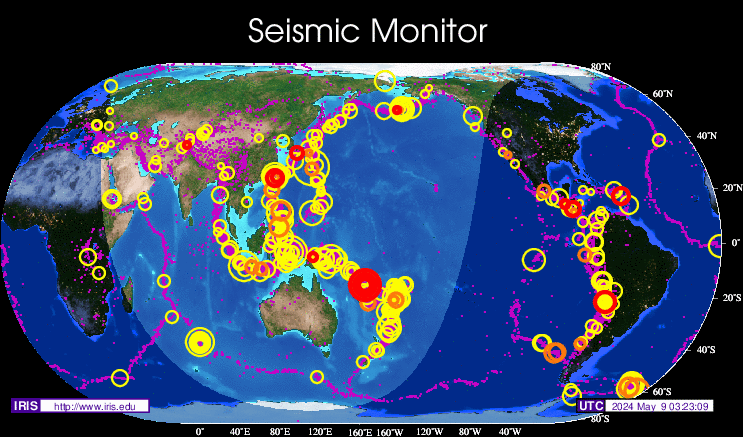
Seismic Map
What They Say About SDA
"Smalldeadanimals doesn't speak for the people of Saskatchewan" - Former Sask Premier Lorne Calvert
"I got so much traffic after your post my web host asked me to buy a larger traffic allowance." - Dr.Ross McKitrick
Holy hell, woman. When you send someone traffic, you send someone TRAFFIC.My hosting provider thought I was being DDoSed. - Sean McCormick
"The New York Times link to me yesterday [...] generated one-fifth of the traffic I normally get from a link from Small Dead Animals." - Kathy Shaidle
"You may be a nasty right winger, but you're not nasty all the time!" - Warren Kinsella
"Go back to collecting your welfare livelihood." - Michael E. Zilkowsky

The short version….lending money to people to buy a house who cannot service the debt is compounded by bundling these “sub-prime” mortgages together to pretend they are triple AAA rated financial instruments…
Net result, much like the crash of ’29 when stocks valued on margin….these financial instruments secured with nothing collapsed like a burst bubble…not rocket science.
The “Cummunity Investment Act of the Clinton regime was the basis for this….Bush tried to head it off but was blocked by a Democrat Congress with Barney Frank as head idiot….and, ACORN community organizer, Barry Soetoro suing banks for not making bad loans.
No mystery!!!!!
sasquatch, that is a good precis of all 33 pages of McKitrick’s presentation.
Of course, some Liberals like weird, et al,who makes comment to National Post articles, like to put all the blame on Bush.
Bush was just as responsible as Clinton for the real estate mess in the States.
Go to youtube.com and search “Home Ownership and George Bush”. You can watch his speech where he’s beaking off like a full fledged leftard.
“Bush was just as responsible as Clinton…”
What idiocy. What part of “The Community Investment Act of 1995” did you not understand? Did you even read McKittrick’s analysis?
“Bush was just as responsible as Clinton” isn’t an opinion, it’s a fact.
What? You never heard the term “The buck stops here”?
And don’t be such an idiot about it.
Did you watch the youtube video? Or would that disturb your narrative too much?
Not only did Bush do next to nothing to stop the economic recklessness, he poured his own brand of gasoline on to it.
And please don’t excuse him because that limp wristed bully named Barney wouldn’t let him. If he really wanted to, he could of changed the outcome of what has happenned, but he didn’t.
Quite fighting over who is or is not to blame. If you read McKitrick’s presentation, it says that Carter planted the seeds, Clinton watered it and helped it grow, Bush did not pull the weed and the results we know.
Carter planted the seeds, Clinton watered it and helped it grow, Bush did not pull the weed and the results we know. Posted by: Ken (Kulak)
That’s a good summary and poetic to boot. I’d only suggest you fit in a line about Clinton spreading his seeds.
Clinton banged a fat girl, E I,E I, O
And lets not forget about some of the other dirty players in all this.
The Bankers, the home builders, the realtors and many other vested interests were lobbying hard for these policies that were so toxic.
And last, but certainly not least, lets not forget about the “Me Generation” who wanted their money for nothing and their chicks for free,
NEW YORK (CNNMoney) — Food prices have been rising worldwide, as the cost of raw materials and agricultural products surge, contributing to political unrest around the globe.
In December, international food prices broke an all-time high when they rose 25% for the year, led by rising costs for staples like rice, wheat, and maize, the United Nations reported.
New York University economist Nouriel Roubini, told CNNMoney’s Poppy Harlow, at the World Economic Forum in Davos, Switzerland this week.
I happened to read Bush’s book, “Decision Points” over Christmas. The last chapter, “Financial Crisis”, explains his views in a general way as to what was happening. He also talks a bit about his relationship with Bernanke and Paulson, etc., and the politics involved.
When Bush signed TARP, the orignial bill did state that toxic assets would be bought up. Hovever, within a couple of days of signing the bill, Bush, et al, decided to buy into the banks and financial institutions directly. This meant that any institution that wanted to be bailed out had to issue a special prefered stock to the gov’t in return for financing. This did 2 things, it allowed money to be moved to the financial sector much faster, and it gave the gov’t a better opportunity to re-coup some of their (and the taxpayers) loses. A lot of people did not like this because it made gov’t an owner of the financial institution and this was unAmerican. The prefered shares, paid 5% a year dividend rising to 9%. The gov’t also received warrants to buy shares in the future at a very low cost. The banks, could buy back these shares at any time and many did. (Note that this is also how Britain handled the Bank of Scotland, how Spain and other Euro countries are handling their banks, and how Ireland screwed themselves by buying the toxic assets of Allied instead of a stake in the Bank.)
McKitrick is not correct in saying that the US bought up toxic assets based on what Bush says. McKitrick is sort of correct in most of his other analyses – for example the issue with China and other foreign ownership. Bush just looks at it from a different perspective including political and decision making points of view (ie. he has direct responsibility to fix it).
Bush used TARP funds to bailout GM and Chrysler. The reasoning here is different than for the financial sector stuff.
In certain cases, for example Bear Stearns (the first case), it was clear that the bank was way over leveraged independent of any law. It was poorly managed. However, they could not do the ‘moral hazard’ thing (i.e let them fail as a axample to others) because of the risk to the American and world economies and so the gov’t facilitated a buyer for them. Lehman Brothers went down although Bush says they tried to find a buyer for them (I have heard others suggesting that this was a ‘moral hazard’ thing to scare the other institutions).
It will be very interesting to read Bernanke’s book when he retires.
BTW, Bush’s book is pretty interesting because it is sometimes surprising as to why he did things the way he did and how he might handle things if he had to do it all over again.
Great paper. Nice to read Bernake behind that Boston Fed paper in 1992.
One other omission: 99% of the public (and financial sector) was blinded by euphoric expectations: nothing could go wrong.
Now let’s go back to the beginning.
Third party agencies (e.g. ACORN) earning $2,000 to find a disadvantaged, discriminated against individual to buy a house he/she couldn’t afford. And government regulations threatening to shut down banks who don’t offer enough mortgages to these people. How did we NOT see this coming?
This is like govt regulation in reverse, with an even more disastrous impact. As the actual cost of regulations is usually what burdens business. Here regulations stipulated NOT to perform due diligence, and thus reduced initial cost.
Behind this is the left shovelling money to the masses to buy votes. Recall that woman in 2008 who thought Obama would buy her a new home/car etc? Why didn’t he tell her about Clinton’s housing plan? O yeah, ’cause banks were now saying “F Clinton’s CRA amendments; we’re not going to lend to unqualified borrowers anymore! We’re going to verify income.” Those bastards!
We, the people, are to blame too. For wanting immediate benefit – electing officials who will give us $ now – in exchange for crippling debt, which they likely won’t even pay for. When I see public union protesters demanding pensions/wages; I think their signs should read “Get the $ from our grandchildren!! We need it now!”.
We, the people, are to blame too. For wanting immediate benefit – electing officials who will give us $ now – in exchange for crippling debt, which they likely won’t even pay for. When I see public union protesters demanding pensions/wages; I think their signs should read “Get the $ from our grandchildren!! We need it now!”.
Posted by: Dave in Mississauga at January 30, 2011 8:44 AM”
ummm, bingo !!!
9hero worship, hero worship, hero worship, hero worship !!!)
On September 29th, 2008, the US House of Representatives voted against the $700 billion dollar bailout bill proposed by treasury leading to an 8.8% decline in the S&P and a 778 point drop in the Dow, the worst ever recorded. Why did the house vote against the bailout bill?
On September 8th, 2008, Sarah Palin, a virtually unknown governor from Alaska, addressed the republican convention and gave a speech credited with breathing life into the McCain campaign. Over the next three weeks, the polls reflected this turn around showing McCain/Palin with a small lead by the last week of September. Internal polling showed that in spite of the economy, the war and George W. Bush, Obama/Biden were in danger of losing what should have been a shoo in.
Members of the house up for re-election had made a back room deal to accommodate the public’s dislike of the bailout bill. Those up for re-election, regardless of party affiliation, could vote against the bill while the rest of the house voted for it thus assuring its passage. This arrangement did not recognize the shifting presidential election environment. It was meant to provide a measure of stability to the financial markets and an orderly re-election of house representatives.
The leadership in the Democratic Party was panicked by the presidential polling. They made a decision to undermine the arrangement in the house regarding the bailout bill. Majority leader Pelosi stood up on September 29th, 2008 and gave an incredibly partisan speech that was so vile, the majority of the republicans made a decision to vote against the bill regardless if they were up for election. This meant that the bill would only pass if the Democratic majority voted in favor. When faced with the prospect of potential defeat at the polls or undermining confidence in the financial markets, they chose the latter to save their own skin and skew the perspective on the presidential election.
On October 3, 2008, the house passed a “revised” bill but the damage had been done. It contained essentially the same provisions but there were some modifications best characterized as window dressing. By October 15th, polls reflected a 6 to 10 point advantage for Obama. The public had shifted their position on the economy and placed blame for the melt down on the republicans with McCain bearing the brunt of this shift. All of this I attribute to the Democratic Party’s decision to risk the world’s financial system to elect Obama. However, credit also has to go to the Republicans who ran a spectacularly awful campaign and John McCain in particular for his deployment of Palin and his decision to make Reverend Wright a non-issue. Proper tactical use of these could have made a difference but we will never know.
People who will risk everything that everybody owns so that they can gain and maintain power are wicked. Actions like this bring into question whether they did not know the effect of what they were doing or they did. If they did not know, they are stupid and incompetent and should never be anywhere near the levers of power. If they knew the damage that their actions would bring and did it anyway, they are evil and should never be anywhere near the levers of power.
beagle>
“We the people” also flooded our markets with millions of food, housing, oil & gas consuming third world people of low skills to no education. 45+ million nonproducing food stamp citizen recipients are only the tip of the iceberg.
How long do you people think this unsustainable unproductive growth can continue?
Actually, it is not “we the people” that created this mess. It’s “you the people” who wouldn’t listen to reason and pushed political correctness and racists slurs against anyone who expressed rational concerns by way of logic, mathematics and historical precedent.