Brian Zinchuk on Evan Bray Show: Coal, CO2 and what it means for oil production, wind in Alberta, Trans Mountain Pipeline Expansion, and a pile of listener calls. (Link is fixed)
Wind turbines won’t be allowed near mountains anymore. And when these reach end of life, those sites won’t be rebuilt with new, larger ones, if these rules stick.
Don’t block our mountains or mess with good farmland: #Alberta releases renewable power rules. And reclamation is going to be paid up front. This story is the full meat, potatoes, gravy and carrots on Wednesday’s wind and solar announcement.
And what’s the pool at for Trudeau resigning today? It’s 40 years to the day since daddy took his “walk in the snow.”
Second day in a row, Alberta’s wind power utterly collapes. Had to relearn how to interpret scientific notation for this one. What does 6.694934166480696e-4 mean? Something like 0.07 per cent of nameplate output? Fool me once, shame on you. Fool me 42 times, shame on me, as only 3 of Alberta’s 45 wind farms produced power at points of Monday night
A few weeks after Alberta’s grid was on the brink, renewables again bottom out, but no crisis this time. Good thing it was -6 C instead of -35 C, eh? And solar didn’t do much either, because a. it snowed and b. the sun went down. Imagine that.
After a weekend of power shortages, Notley takes credit for getting rid of coal-fired power and building wind and solar. Because of course she did. Not sure when it was filmed, but there wasn’t a hint of shame that she was largely the cause of what happened over the weekend.
The past weekend proved to be a close-run thing for the Alberta electrical grid, and Saskatchewan Premier Scott Moe is making statements resolving he won’t allow that to happen here.
Specifically, after having nearly completely divested itself of coal-fired power production, Alberta’s dramatic buildout of wind and solar proved impossible to keep the lights on in that province when the chips were down and temperatures hit -35 C, or worse.
Also note: Saskatchewan has about a million cars registered. So a good bet is Alberta probably has four million. What would have happened if four million EVs were all plugged in last weekend?
If you missed them, these five stories, in order, chronicle what happened in Alberta.
For the third day in a row, Alberta went into an electrical grid alert on Sunday. At one point it had no contingency reserve left at all, but imports from BC appeared to save the day. While it looked a little hairy there for a bit, there was no emergency alert declared, unlike Saturday.
Did I mention before that Alberta has more coal, oil and natural gas than God? Because guess what? It still does.
It was the second evening in a row Alberta saw “grid alert” issued, but this time, it was a much closer-run thing.
Alberta’s electrical grid was in such peril of falling into rotating blackouts on Saturday night, the provincial government urged people to even turn off their bathroom fans, among other things.
Alberta went under grid alert for just under 5 hours on Jan. 12. And yes, the AESO suggested people shouldn’t run their dishwashers. Alberta has more coal, oil and gas than God, because God gave all his to Alberta, and people there shouldn’t have washed their dishes lest the lights go out. That is no word of a lie. I was up all evening monitoring it, as you’ll see in the story.
It looks like Trans Mountain might, indeed be allowed to finish the darn pipeline in weeks instead of years. That is, unless they find another hummingbird on the right of way. The Canada Energy Regulator apparently removed its head from its posterior.
The story originally said five days. SaskPower got back to me and noted the streak continued Jan. 7 and 8 as well. So that’s a whole week with wind flatlining. Total, complete flatline for part of the day, each day. How do you power the hospital my wife is an ER nurse at with zero power? Inquiring minds would like to know?
Bonus points for Quick Dick’s instruction on how to use the box from a Pilsner 2-4 for a winterfront. Nothing says Saskatchewan like a Pil box on your pickup
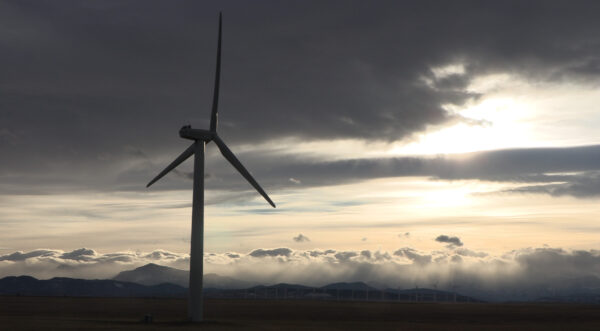
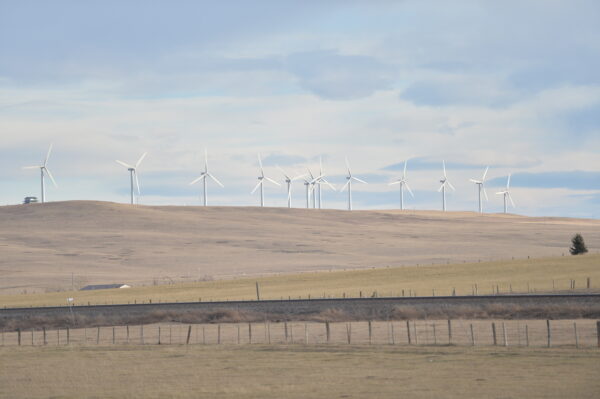
Wind turbines near Pincher Creek, Alberta. Photo by Brian Zinchuk
It’s starting to get cold out. The sun was down and Alberta’s wind power generation fell to next to nothing last night – less than half a per cent capacity.
Meanwhile in Saskatchewan, we’ve had several days of minimal wind power generation.
Zero reliability, this wind thing. And I had to start wearing my parka this week, too.
Put our trust in wind, and we’ll all freeze. In the dark.
Also, switching to third person:
Pipeline Online editor and owner Brian Zinchuk is back on the air with CJME/CKOM’s Evan Bray Show. He was on the air for a full hour on Wednesday, Jan. 3. Here’s the podcast of that appearance, including responses to several calls. One was on whether or not the Trans Mountain Expansion will ever be finished. (With the ads and news breaks removed, it’s only 35 minutes).