

Deerfoot Trail

Glenmore Trail
Thanks to reader Larry Weber for the photos. (The Glenmore underpass looked like that last time I was in Calgary, come to think of it.)
The Civil War In Four Minutes Whoops!
Sorry about that! In the interval between writing this post and the software auto-publishing it, the link went dead.
My apologies for the confusion.
So instead, a photo of new Champion Minuteman Death Valley Days, who was the reason I was pre-writing posts in the first place. He finished his title in Winnipeg on Friday.

When the second dog with me (a friend’s) also completed his title yesterday, I was able to pack up and head home early. Finally pulled over near Indian Head last night to crash for a few hours, and I’m still a bit buzzy – so there won’t be anything new from me for a few more hours.
Elk Crossing

Victoria Day
Adventures In Ammo Shopping
WOMAN IN LINE (looking at the 10 boxes of ammo I’m carrying): I can’t believe they let you just carry that through the store.
ME: Well, the last time I drove up to the ammo counter they told me to leave my car outside from now on.
Via Clayton Cramer.
Lower Taxes Or Reduce Global Warming?
“That’s a lot of fire”
There’s a shotgun in the “survival kit” of every Soyuz spacecraft – added, the story goes, after a Soviet astronaut crew landed in a remote area to find themselves fighting off wolves.
 |
|
If the book is as entertaining as this Quirks and Quarks interview with author Chris Jones, it’s worth checking out.
mp3 (8.3 megs)
Sign Of Support
MYTISCHI, Russia (AP) – Erik Staal scored 23 seconds into overtime Sunday to give Canada a 4-3 victory over the Czech Republic, but the point earned by reaching overtime still was enough to advance the Czechs to the quarterfinals at the world championships. […]
Tomas Plekanek put the Czechs back in the lead on the power play at 12:05 of the second period, but Staal made it 2-2 by beating Cechmanek with a backhand at 3:22 of the third. Rostislav Olesz then knocked in a rebound to make it 3-2 for the Czechs at 6:36, but Shane Doan forced the extra period by shooting through Cechmanek’s pads at 10:57.
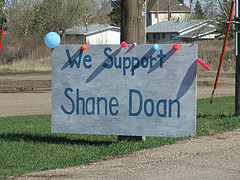
Photo courtesy Flaming Bear.
Boris Yeltsin
“They had to fool the people,” he told Sukhanov. “It is now clear why they made it so difficult for the average Soviet citizen to go abroad. They were afraid that people’s eyes would open.”
May he rest in peace.
A Modern Day Trail of Tears
“…but stickier.”
They need our help.
If You Can Read This
Archeologists have discovered the remains of two dozen children who were apparent sacrificial victims to a rain god by Mexican Indians nearly a thousand years ago, researchers said Tuesday.
The bones of the children, dating from about 950 to 1150, were found on the outskirts of the Toltec archaeological zone of Tula, said Luis Gamboa, an archaeologist with the National Institute of Anthropology and History. The discovery about 40 miles north of Mexico City predates the Aztecs, an advanced civilization conquered by the Spanish in the 16th century.
The bodies of the children, who ranged in age from 5 to about 15, were found in a single pit during excavations that began last month near a police station just outside the archaeological site.
All of the bodies were laid out in the same position — facing east — around a shrine to the god Tlaloc, leading archeologists to believe “this was something collective, done simultaneously,” in a single ritual, Gamboa said.
“They had some incisions on the vertebrae that suggested they had used some sort of (stone) to cut their throats,” he said.
Never Aggravate An Engineer

“You’d hardly know there is a war on only one hour away.”
If you’ve never been through a real middle-eastern market before, you’ve missed a wonder. Especially for those of us accustomed to shopping in strict rectilinear grids laid out according to the results of exhaustive market research. To add strangeness to the western mind, similar vendors are set alongside each other in Kurdistan, so competitors see each other. We normally avoid putting two grocers side by side, but here you have six or twelve all calling out for your business. Loudly.
The Hybrid
That might have made Dick Cheney President.
Property Rights In China

Now Is The Time At SDA When We Dance
(With apologies to the Flea.)
Jury Consulting
An art or a scourge? You be the judge;
Jury consultants hail from a variety of fields—business, law, marketing, communications, theater, statistics, but especially psychology. About half of all trial consultants are psychologists. Work can begin months before a trial with community surveys. Consultants may cold-call random people from the local phone book and ask them questions about their age, race, gender, religion, profession, and political views. Then they ask about their views on issues pertaining to the case and maybe their reactions to a brief case description. They’re looking for correlations between the two sets of answers.
Next they’ll pay a small number of people to participate in focus groups, where they actually test parts of their case—particular arguments, pieces of evidence, or witnesses. That furnishes detail on how different types of jurors react. On occasion consultants stage full mock trials with the lawyers and actors and then scrutinize the “jurors” as they deliberate.
Armed with a sense of which issues and which juror characteristics matter most to the trial, consultants draw up juror questionnaires and devise strategies for voir dire. Some question topics are straightforward: family, education, experiences with the justice system. Some are highly detailed: The questionnaire for the 2004 Kobe Bryant rape case asked, “How do you feel about interracial relationships?”, “Which of the following best describes your opinion of professional basketball players?”, and “Describe your exposure [to this case from each of the following media outlets].” Forms usually run a few pages, but can be much longer in big cases; the questionnaire in the O.J. trial ran 75 pages, with more than 300 questions.
h/t Maggies Farm
Stats Canada 2006 Census
Population and dwelling counts for Canada provinces and territories – 2006 vs 2001.
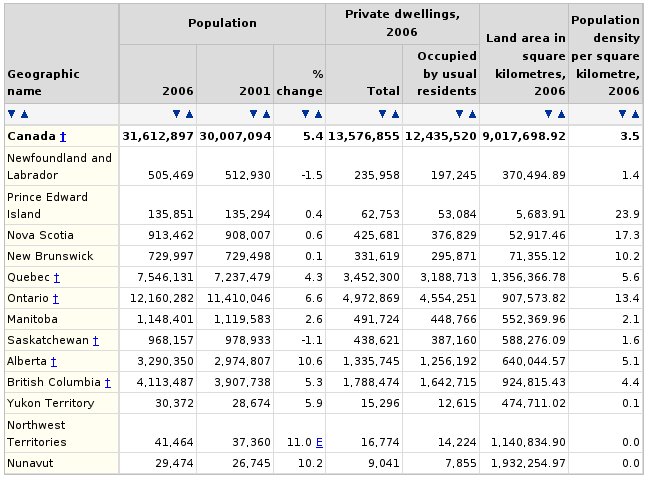
Main page here.
This is especially not good. The smaller and medium sized communities are bleeding population. While that may have been somewhat alleviated in the past year with growth in the resource industry, it’s nonetheless sobering for those who assume that the construction activity in Regina and Saskatoon signals a turn around for the province’s fortunes. What we are witnessing is population shift, not growth. And that’s not good unless you believe we should emulate the economic miracle known as “Wyoming”.
Which brings me to wish I were better with bar graphs. I’d be tempted to plot the 10,776 person decrease in overall population against the 6% increase in the number of civil servants on the province’s payroll since Calvert took office.
His Day In Court
Montague and his wife Donna were charged in 2004 for their deliberate refusal to comply with firearms paperwork which they believe to be an unwarranted threat to their freedom, privacy and property.
Calvin Martin QC will be presenting the Montagues’ arguments to Justice John Wright.
“After over a decade fighting Bill C-68 at all levels of government, we’re excited to present a strong case to strike this expensive, ineffective and contradictory legislation off our books” said Martin.
“This is very costly and personally draining” says Donna Montague. “We really hope the courtroom will be packed with supporters demonstrating the concern of average citizens.”
The hearing will be held at Superior Court of Ontario in Kenora, Ontario at 2:00 pm, Monday. (March 12)
Googlefight!
Warren Kinsella versus Antonia Zerbisias –> and the winner is… [click]
Small Dead Animals versus My Blahg –> and the winner is…[click]
The Two Stephs –> and the winner is… [click]
Colby Cosh versus Andrew Coyne –> and the winner is… [click]
Right versus Left –> and the winner is… [click]
Create your own Googlefights and post the results in the comments!