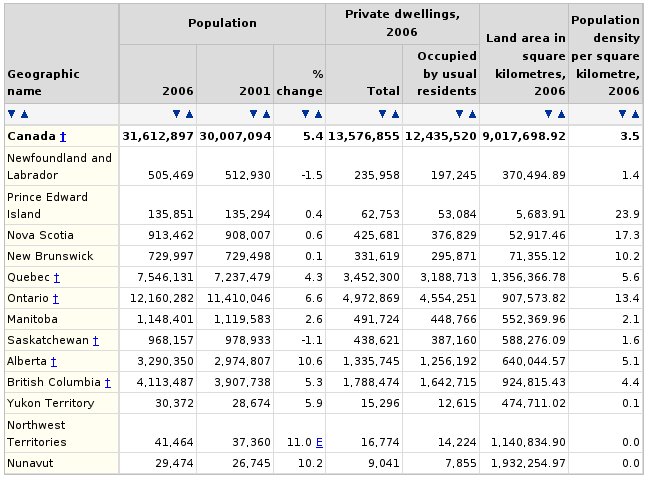
Population and dwelling counts for Canada provinces and territories – 2006 vs 2001.
Main page here.
This is especially not good. The smaller and medium sized communities are bleeding population. While that may have been somewhat alleviated in the past year with growth in the resource industry, it’s nonetheless sobering for those who assume that the construction activity in Regina and Saskatoon signals a turn around for the province’s fortunes. What we are witnessing is population shift, not growth. And that’s not good unless you believe we should emulate the economic miracle known as “Wyoming”.
Which brings me to wish I were better with bar graphs. I’d be tempted to plot the 10,776 person decrease in overall population against the 6% increase in the number of civil servants on the province’s payroll since Calvert took office.

Not so good, but also not too suprising.
I recall doing a bit of very sketchy research a couple of years ago while pondering the differences in US and Canadian voting habits, thinking that (in general) urban voters tend to be more liberal and rural types more conservative. (There was a discussion of that subject here at SDA back around the last election.)
I found a couple of websites with population data for the two countries, and what I found was quite an eye-opener. The fifty largest cities in the US (from New York at #1 to Wichita at #50) contain a total of about 16% of the overall US population. Meanwhile, the largest thirty Canadian cities (Toronto to Moncton) contain 66% – that’s two thirds – of the national population. Toronto alone contains 16%, proportionally equivalent to those top 50 US cities.
Moreover, the second site noted that this urban concentration is concentrated even more, with half the Canadian population living in four areas – the extended Golden Horseshoe in southern Ontario, Montréal and environs, British Columbia’s Lower Mainland and southern Vancouver Island, and the Calgary-Edmonton corridor.
Which means that if the process continues, this country risks devolving into what is essentially a loose alliance of city-states, with some shared colonial possessions.
Not such a wonderful thing, is it?
check out this research:
http://www.crerl.usask.ca/research.php
it’s not brain surgery – it’s a whole continent of demographic shifts. it’s not based on political ideology but rather the basic industries that have traditionally garnered steam in rural areas in North America.
Fascinating. Not only are we a loose alliance of city states, but these cities are primarily all located within 160 km of the US border.
Notice how Saskatchewan’s population density of 1.6 per sq km, is one of the lowest (not counting the far north). Only Nfld is ‘slightly lower’ at 1.4, and both of them are losing population.
Notice also that Quebec’s population is relatively stagnant, with a population density comparable to that of Alberta, BUT, Alberta, with one-half the land mass of Quebec, has seen an enormous growth.
Notice also the high density populations of the Maritime provinces, which tells us that, possibly, they’ve reached ‘carrying capacity’.
I think Kate has a point, the increased bureaucracy in Saskatchewan is somehow linked to its decreased productivity (same as in Quebec).
How many generations before we are required to follow Sharia Law?
Tighten up Muslim immigration rates and increase European rates.
Western civilization is at risk The UK is closer to the tipping point than we are so is France, but it is coming.
Governments have used quotas before and they can use them again.
One of the really BAD situations evident in the data is the census by federal electoral district:
http://www12.statcan.ca/english/census06/data/popdwell/Table.cfm?T=501&S=1&O=A
See how lots of urban ridings in Ontario, Alberta and BC are underrepresented, but ridings in Atlantic Canada, Quebec, Manitoba and Saskatchewan are overrepresented… THIS needs to be fixed.
Driving through Calgary I can’t help laugh when I see the billboards advertising “Saskatchewan, rush hour is 15 minutes and there are [really, I mean really, don’t mock me] good jobs here too.”
That’s right, give up your six figure job in Calgary for something on the order of $30k a year in Saskatchewan. You’ll have the satisfaction knowing that 30% of your income is going in to the trough of the unions and tribal reserves. Doesn’t that warm you heart?
Interestingly enough the provincial governments of Sask and Ont seem to be encouraging people to move to the cities. In Ontario, the government jsut recently announced it is changing drug coverage funding, which will, in effect, close 300 small town pharmacies, thereby forcing people to go to the cities for their drugs. Sask is currently discussing closing rural schools in one area and bussing students to the cities. This causes a mass shift to the cities. What the hell happened to Global Warming–we are being forced to commute further and further thus producing more CO2–wish our governments could get things straight.
With the exception of greater Saskatoon, greater Regina and a few northern places (large native population, higher birth rates), almost all the other SK areas are declining. Surely, this is the continuation of a trend that started at least 50 years ago. Why? The mechanization of farming. No local jobs. And, you can run a farm located near the Battlefords just as easily from Saskatoon as you can from near the Battlefords.
By way of contrast, with the exception of a handful of northern places, almost all ON areas show increases. But this is largely fuelled by immigration, which is why the Golden Horseshoe is booming. Statistics Canada says it will have a further report on internal and external migration in a few weeks. It should clear up a lot of this.
Well I didn’t think I’d get a chuckle out of a census table, but check out the density in Nunavut: they’re evidently having “none of it” with a pop. density of 0.0 persons per sq km. Perhaps the stat needs to be changed to # persons/1000 sq. kms to get a reading so that Nunavut can have some of it.
TechBard is quite correct; Ontario has 38% of the population but only 34% of the seats. At 4.1% under-representation, it has the largest deficit. Alberta and BC are at 1.3% each; every other province, including Quebec, is over-represented.
Why should PEI have 4 seats, with an average of 33,000 citizens per seat, while Ontario, Alberta, and BC have more than 110,000 citizens per seat? Is my vote in Ontario only worth one-quarter of an Islander’s vote?
And the most over-represented province? Sorry, Kate, but it’s SK with 3% of the population but 4.5% of the seats.
I wish some of the people who post anti-Toronto comments here can understand why we get ticked off mightily when we a) provide huge amounts of equalization payments, and b) have personal votes worth less than any other province than AB (I can understand why Albertans get ticked for the same reasons). We’re paying the freight, but we don’t get the same say proportionately as everybody else.
This is going to be interesting for Electoral redistribution. Hard to justify letting Saskatchewan have continue 14 seats when it population is just slightly larger than Nova Scotia with 11 seats and its not even close to Manitoba any more. Alberta and B.C. should be screaming for seats. It is going to be fun.
ET, this is one of the rare times I have to disagree with you.
Look at the Quebec numbers again. In absolute terms, they added just barely less population over the 2001-2006 timeframe as Alberta (309K vs 316K). That is not stagnant; the Maritimes are stagnant, with each of the three coming in at less than 1%. Alberta’s % figure comes out much higher than Quebec’s simply because they start from a lower figure. Quebec still outnumbers the combined total of AB & BC, in fact, which is politically significant; there won’t be a great westward shift of political representation based on these figures.
The alarming figure from the numbers released today isn’t on the chart. It’s the figure 1.2 million – the number of immigrants in the 1.6 million population growth. This represents a potentially huge demographic shift in the makeup of the country, and the MSM hasn’t once that I’ve read or heard today questioned whether this is in Canada’s best interests in the long term.
Re: Seats and population
The problem is that neither the House nor the Senate properly reflect Population. The Senate needs to be reformed into an elected (or even partly elected, partly nominated by premiers) institution with equal representation for each province – say 8 Senators per province and 2 for each territory. Then the House needs to be truly representative of population. I mean, why on earth should the whole dynamic and growing west have less Senate representation than the slowly dying Atlantic or the same as the stagnant Quebec?
Doug — regarding the urban vs rural divide compared to the US, especially how concentrated we are supposed to be in certain cities.
I would not count on these stats to tell you this. The reason for this is that Stats Can tended to use pretty broad categories to determine cities in Canada. For example, if you look at the stats you won’t see Burlington or Oakville in there. They just lump them in with Toronto. So take NYC as an example — to do the same thing there, they would have to throw in Hoboken, White Plains, Newark, etc, etc. Unless, the stats you were looking at did that, it’s not a useful comparison.
Same with San Fran, Chicago, etc — the actual municipalities do not have large populations but the whole area does. So it comes down to a fairly arbitrary decision to determine how concentrated we are in specific cities.
Great link to “the Wyoming economic miracle” Kate!
Your government employment numbers are wrong.
The increase is actually substantially larger then 6%.
From the Third Quarter of 2001 to 2006 according to Stats Canada, our government employment increased 33%. From 107226 in The fall of 2006 to 142802 in the winter of 2006.
This includes full and part time and all sectors of government including local and federal.
http://www.statcan.ca/Daily/English/011213/d011213c.htm
http://www40.statcan.ca/l01/cst01/govt62e.htm
compare
Lloydminster SK +3.5%
Lloydminster AB +21%
(from statscan site)
I don’t know the area but I suspect there is a reason why the AB side is booming.
ian in ns – I agree with you but the point is, that Quebec’s population has stagnated over a long period of time, while Alberta and BC have grown. Go to stats canada.
The 3w. statcan.ca/Daily/English/061221/d061221d.htm
As well, in a stats.can comparison of 2001 and 1996, Quebec’s population growth was only 1.4. Alberta’s was 10.3, and BC was 4.9. Certainly, Quebec has finally, after years of stagnation, started to move, but I don’t think it can compare with the West.
What Quebec has to do, is get out of its socialist welfare structure, which is dependent on the federal trough, and start to be more fiscally independent, capitalist and entrepreneurial. It is slowly, slowly, starting to realize that. I’d say, also, that the era of ‘separatism’ is over in Quebec, and a new era is emerging IF it can move out of a dependent socialism. The next few years are vital.
As for the inequality of the House representation, I’ve been ranting on that for years. Quebec has 75 seats guaranteed, while BC and Alberta, with effectively, statistically, the same population, only have 64 seats. That’s why Quebec is such a lynchpin for gov’t and why Harper has to cater to Quebec – until the House seats are changed to valid representation.
Actually, ian, the MSM has been commenting on the fact that Canada’s growth in population will more and more be based on immigration. That’s another interesting scenario. Quebec, for example, has just about the lowest immigrant ratio in the country; almost 95% of immigrants in Quebec can be found only in Montreal – and even that city has less than, for example, Winnipeg. (There are statscan sites on these figures).
To Kevinb
One of the main reasons why there is such an anti-Toronto bias here is because, underrepresented or not, the GTA still keeps sending mainly Liberals to Ottawa. Maybe if that changed we might have a hope of getting some fairness into the system.
The other reason for Toronto bashing is because it is so much fun.
“raprezanting piples per seat in diz county, I do nowt see diz as a problem for kay bec ” borat dion , “dis is base on the two tousand and wan censis”
Newfoundland and Labrador 73 276
Prince Edward Island 33 824
Nova Scotia 82 546
New Brunswick 72 950
Quebec 96 500
Ontario 107 642
Manitoba 79 970
Saskatchewan 69 924
Alberta 106 243
British Columbia 108 548
Nunavut 26 745
Northwest Territories 37 360
Yukon Territory 28 674
“””””One of the main reasons why there is such an anti-Toronto bias here is because, underrepresented or not, the GTA still keeps sending mainly Liberals to Ottawa. Maybe if that changed we might have a hope of getting some fairness into the system.””””
well now,you didn’t expect us’n Ontario conservatives to vote for Mister Seadoo now did you????
you quit trying to put ministers in power and we’ll all be on the same page
“The smaller and medium sized communities are bleeding population”
Good for buyers winding down a career and shopping the small towns for diggs out of the bat race in the urban areas…I can buy there and put money away after selling an urban property…we are seeing this trend in a lot of rural Canada as the small towns and villages become retirement communities
Stats Can has confirmed what happens when you live under years of Socialism/Communism as we do here in Sask. Sask is a welfare state with a penchant for mediocrity, despite sitting on natural resource wealth greater than Alberta’s.
The NDP are killing this province. When the gov’t is the largest employer and the number of people living on gov’t largesse is ever increasing, you wonder why the NDP is the natural governing party.
Moving to Sask. is ridiculous unless you are on Social Services, Aboriginal, retired, or have made your fortune elsewhere. Our land and house prices are moderately expensive. However, Sask. is seriously lacking in jobs for those who want a career. There are many jobs to be had but mainly in retail or the service industry where the pay is $8-$10/hr. We do have a shortage of skilled trades people who are decently paid.
Sask. is not a place to move to until the Sask. Party has had at least 10 years to reverse the NDP death sentence of the last 50 years.
Well this confirms for me that long winter nights make for a population explosion. (Yuko and Nunavut)
The provinces east of ON =9.7 MM
the provinces west of ON = 9.5MM
Another five years and the balance will have finally shifted to the West.
ET: The NL pop. figure is a bit distorting. Lab. is 270,000 km of the 370000 km total. And half of the interior of Nfld. is uninhabitable barrens.
The move to urban centres has been going on since the invention of steam power and will continue to. The back wash of people moving to well-serviced (i.e. hospitals and schools) rural towns will accelerate and it may be possible to determine this in the census stats – I haven’t looked yet. Employing market distorting policies to keep people on the farms or in the woods is folly – just look at what the EU has created in its ag sector.
Kate and all of us should be celebrating the free-movement of people and pushing for more liberalized ag policy (ending the CWB and supply-management) so that those who remain in the ag sector are amoung the world’s most prosperous and productive.
The demographic moves are all about productivity. 100 years ago most people were involved in farming. Today its only a few percent. 50 years ago almost half the population was involved in some aspect of manufacturing, today its less than 15% and shrinking. The point is fewer people are producing more food, lumber, fish, oil and minerals. This is why rural areas are shrinking.
Contrary to what the environmentalists are telling you, today there is actually more forest and natural land than there was 100 years ago when farmers ruled. Farming is basically a very environmentally destructive activity as it clear cuts huge areas of land and replaces it with a monoculture. Modern farming uses much less land and gets much higher yields. Organic farming gets lower yields and hence is much more destructive to the habitat as more land must converted to farms to produce the same amount of food. In BC we have hot house farms that grow produce 12 months of the year in greenhouses – a very high yield per acre. The most important input is cheap energy.
I live in Swift Current. Go to http://www.swiftcurrentonline.com. That website dubs Swift Current as a “city on the grow”! Woowee!!! Since 2001 we have grown by a whole 135, an average of 23 persons a year! WOW!!! In the meantime our per capita debt has absolutely skyrocketed! All this by a really socialist city council that believes you can actually spend your way to prosperity. Their motto is”if you build it they will come”. Here in Swift Current we are bracing ourselves for absolutely massive increases in the city portion of the mill rate.
I moved to this city in 1971 and the population then was some 15,000. Today the number is slightly lower than that. Sheeesh!
And don’t you find it interesting, that with five million less in population than Ontario has, Quebec has twice as many government flunkies?
(And that does not include the ones they ship to Ottawa, and across Canada?) Wow!
Census. It is posts like this that makes Kate’s sda so relevant, so topical, so important, and so revealing.
Kate can get everyone to THINK. Even if one does not always agree, most will think.
Perhaps the biggest reason why rural pops are declining in Canada; Grain farming is a driver of prairie rural population trends.
100 years ago, European poverty stricken cities sacrificed a lot of their people to the Canadian prairies, the breadbasket of the world. These immigrants and the prairie soil saved much of the world from starvation. Especially during the two World Wars.
Farm machinery is a major driver of the required number of farmers. In the last 50 years, tractors have increased from 40hp to 400hp. 10 fold.
Virtualy 10% of the operators can now perform the task of supplying the world with food. The most important profession of all. Sad, but true, for rural Canada.
“Grain farming is a driver of prairie rural population trends.”
One of the little known facts of Saskatchewan is that agriculture has been surpassed by a number of other industries in terms of the province’s economy.
An even lesser known fact is that agriculture remains the largest employer.
See my previous comment about Wyoming.
The latest census also showed that Canada is fast approaching the day when all our population growth will be reliant on immigration.
Without immigration, our population would be stagnant. And so would our economy. And so would our pension plans. No one to fund the retires.
Also, by 2040-50 Canada’s population will probably decline. So will everthing else. GDP, pension payouts, housing starts, govmit revenue, required teachers, …
If one wants to see how it may all turn out read “America Alone”, by Mark Steyn.
Wyoming link not working ??
If ag surpassed by other sectors, but remains the largest employer, does that mean ag is far less efficient at generating wealth ??
If true, is it because ag has to compete on the world stage with patheticaly huge, rich subsidizers such as France, Japan, USA ??
“.. ag remains the largest employer”.
Because of all the civil servants ??
The reference to Wyoming eludes me. My wife and I travelled through the Pinedale area in the summer of 2005 and found it difficult to find a place to stay because virtually all of the accommodations were being rented by oil and gas workers.
From the Casper Star-Tribune of April 2005:
Unemployment rate lowest in U.S.
For the first time in more than 20 years, Wyoming registered the lowest unemployment rate in the nation during February, an analyst for the state Department of Employment announced Thursday.
The state’s seasonally adjusted rate fell from 3.4 percent in January to 2.9 percent in February. The U.S. unemployment rate for February was 5.4 percent.
The last time Wyoming had the lowest unemployment rate in the nation was March 1982, and the last time the state rate fell to 2.9 percent was November 1979.
“Natural gas drilling especially, and other mining activity, is really driving the job growth, and job growth seems to be pushing down the unemployment rate,” said David Bullard, senior economist in the Research and Planning Section, state Department of Employment.
Even as the unemployment rate declined, the state’s civilian labor force grew, increasing by 2,895 people, or by 1.0, from the level attained in February 2004. The civilian labor force is the sum of all employed and unemployed people.
So what am I missing here? Other than having worse weather than Saskatchewan, what exactly going wrong in Wyoming?
The lack of growth in NL an SK should precipitate the resignations of Danny Williams and Calvert. Talk about squandered opportunity…
If Canada wants to consider reform of it’s National Government to more equitably share power among the provinces, you may want to closely examine the Australian model.
Australia is similar to Canada in that it’s a large country with a relatively small population concentrated in a few cities and two of it’s states.
Australia’s Constitution enshrined a delineated sharing of powers between the National and State Governments. There’s a bicameral federal Parliament, with a Senate and Commons, both of which are elected by the people. The Senate has the same fixed number of Senators for each of the States, whereas the Commons is based on population proportionality. The powers are shared – balanced – between the two Houses of Parliament.
All these features form a system of checks and balances. They have enabled Australia to avoid a “tyranny of the majority”, such as in Canada in which Ontario and Quebec essentially control the National Government by virtue of their combined majority of Commons seats.
The Australian Constitution can be read at http://www.australianpolitics.com/constitution/
Fritz: “Contrary to what the environmentalists are telling you, today there is actually more forest and natural land than there was 100 years ago when farmers ruled”
Not to take the side of environmentalists, but almoost all of northern Sasktchewan farmland was forest 100 years ago. Many of the communities were founded during the thirties when people abandoned/sold their farms in southern Saskatchewan and moved north to get out of the dust. Literally hundreds of thousands of acres of forest were cleared for sustainable farming.
None of that land had returned to forest the last time I was there.
How are you gonna keep ém on the farm when they’ve been to gay Paree?
Alberta should just buy Saskatchewan, lets see now…..
8 Billion dollar surplus, 968,000 residents….
That works out to a little over 8,000 per resident.
We could call it “Ralph bucks” in honour of our past premier, or “Ed bucks”.
We promise to get rid of your PST,reduce your tax rate, and pay off your debt, but you will have to implement daylight savings time and make giant snow piles in the winter so the folks moving over won’t get too home sick.
My trackback isn’t showing up. Maybe the filters are too strong.
Since we brought in the SAM CANADIAN wheat board the rural pop has dropped continuously.
Gosh look our population went up and people say we need immigration to stop it from falling.
Funny we had to do that in 1967 when our pop was 20 million and we’ve got it way up just in case it falls. And if it falls and homes were as affordable in Toronto as Regina well that would be bad for Canadians.
The NDP (Naturally Depopulating Party) is trying to put a positive spin on the falling population in Saskatchewan. Good luck with that Lorne.
I want first nations people to be happy, healthy, highly educated, prosperous and fully enfranchised Canadians on every level.
Having said that, I would like to know how the Saskatchewan based first nations population has increased so we have a better idea of the net out migration statistics of non-first nations people.
If the first nations people have increased by, say, 30,000 people then the out migration is much higher than the statistics might indicate at first blush.
It would be interesting to know how many people paid income tax in Saskatchewan in the previous census compared to the most current census.
It would also be interesting to know how many net income tax payers there were in Saskatchewan in the previous census compared to the most current census. By this I mean the change in non-government paid employees in the previous census compared to the most current census.
Sorry John – the trackback function here is hopelessly borked.
What’s a net income tax payer, EWS? You mean gov’t paid employees don’t pay income tax?
Forgive my ignorance, but why do they say “Land area in square kilometres, 2006”? Is it really different from the land area in square kilometres from, say, the 1980 census?
Posted by: devine at March 14, 2007 11:17 PM
Of course government employees pay tax. That was certainly not my point. to the contrary, I think government employees, thanks to the close relationship between unions and the NDP are generally exteremly well paid and are often in the top two highest tax bracket.
I would like to know the number of Saskatchewan tax payers who do not earn their salaries from tax paid by other Saskatchewan residents. It is certainly not the only useful metric but it is useful metric in provinces where there MAY be a disproportionately large number of government paid employees.
Eyes, it certainly depends on the area of government though. There are government funded employees managed by boards other than cabinet.
EWS, what is your point? Are gov’t. employees paid less in jurisdictions unfriendly to unions, say Alberta, for instance?