Why this blog?
Until this moment I have been forced to listen while media and politicians alike have told me "what Canadians think". In all that time they never once asked.
This is just the voice of an ordinary Canadian yelling back at the radio -
"You don't speak for me."
email Kate
Goes to a private
mailserver in Europe.
I can't answer or use every tip, but all are appreciated!

Katewerk Art
Support SDA
Paypal:
Etransfers:
katewerk(at)sasktel.net
Not a registered charity.
I cannot issue tax receipts
Favourites/Resources
Instapundit
The Federalist
Powerline Blog
Babylon Bee
American Thinker
Legal Insurrection
Mark Steyn
American Greatness
Google Newspaper Archive
Pipeline Online
David Thompson
Podcasts
Steve Bannon's War Room
Scott Adams
Dark Horse
Michael Malice
Timcast
@Social
@Andy Ngo
@Cernovich
@Jack Posobeic
@IanMilesCheong
@AlinaChan
@YuriDeigin
@GlenGreenwald
@MattTaibbi
Support Our Advertisers
Sweetwater
Don't Run

Polar Bear Evolution
Email the Author
Wind Rain Temp
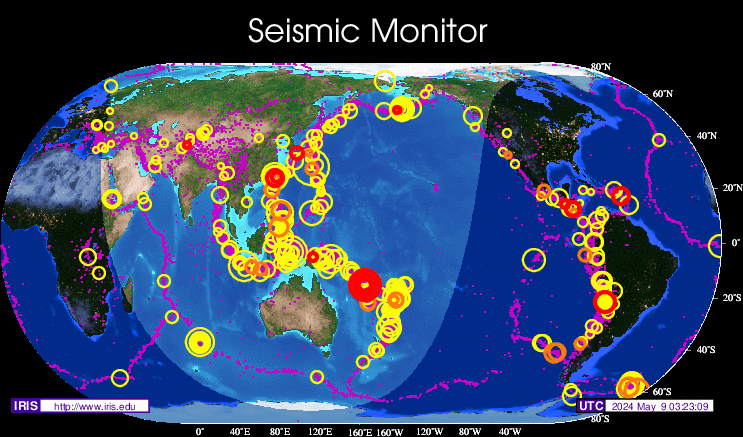
Seismic Map
What They Say About SDA
"Smalldeadanimals doesn't speak for the people of Saskatchewan" - Former Sask Premier Lorne Calvert
"I got so much traffic after your post my web host asked me to buy a larger traffic allowance." - Dr.Ross McKitrick
Holy hell, woman. When you send someone traffic, you send someone TRAFFIC.My hosting provider thought I was being DDoSed. - Sean McCormick
"The New York Times link to me yesterday [...] generated one-fifth of the traffic I normally get from a link from Small Dead Animals." - Kathy Shaidle
"You may be a nasty right winger, but you're not nasty all the time!" - Warren Kinsella
"Go back to collecting your welfare livelihood." - Michael E. Zilkowsky

So by cutting off the blood supply, oxygenated blood does not flow, hence suffocation.
That’s pretty stupid.
Before: We thought they squeezed prey to death.
After: We still think they squeeze prey to death.
No wonder the MSM gets away with such shenanigans.
“cutting off the blood supply”
Saskatoon’s mayor Charlie Clark “City facing a potential financial crisis” after the provincial budget slashed millions. Well lefty Charlie Clark this is what happens when socialists run out of other people’s money. Suck it up and start some waste cutting.
We live along a city bus route and city buses run as empty as STC!!!
So Socialist economic policy acts on a country’s economy like a Boa on a rat. Got it.
Thank you for sharing this. Would you say there was a 95% scientific consensus on constrictors cutting off ventilation as a means of killing their prey? I think that implies this new stuff must be wrong.
@smitherenzes: No, dead wrong. Cutting off the blood channels disrupts the heartbeat, which causes death quickly. Cutting off ventilation affects oxygen in the blood, which is a slower way to kill. Evolution at its finest!
So why the sound of crunching bones when one wraps around its prey?
When someone cuts off the blood flow to your brain through a good choke hold, you have only a few seconds before you black out, and perhaps a minute before you have permanent brain damage. This demonstrates the power of constricting the blood supply.
All I know is that Al Gore has suffocated REAL science. He has both cut-off its blood supply (money), and restricted its breathing (media propaganda)until GENUINE science is DEAD. Only the SNAKES who purvey JUNK science are left slithering through the halls of our Universities and Government Science Agencies. Yes, as a matter of fact … the SWAMP … IS … a favored environment for the reptilian JUNK scienci-tists.
… it is very likely that it was the increase in the CO2 content of the atmosphere, to levels above 250 ppm, that created the conditions for the plants that served as food sources to humans to thrive, and that made it worthwhile for humans to spend the time and energy in cultivating crops, which then allowed for the creation of cities and much more complex social orders. Prior to reaching this turning point, it was more efficient for humans to let wild animal species forage for the more limited vegetative offerings available, convert the plant material to protein and fat, and harvest the animals. Until about 8000 years ago, the human diet was composed primarily of meat from wild animals, supplemented with nuts, berries, mushrooms, and fungi in the local area. The transition from hunter/gatherer to agriculturalist was not necessarily a one-way process. Climatic changes could have necessitated a return to past methods when necessary for survival, such as occurred during the Younger Dryas.
https://wattsupwiththat.com/2017/03/24/effect-of-atmospheric-co2-concentrations-on-early-human-societies/
Phew, that’s a relief.