Why this blog?
Until this moment I have been forced to listen while media and politicians alike have told me "what Canadians think". In all that time they never once asked.
This is just the voice of an ordinary Canadian yelling back at the radio -
"You don't speak for me."
email Kate
Goes to a private
mailserver in Europe.
I can't answer or use every tip, but all are appreciated!


Katewerk Art
Support SDA
Paypal:
Etransfers:
katewerk(at)sasktel.net
Not a registered charity.
I cannot issue tax receipts
Favourites/Resources
Instapundit
The Federalist
Powerline Blog
Babylon Bee
American Thinker
Legal Insurrection
Mark Steyn
American Greatness
Google Newspaper Archive
Pipeline Online
David Thompson
Podcasts
Steve Bannon's War Room
Scott Adams
Dark Horse
Michael Malice
Timcast
@Social
@Andy Ngo
@Cernovich
@Jack Posobeic
@IanMilesCheong
@AlinaChan
@YuriDeigin
@GlenGreenwald
@MattTaibbi
Support Our Advertisers

Sweetwater
Don't Run

Polar Bear Evolution
Email the Author
Wind Rain Temp

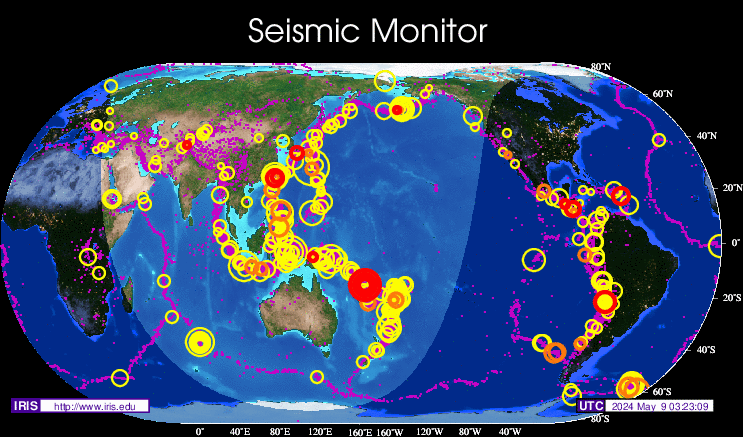
Seismic Map
What They Say About SDA
"Smalldeadanimals doesn't speak for the people of Saskatchewan" - Former Sask Premier Lorne Calvert
"I got so much traffic after your post my web host asked me to buy a larger traffic allowance." - Dr.Ross McKitrick
Holy hell, woman. When you send someone traffic, you send someone TRAFFIC.My hosting provider thought I was being DDoSed. - Sean McCormick
"The New York Times link to me yesterday [...] generated one-fifth of the traffic I normally get from a link from Small Dead Animals." - Kathy Shaidle
"You may be a nasty right winger, but you're not nasty all the time!" - Warren Kinsella
"Go back to collecting your welfare livelihood." - Michael E. Zilkowsky

Too bad for the Back to Nature freakos but old maw nature dont play favors like the tree huggers/granola munchers thenk she done
What part of the word Pest-i-Cide do they not understand?
Pesticides kill insects, period stop. If organic pesticides do not kill insects, then they are not pesticides, just another organic scam.
The adverse affects were dramatic on the next generation of bees. Maybe it is good that granola munchers don’t have kids.
The publisher of this article needs to run away…far away!!!
Of all the things to worry about, the worry over the health of insects is likely the most pointless.
Life on earth could be terminated tomorrow and within a short period of time all of our insects would be back and probably thriving quite nicely if there was anything to eat.
Here’s an all-natural pesticide for you, Strychnine, derived from a genus of trees and climbing shrubs of the gentian order.
From Wikipedia:
“The seeds and bark of many plants in this genus contain the powerful poison strychnine… seeds are the chief commercial source of strychnine and were first imported to and marketed in Europe [from India] as a poison to kill rodents and small predators.”
Who knew that “natural” poisons can kill as well as as the artificial stuff?
rd is right. Pesticides, or insecticides if you want to be more specific, are intended to kill insects. Bees are insects. Now maybe some of those “nasty” chemical pesticides are so carefully tailored that they can kill only certain harmful species, and leave benign species like honeybees untouched. But natural-sourced insecticides probably tend to be more broad-spectrum, because they come from plants that evolved such chemicals as a strategy to avoid being eaten by insects.
And curiously, one of the most commonly-used natural-source insecticides, pyrethrin, is not mentioned at all in that article. And I know it kills bees dead, because I used some to kill a swarm of bees that set up a colony in my porch. And yes, I contacted local beekeepers, and asked them to come get the colony, but was turned down for reason of the fear of inadvertently importing disease to their hives.
Cyanide is also a natural poison, though apparently designed to protect the plant against herbivores.
Came here to say exactly that.