Why this blog?
Until this moment I have been forced to listen while media and politicians alike have told me "what Canadians think". In all that time they never once asked.
This is just the voice of an ordinary Canadian yelling back at the radio -
"You don't speak for me."
email Kate
Goes to a private
mailserver in Europe.
I can't answer or use every tip, but all are appreciated!

Katewerk Art
Support SDA
Paypal:
Etransfers:
katewerk(at)sasktel.net
Not a registered charity.
I cannot issue tax receipts
Favourites/Resources
Instapundit
The Federalist
Powerline Blog
Babylon Bee
American Thinker
Legal Insurrection
Mark Steyn
American Greatness
Google Newspaper Archive
Pipeline Online
David Thompson
Podcasts
Steve Bannon's War Room
Scott Adams
Dark Horse
Michael Malice
Timcast
@Social
@Andy Ngo
@Cernovich
@Jack Posobeic
@IanMilesCheong
@AlinaChan
@YuriDeigin
@GlenGreenwald
@MattTaibbi
Support Our Advertisers

Sweetwater

Don't Run

Polar Bear Evolution
Email the Author
Wind Rain Temp

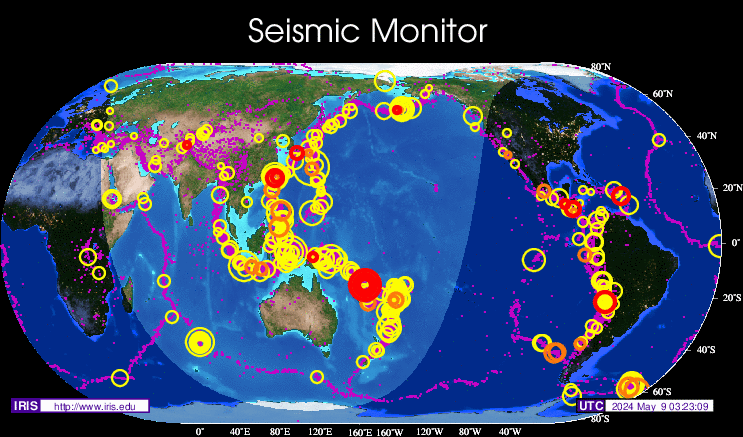
Seismic Map
What They Say About SDA
"Smalldeadanimals doesn't speak for the people of Saskatchewan" - Former Sask Premier Lorne Calvert
"I got so much traffic after your post my web host asked me to buy a larger traffic allowance." - Dr.Ross McKitrick
Holy hell, woman. When you send someone traffic, you send someone TRAFFIC.My hosting provider thought I was being DDoSed. - Sean McCormick
"The New York Times link to me yesterday [...] generated one-fifth of the traffic I normally get from a link from Small Dead Animals." - Kathy Shaidle
"You may be a nasty right winger, but you're not nasty all the time!" - Warren Kinsella
"Go back to collecting your welfare livelihood." - Michael E. Zilkowsky


When I was a kid we enjoyed playing in the old threshing machine. With its many hinged panels and compartments it became our “submarine”
Name That Tractor!
Coxswain
CBC at it’s very best. The modern side of Saskatchewan.
Time for “Stuck in the Mud” contest again.
Picture is not that clear but looks like a John Deere “D”.
Minneapolis-Moline or Cockshutt
Oh my Gawd! I remember the giant sloughs outside Edmonton in the spring.
A subtitle to the picture might be, “prelude to food riots”.
A picture worth a thousand words. The CBC rising (or is it sinking) to their level of incompetence.
The melt is in full force now. A few more warm and breezy days and we will be out on the high ground at least.
Pretty fuzzy picture (just like the CBC), I’m guessing a WD6 International.
In 1979 there were no crops sowed till May 28 in my area of southern Sask.We got the crops off with no frost damage.There was ten inches of snow on May 16.
How best to describe the CBC’s incompetence?
UN-BEH-EFF-IN-LEAVE-A-BULL
I’m with the LS from SK; JD “D” (large diameter flywheel on left side, plus placement of stacks).
Melita, Manitoba? It’s supposed to be a SK story.
Looks like a McCormick 15-30 on rubber to me.
Pathetic! They try to put so much doom and gloom into the story but they can’t find a Saskatchewan farmer willing to collaborate. And they forgot to blame Harper!!!!
Looks like a later model John Deere model D.
Way back when Minneapolis-Moline closed its doors, folklore has it that John Deere bought the M-M factory to use a warehouse to store John Deere toys.
Deere never sold on price, but quality. They’ve seen a multitude of competition come and go, but research and development is what put them and kept them on top.
We have two model D’s in the family. A 1925 and a 1928 model year and we can still get some parts for them!
Sadly most city dwellers think that is what is still used for farm equipment.
John Deere D. Yellow wheels and you can see daylight under the hood, so it’s horizontal engine.
Sadly most city dwellers think that is what is still used for farm equipment.
That tractor might still be useful for some work. I mean, I would take one if someone offered me one!
As for the other machine — forgive my ignorance (yes, I live in the burbs and just drive through farm country on my way to and from work, but I am interested in old machinery like this) — what is it?
A similar machine was parked for years in a field immediately north of the Queensville, Ontario, cemetery. I was always surprised at how well the galvanized sheet metal on the thing had held up, making me wonder if someone might still be using and maintaining the thing.
While these machines are no longer efficient, are they still usable? I mean, if one really wanted to use one?
Man, it must have cost a fortune back then to get the fullly-buoyant option.
“As for the other machine — — what is it? ”
I already told you – a submarine.
“That tractor might still be useful for some work. I mean, I would take one if someone offered me one!”
yup, those old tractors are handy for odd yard work. Still use a ’46 Oliver 70 as a loader, clearing snow, and for plowing the garden.
CBC NEWS: After $600,000,000 refit, Canadian submarine sighted on Sasketchewan proving grounds.
Great header Kate. The crop of 42! That is a thrashing machine.
Besides the smooth forehead, hasn’t Iggy trimmed his uni-brow?
That picture brings back memories of Grandpa’s farm. He had an old Fieldmarshal tractor that he used to drag the old threshing machine to the middle of field then roll out its flat belt, cross it twice and put it on the tractor’s pulley then carefully align the tractor and threshing machine’s pulleys and tension the belt. For those who don’t know the silver machine is the threshing machine which was used to separate the grain from the straw. The smaller machine behind the threshing machine is a double disk drill (seeder). The farmers might wish they still had a double disk drill because they could seed in mud just as well as dry soil.
Aww, the image of quaint Saskatchewan farm practices could be worse.
On the bright side, this low-tech style of farm machinery will be back in style in the post-fossil fuel age after the UN passes the Declaration on the Rights of Mother Earth (and the “inalienable rights of other members of the Earth community — plants, animals, and terrain.”).
…roll out its flat belt,cross it twice…
Isn’t that like “pulling a 360 to get outta here”
I think I can safely say that there is no other place on the internet where you can read a comment thread like the one above.
You had to cross the flat belt or else it vibrated off of the pulleys. You had to cross it twice to get the threshing machine’s cylinder to turn the right direction.
Come to think of it the old Fieldmarshal’s engine could run forward or backward. You had to be careful when you cranked it or when you put it in reverse it went forward!
Kate at 2:49,
As a wise person once said (on this blog):
“not everything is political” 😉
Jack
[…..John Deere D. Yellow wheels and you can see daylight under the hood, so it’s horizontal engine……]
That and it’s too close coupled for the other suggestions….that shot of daylight is the instant dead give-away.
Not sure about the quality thing about the John Deere D though….their popularity was due they could run on distillate(kerosene/coal-oil) and were simple to over-haul…..but needed overhauling more often. Crude would be the proper, term, not quality, in that vintage….
John Deere R.
“I already told you – a submarine.”
Mine was a rocket ship.
I suspect that is a John Deere model D. The model R had the exhaust stack closer to the operator while the D had the air cleaner intake closer to the operator.
Sorry Nick – the JD “R”, although still a 2 Cylinder, was larger and much faster and came out in 1949 and no longer had a Flywheel – an electric start or Starter motor on the diesels (the R” was JDs first Diesel)
That’s a John Deere “D”….you can tell by the twin stacks…one intake, one exhaust plus the set back seat….plus the tin work/radiator….just so ya know !!
It seems the “D”s have it.
To confirm, call
Rural Municipality of Arthur (pop 440 and decreasing)
138 Main St
Melita, MB, R0M1L0
(204) 522-3263
They’ll know the tractor, and they’ll be tickled with the attention.
The ducks will be happy. The greater tragedy is the loss of arable land. The price of grain and feed will rise and the poor will be rioting in third world countries. Cheers. ps: don’t see downtown Toronto or Vancouver planting wheat, or allowing chickens to run free – so perhaps domestic peace is not so secure. You don’t need a HD tv to live but take away bread and meat -different story.
I have pictures of my father working on a threshing machine which is being powered by a steam engine. Burning the stalks I think.
The ducks will be happy. The greater tragedy is the loss of arable land. The price of grain and feed will rise and the poor will be rioting in third world countries. Cheers. ps: don’t see downtown Toronto or Vancouver planting wheat, or allowing chickens to run free – so perhaps domestic peace is not so secure. You don’t need a HD tv to live but take away bread and meat -different story.
And here is a video of a less water logged version.
http://www.youtube.com/watch?v=WdYoumKTVgs
But Glasnost – now that you have drawn attention to Melita – all the liberals in their Volvos will be moving there to hide from post-election embarrassment?
Sorry, slow day here.
On the bright side, this low-tech style of farm machinery will be back in style in the post-fossil fuel age after the UN passes the Declaration on the Rights of Mother Earth (and the “inalienable rights of other members of the Earth community — plants, animals, and terrain.”).
Posted by: LC Bennett at April 25, 2011 2:42 PM
I can just picture a bunch of useless greenie lefties doing the stooking.
Ya think they will last a whole hour doing that sort of physical work?
Ya think they will last a whole hour doing that sort of physical work
They’re more likely to be distracted by the field mice that need saving.
I remember this story from last year and the year before that and the year before that. Almost like it happens every year, yet it seems fresh and threateningly exciting for CBC. Where I am the ground is still too cold to the bare arse for planting.
I can just picture a bunch of useless greenie lefties doing the stooking.
Ya think they will last a whole hour doing that sort of physical work
I think roving coyote packs would fare well on a steady diet of Elois, Gaia would smile. 🙂
The tractor is definitely a “styled” Model D of 1940’s vintage. We had a pair of D’s, one was a 1938 unstyled hand bomber and the other was a 1947 electric start. They both burned in the mid 60’s so my dad stripped a bunch of parts off of the ’47 and put them on the ’38 and made something of a Johnny Cash hybrid. We threshed with an outfit like that in the photo back around 1960-61, the separator was an Addison. Even then it was a thing of the past, and like today, all of the oldtimers came out to watch or pitch. I still fire up the old D once in a while and pick a few stones although there isn’t much call for a 40hp field tractor anymore.
We use two IH model”C”s on our farm .One is a ’49 model and the other is a bit newer.We have larger tractors also but these run nearly every day.We trade the larger ones off for newer but not these two.
From the CBC comments:
note to earlier posters re: the headline photo: there are neither ‘”thrashing” nor ‘”trashing” machines. It’s probably a threshing machine. Although honestly I think it may be a complete combine harvester – not too sure. I don’t know farm machines as well as I do my speeling. What’s a letter, here and there, though? Eh?.
First off, “thrashing” and “trashing” are perpectly acceptable names for the equipment in the photo. (If you are of the Ukrainian persuasion, it’s definitely “TRASHING”!!!) No one I ever knew growing up on the farm actually called it a “threshing” machine. Nor did I ever hear a combine called a “combine harvester”. Kind of like those that preface hockey with the word “ice”. There is a term for these kind of people. It’s called “city slicker”.
And Kate, you’re right…where else but SDA could we have a thread like this?. And tomorrow the topic might be economics or nuclear theory!