Why this blog?
Until this moment I have been forced to listen while media and politicians alike have told me "what Canadians think". In all that time they never once asked.
This is just the voice of an ordinary Canadian yelling back at the radio -
"You don't speak for me."
email Kate
Goes to a private
mailserver in Europe.
I can't answer or use every tip, but all are appreciated!


Katewerk Art
Support SDA
Paypal:
Etransfers:
katewerk(at)sasktel.net
Not a registered charity.
I cannot issue tax receipts
Favourites/Resources
Instapundit
The Federalist
Powerline Blog
Babylon Bee
American Thinker
Legal Insurrection
Mark Steyn
American Greatness
Google Newspaper Archive
Pipeline Online
David Thompson
Podcasts
Steve Bannon's War Room
Scott Adams
Dark Horse
Michael Malice
Timcast
@Social
@Andy Ngo
@Cernovich
@Jack Posobeic
@IanMilesCheong
@AlinaChan
@YuriDeigin
@GlenGreenwald
@MattTaibbi
Support Our Advertisers

Sweetwater

Don't Run

Polar Bear Evolution

Email the Author
Wind Rain Temp

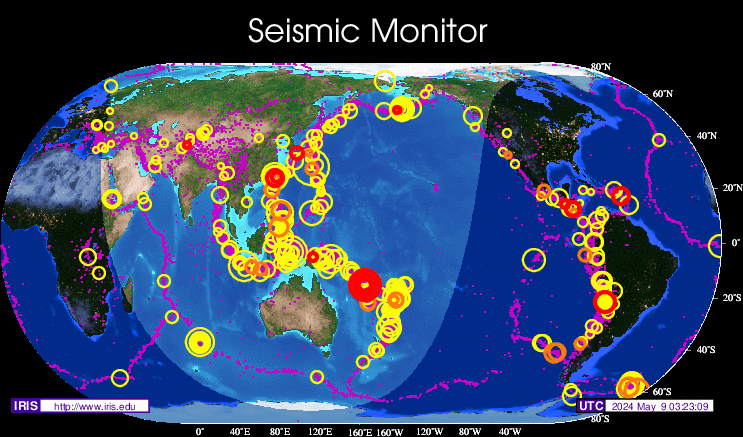
Seismic Map
What They Say About SDA
"Smalldeadanimals doesn't speak for the people of Saskatchewan" - Former Sask Premier Lorne Calvert
"I got so much traffic after your post my web host asked me to buy a larger traffic allowance." - Dr.Ross McKitrick
Holy hell, woman. When you send someone traffic, you send someone TRAFFIC.My hosting provider thought I was being DDoSed. - Sean McCormick
"The New York Times link to me yesterday [...] generated one-fifth of the traffic I normally get from a link from Small Dead Animals." - Kathy Shaidle
"You may be a nasty right winger, but you're not nasty all the time!" - Warren Kinsella
"Go back to collecting your welfare livelihood." - Michael E. Zilkowsky

And if Canada had electoral votes, they would have gone to Obama nearly 100%.
See that long line stretching for miles? That’s the line of Obama’s suckers, take your place.
pete – my argument against the Canadian reliance on only the US market for our exports is hardly confined to softwood lumber. We rely on the US consumer for almost ALL our exports. That’s my point. We refuse to become competitive in the world market.
My argument about the softwood lumber deal refers only to our practice of subsidizing lumber production by our stumpage fees, which are so low that they effectively funtion as a govt subsidy. And, if we refer to only McGuinty’s actions, they most certainly ARE a govt subsidy.
And if we can import blueberries from Chile, and shoes from Germany, then, we can export our products to these same countries.
jethro – individuals may carry out the export and import activities, but setting up tariffs, trade agreements between nations, establishing import and export taxes and establishing costs of shipping, developing trade links and agreements, etc is the task of government.
Canada has not made it productive to export to multiple countries, and this is a short-sighted arrangment for it puts Canada at risk of the American consumer. If that same consumer can get cheaper goods from another country – they most certainly will do so.
How does the government decide how much I will charge to take a load on MY truck from here to whereever? What BS
ET, the same factors that apply to lumber also apply to any product you want to name. We are separated from the rest of the world by two very large bodies of water. In order for us to compete, we have to be providing something unique, otherwise the transportation costs make it a non-competitive product. And even if it is a unique product, there’s a close to 50% chance already it’s going to be going to the US simply because they are the biggest market. Also worth considering are the labour costs that make it worthwhile to import products halfway around the world, but prevent us from doing the same. Until there’s a dirt-cheap form of bulk transport, Canada will naturally export the majority of our product to the US.
I am in the log business in the northeastern US. I watched this unfold during the Reagan years when canadian mills began forays into our area buying white pine sawlogs at unheard of prices.
Our local pine mills couldn’t compete and went out of business, some had been in the family for years. Nobody could afford to sell them logs when the canadians were paying 50% more.
Then the canadians started buying spruce-fir stud logs down to 5″diameter (a market which did not previously exist) which began to pressure softwood pulp mills for material. Two of them closed. They could not compete financially and could not produce paper using only topwood.
We figured that canadian sawmill production costs were similar to ours, so how could they buy logs at inflated prices and make a profit? Must be some form of govt. subsidy. Stumpage cost reduction is part of it, but can’t explain it all. This has yet to be explained.
Now the canadians own the market since we have few domestic mills left, they get all the softwood sawlogs, the price is marginal and uncompetitive, and they ship the dimension lumber back to the US.
Unfortunately, we need those canadian mills since we have none left. The US market for building lumber is reduced substantially and they won’t send trucks down to pick up logs unless they can run loaded both ways.
A tariff is completely useless to the northeastern USA. It punishes both canadian buyer and American log seller and raises cost of materials to consumers. The time to have confronted this sanely would have been during the 1980’s, this is just Obama window dressing. What a lightweight!
The one thing no one takes into account is most of these companies are both American & Canadian owned. Mostley jointly to smooth out inter border shipping.
C
we got logs and you got people.
makes sense for us to send you logs to build houses. \
china has people , we have resources. makes sense to send them raw material and them to send us finished product.
the lowest cost is always the best. tariffs undo the leveling of the market which provides the lowest cost goods to everyone- the maximum economic case under any system.
note to taliban Jack and Barry Hussien Obama. that applies to you, cheapest goods , not highest wages cause the best distribution of wealth. economy 101
This is not a free market system but based on an arbitrary (gov’t defined) price system.
Is Canada’s “free” healthcare a factor in negotiations between the two countries (US companies’ obligations regarding workers)?
cal2 –
i also am of the belief that free market is the most efficient means of distributing wealth, but you may have missed part of my point.
Canadian mills appear to have been subsidized by their government. This impeded the free market in competitively determining fair price for sawlogs.
As a result many US mills went broke because Canadian mills payed inflated prices. Canadians now have, for practical purposes, a buyer’s monopoly since there is no northeastern US competition for buying softwood logs. They can now name their (low) price.
How is a US tariff on decreased Canadian lumber sales going to make this right? It won’t. Were their to be a tariff, it should have happened 25 years ago in response to canadians ruining existing US mills and markets by force of govt. subsidy.
Problem is, canadians have driven down the price of logs via their northeastern monopoly and they now will pay even less stumpage for Crown timber sales. In the end the canadians lose considerable revenue.
The tariff is pointless, useless, and years late. My question is how do we build up a competitive free market cross-border log market with governments who choose to subsidize or impose tariffs?