Why this blog?
Until this moment I have been forced to listen while media and politicians alike have told me "what Canadians think". In all that time they never once asked.
This is just the voice of an ordinary Canadian yelling back at the radio -
"You don't speak for me."
email Kate
Goes to a private
mailserver in Europe.
I can't answer or use every tip, but all are appreciated!


Katewerk Art
Support SDA
Paypal:
Etransfers:
katewerk(at)sasktel.net
Not a registered charity.
I cannot issue tax receipts
Favourites/Resources
Instapundit
The Federalist
Powerline Blog
Babylon Bee
American Thinker
Legal Insurrection
Mark Steyn
American Greatness
Google Newspaper Archive
Pipeline Online
David Thompson
Podcasts
Steve Bannon's War Room
Scott Adams
Dark Horse
Michael Malice
Timcast
@Social
@Andy Ngo
@Cernovich
@Jack Posobeic
@IanMilesCheong
@AlinaChan
@YuriDeigin
@GlenGreenwald
@MattTaibbi
Support Our Advertisers

Sweetwater

Don't Run

Polar Bear Evolution
Email the Author
Wind Rain Temp
Seismic Map
What They Say About SDA
"Smalldeadanimals doesn't speak for the people of Saskatchewan" - Former Sask Premier Lorne Calvert
"I got so much traffic after your post my web host asked me to buy a larger traffic allowance." - Dr.Ross McKitrick
Holy hell, woman. When you send someone traffic, you send someone TRAFFIC.My hosting provider thought I was being DDoSed. - Sean McCormick
"The New York Times link to me yesterday [...] generated one-fifth of the traffic I normally get from a link from Small Dead Animals." - Kathy Shaidle
"You may be a nasty right winger, but you're not nasty all the time!" - Warren Kinsella
"Go back to collecting your welfare livelihood." - Michael E. Zilkowsky
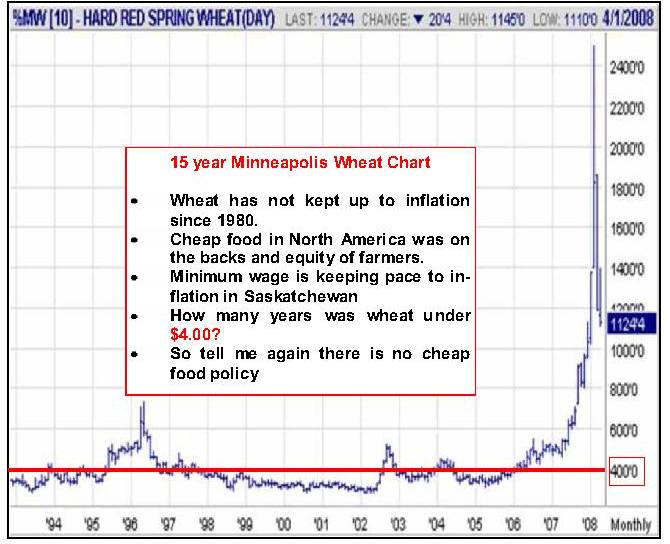

I’m curious that the graphic implies there was a mis-pricing of wheat during this period, due to inflation (or that farmers we getting the short end of the stick along the way).
Applying inflation to commodities is a common fallacy – as if resources should somehow have a linkage to inflation.
Equities (shares) are priced (generally) upon the total expected earnings of the underlying revenue stream. These streams are based upon prices consumers or industrial purchasors expect to pay into the future. In the case of these income streams, there is a tighter correlation between input costs, and perceived value. That is, it is easier for linkages to exist between inflation and what the marginal consumer is willing to part with.
Commodities are a different critter – inasmuch as the the valuation of the commodity is far more closely aligned with the current (and expected) future demand, relative to current and expected future supply.
Now, current ‘shortages’ of essential foodstuffs is the result of many factors coming together at once: biofuel diversion of arable land, increased protein consumption in China & India, and the hideous morass of subsidies, tariffs, quotas, wheat boards, and numerous other distortions that mute the expected value – price – of output.
In the abscence of a price signal, production is thus distorted – leading to our government blowing $74 million this year to slaughter thousands of breeding sows, or alternatively, a spike of the forward curve shown on the graphic above.
Ultimately, the notion that farmers ‘got it bad’ because their incomes were not linked with inflation states clearly that MORE intervention is required to enable the pricing mechanism to reward these people – at least to ‘keep pace with inflation’.
Of course, other factors come into play, notably the ‘National Security’ factor, which some argue that a nation’s reliance upon foreign foodstuffs is the last line of defence of soveriegnty. That, and the wistful notion that some nice farmer and his family have been producing for generations should be enabled to continue – no matter the economics, or cost to society.
Myself, I don’t believe in government imposed price controls. Nor a metasticizing bureaucracy to administer it.
And suggesting inflation shoudl intrinsically be linked commodity prices is under the same theme that create institutions such as the Canadian Wheat Board.
This is simply central planning and control, benefiting one group in the nation versus another – one paying, one receiving. With governmant as the referee (and skimming %30 off the top to finance their action).
Is there a cheap food policy? Of course not. But there is enough distortions and central planning comrade to muffle the price signal, which results in ‘supressed’ food prices.
Above all, I state that what you are paying for whatever you are buying is the actual value at that very moment you are laying out the cash.
To suggest different suggests you know what the value is. Which means you will be highly valued in a centrally planned and state controlled economy Comrade.
We have a mechanism for price discovery. It’s called a futures market. If you think somethings cheap – buy lots and lots of futures, and watch the money roll in 🙂 By the time you are done, the price will have risen to where supply created equals demand. And you will have done your job well to permit the markets to determine the value of a good.
Instead of a central planner.
One additional thing: Production of foodstuffs for biofuel creation was limited before – in part because of smaller refining capacity, lack of government subsidy, among other reasons.
Essential food prices have never historically varied that much (the technical term is volatility), because growth cycles and production can be estimated pretty well in advance, and food consumption is relatively stable – ie: linked to population growth.
The demand for biofuels though has created a new factor that had previously not existed: a diect linkage between energy prices and agriculture.
Thus, energy – which has a seismic level of volatility relative to grains – becomes food. And vice versa. The result is introducing energy price volatility into a place where it has never before existed.
In energy circles, it is well known that power is by far the most volatile, followed by natural gas, with oil prices a distand third.
Welcome to the future. I do hope that large scale power generation from biofuels remains a figment of the imagination.
When supply and demand truly set the price, it is the best system going. That, however, has not been the case for some time now.
Two things skew the grains & oil seeds market in a big way – Gov’t intervention and fund speculators.
Supply and demand does not set the price any more – carry over does. Virtually all gov’ts try to control carry over, reserves. (aka surplus, in order to lower prices)
The other is funds speculation;
[According to figures compiled by Gresham Investment Management, a commodities brokerage in New York, the amount of speculative money in commodities futures – that is, investors such as big funds that don’t buy or sell the physical commodity but merely bet on price movements – was less than $5-billion (U.S.) in 2000. Last year, it ballooned to roughly $175-billion.] G&M
http://www.globeinvestor.com/servlet/story/RTGAM.20080424.wfood25/GIStory/
The markets have now cycled higher after years of very low farm gate prices. One would think that, after being ridiculed for needing gov`t bailouts, the Farmers could now enjoy reasonable market place returns. But no. The Funds jumped in and now we have food shortage headlines, astronomical crop input expenses and the biofuel fiasco.
I am afraid it will be the Farmers who end up wearing this whole thing. Thanks to Gore, Suzuki and Maurice Strong.
Hi Ron in Kelowna. Say, can you explain how these ‘funds’ reduce farmer’s returns?
I bet if we superimpose the goracle’s temperature chart over this one, we will see beyond a reasonable doubt that global warming is to blame for recent wheat price spikes….
Shere Khan, let’s extrapolate that to include the rise in all commodities, minerals, petroleum products, etc.
those global warming fools are going to drive us all to HELL! (in a hummer)
Enter the usual “farmer’s are subsidized” rant in three, two, one…
“Is there a cheap food policy? Of course not.” – Hardboiled
Nice try HB but you are 110% wrong when you mention the Canadian Wheat Board and Canada in your comments.
And it is so easy to show you from this graph.
Look at the spike in the 1996.
The CWB stopped selling grain to the world market before the grain prices peaked.
Grain cars sat at our elevator from late Nov to early Mar without moving that year.
Look at 2002 the drought year.
The CWB stopped selling grain before the market price topped and resumed selling at much lower prices after the peak was over.
It seems to me that that this was also the year that they lost money in one of the pools because of their piss poor market timing. (Someone will correct me I’m sure)
Look at the year 2008.
Sask Ritter, the ex Pres of the CWB, boasted to farmers in their meetings this year that the CWB was holding some 4.0 million tonnes of CWRS back for 2008 fall delivery.
Four million tonnes at $700/mt is $2.8 billion.
Given that it will be sold later at maybe $300/mt it is a real loss of at least $1.6 BILLION which is taken directly out the pockets of western grain producers.
Nobody else pays or helps pay for this economic discrimination.
And for what reason.
Because the CWB is not a marketer of grain that tries to maximize the returns to its members.
The CWB is a dabbler and screwer upper of the grain markets, which is probably why the US doesn’t like it.
The primary purpose of the CWB is control the stocks of grain in Canada.
It is an expensive inventory accounting program.
When the CWB holds grain off the market to increase our inventory, it reduces the price paid by Canadian food users and processors and therefore, is a CHEAP FOOD POLICY.
About a $1.6 billion program this year.
It doesn’t get any simpler than that. Comprehendez?
But hey don’t feel bad, even some university professors still do not understand what the CWB does yet.
Rockyt, you note that the CWB will sell their holdings later at a potential loss of $400/tonne. What is the basis for this? Does the CWB have a mandate to maintain some volume in granary? Is Ritter hedging against the possibility of a poor 2008 crop?
Hardboiled, agree with most of your 11:56 comments. About the cheap food policy, there may indeed be a cheap food policy in some commodities but perhaps not in others. That is certainly the case with the dairy marketing board which has been protecting the dairy industry and in particular Quebec’s dairy industry for decades.
That is economic illiteracy.
Given a static price not linked to inflation, those that do not increase efficiencies by the rate of inflation lose, those that find better ways to do things win.
The other issue is subsidies. How many billions have been paid to farmers in handouts? How many people would be out of the farming business (and thus decreasing supply/increasing price) if there wasn’t interference? How many of the good, high-efficiency farmers would have been able to expand onto the land of the farmers who didn’t invest in yield/productivity enhancing technology and equipment? Subsidies are handouts to failures. It decreases yields per acre and increases food costs more over the long-term. Just because you don’t see the full cost of your meal (because part is hidden in taxes) doesn’t mean the full cost isn’t paid.
Lastly, since when are farmers alone amongst businesses to be guaranteed a profit?
The is a “cheap food” policy. It was introduced in the early seventies by Earl Butz – Nixon’s ag secretary. Over the years it has saved billions of people from starvation as it kept countries with more politically-driven Ag sectors (CDA, Japan and the EU) at least a little more honest and paying a little more heed to the end consumers rather than the producers.
That the nominal price of wheat has been static until recently is indicative of nothing. Productivity gains have reduced the cost of production until recently when inputs like potash and ammonia have jumped. this jump has been more than offset by the increase in the farmgate price for grains except those regulated by the CWB.
(snip) “The CWB is a dabbler and screwer upper of the grain markets” (snip) “The primary purpose of the CWB is control the stocks of grain in Canada”
Posted by: rockyt at April 25, 2008 2:11 PM
I take your post rockyt to argue that cheap food policy does exist – the CWB being a great example. And your first line I pulled above is in complete agreement with that.
Has the CWB kept costs to Canadian consumers low? Perhaps, I am not an expert in grains, nor the CWB’s impact upon them. Could somewhere along the way it has artificially supported prices at certain times? Probably just as likely.
I didn’t use it as support of a ‘cheap food policy’ tool, but as an example of government interference in the market, that results in price distortions. Up or down. Which creates winners, and losers, whether they are consumers, farmers, taxpayers, provinces, or regions. Its a mechanism to provide a transfer of wealth from one group to another.
From another comment: “Given a static price not linked to inflation, those that do not increase efficiencies by the rate of inflation lose, those that find better ways to do things win.” Posted by: Warwick at April 25, 2008 3:08 PM
You are right, inasmuch as this applies primarily to fabrication, processing, and refinement. It does not (in general) apply to the primary commodity itself – because the long run value of commodities is ultimately to go to zero.
Yep. It’s true. And this is the hardest part for people to understand when it comes to commodities.
Because improvements in mining, harvesting, growth cycle (for plants), and logistics are the only inflation linked piece of the commodites’ underlying value.
Substitute goods, new bio-tech, and a host of demand/supply factors drive the price – which, of the price signal is significant enough – will induce people to switch consumption patterns, perhaps eliminating or adjusting basic habits.
Now, as always, exceptions exist. Gold is a great example as one – but it’s intrinsic valuation is driven by people who accept it as a store of value. It’s universal money. This is wide spread and accepted by people everywhere. Thus, gold is far more linked to currency markets than it is the Chicago Board of Trade (CBOT), or why the London Metals Exchange (LME) exists as a seperate bourse. As well, unlike grains or proteins, it is not homogenous, and substitutes are as such less in value. But because of the price signal, companies that relied upon it in the past have simply switched to using different conductors in their electronic boards, or as dentists have done, begun adopting cerex and other synthetics for use in dental work. If you catch my drift, whatever our common use of a product is, this changes when costs are higher than an alternative.
Improvements in production are a requisite to compete, only if there is a lower cost substitute or lower cost of manufacture available. Thus, commodities that have a high level of substitution – despite being a ‘basic neccesity’ – aren’t as nessecary as one might think. In countries that have low cost of labour or cheap input costs (low irrigation needs say), every other producer will be subjected to the price that they are willing to sell for.
Above all – the preceding isn’t academic – it’s applied. If anyone is curious about more, feel free to email me.
And…”dairy marketing board” Posted by: cgh at April 25, 2008 2:32 PM
Yep, forgot about that one. Pricing and supply side control all in one. I don’t know though if the price is cheap per se, or simply supply side managed to ensure certain farmers get a way to make a guaranteed rate of return.
“Its (CWB) a mechanism to provide a transfer wealth from one group to another.” – HB
An excellent observation HB!
And as well as transferring wealth, the state corporation also provides/ensures political power to favored Liberal groups.
In the case of the CWB, it has been the favorite method of transferring ag wealth from the West to Ontario and Quebec’s big Liberal supporting corporations.
And that would not occur if the CWB did not exist or if it was totally run by professional grain marketers.
Which is exactly why I want that sick and twisted compulsory CWB gone completely.
The present CWB is a farce and they have devolved into nothing but a Liberal party re-election organization.
The other clue as to the present non-grain marketing purpose of the CWB is to see how many politicians from outside of Western Canada strongly support it. And even demand it to be strengthened.
But then I guess being called Wheat King (go Brandon) sounds so much more impressive and has so much more cachet than being called Spud King, eh?
PS
If western farmers were smart, they would be demanding an public enquiry into Sask Ritters business model of holding wealth creating grain off the market to sell at a much lower price later on.
These are billions of dollars of farmers money at stake and it is calvalier to make ignorant business decisions like that.
In a private company the guy’s head would roll immediately if not sooner.
There is no cheap food policy.
Food isn’t cheap.
Farmers are entitled to their entitlement freeloaders.
Scratch a conservative, find a hypocrite.
Not to be too much of a kvetcher, I was on the floor of the Chicago Board of Trade for 22 years and, although I was in the financial room next door to the grain room, and I had to study “the grains” as well as my own markets. So bear with me, I will address the chart directly and pointedly, and soon.
The chart in question is a chart of Hard Red Spring (read “Winter”) Wheat, which trades at the Minneapolis Grain Exchange, just about the only futures contract they trade. (And yes, I’m biased) The common game is to trade the delivery difference between this contract and the front month “Soft” Wheat contract on the Chicago Board of Trade(CBOT). It’s an arbitrage spread. Traders are just trying to pick a little bit of the difference up off the table.
Here’s the twist, Hard Red “Winter” Wheat is called this because of when it is growing, and the Spring is when it will be delivered. Anything in particular happen this winter? Maybe snow, and bad planting conditions globally? Therefore, there wasn’t much of a crop to deliver this spring, unless there were excess supplies left over from past crops. (Which I supremely doubt the CWB had the foresight to plan for…) Throw in the shift to corn by US farmers due to ethanol subsidies, which would add to the scarcity, and what do you get? A big whoppin’ spike in price action and a chart that will look just like that.
Politics of “cheap food” may come into play with the CWB, but to me the look like amateurs plagued with what they themselves would call “bad luck”. Not rank stupidity, no, not that.
Just my thoughts. I’ll be back later.
While its true that some farmers are heavily subsidized, it’s also true that others are not, and are in fact paying both financially and politically for those that are receiving those subsidies.
As a western Canadian grain farmer, I’m tired of being accused of receiving subsidies when the production from my farm is unfairly tariffed, taxed, or devalued either by foreign or our own governments. There are countries that tariff our grains and oilseeds because we tariff their dairy/chicken/egg products. And if that isn’t enough, we have the CWB making sure that there is lots of cheap domestic grain to feed their animals as well.
And then while receiving none of the consumer subsidies that supply managed dairy/chicken/eggs get, western grain farmers get accused of benefiting from taxpayers by somehow receiving “subsidies”. Frankly, I’m starting to get a little ticked at the mannys of the world. Food may be expensive (compared to what?), but do you really think that the 10 cents of wheat in a loaf of bread that the grain farmer received (and had to pay all his expenses from), was too much?
do you really think that the 10 cents of wheat in a loaf of bread that the grain farmer received (and had to pay all his expenses from), was too much?
No, I believe the $5 billion plus in direct subsidies farmers receive is $5 billion too much.
“the $5 billion plus in direct subsidies farmers receive”
Let me see here, and Ontario farmer gets a cheque and manny blames the Prairie.
Allrighty then….
an Ontario farmer gets a cheque and manny blames the prairie farmer.
It’s late, sorry
Back from the food lines in Cuba, eh Manny?
What will you complain about when there is NO food, or even your much hated subsidized food, on the shelves to buy at any price, like in Cuba?
BTW, some stores in Japan really have run out of butter.
What will you complain about when there is NO food,…..
I’m sure you’ll still have your freeloading face in the trough, rocky. I’ll complain about that.
5 billion, eh? My cheque must still be in the mail.
Yes, the CWB is near criminal in its restriction of trade, but to assert that western farmers aren’t subsidized hurts the case of those farmers.
Subsidies such as:
Dyed fuel
weaker farm labour laws
cap gains free transfers of property to dependents
CAIS, FISA and their new replacement
subsidized crop insurance
subsidized farm management programs – estate planning, environmental planning etc. etc.
are they subsidized to the obscene degree as dairy, milk and egg producers? absolutely not, but they are subsidized nonetheless.
5 billion, eh? My cheque must still be in the mail.
Free Thinker
From the above I gather that
1- you’re a farmer and
2- you haven’t ever received
a dime in subsidies
Then you would have no problem with the elimination of all ag programs.
I don’t have a problem with that Manny, as long as we cut off all subsidies and strikes.
The way i see it, everyone going on strike… usually, in one way or another cost’s a farmer money….and the farmer has no way of recapturing those costs…i call that a hand out at a farmers expense.
I bet thats ok, right?
How about bailouts for bombardier, air canada, cn or cp rail, packing co’s, lumber co’s, the auto industy, welfare or how about those free drug shootem up sites….or even that subsidy for that new furnace?
So relax Manny, run along and cash your welfare cheque.
bygeorge:
Thus you admit that farmers in the west do indeed recieve subsidies. The argument you should be making is that they either aren’t enough or that your competition has more than you do.
Either way my retort would be for the grain farmers to publically demand that the chief impediment to free trade in their sector – according to the WTO and others – be dismanted forthwith. That impediment is supply-managed dairy eggs and poultry – Not the CWB – it is a distant second.
In regard to strikes being an affront to farmers, I would go along with back-to-work legislation for them if we could do the same for farmers who grow grain and take the winter off. One way or another that’s costing non-farmers money…
I just pointed out how all are subsidised right on down to the welfare resip.
That would include you Gord!
to stop one you have to stop them all.
As for the cwb…..how come the farmer in the east isn’t forced into it like the farmer in the west Gord?
I don’t hear of any eastern farmers going to jail for selling their wheat in the US.
Oh and can you make wheat grow at fourty below Gord? Your starting to sound rather dumb.
bygeorge:
It was you who intimated that western farmers weren’t subsidized. I will grant you that everyone is subsidized to some degree, but no other small business (save those working in the fishery) is as subsidized as the farm sector – not by a long shot. You get to transfer your property to your kids tax-deferred, for many – especially now that grain prices have rebounded – that is easily a subsidy into the millions per farm for many in western CDA. I drive 60000 km/yr on business and I don’t get to put purple gas in my tank. (or my motorhome’s or skidoo’s or quad’s or wife’s SUV that she drives to and from her part-time job at the bank or the pontiac firefly that the daughter drives to and from the high school’s tank)
The CWB should be deregulated – I have been active in pushing that policy both within the Chamber of Commerce (the RED DEER CofC put the policy motion forward that is now the national CofC’s policy) and the CParty.
But I repeat, it is NOT the main reason why the western grain farmer is at a competitive disadvantage vis-a-vis the rest of the world, it is the supply-managed sector. And if the grain guys would get off of their butts and publically denounce the dairy/chicken and egg sector it would go a very long way to getting the logjam broken (and the price of feed grains in western canada would jump too, BTW). Care to start the ball rolling by typing that you agree with the above?
As for the get to work in January comment, that was meant sarcastically, as you were the one telling others to not go on-strike because of the impact it has on you. If some group wishes to go on strike that’s their business, if it has an impact on yours that should be none of their concern. Whether it’s the concern of the gov’t is another matter. I have no business telling you to work in Jan. and you have no business telling someone not to go on strike.
The supply management issue is a red herring, tulk. The consumer has a choice whether to purchase supply managed products, and can therefore opt out of supporting that sector. The taxpayer has NO choice when it comes to subsidizing the rest of agriculture, even when the crop is being used for biofuels, or birdseed. I’ll bet Kate even gets an ag subsidy for raising poodles.
How is it a red herring?
Expecting the consumer to stop eating eggs, milk, chicken, turkey and cheese and all of the products made with them is utterly unrealistic. The imputed subsidy is 15 BB per year – 800$ after tax for a family of four.
Even if the consumer was to succeed in avoiding them directly, they pay for them in higher production costs due to higher labour/cost of living factors for those who do consume these products.
It is one of the most egregious subsidies in the industrialized world and has been a major stumbling block to progress at the GATT. We look like hypocrites asking for grain subsidies to be removed while at the same time saying hands off the supply-managed sectors.
How about stopping all $19 billion per year subsidies to business (agri-business incl.)?
Then, taxpayers don’t have to deal with the greasy organized gerbils that are commonly known as ‘politicians’.
How nice would that be?
A fair game, without a beggar with a hand outstretched?
Wouldn’t that be great?
Where did i say farmers weren’t subsidized Tulk?
I pointed out that ALL are subsidized, even you.
To which you seponded that was true but you weren’t subsidized to the point farmers are.
Sounds like your saying you would like more, a true socialist.
But then you did point out i should be yelling for more myself. Then on the other hand you complain i get to much now.
Your a true hypocrite Gord!
You say you have your own buisness and drive 60 k a year.
Your car costs what, 40 grand…of which you write it off as an expense. Just one small tractor or baler will cost a farmer that much.
And you write every litre of gas off as well, purple or not..don’t you. Just like the farmer.
..and you also fill your wifes car and your daughters car on the co. credit card and write that off also! No doubt the odd liter hits the skidoo to eh Gord….I’m sure your cool with that though.
As far as your winter jab… Do you suppose the grain gets to the elevator only in the summmer months?
Do you think the cattle quite eating just because its fourty below?
I know a number of farmers who work the rigs or drive truck in the winter.
As for your strike comment….sure he can go on strike….and when he gets hungy enough he will return.
Ever seen a farmer go on strike Gord?
Almost everytime someone goes on strike the cost is passed on down and down till it eventually hits the farmers pocket.
Do you like to eat Gord?
I think your about to find out what happens when there isn’t enough grain around.
Ever heard the “penny for a loaf of bread” statement.
I think were about to find out what that means, And i’m betting it isn’t going to be pretty!
Cheers Gord…and enjoy your subsidy fella.
Tulk, supply management is not at all egregious, since production is limited to the domestic market, there is no international trade distortion.
If the consumer must consume supply managed products, then they only “subsidize” those products that they choose to buy, unlike in other sectors where one is forced to subsidize the international trade, regardless of what is produced, birdseed, poodles, etc.
I don’t know where you get that $15 billion figure from. I doubt it would stand up to scrutiny. I do know the cost of non-supply managed subsidies for a Sask family of four is close to $2000.00. Now THAT’S egregious.
And just because you said ALL are subsidized, bygeo, don’t make it so. And even if it is so on some level, farmers are subsidized as much as ALL are, and then they are subsidized a hell of a lot more. They’re still freeloaders.
Just for the record Manny, the only subsidy I get is the farm fuel subsidy because it is available to all grain farmers meeting the requirements.
Filling out an endless blizzard of paper forms to maybe get some tidbit from some govt agency is not my idea of life.
And kissing some politicians a$$ to get more, has never be on my list of things to do.