
The cover of the first issue of Captain America* showed Cap socking Hitler with a right cross nearly a year before America declared war on Germany. A champion of American freedom, Cap’s popularity soared during World War II as he battled Nazis and the Japanese with Bucky at his side.
After the war, sales of Captain America dwindled; the title was canceled in 1950. As Bradford Wright details in “Comic Book Nation,” Marvel brought Cap back several years later as a Cold Warrior: “Captain America . . . Commie Smasher.” This time, he and Bucky fought communist agents “who hid behind the privileges of a free society in order to subvert American institutions.” The series sold poorly and was dropped after a few issues.
Captain America changed with the times. He returned in 1964 and found renewed fame, but not as the same rock-jawed, stalwart soldier. In 1969 he was paired with the first African-American superhero, the Falcon. In one small sign of how comics were evolving, the Falcon’s alter ego, Sam Wilson, was a Harlem social worker.
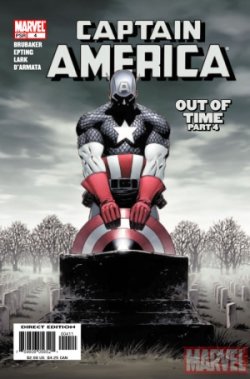
It was the beginning of the end.
Related, from 2003 – Some saw it coming.
h/t
Marvel’s pretty much been taken over by a bunch of really weird Lefties. I stopped collecting a long time ago when they began killing off characters and bystanders. Their descent into perverse story lines and lots of death to support same is quite disgusting. This latest Civil War storyline makes me want to take a shower. Ew.
On the bright(ish) side, the movies made from these books are pretty fun. Ghost Rider is a hoot. ~:D
you mean like how the fbi RIGHT NOW is exposed as using the patriot act to dig up information that has nothing to do with terrorism?
I made the mistake of picking up the “The Ultimates” graphic novel a few years back. Leftie talking points inserted hither and yon with the other side presented in -forgive me- cartoonish fashion only. Thor, the norse god of thunder is presented as a hippy-environmentalist who won’t take action to save New York until the president promisted to increase foreign aid tenfold. (After all, we all know that Norse Gods were all about the environment and not about killing, looting, drinking and whoring)
It was the feel-bad title of the year. Needless to say I’m not buying any more of that title. The way Marvel’s writers casually insert their politics into their comics is disgusting.
The “Ultimate Spiderman” series has managed to remain mostly unpolluted. that’s a fun series.
The last time I read a comic book, they cost ten cents each! (But I still like Bart Simpson as ‘FALLOUTBOY’)
I am enjoying the anti-Persian fallout from 300.
Now I know it has the Iranians pissed, I’ll have to go see it again.
Oh yes. “300” kicked unholy butt. Highly recommended, as long as you can tolerate large amounts of bloodshed.
Gee, I wonder if the sequel would be called “301” or “299”? (Just kidding)
don’t need a super hero when you have social workers
Oh Man, BC , now that just ain’t right .
Besides, I thought everyone died ?
The “Ultimate Spiderman” series has managed to remain mostly unpolluted. that’s a fun series.
How’s “Sensational Spider-Man”? Never read it myself, but I used to know the guy who writes it.
Why dont they print a front cover showing CAPTIAN AMERICA belting some hooded AL QUEDA terrorists and saying THIS IS FOR THE WORLD TRADE CENTER AND THE PENTIGON
Speaking of comic books. How many thousands of dollars did our parents throw out, years ago, by tossing our read and reread comics. Guess I did the same thing to my kids books.
So comic books have decided to go mainstream.
Just like the MSM, they would rather die red, than live read.
Buubye.
Didn’t bother with the Marvel Civil War bit, since I got all I needed in this 30 second synopsis: http://the-isb.blogspot.com/2007/02/civil-war-in-30-seconds.html.
BTW, as far as movie tie-ins go, one word: Mallrats. 🙂
“I am enjoying the anti-Persian fallout from 300.
Now I know it has the Iranians pissed, I’ll have to go see it again.”
“The abandonment of sick, puny and misshapen children by the Spartans was more humanitarian and, in reality, a thousand times more humane than the pitiful madness of our present time where the most sickly subjects are preserved at any price only to be followed by the breeding of a race from degenerates burdened with disease.”
guess who