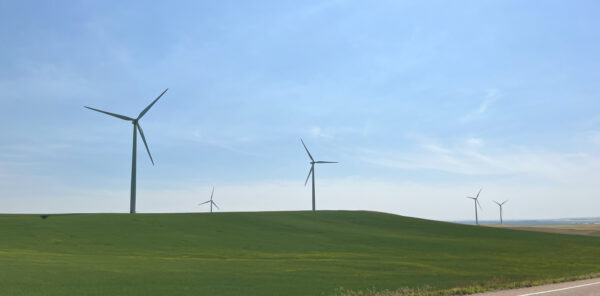
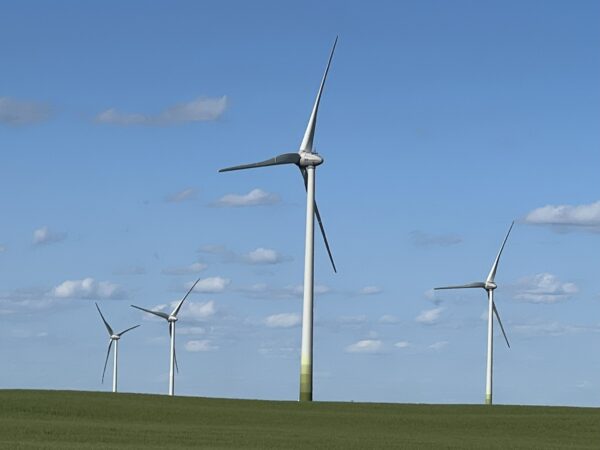
NDP release Pembina Institute paper on costs of coal refurbishment, but the paper leaves out a lot of context. The report puts a lot of faith in wind and solar, but real world examples over the last two weeks bring that faith into doubt. Using the scenarios the Pembina Institute outlines in the report quoted by the NDP, on Aug. 12, Saskatchewan would have run out of batteries six times in 24 hours.
And just after I finished writing this at 2 a.m., I got an email alert that Alberta wind generation fell to less than 1 per cent output, again. But they have no use for baseload power. Good grief.
I spent 11 hours working on this story, which I broke into four parts. These are the first two, the next two will come out early next week.
The NDP again want to see coal-fired power go away, “as practical.” The want to convert coal plants to natural gas, even though Saskatchewan has lots of coal but not much in the way of natural gas anymore. We drilled ten gas wells over the last decade, and Alberta did that many by noon today.
There is of course the obligatory massive buildout of wind and solar, and storage. And just coincidentally, three hours after the press conference, wind output in Alberta fell to next to nothing, again.
Digging deep on the NDP’s “Grid & Growth” plan for Saskatchewan’ electrical grid, Part 1
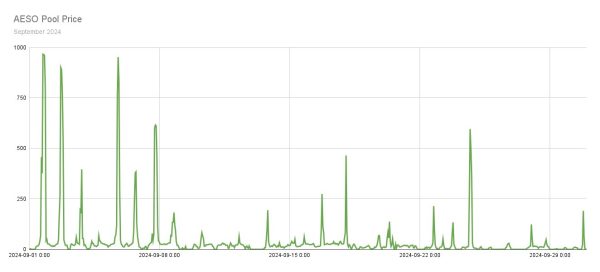
Some poor bastards, also known as the Alberta ratepayers and Alberta industry, get to pay those rates. And just as sometimes the wholesale price goes to $999.99 per megawatt-hour now, it will go to $2999.99 per megawatt-hour in 2032. And somebody has to pay that. If you live in Wild Rose country, that somebody will be you.
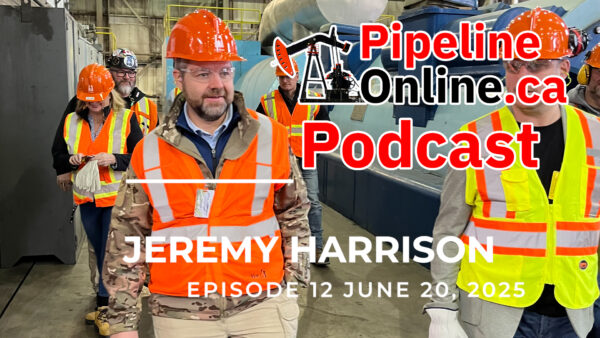
Saskatchewan is rebuildings its coal fleet. Here’s a chance to hear from Crown Investments Corp and SaskPower Minister Jeremy Harrison explain how this came about. It’s the biggest energy decision in 10 years. If you work in the coal industry in take time this weekend to watch/listen.
If SaskPower carries through with rejuvenating coal, it will save three power plants, two mines, ~1000 jobs and two communities.
The significance of the shift on coal cannot be understated. When SaskPower’s then-CEO Mike Marsh came to Estevan in 2018 to say they would not be installing carbon capture technology on Boundary Dam Units 4 and 5, it wasn’t the obituary for the community, but it sure felt like the cancer diagnosis. And with no talk of carbon capture for Coronach’s Poplar River Power station, it seemed all but certain that town would whither away once the coal plant and related mine shut down by the federally mandated 2030 deadline. The January, 2025, announcement of SaskPower looking to rebuild both Boundary Dam and Poplar River, if carried out, would be a decades-long reprieve for both communities.
To extend the metaphor, effectively Estevan and Coronach just went into chemotherapy, and the results may be positive.
The implications of this change in direction, from the impending death of coal, to its possible rejuvenation, have local, provincial, national and international aspects, detailed in the story.
Watch for the Pipeline Online Podcast, Episode 2, to be broadcast on LinkedIn, Facebook and X at 1 p.m. on Friday, Jan. 24.. Crown Investments Corp Minister Jeremy Harrison is the guest, where we will delve even further into this new direction on coal-fired power generation.
Assembly of a wind turbine near Assiniboia, SK, on Jan. 7, 2021. Photo by Brian Zinchuk
I worked on this story for many days with one of the proponents whose family will account for around half of the land assembly for the project. The number was initially a lot higher but the project has been changed and adapted. He has some strong points in favour of wind development, and they should be heard.
This is what they call “journalism,” as in telling multiple sides of a story. And no one else is writing in depth stories like this in Saskatchewan.
That being said, I have another wind story about a great day of wind production in Alberta on Sunday – 74 per cent output. That’s four orders of magnitude better than it was at noon precisely seven days before. But that also caused pool prices to hit zero for 12 hours.
Again, I point out the problem with no one making money is no one is making money. That’s unsustainable. And the proposed reforms in Alberta will make it much worse, by introducing negative pricing. Ridiculous! Nothing with intrinsic value should ever be zero. Ever.
But hey! At that very moment, at noon, solar’s output was less than 10 per cent!
The number was so low that if you enter those numbers into your Windows calculator app (0.39 megawatts / 5476 megawatts), it will give you the scientific notation of 7.121986851716581e-5.
That’s right – the percentage was in scientific notation, because normal numbers don’t go that low. And this is after many, many billions spend on wind.
I keep asking: Why are we throwing away what we know works, for what we know absolutely does not work?
Electricity is the very oxygen of our economy. When you have lots of oxygen to breathe, no problem. The very second you run out – big problem. And we are entrusting our very lives with technology that continually completely collapses in a widespread basis. Fool me once, shame on you. Fool me 49 times (the number of Alberta wind farms) shame on me. And fool me 1722 times (the number of Alberta grid-scale wind turbines) … well, you get the idea.
The Saskatchewan Green Party proposes to “Make Green Jobs the future of Saskatchewan’s economy by transitioning away from fossil fuels,” while financing its extensive socialist policy platform by modelling Norway which applies “a whopping 78 percent total tax” on oil and gas revenues.
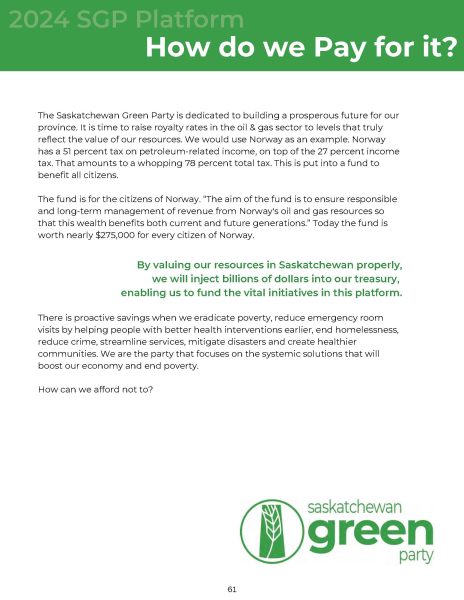
Notably, it includes five pages discussing the Greens opposition to small modular reactors. And the policy document closes by saying on the last page, “How do we pay for it? The Saskatchewan Green Party is dedicated to building a prosperous future for our province. It is time to raise royalty rates in the oil & gas sector to levels that truly reflect the value of our resources. We would use Norway as an example. Norway has a 51 percent tax on petroleum-related income, on top of the 27 percent income tax. That amounts to a whopping 78 percent total tax. This is put into a fund to benefit all citizens.”
That page does not list any other major revenue source, or indeed any revenue source at all, other than heavily taxing oil and gas, the same oil and gas earlier in the document the party promises to transition away from. If the party does succeed in “transitioning away from fossil fuels,” (Page 17) it offers no other source of revenue on the “How do we pay for it?” page (Page 61).
This is the third in a series of in-depth interviews with the parties vying for the Saskatchewan election. In it, NDP Energy Critic Aleana Young speaks about the NDP’s all-of-the-above energy strategy.
The greatest threat to nuclear development is not technological or even financial – it’s change in government. This was evident with the Site C Dam in BC, where a new NDP government pumped the brakes, but then ultimately went ahead with it. The NDP in Saskatchewan continue to support nuclear power development, but “we have to get it right.”
As I’ve done with the other parties, I reproduced everything I could find in the party platform related to energy. Well, the terms “oil” “natural gas” “potash” “critical minerals” “SMR” “nuclear” or “electricity” are not referenced within the document. But “healthcare” comes up 35 times.
Friday will be the Buffalo Party. So far, I have not heard from the Greens, PCs or Progressives. Wonder why? Is anyone else writing 3200 word stories on their energy policies?
On a side note, I attended a three hour long Estevan city council/mayor town hall this evening. It took 2 hours and 25 minutes before anyone made any serious comments about coal. That was right before I got my chance to ask about dealing with the impending eventual shut down of coal-fired power generation, but also preparing the city for nuclear power. Amazingly, about half of the 13 people on stage really had no substantive answer on that front, and several had no clue or hadn’t thought of it. You would think that would be the most important issue facing this city – much more important than sidewalks or boulevard flowers (which got more discussion up until that point than coal or nuclear). Especially since the nuclear built out will be the most costly infrastructure project in Saskatchewan history to date. (If I attend a forum like this, you can be damned sure I’m going to ask the toughest questions.)
About a month ago I did some serious digging into Alberta’s electrical grid going into zero dollar hours for pricing. As in all the power on the grid, for the generators anyway, was free, for a few hours. I thought I had published it, but apparently not, as I was reminded by @ReliableAB. And funny thing is, it happened again this past weekend.
The problem with no one getting paid is no one is getting paid. No business model is sustainable like that. I don’t care about averaging things out. No one wants to give away product for free, especially if they are paying for inputs like natural gas for fuel and staffing.
Wind and hydro actually pair very well together, as hydro can ramp up and down very quickly. Building wind in Manitoba will allow them to build up their reservoirs and maintain more capacity overall, especially in low water conditions like the prairies have seen in recent years. So, believe it or not, I’m not wholly against that idea, for Manitoba, at least. I’m surprised they haven’t built more until now.
Also, this was from the Canadian Press. Take that for what you will.
Facing a groundswell of opposition to a proposed 200 megawatt wind project near Weyburn which would be built, operated and owned by Enbridge as an independent power producer, SaskPower posted the following on its corporate blog on Aug. 23.
That blog posting was then promoted via advertising on social media, including Facebook.
What the blog does not say is that Alberta’s fleet of now 47 wind farms, with a total capacity of 5,214 megawatts was producing 35 megawatts at 3:38 p.m. on Thursday, Aug. 22, according to X account @ReliableAB. That’s after the recent addition of a new 466 megawatt windfarm which is being brought online. And 35 megawatts was 0.7 per cent of capacity at that moment, while 5,214 megawatts is nearly the entire Saskatchewan grid if every single generating facility was running full our, which never happens.
The ads below are not part of the original blog, but part of every Pipeline Online story to pay the bills. This is that blog posting, verbatim.