
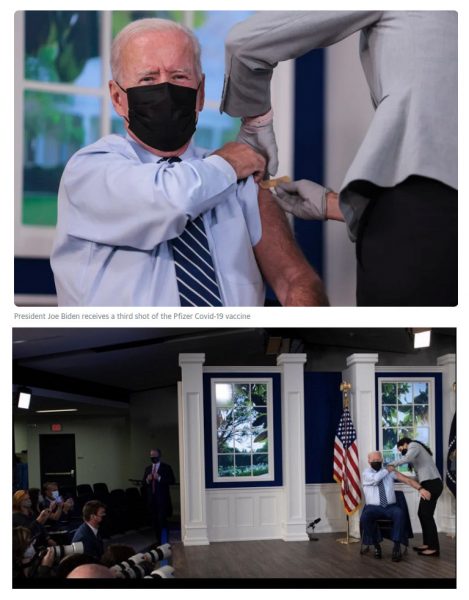
I, Napoleon
These are the people complaining about the public turning to “the internet” for medical advice.
The strawman cometh
As far as the mainstream media is concerned, the main purpose of a story on Ivermectin is not to discuss the topic seriously and to seek the opinions of trained medical professionals who have actually used it successfully to treat Covid, but to promote the narrative that it is a dangerous fringe treatment pursued only by crazy people. It’s all about the primacy of consciousness: Pierre Kory and Joseph Varon will not exist if we simply refuse to believe that they do.
In the U.S., prescriptions for ivermectin have increased 24-fold from pre-pandemic levels.
There have also been reports of people ingesting veterinary formulas intended for horses, sheep and cattle, which don’t require a prescription. Purchases have increased and the owner of a Calgary feed store was forced to hide his stock of the dewormer after getting numerous calls.
Wuhan Flu: Follow The Sciencers
Avoid the viral videos, ignore the conspiracy kooks and shun the anti-vax charlatans.
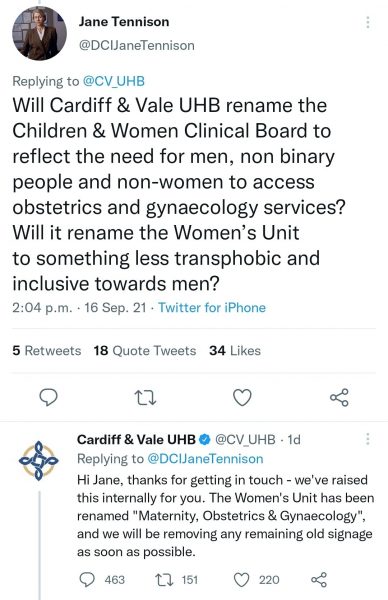
When it comes to protecting yourself and your family with the latest, most up to date science and information on COVID-19 here is no better source than the American Association of Biological Sex Deniers.
Could you please be more vague?
If you’re wondering why this country’s approach to the pandemic is floundering badly, it’s precisely due to the fact that we put our trust in “experts” like these whose solutions are largely a pack of bromides, empty slogans and arguments over which version of central planning ought to be adopted. Just like in the Soviet Union where food supply problems were caused by perpetual “bad harvests”:
“We’re not going to be able to vaccinate ourselves out of this because of supply issues, distribution issues — we simply don’t have enough,” Warner said.
And no issue can be discussed these days without the obligatory nod to the non-concepts of racial and class consciousness:
Warner said that ICU doctors have been seeing “racialized, marginalized people getting nailed by this.
Of course, if the current lockdowns are not working as hoped, that can only be because they are not severe enough. If this one trick pony keeps kicking you, just tell yourself that it’s for your own good:
“We bring in these measures every now and then, they’re pretty lightweight,” she said. “Based on some other countries like Australia and New Zealand, Taiwan, China, […] if we had done a really heavy duty lockdown a year ago, we might be in a different situation, but now I think we’re all just tired of it.
If we all buckle down, we can get out of this. Someday. We’re not too sure exactly when…
“In Canada, we have the fundamentals pretty much, right. We have the tools available to us to get us out of this,” Conway said. “It’s just not happening today or tomorrow. And if it deteriorates over the next week, we need to adapt our behaviour to the circumstances of that day. Trusting that at some point in the future, by the fall or something, things will be better.”
Science
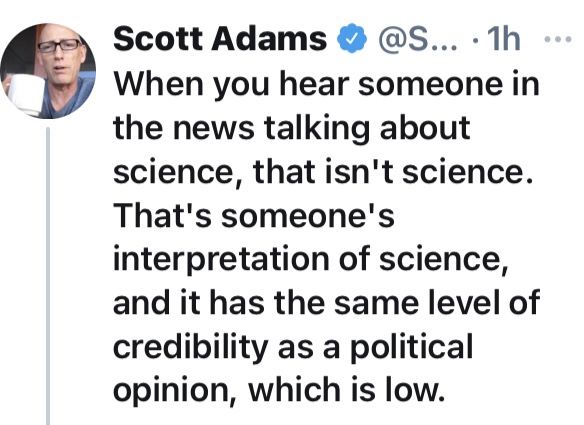
“None of us are “following the science.” We are following people who tell us they can accurately interpret science and create rational policy from that.
What Could Possibly Go Wrong?
New Zealand, meet your new doctors.
For this year’s intake, Otago had 202 places available for first year students entering from its intermediate year. (Otago does not take first year students from other universities). Of those, 120 were given to those entering under a raft of categories.
Of those, 58 were Māori, 20 were Pasifika, 1 Māori/Pasifika and 29 entered through the rural gate. Eleven students went in under the low socio-economic category and one under a new refugee category. That left only 82 general entry places (40 per cent).
As well as the 202 places for first year students, Otago medical school fills another 80 places with graduates. Overall for 2020, Māori and Pasifika make up 32 per cent of students starting at the school, while 14 per cent have rural backgrounds, 4 per cent low socioeconomic, and 1 per cent refugee.
Auckland medical school shows a similar pattern. For the 2020 year it had 185 places for first year health science or bio-medicine students. Māori and Pasifika took up 52 places, rural got 25, disabled 2, low socioeconomic 5 and refugee 1. That left 101 places (55 per cent) for general entry students.
Looking at percentages for the 2020 intake, Māori and Pasifika students took up nearly 40 per cent of the places at Otago for first year health science students and 28.1 per cent of the total places for first year students at Auckland.
At Otago that meant general entry students had to get, as one student put it, “ludicrously” high grades to be accepted. In fact candidates needed at least a 94 per cent average mark for their seven papers to get an offer. […]
The average mark for the sub-category entrants is not held by the university and it was not able to provide it before deadline.
However, sub-category entrants must get a 70 per cent minimum for each paper. Those who achieve an average of at least 70 per cent can be admitted with individual subject marks under 70 per cent so long as the admissions committee is satisfied about their academic ability to complete the programme.
Who Is Judy Mikovits?
A brief history of scientific malpractice, from our friends at Retraction Watch.
Drunk Monkeys, Soap Operas, And Tailgating
What would we do without research?
On a steamy summer day inside the lecture auditorium of the storied National Institutes of Health headquarters, Dr. Michael Bracken delivered a stark message to an audience that dedicated its life, and owed its living, to medical research.
As much as 87.5% of biomedical research is wasted or inefficient, the respected Yale University epidemiologist declared in a sobering assessment for a federal research agency that spends about $40 billion a year on medical studies.
He backed his staggering statistic with these additional stats: 50 out of every 100 medical studies fail to produce published findings, and half of those that do publish have serious design flaws. And those that aren’t flawed and manage to publish are often needlessly redundant.
What Would We Do Without Peer Review?
Online sleuths have discovered what they suspect is a paper mill that has produced more than 400 scientific papers with potentially fabricated images. Some journals are now investigating the papers.
Elisabeth Bik, a microbiologist–turned–research integrity expert based in San Francisco, along with other “forensic detectives,” identified the potentially problematic papers, which they think came from a single source. They say the papers contain western blot images—used in molecular biology to visualize the presence of proteins—that contain remarkably similar background patterns and unusually neat bands lacking smears, stains, or dots, which often appear in such images.
“We think that these western blots are not real,” says Bik, who wrote about the case on her blog on 21 February. “Most of them have a very similar layout so we realized these are all coming from the same stable.”
More detail on this thread.
“It is no coincidence that so much dietary advice in the media comes from people whose relationship with food is affected by mental illness.”
Recently, whilst publicising her latest diet book, unbearably smug radio personality and all-round irritant Fearne Cotton revealed that she had secretly suffered from bulimia for around 10 years. She said that she was ‘no longer afraid’, and hoped that in speaking out she would encourage others to do so. I suppose her honesty at opening up should be praised, and certainly the reaction has been generally positive. But in truth, I have struggled with this story and the media response to it.
Although listening to Cotton on the radio generally makes me want to lance my eardrums with a hypodermic syringe, I understand that she has astonishing popularity and reach, giving her the ability to spread a positive message that might just remove some of the stigma surrounding these conditions. But I cannot get over the fact that she is just one of a troubling succession of diet book authors who have disseminated prescriptive food advice whilst suffering from an eating disorder. She may not be the worst offender, but she is perhaps the highest in profile, which makes writing critically about her full of risk. When friend of the blog ‘Not Plant Based’ covered the story in less than glowing terms, the author received a torrent of abuse on social media. […]
So great, let’s have a fucking conversation. Let’s talk openly about our problems. But if we are going to do that, let’s not shy away from discussing the huge dietary revenue stream that feeds on the food insecurities of others. The lucrative rhetoric that drives people towards disorder, and keeps them held within its grip. The restrictive diets and magical food thinking that Cotton and others in the industry have spent years encouraging. The eating patterns that can prove fatal if they take hold in vulnerable minds.
Let’s also talk about the concerns of dietitians and eating disorder professionals that are so often blithely dismissed by the authors and publishers of these books. The people that work for months with patients only to have their hard work overturned by a dismissive comment from an influencer that a packet of crisps or a chocolate bar is toxic and doing them harm. Let’s talk about the books and articles that Cotton has written about food, telling countless young people exactly how to eat and what to restrict. Let’s explore her back catalogue, and talk about which parts of it should be immediately withdrawn from sale if she really cares about people’s mental wellbeing. Let’s have a conversation about the pointless, tortured and restrictive food mantras she has spent years preaching. Although she should never be judged for what her illness drove her to, perhaps she should be judged for not looking back and considering the harm this might have done to others.
More.
The woman who invented ‘I Quit Sugar’ had an eating disorder for a decade. Struggled writing this as it feels v uncomfortable to expose another woman but I felt someone has to in aid of the thousands of followers who replicate her eating 1/2 https://t.co/kBHBCxKVXx
— Eve Simmons (@EveSimmns) September 22, 2019