Why this blog?
Until this moment I have been forced to listen while media and politicians alike have told me "what Canadians think". In all that time they never once asked.
This is just the voice of an ordinary Canadian yelling back at the radio -
"You don't speak for me."
email Kate
Goes to a private
mailserver in Europe.
I can't answer or use every tip, but all are appreciated!


Katewerk Art
Support SDA
Paypal:
Etransfers:
katewerk(at)sasktel.net
Not a registered charity.
I cannot issue tax receipts
Favourites/Resources
Instapundit
The Federalist
Powerline Blog
Babylon Bee
American Thinker
Legal Insurrection
Mark Steyn
American Greatness
Google Newspaper Archive
Pipeline Online
David Thompson
Podcasts
Steve Bannon's War Room
Scott Adams
Dark Horse
Michael Malice
Timcast
@Social
@Andy Ngo
@Cernovich
@Jack Posobeic
@IanMilesCheong
@AlinaChan
@YuriDeigin
@GlenGreenwald
@MattTaibbi
Support Our Advertisers

Sweetwater

Don't Run

Polar Bear Evolution

Email the Author
Wind Rain Temp
Seismic Map
What They Say About SDA
"Smalldeadanimals doesn't speak for the people of Saskatchewan" - Former Sask Premier Lorne Calvert
"I got so much traffic after your post my web host asked me to buy a larger traffic allowance." - Dr.Ross McKitrick
Holy hell, woman. When you send someone traffic, you send someone TRAFFIC.My hosting provider thought I was being DDoSed. - Sean McCormick
"The New York Times link to me yesterday [...] generated one-fifth of the traffic I normally get from a link from Small Dead Animals." - Kathy Shaidle
"You may be a nasty right winger, but you're not nasty all the time!" - Warren Kinsella
"Go back to collecting your welfare livelihood." - Michael E. Zilkowsky

There’s so many ways to look at what went down.
yeah, oil.
But also:
China, Russia
Brics
Internal turmoil and instability
Drugs and related crime
Infiltrating to USA
Where all of that leads to
One of the charges agvainst Chavez was something like “posession of an army” or some such. 🙂
agvainst Chavez no less
OK Maduro … huh
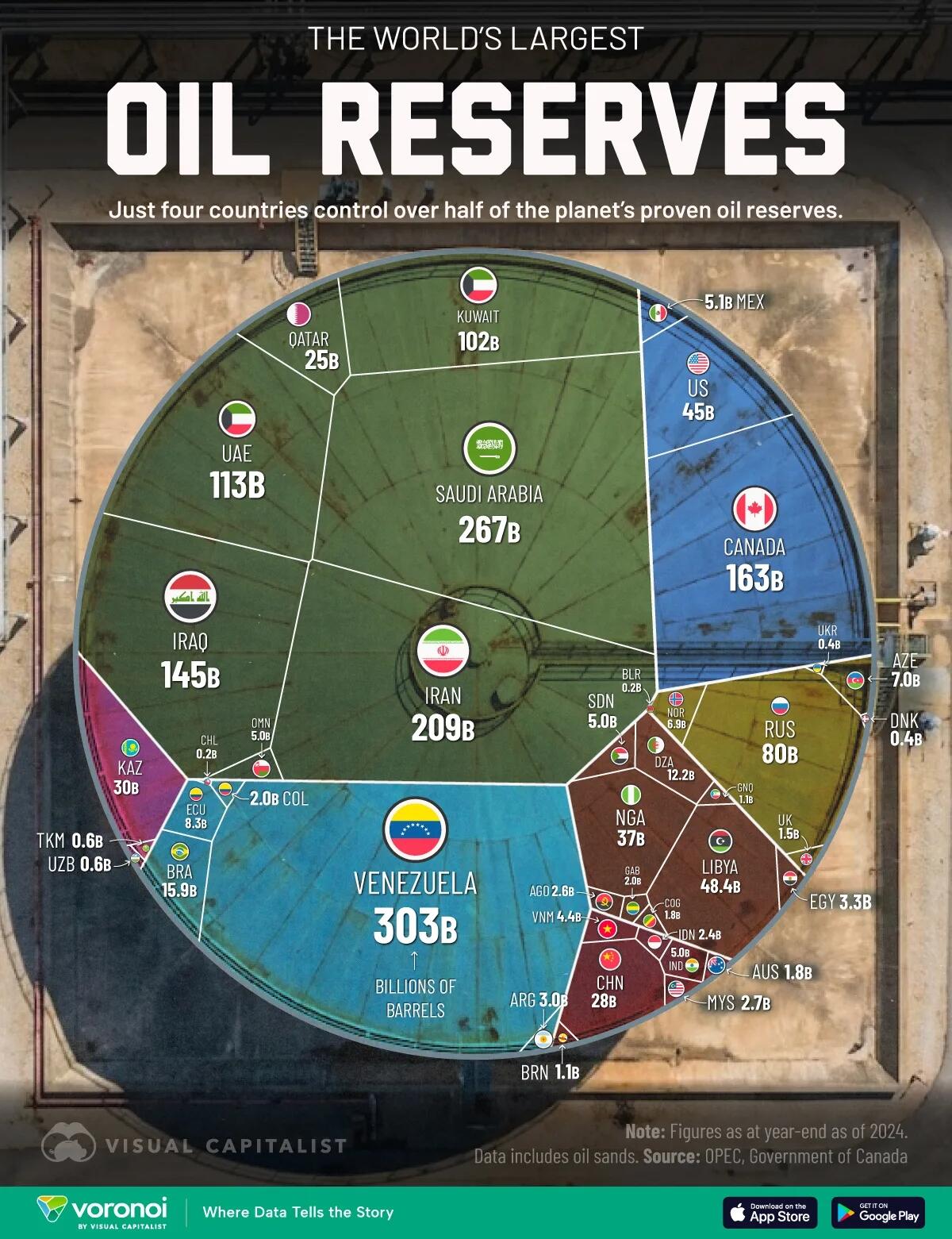
If all (crude) oil was equal.. Charts like this oversimplify a complex question.
And somehow Canada still imports oil by ocean tanker from other continents.
But only to Atlantic ports.
Because….
Irvings on the east coast. Suzukis on the west coast.
Clowns to the left of me, jokers to the right…
As I have said many times before, nomenclature is fundamental to understanding that which is portrayed.
“Proven reserves” is the key in this respect and that means exactly what it says, what it doesn’t say is, all the rest or if you want, everything else. And that is frankly a much bigger picture.
Remembering that only at best 20% of the earths “surface” has been explored for hydrocarbons and that is quantified by the word “explored”.
DSV
You just posted my thoughts!
Plus throw in QUALITY of product, as not all oils are equal.
Other metrics include the reserve replacement ratio and reserve life. Problem is, when the price of crude is low (like now) these metrics all decline because oil companies pull back on exploration. When the price shoots up these metrics take awhile to change so there is a time lag to update known reserves.
The best metric IMO is current worldwide production which is increasing. If production is increasing in a low price environment there is no impending shortage of oil.
U.S. crude oil production is currently 13.8 million bpd. Or 5 billion bbl/year. Note: crude oil, not hydrocarbon liquids
The chart says US reserves of crude oil are 45 billion bbl. Raw data is here: https://www.opec.org/assets/assetdb/asb-2025.pdf
Simplistically, the US has approx 9 years of crude oil reserves at current levels of production.
Note; this ignores price fluctuations, new discoveries, reserve additions, and new technologies. Also ignores oil field decline rates, which mean production will last a lot longer than 9 years, but production below 13.8 million bpd will occur earlier than 9 years from now.
9 years of crude?
Awesome! Since the global warmists claim we only have 10years to save the planet by halting our use of fossil fuels … it looks like we’ll JUST make it out alive. Good news, Joe … if you enjoy playing the peak oil style warmist game.
Peak Oil?
Is there such a thing as peak oil?
The amount of oil still in the ground is truly enormous. For example: the Alberta oilsands have approximately 1.7 trillion barrels in place. And underneath much of the oilsands is the carbonate triangle; another very large deposit. How much is recoverable, partially depends on price, and available technology.
In the US the oil contained in oil shales is even larger. The Green River oil shales in Colorado, Wyoming, Utah, contain 2.2 to 4.3 trillion bbls. The US Dept of Energy estimates 800 billion barrels may be recoverable.
In addition the US could produce naphtha (diesel) from its abundant natural gas, the GTL technology. Or it could produce oil from coal.
How much oil from these other sources depends a lot on the price.
Kenji, would you prefer relatively cheap Venezuelan oil (which implies low cost gasoline) or expensive American oil (gasoline) from oil shale, natural gas, and or coal?
I’ve read that Venezuelas reserves need to be questioned. Chavez unilaterally tripled the reported oil reserves and that number has not been verified by any independent source. Most likely Alberta’s reserves exceed Venezuela’s. Alberta’s infrastructure and technological advantage greatly exceed Venezuela’s because the Chavez/Maduro regime caused their oil infrastructure to deteriorate badly. Venezuela’s oil industry isn’t a short term or even medium term threat to the Alberta oil sands.
On the other hand, Ottawa’s policies, hostile provinces and the Canadian courts that continually attack Alberta’s oil industry likely mean it’s a toss up if Venezuela’s oil industry will recover faster than Canada can build export pipelines.
Wouldn’t it be nice if Alberta didn’t have to get permission from Ottawa and other provinces to develop their energy industry?
The Orinoco oil belt has approx 1.2 trillion barrels in place. Predominantly very heavy, viscous oil (tar). This report dated 1987, so before Chavez.
https://pubs.geoscienceworld.org/aapg/books/edited-volume/1363/chapter-abstract/107724148/Exploration-and-Evaluation-of-the-Orinoco-Oil-Belt?
What the recovery factor would be is unknown.
I’m not an oil expert and have never worked in that part of the energy industry. I do know that coal plants, water treatment facilities and such are built based on the specs determined by the coal or water that they will be using. It’s not feasible to change to a significantly different coal type or water source and expect the equipment to function effectively. I assume this is the same for oil upgraders and refiners.
Social media commenters seem to think that it’s just a matter of turning on Venezuela oil taps, shipping it to the USA and “abracadabra” Alberta oil sands can be replaced. As always, everyone needs to do their own research and be skeptical of doomsday scenarios.
Venezuela has 300 Billion barrels of oil, yet produces 1 million/day.
They have 3 growing seasons/year, yet produce less than one crop.
There is a long list of reasons for that, and to repair the damage isn’t like turning on a switch.
The good part of Venezuela’s oil is, “it’s right there and nobody needs to go looking for it”
The problem is, extraction from a country without the infrastructure to move it, and the port capacity at about 2 million/day, when all goes right.
They often have rolling blackouts for months during the dry season (usually for 8-12 hours EACH DAY)
No extra capacity of electricity to deal with these 300 Billion barrels of oil, and the cost to extract is enormously more than what it took to build Ft Mac in Alberta.
Yet internet media people say they’re going to supply the western hemisphere with this and “it’s all over for Alberta” and “we’ve missed our chance”
It wouldn’t matter if Venezuela had 2 Trillion barrels of oil as it’s not available for export without near to $1 Trillion in spending to bring it to market. Socialism kneecapped Venezuela, and right now they’re waiting at the economics hospital to see how long before they can get in.
As Canadians, we should all understand that analogy.
I think this overview is still too optimistic.
https://x.com/PiQSuite/status/2007404417159413968
It’s interesting, that link. The way I read it, Venezuela could increase production by 500,000 bbls per day just by the USA lifting sanctions.
I bet our reserves are larger than thought.
Yes, “total reserves” may be about 2.2 Trillion barrels, of which maybe 900 Billion barrels recoverable, with current tech, but that’s not with current pricing.
Current costs are near to $50 / barrel in AB, so if oil was at $120 the reserves recoverable would lean higher, and if oil was at $200 / barrel maybe the recoverable would be at 900 Billion, instead of the often cited 170 billion barrels at current costs.
The media generally uses 170 billion as it doesn’t require any thinking or explanation to get into it
https://www.macdonaldlaurier.ca/files/pdf/PRIAROÔÇöinside%20policy.pdf
What is more likely to happen is the oil price will climb as the easier oil is pumped and sold. This will keep reserves more or less constant for a much longer period time as prices climb and “new” reserves are added.
Yes, 100% Steve.
Above in the comments from Joe, shale oil mentioned, an amount that only scarcely makes sense. It’s tight though and the tech is still being improved.
Well, but thought isn’t very large.