
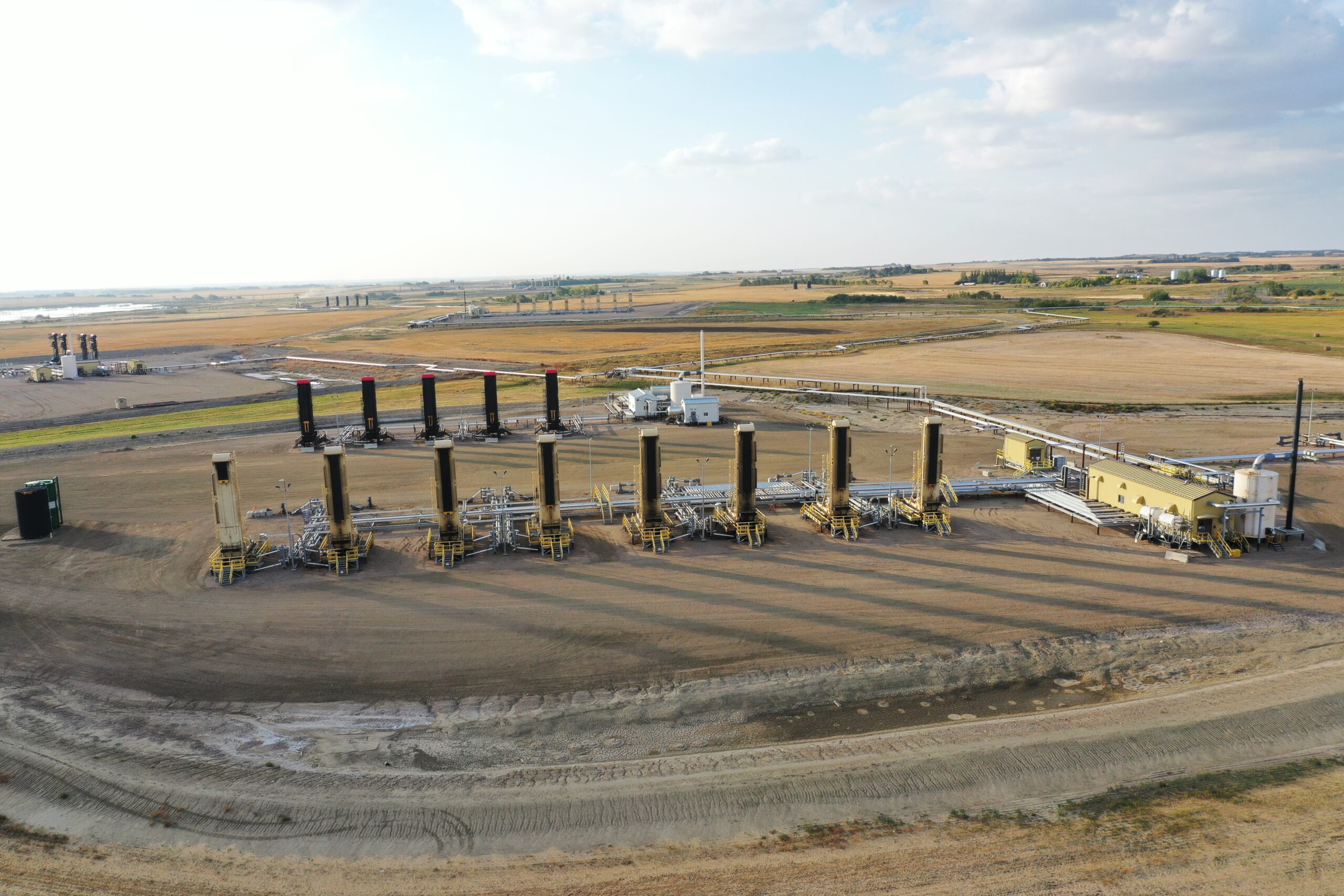
When I interviewed Premier Scott Moe during the fall election, he surprised me by saying he would like to see this province reach 1 million barrels of oil production per day, up from its current ~450,000 bpd. In 2019, the Saskatchewan Party government put forward a goal of hitting 600,000 bpd by 2030.
That got me thinking – could this be done? How? What would it take?
And when he won the election and promised to get everyone a family physician, I immediately wondered, where would the money come from? How are we going to pay for all of these doctors and teachers?
And what would the benefit be if we did double oil production? The impact would be massive. Oil is already our number one contributor to GDP, greater than ag or potash. We can’t easily double either of those. But we can do something about oil.
North Dakota went from 90,000 bpd to over a million in a few short years. They have vastly superior geology in one way, but we have 30 billion barrels of heavy oil that they don’t have.
So I started asking around, and did a few interviews, the first of many. I’ve been talking about this for a while, and now it’s time to put the pedal to the metal.
This will be an ongoing series, meant to explore just how Saskatchewan could double its oil production. Some might be naysayers. But maybe some will have some good ideas. I’m going to interview all the smartest people in the room over the coming months, even years, and keep pumping out stories. Premier Moe told me during my Christmas interview to “keep the heat on us,” and I intend to.
And in the end these stories are going to effectively be wrapped in a bow and plopped on the energy minister’s desk, with the ideas from the brightest people in the Saskatchewan oilpatch. Here you go, have at ‘er.
Increasing production isn’t a problem. Getting that production to market is. And those in power prevent us from doing so by using every means at their disposal to ensure no new pipelines are built.
By our rulers limiting our ability to move production, they keep the sales prices artificially low, as well as limit the wealth flowing into those provinces. If more wealth flowed into those provinces, the people would become well off and wouldn’t require government.
And so pipelines aren’t built.
As a bonus, we are bled dry through the carbon tax which is only made possible by continuously lying to the people about the moronic anti-scientific lie of anthropogenic global warming. The carbon tax is the largest, though certainly not the only tax put on oil and gas (in addition to the royalties already paid) which pushes a great deal of production into the uneconomical range. Were taxes lowered, entire fields would be reactivated.
Many outside the industry don’t realize how little oil is actually recovered from fields. And this is because at a certain point the incremental cost to recover a barrel of oil is higher than the revenue generated. Were the costs lowered (many of which are artificial, like taxes, and many more are beyond idiotic, like anything whatsoever to do with solving non-problems, like lowering “greenhouse gasses”) much more oil and gas would continue to be produced.
You got it in one, Watto. That right there is the elevator pitch for how to get to a million barrels per day.
Here’s something relevant to your point about pipeline capacity, Watto.
https://www.issueslab.com/2018/10/how-much-oil-can-a-rail-car-transport/
Canada is shipping 150,000 bpd by rail because there is no more pipeline capacity. So, of the 450,000 bpd currently being produced, it seems that pipeline capacity is around 300,000 bpd.
Something I do not know is the difference in cost between building 700,000 bpd pipeline capacity vs.555,000 bpd of rail transport capacity to handle the increased production of 1,000,000 bpd. Also, I don’t know how much more rail capacity already exists. Is it maxed out now? I dunno.
And your point about taxes is spot on. If you want less of something, tax it. If you want more of something, subsidize it. In the case of a commodity like oil, if the government does neither, the market will determine how much is produced given the producers’ costs.
I did some research regarding water pollution around Fort MacMurray about 30 years ago and found it was less after the oil extraction had been done. As a side note, it seemed to me that Saskatchewan had more oil sands capability than Alberta but just not utilized. I’m wondering if I was correct.
Anders you are way wrong. I looked for some good maps to link to but you can search for Clearwater heavy oil etc as well as I can.
Anyway not even close as the main oil sand reservoirs and source rocks either aren’t present in Sask or the sourced oil migrated away from Sask due to structural geology of the WCSB.
Don’t overlook the fact that not too far east of Ft Mac is the Canadian Shield ie all the oil reservoirs were eroded a long time ago.
And yes I am a geologist and worked Sask / Manitoba for decades.
I appreciate your comment. I did a quick search and the reserves are definitely smaller. One source shows them as an extention of the Ft. Mac. deposit and the Sask. government website says they are further south near Cold Lake. I can’t find it now, but I seemed to remember a paper article (not electronic) from around 1997, saying the reserves were larger and less accessible. Like all information, it could have been misinformation.
I don’t know how much more rail capacity there is. Saskatchewan is very good at rail transport and many trains loaded with oil head east to Winnipeg and then south to the Gulf refineries. Rail isn’t the long term answer if production increases to 1m but it can fill the gap in the short term.
If I am in any way successful in pushing Saskatchewan to get somewhere close to this goal, it will have been the most consequential thing I have done in my career. So there’s that.
There have been several times in recent years where production far surpassed pipeline (and rail) capacity. In such cases, there was a rush to fill storage in addition to shutting in production. This caused a fight over whose volumes could be sold, with available volumes being prorated or some such thing – I’m fuzzy remembering the details.
It also predictably crashed prices.
This is one of the reasons there isn’t more production today, though since then one can add the ever-rising carbon taxes and new costs and ever-changing regulations (which themselves create additional G&A costs) related to the junk science of AGW.
If pipeline (and expensive rail, which exists as an option only due to pipeline constraints) constraints were removed, production would increase significantly. And this would happen organically w/o any gov’t involvement.
If oil could be loaded to either coast, we would receive world prices and no longer be forced to sell for a discount to the US. The discounts (based on density) are publicly available, and are sometimes pretty steep.
Interestingly enough, Part 2, likely to be published Thursday, addresses pipelines.
… and you need to NOT alienate your best customer … US! You might want to mention that to Ottawa.
i think trump made that clear to the boy stupid. more than one reason he is exiting stage left
Kenji
Trumpy says the US doesn’t need Canadian oil.
Thus, Canada should build more pipelines to get our oil to market, rather than sending it through US pipelines (which apparently are needed for all that shut in US oil, that Trumpy wants to produce).
Harper summed it up pretty well the other day replying to Trumps threats. He said Canada has been subsidizing US oil production for decades. Trump might want to look into that before he slaps on tariffs.