
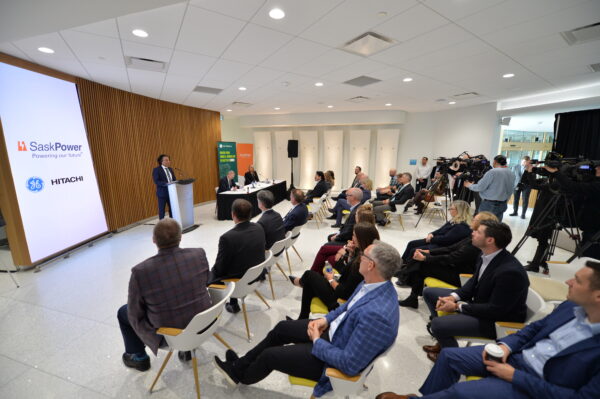
SaskPower and GE Hitachi advance small modular reactor plans, but won’t say how many, or how much they’ll cost just yet. Also, SaskPower looking at increasing grid by 2.5x in 25 years and 11 months. Didn’t I just write a column about that earlier this week? Oh yeah. What doubling the grid really means. Also, if you start doing the math, my earlier predictions Saskatchewan will need 15-20 small modular reactors (if not more) is looking pretty much on the money.
We could use way more reactors,,, judging the energy plans Manitoba put forward yesterday, they would be a nearby customer for us in the future.
Likely entirely right. It’s improbable that Manitoba will ever get its act together to build Conawapa. Compared to other Canadian provinces, Saskatchewan is unlucky not to have any large, high electricity demand US states immediately to the south.
All those reactors are going to require a lot of cooling water for normal operations and for emergency standby. Does Saskatchewan have enough drought proof cooling water reservoirs , lakes, and rivers?
We always had concerns about late Summer operations in dry years because of river flow, and/or water temperature. Never had to shutdown, but we had some nervous moments.
The main way to deal with a problem of cooling water shortage is to build closed-circuit cooling towers. This cools steam via condensation independently of withdrawing water from a large, cold water body. The only water loss is a very limited amount from evaporation. This amount lost by evaporation is about 1% of the total mass.
The EPA Laws requires us to return any water used at a lower temperature. I worked at a 550 MWe unit that was pretty much closed loop. It took 6,000-12,000 gpm in, did all the cycles and recycle like you said, and dumped 1,500 gpm of really muddy goo into a ditch headed back towards the river.
We still had issues. The river temperature in August sometimes got close to the shut down temperature of 95F. Sometimes the river flow and level approached the shutdown levels, and we started draining a nearby recreational reservoir. A major well timed thunderstorm often corrected the problem.
I worked at other plants on the Big Mississippi and Missouri rivers, and we still had concerns some drought years.
Saskpower has Shand coal power plant. It is a zero effluent plant. Instead of a large water body, it pipes in water from 2 large reservoirs (Rafferty and Alameda, IIRC). The water is cooled by a cooling tower and then sent to a “pond” system (large lined dugouts) which are recirculated until it’s sludge. So, in theory and practice this would likely work for a small reactor. Winter is cold and summer nights are cool enough to maintain cool water temps.
But, yes, the two sites chosen are near large water bodies. Rafferty/Alameda/Boundary Dam near Estevan. Elbow is on the shores of Lake Diefenbaker which is one of the biggest rammed earth dams in Canada. Saskatchewan also has water bodies large enough to produce hydro power for saskpower – Lake Diefenbaker/Gardiner Dam, the Nipawin region (more than one hydro plant) Island Falls, the Athabasca area (more than one hydro plant).
I live on the SSR upstream from Diefenbaker. The river right now and the summer of ’23 is ‘flowing’ at critically low rates.
Alberta has already issued low water warnings for this year. Water levels are not guaranteed just because you have a dam. Far from it.
Yes, the last few years have been particularly dry and it’s affected water levels and hydro production. Dief isn’t getting much water from AB and BC because they’re drier too (provincial water agreements govern the water transfers coming east to SK and MB). But, there’s still lots of water because of the size of the lake.
A decade before 2023 was normal water levels.5 years before that was too wet and Dief was full. Saskatchewan weather and moisture/rainfall levels move in multi-year cycles, as they always have.
Rafferty and Alameda were built during a dry cycle and people joked it would take 20 years to fill them. It took less than 5 years because there were a series of high rainfall years.
Nuclear Energy has potential but don’t use the line with me that it will release less omissions of CO2 than fossil fuels! Co2 is the food for photosynthesis and is the reason we are alive on this planet!
And what the scientists don’t want to talk about is the storage of spent fuel and RD mentions the problem of cooling!
Spent fuel storage is not a problem. Dry storage for used nuclear fuel has been in use in Ontario, New Brunswick and Quebec for more than 40 years. It’s been used in many countries around the world. It has a 100% success in containing used fuel, in preventing radiation from leaking into the environment. Worldwide, no person has ever been injured by any failure of any dry storage cannister anywhere.
CGH your storage facilities last for how many years ?
The fuel storage casks are monitored continuously. The design is simple and robust and should last for hundreds, if not thousands of years. The casks are made out of inches thick stainless steel. The radioactive fuel itself is still contained and prevented from escaping by the zirconium metal fuel cladding when it is installed in the cask itself.
Long term? I hope we begin reprocessing the fuel. There is still a lot of fissionable Uranium and Plutonium left in the fuel, along with lots of radioactive daughter products that can be converted into less radioactive material by neutron bombardment in a reactor.
France and Japan already reprocess nuclear fuel.
You could reprocess that fuel many, many times, if you really wanted to. The pesky plutonium is a bit of a problem, however. Was useful when everyone was building nuclear warheads, not so much otherwise.
Plutonium fissions just fine, and the more you expose the natural U238 to neutrons, the more plutonium you get.
With our BWR Reactor, we were getting more power from the plutonium bred in the third cycle fuel assembly than from the enriched uranium at the end of cycle. The biggest design issue with Plutonium is the shorter delayed neutron fraction. It makes the reactor more responsive to positive reactivity transients. It is a design issue.
I think we missed an opportunity by not buying Russian Plutonium for use in commercial Mixed Oxide fuel in the 1990’s. Get rid of their nuclear weapons for them.
RD–Storage of spent fuel is a problem—-what’s your option on these facts—–Stainless steel retains its integrity for over 50 years. The metal can take 100 to 1000 years to complete breakdown into natural elements.
Zirconium—–the metal is exceptionally resistant to corrosion and high temperatures
But—there is always a but -zirconium reacts with water.
Zirconium reacts violently or explosively with borax : and Potassium Hydroxide and Sodium Hydroxide when heated, and also reacts violently with copper oxide and Lead oxide.—-Dust of pure zirconium will ignite or explode when in contact with WATER!!!
JUST saying safe storage of used fuel is a problem!
Cooling is not a problem as long as the unit is sited properly.
I hear the word “Prairie” and I think hot and dry. If it was wetter, it would be Forest, not Grassland.
Palo Verde has three HUGE 1100 MWe units in the middle of a desert. Their major source of water is the Phoenix area waste water. It works.
The problem is do you have good sites for a dozen units? Two dozen? Or maybe just 10?
Trouble with nuclear power is that it is too expensive for a debt ridden population about to enter the greater depression. Government has no more resources to prop the economy up anymore so down it will go. We are seeing that in commodity prices everywhere. canuckistan is commodity dependent and producer prices are mostly below cost of production right now. More coal is the solution in the short run.
I’m sensing a glitch in the matrix. The matrix tells us we will need twice the amount of electricity to power our renewable future including EVs. But Morpheus tells us the matrix is a lie. We don’t need that extra electricity because EVs won’t work in Saskatchewan. The two claims are contradictory. We either need more electricity or we don’t. But doubling electricity to replace fossil fuels when it’s not needed seems a fool’s errand.
Plus Saskatchewan can’t export it’s excess electricity because there are no customers (none to the north or south, Alberta and Ontario to the west and east that would rather buy their own power) and nobody above or below.
What am I missing or than cucumbers in Western Canada?
All very good points. Ever driven straight south of Saskatchewan? There is NOTHING and NO ONE. I drove through most of Montana a few weeks ago for the first time. And some people call Saskatchewan empty??? Mine if I steal these points for a future column?
You’re welcome to take those points. I’ve driven through Northern Saskatchewan many times. Luckily we didn’t have hub-caps on our van.
I think the EV craze will fade out long before we require 2.5x more electricty to power EVs. Is saskpower serious or merely playing the long game until the net zero fad also fades away?
Saskpower does need more electricity for mining and mining processing growth (like potash and uranium) , oil and gas, agriculture secondary industries (oilseed, biofuel etc), Saskatoon’s growing high tech sector growing around the CLS Synchotron and, of course, population growth.
Building natgas power plants is still the cheapest and fastest. Natgas is considered clean energy in most of the world. Not opposed to nuclear though.
A smart play would be to be the early mover in the middle of the continent, setup the SMR factory with the idea of suppling the couple dozen reactors locally but reserve slots every year for the needs in Alberta, Manitoba, western Ont and all of the midwest US.
All of these schemes assume someone has built a SMR factory for them somewhere they can receive these fast, low cost reactors from. There are great jobs to be had making these reactors, highly skilled welders, fabricators, generally the great jobs from the O&G and mining supply chain that has been outsourced to Asia.
Finish developing Manitoba hydro power. Build a transmission line through Saskatchewan to Alberta maybe one to NW Ontario as well.