
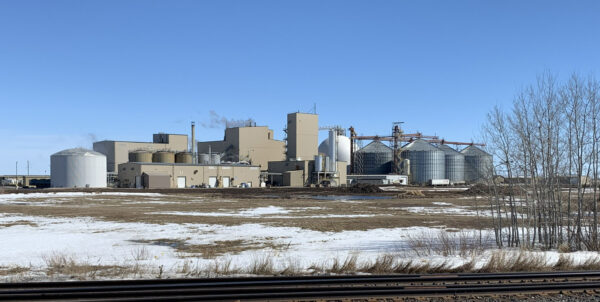
Yorkton’s Louis Dreyfus canola crushing plant to double in size, driven by the Clean Fuel Standard Saskatchewan’s government opposes.
This is a real conundrum for the provincial government. The mantra, for decades, is to bring value-added processing here. But in this case, it’s to replace petroleum with biofuels. Which, in turn, takes farmland out of food production and puts it into fuel production. That might be okay, if everyone on this planet was properly fed. They aren’t,
This is a real conundrum for the provincial government. The mantra, for decades, is to bring value-added processing here. But in this case, it’s to replace petroleum with biofuels. Which, in turn, takes farmland out of food production and puts it into fuel production. That might be okay, if everyone on this planet was properly fed. They aren’t,
My mom lives directly across the fence from both this plant and the JRI plant. She was there long before they were built in 2009. They were both built directly upwind of the city of Yorkton. And they smell like the contents of a diaper of a four-month-old baby, ALL THE TIME. Oddly enough, the prevailing winds sometimes sweep that smell right past the acreage and straight into the heart of Yorkton. You can often clearly smell it clear across the city, from Broadway to the Parkland Mall. While that may be the smell of money for the few hundred people that work at them, it’s definitely not for the 16,000 other residents.
With billions of barrels of petroleum under the prairies, I think it’s the height of idiocy to be burning food, or to be growing burnable food instead of edible food, where edible food could be grown.
Burn your food. What great f*****g idea. Canadians cannot be this stupid.
I noticed this in Brooks with meat packers west of town. Why put these plants upwind (predominant wind direction) of a population? Nobody thought of this before they gave them licenses? And yeah, using food growing land for energy is lunacy.
When the company put up the ethanol plant in Chatham, Ontario it was also on the windward side of town. Partly for rail access, gotta bring in that USA corn to drive down Ontario prices. Eventually the company spent a BIG wad of money to extend the discharge stack higher in the skyline to dissipate the odour and complaints.
a good amount of the time, the plant was there first, and then people started building around it… It’s one of the reasons the Stockyards in Toronto no longer exist
My father did some of the original research and testing on vegetable oil as lubricants. The problem is still the same – removing the plant fibers from the mix so that flow is not interrupted by clogging.
The British economist Tim Worstall pointed out that if biofuels were economic, farmers would be using them to produce them. They aren’t.
In an energy economy like ours something that isn’t economic is probably also energy inefficient. Odds are the studies saying biofuels cost more energy than they produce are correct. And frankly, the studies edged in their favour only show low to modest gains.
Here’s a thought experiment: if you used deisel to plant a section of bio fuel crops how many more sections would said biofuel allow you to plant? Is it greater than 1?
Grey, hahahahahaha. Good one.
“Odds are the studies saying biofuels cost more energy than they produce are correct.”
You can bank on that, Grey. Because even Natural Catastrophic Magazine admitted (reluctantly) as much in an article I read about fifteen years ago.
Some rough calculations using numbers from my farm. Liters of diesel used to produce a section of canola – approximately 9000 Canola production (using my crop insurance numbers) from 640 acres of canola – 750 tonnes. Oil content of canola – 44%. 750 x .44 = 330 tonnes of oil produced. There’s roughly 1200 liters of oil / tonne, so 330 x 1200 = 396,000 liters of canola oil produced in one section of land. It would take 18 super b’s to move the canola to the crusher. Let’s say 100 liters / trip. 1800 liters for trucking plus 9000 liters used in production. Under 11000 liters to produce 396,000 liters of canola oil.. Of course the crusher would use a certain amount of energy, and that would have to be factored in as well.
Thanks for the numbers to plug in.
Of course you won’t be pouring canola oil in your tank and doing another 40 sections. Not even with 20% real deisel that’s normally mixed with biofuel. A lot more needs to happen before that canola oil is actually a viable fuel source.
So we use 11000 L of deisel at appx 38mj per litre, to get 400000l of canola oil at from what I can find 17mj per kg. Canola is like 950g per litre so close enough to just 1:1 it. That gets us down to about 18x the theoretical energy gain. Good enough if that was where the story ended.
And yet no one, not even the gungo-ho biofuel folks, are giving us numbers like that. Any idea why on your end? Surely the process of converting canola oil to viable bio fuel doesn’t entail a 90% energy loss. An 18 fold increase is plenty, even a 10 fold increase is plenty. The bio fuel research I read was bragging about a 2 fold increase, while the skeptics gave a loss of around x.8 the inputs.
Could be even the bio supporters in unis have shit for brains and undercalculated the gains. Your numbers look good to me and indicate at least 15x gains.
If anyone here has a guess at what the discrepancy is let me know.
What about the Fertilizer, Herbicides, and Pesticides?
Ammomia / NH3 and Nitrate / NO3 fertilizer are made from Natural Gas.
Pesticides and Herbicides are petrochemicals.
Don’t we need to add in those inputs too?
I remember when Sri Lanka went organic and outlawed fertilizers, pesticides, and herbicides.
It did not go well.
Plus I think the biodiesel content has to be cut back drastically for winter diesel.
That would be a great letter to the editor for Pipeline Online. If you like, email me at brian.zinchuk@pipelineonline.ca
In 2011, in one study, they managed to show that the opportunity cost of producing 15,000 gallons of biofuel, was -$9,235, versus the market margin of just selling the canola.
https://www.gov.mb.ca/agriculture/farm-management/production-economics/pubs/cop_agrienergy_canolabiodieselfarmfuel.pdf
you can also search for “Smith, E.G., Janzen, H.H., and Newlands, N.K. (2007). “Energy balances of biodiesel production from soybean and canola in Canada.”, Canadian Journal of Plant Science, 87(4), pp. 793-801. doi : 10.4141/CJPS06067″ which somehow comes up with a ratio of biodiesel energy produced per energy input of 2.08 to 2.41
There was a later study called “Energy balance of biodiesel production from canola” in 2017, which came up with an energy balance of 1.39.
By this time we should have actual number from the various plants that currently refine biodiesel, which should have the various manufactures shouting those numbers from the rooftops, and yet they aren’t… why is that?
A flimflam scam.
The US farm lobby loves the subsidies and so do Canadian farmers. Shame on them all.
There is no “Energy Transition” taking place. Some people will be driven further into poverty, but…
https://oilprice.com/Energy/Crude-Oil/Oil-Demand-Set-To-Remain-Strong-For-Years-To-Come.html
There’s a similar plant just south of Lethbridge. They’re currently expanding operations.
Corn alcochol for fuel is probably worse. Enormous energy to boil and ferment to get like 12% alcohol. Then enormous energy to boil off all the water to get 97%. Then enzymes to get to 99% alcohol. Then enormous energy to dry the spent grains for disposal / feed.
ethanol is half burnt ethane . easy math .
Where did the idiotic notion come from that not everyone on Earth is properly fed? Of course they’re not. 50% of Earthlings eat too much food and they are extremely fat (and ugly) and most of the other 50% can’t afford to eat. Eating has nothing to do with food production. There is nothing wrong with pumping oil and gas, processing canola into biofuel AND growing food. Do it all Saskatchewan. Feed and power the world. No apologies necessary.
Remaining unsaid is the tremendous waste of water associated with biofuels. The “fruited plain” all the way from eastern Wyoming to Kentucky is now a vast, single crop planting driven by the demand (and subsidies) for ethanol. (So much for diversity). A good deal of this land is, without irrigation, unsuited to row crops and would be better grazed by farting, belching, edible ruminants. The depletion of the aquifers is significant, all in the interest of reducing the emission of benevolent, fertilizing CO2.
Also unsaid is the absurd belief that Western emission reductions can impact atmospheric levels of CO2 in a way that is at all significant, when India and China are building coal-fired power plants as quickly as they can. Madness, I tell you. Madness.
If nitrogen fertilizer is cut back existing crops will be less productive. Therefore more land will have to dedicated to fuel production that would have been dedicated to food. The result would be less food production. Sounds like winning plan. Not!
Wait a minute? Are you all saying that it isn’t worth taking farmland, while at the same time being subsidized by money stolen from the oil and gas industry in order to produce one of the shittiest fuels on earth?
If it wasn’t for ethanol, small engines wouldn’t get gummed up, and then the related pieces of equipment wouldn’t be largely thrown in the dump.
For this is what greases the wheels of the economy – in essence stimulating it.
Right, Keynesians?
Pretty close to on the money there.
A few yrs ago I read an excellent report by USN Captain Ike Kiefer on the potential for utilizing Bio Fuels for the US Navy.
His conclusion – not a freaking chance. Simply not cost effective and takes far far too much food production.
chrome-extension://efaidnbmnnnibpcajpcglclefindmkaj/https://www.airuniversity.af.edu/Portals/10/SSQ/documents/Volume-07_Issue-1/Kiefer.pdf
https://www.amazon.com/Twenty-First-Century-Snake-Oil-Biofuels/dp/0991887808
Among his findings:
Biodiesel and ethanol are less energy-dense their petroleum-based counterparts.
Some biofuels consume more energy than they produce. “Making corn ethanol is a negative energy-balance process.”
Commercially viable cellulosic biofuels do not yet exist. “Despite all the subsidies, tax breaks, and fuel-mixing mandates since 2005, there is not a single commercially viable cellulosic ethanol facility in the United States today.” (Range Fuels announced production from what it calls the country’s first commercial cellulosic biofuels plant in August).
Biofuels do not reduce price volatility. “Liquid biofuel prices are already as volatile as oil prices and track up and down with the international oil market.”
Fossil fuels will still be required to power farm machinery, produce heat and electricity for conversion of biomass to fuel, as feedstock for herbicides and pesticides, and to prepare cultures used in fermentation processes. “The parasitic dependence of biofuels upon fossil fuels precludes any chance of their reducing dependence on foreign oil, assuring domestic supply, or stabilizing prices.”
Biofuels are costly. Kiefer cites one estimate that the Navy has never paid less for any biofuel than $1,123.50 per barrel. This does not factor in additional outlays by the US, such as government-funded research and development.
Using food crops for fuel can drive up global food prices. “A union of the world’s preeminent food and financial assistance agencies, including the World Food Program and the Food and Agriculture Organization of the United Nations, has formally called for all G20 nations to drop their biofuels subsidies and mandates because of the impact on food prices around the world.”
Lifecycle analysis calls into question the environmental benefits, and water footprint, of biofuels versus their petroleum-based counterparts.
HE pretty much nails it IMO.
Fifty years ago rapeseed oil was used as a machine lubricant. A larger more profitable market awaited if people were convinced to eat it. After “refining” it , the name was changed to canola oil. This is not the first time something like this was done. Before 1911 cottonseed oil was used for soap and candle making. Proctor and Gamble hydrogenated it and so was created Crisco. Crisco is a contraction of the phrase crystalized cottonseed oil. Crisco now is made using canola oil.
ethanol is half burnt ethane . easy math .
L – So, the City of Yorkton and the gov’t. of Saskatchewan agreed to
locating this processing plant upwind of Yorkton. Interesting, the
city, prov. and fed. politicians would have to answer to the residents
of the city of Yorkton before hand. If the issue came up… was everyone
asleep at the wheel? How much federal money is involved?
Taking farmland out of food production and into uneconomic, low
quality “bio”-diesel. This in order to appease the Trudeau regime’s
plan to use E.S.G. as a justification to seize total control of the economy
regardless.
As a kid in Yorkton in Grade 8, I clearly remember doing a school assignment about placing industries with relation to prevailing winds. Guess no one else passed that class.
It would be interesting looking into the real estate shenanigans in Yorkton, circa 2000-2007.
Was it an Expropriation issue (Eminent Domain for you Americans)?
Or was some politician’s friend a large landowner northwest of Yorkton?
Can’t be a road or rail access problem.
I drive past that site a few times every year on may way to visit relatives and have been astounded at the growth north and west of Yorkton.
This is what tells the story:
EROI =
Energy available in newly produced fuel
Divided by
Energy consumed in producing the new fuel
STOOPID by any calculation…but then who ever thought Politicians had any level of Intelligence…just take a good look around ya…??
Nothing but Gritfing blobs of STOOPIDITY – pissing away billions on pure nonsensical Bullshit.
But billions must be spent to combat a problem that doesn’t exist – global warming!
The scum who rule us are prepared to spare no expense (for which we must pay) in order for this to be accomplished.
Once we are all reduced to servitude, then the real problem will be solved – the existence of rights and freedoms for the people.
Though those on the left (aka imbeciles) still won’t see the forest for the trees, and will continue to assist their slave masters by attacking those with the ability to reason, and the fortitude to stand up against tyranny.
Canadian politicians decided to fund massive cucumber greenhouses in the coldest and rainiest province (Newfoundland)(google “Sprung Greenhouses”)
They also decided to build sh*tty, poorly made sportscars in New Brunswick (Bricklin Motors).
And right now the are building faulty Navy and Coast Guard ships (CCGS Franklin, Cartier, Cabot).
What’s another few billion here and a few billion there?
Generally, the viability of such projects should be judged by their profitability – net of any subsidies. If it’s heavily subsidized, it’s usually not viable. LCROEs are all over the board on biodiesel and negative with ethanol.
Lloydminster is home to ADM’s canola crush plant, located in the AB west side (prevailing). Cenovus refinery and ethanol plant in SE, Sk side
Red Deer Permalex ethanol plant on #2 north of the river. (Upwind)
Edmonton refinery row was on eastern boundary. (Upwind of “the village of” Sherwood Park).
french company, experts at government handouts
Better to burn them than eat them. (Even though growing canola keeps my brother-in-law in a lifestyle that he’s become accustomed to.)
How the ubiquitous use of processed seed oils ushered in a new age of disease.
https://www.theepochtimes.com/health/the-omega-6-apocalypse_4066081.html
The stupidity is that if you produced biofuels in an enclosed loop you would eventually run out of energy. Drilling for fuel produces much more energy than it consumes. Not so with biofuels. The whole exercise is moronic.
At least they are going to build the stinky plant behind the Garlic Curtain.
The Regina AGT Food crush plant and FCL renewable diesel refinery are going to be built within about 2 miles or less of Gavin Semple’s place. Isn’t he a billionaire by now? I wonder what he’s going to think of the smell?
Garlic Curtain. Isn’t Yorkton in the Pyrogy Triangle? Hit Yorkton late one night and some restaurant had a Ukrainian plate. Kubaca holopchi and pierogies – the second holy trinity.
Canola oil is horrible for human health. But it’s worse for fuel.
Stupid. Stupid. Stupid.
And don’t lecture me. I have to grow this stuff to turn a $.
Dumba$$
Thumbs up to that.