Why this blog?
Until this moment I have been forced to listen while media and politicians alike have told me "what Canadians think". In all that time they never once asked.
This is just the voice of an ordinary Canadian yelling back at the radio -
"You don't speak for me."
email Kate
Goes to a private
mailserver in Europe.
I can't answer or use every tip, but all are appreciated!


Katewerk Art
Support SDA
Paypal:
Etransfers:
katewerk(at)sasktel.net
Not a registered charity.
I cannot issue tax receipts
Favourites/Resources
Instapundit
The Federalist
Powerline Blog
Babylon Bee
American Thinker
Legal Insurrection
Mark Steyn
American Greatness
Google Newspaper Archive
Pipeline Online
David Thompson
Podcasts
Steve Bannon's War Room
Scott Adams
Dark Horse
Michael Malice
Timcast
@Social
@Andy Ngo
@Cernovich
@Jack Posobeic
@IanMilesCheong
@AlinaChan
@YuriDeigin
@GlenGreenwald
@MattTaibbi
Support Our Advertisers

Sweetwater

Don't Run

Polar Bear Evolution

Email the Author
Wind Rain Temp

Seismic Map
What They Say About SDA
"Smalldeadanimals doesn't speak for the people of Saskatchewan" - Former Sask Premier Lorne Calvert
"I got so much traffic after your post my web host asked me to buy a larger traffic allowance." - Dr.Ross McKitrick
Holy hell, woman. When you send someone traffic, you send someone TRAFFIC.My hosting provider thought I was being DDoSed. - Sean McCormick
"The New York Times link to me yesterday [...] generated one-fifth of the traffic I normally get from a link from Small Dead Animals." - Kathy Shaidle
"You may be a nasty right winger, but you're not nasty all the time!" - Warren Kinsella
"Go back to collecting your welfare livelihood." - Michael E. Zilkowsky

Kind of mixed on this.
There are many challenges we have not overcome despite massive efforts, and there’s no law that says these problems must eventually succumb to human ingenuity.
I remember arguing with people over certain types of renewable energy, pointing out some of the fundamental drawbacks. But these people insisted that if we only throw enough science at it, we can solve those problems. After all, we put a man on the moon didn’t we? But thermodynamics is an implacable foe; the first and second laws might never be breached, and hoping they will is extraordinarily optimistic.
Clarke’s Maxim applies. I’m sure we haven’t seen the end of exponential leaps in technology, like airplanes in the first half of the 2th century and microchips in the second. But I think it’s a reasonable approach to expect that those who believe that intractable problems with renewable energy can be solved by “throwing enough science at it” pay for the science themselves.
I think technology growth will continue.
But not always in the directions we expect. Some problems will remain intractable.
Renewables will never be able to power this planet. Unless the oligarchs succeed in massive depopulation. The laws of physics don’t conform to human will.
https://www.manhattan-institute.org/green-energy-revolution-near-impossible
Unless the oligarchs succeed in massive depopulation.
What do you think the recent fake pandemic was all a bout … it was a dress rehearsal. More and deadlier to come.
Once everyone has taken the jab, by force if necessary … we are then set up to die young while unable to procreate … nice and tidy and no ordinance required.
Biz tip … Get into the funeral business now. All you will need is a backhoe and a front end loader.
Circa June 24, 2016
editorial
The Brexit vote is complete folly, but there is still time to reverse it
“First, the anger.
It is appalling that fear has won the day in Britain. In a result so close – 52 per cent Leave versus 48 Remain – it is inevitable that voters motivated by the veiled racism in the anti-immigration rhetoric of the Leave side had a direct impact on the outcome.”
Sound familiar?
https://www.theglobeandmail.com/opinion/editorials/the-brexit-vote-is-complete-folly-but-there-is-still-time-to-reverse-it/article30608142/
The biggest challenge we face in technology may well be water related. There is likely to be excess fresh water generated by slowly receding arctic (and eventually perhaps Antarctic) ice. Even if not so, there is an annual cycle where predictable amounts of fresh water rush into the oceans in polar latitudes. The places that could most profit from that excess water are many thousands of miles away, for example, the southwestern U.S. — so here’s the challenge, how could that water flowing into the ocean be transported to places where it can be made useful? Or is that the solution? More local desalination, or other ways to create water resources that do not exist today.
I don’t claim to know the answers. I just know this is a challenge we should work on, perhaps more urgently than finding Nazis in Ukraine or new genders we didn’t know about until after lunch time today.
No matter what we do nature will eventually take care of it.
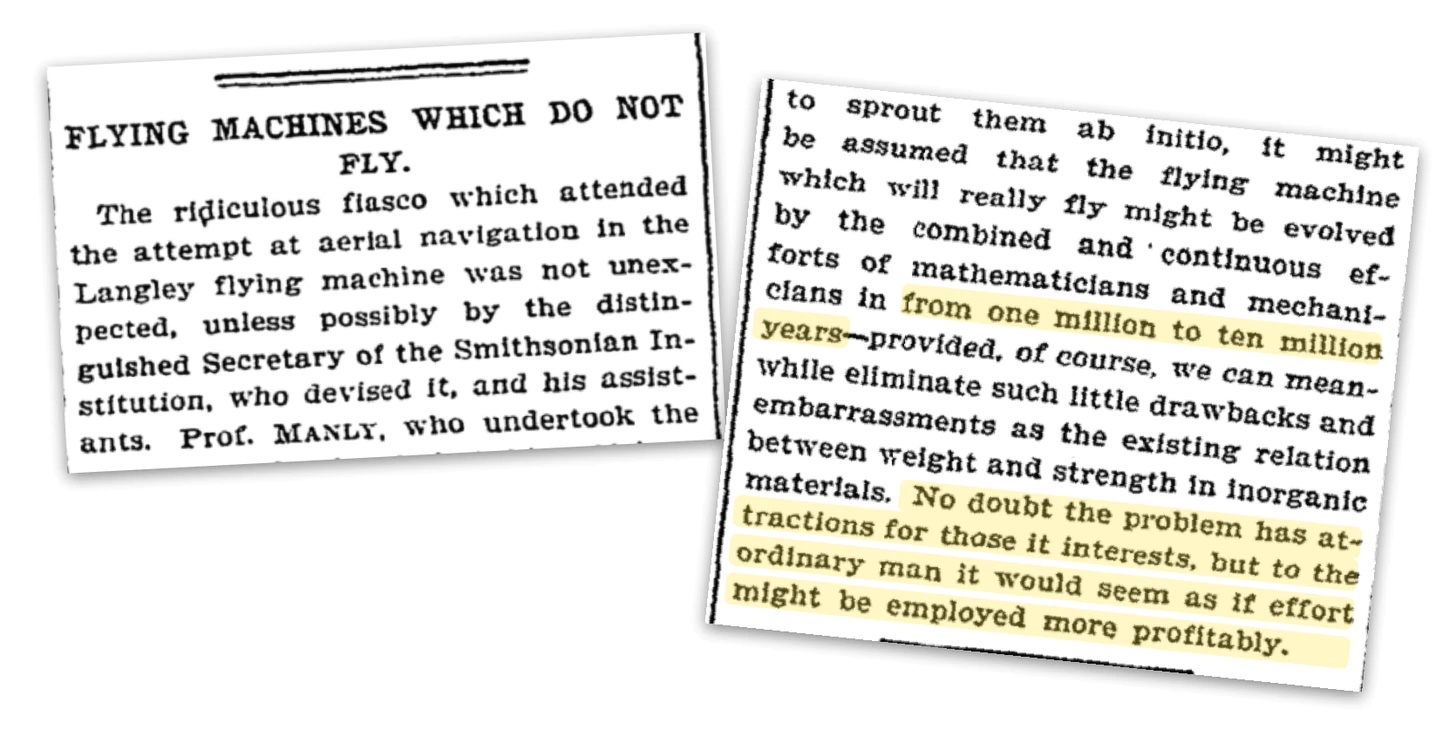
Langley had been given 25 thousand dollars by the US government to develop a flying machine, and succeeded only in launching it into the Potomac.
Meanwhile two bicycle mechanics developed the laws of aerodynamics on their own dime.
The Wrights continued what Otto and Gustav Lilienthal worked on. Both pairs of brothers observed birds and used them as the basis for their planes. The Wrights also tested some of their early concepts by building kites.
Don’t forget that back then, aviation was a new field and anybody, regardless of background or education, could easily become an expert. If I’m not mistaken, the Wrights eventually created charts of lift coefficients which even university-educated enthusiasts, designers, and researchers referred to.
Otto Lilienthal died in 1896 from injuries because the glider he was flying crashed. Had that not happened, he might have been the first one to fly a powered airplane. Gustav Lilienthal died in 1933, long enough to see what he and his brother worked on become not just practical but commercial.
Similarly, Wilbur Wright died in 1912 from typhoid. Orville died in 1948, a few months after Chuck Yeager broke the sound barrier.
I just ordered my space helmet. I put the rest of the space suit on layaway.
That quote was from the Editorial Page of the New York TImes.
Same stupidity and ignorance and it’s 119 years later.
By the way Kitty Hawk and the Wrights Brothers was also 1903.
New Zealander Richard Pearse may have independently developed a primitive flying machine, at around the same time as the Wright brothers and with some interesting innovations! They built a working model based on the designs and parts they discovered, and it can manage short hops. But there were few witnesses, poor communication in the sticks there, and it was never then widely reported; and Pearse never got serious about it.