Why this blog?
Until this moment I have been forced to listen while media and politicians alike have told me "what Canadians think". In all that time they never once asked.
This is just the voice of an ordinary Canadian yelling back at the radio -
"You don't speak for me."
email Kate
Goes to a private
mailserver in Europe.
I can't answer or use every tip, but all are appreciated!


Katewerk Art
Support SDA
Paypal:
Etransfers:
katewerk(at)sasktel.net
Not a registered charity.
I cannot issue tax receipts
Favourites/Resources
Instapundit
The Federalist
Powerline Blog
Babylon Bee
American Thinker
Legal Insurrection
Mark Steyn
American Greatness
Google Newspaper Archive
Pipeline Online
David Thompson
Podcasts
Steve Bannon's War Room
Scott Adams
Dark Horse
Michael Malice
Timcast
@Social
@Andy Ngo
@Cernovich
@Jack Posobeic
@IanMilesCheong
@AlinaChan
@YuriDeigin
@GlenGreenwald
@MattTaibbi
Support Our Advertisers

Sweetwater

Don't Run

Polar Bear Evolution

Email the Author
Wind Rain Temp

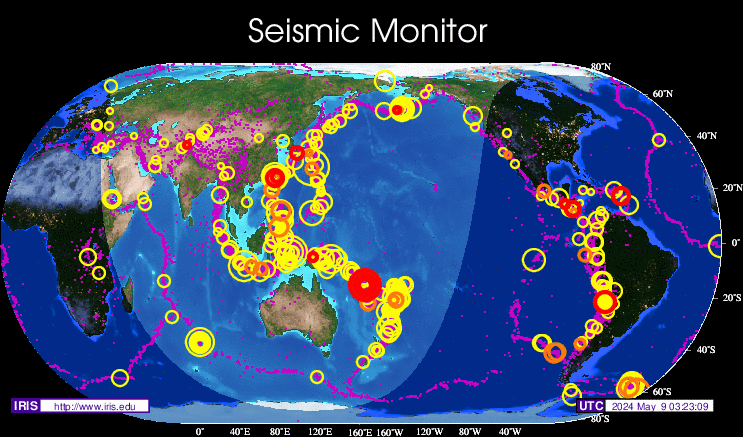
Seismic Map
What They Say About SDA
"Smalldeadanimals doesn't speak for the people of Saskatchewan" - Former Sask Premier Lorne Calvert
"I got so much traffic after your post my web host asked me to buy a larger traffic allowance." - Dr.Ross McKitrick
Holy hell, woman. When you send someone traffic, you send someone TRAFFIC.My hosting provider thought I was being DDoSed. - Sean McCormick
"The New York Times link to me yesterday [...] generated one-fifth of the traffic I normally get from a link from Small Dead Animals." - Kathy Shaidle
"You may be a nasty right winger, but you're not nasty all the time!" - Warren Kinsella
"Go back to collecting your welfare livelihood." - Michael E. Zilkowsky

Many years ago, there was the theory that the Earth and the moon were originally a single body. The combined mass spun sufficiently fast that the moon broke off, creating the Pacific basin.
A short while later, that idea was discarded because the concept of plate tectonics had been formulated. It only explained how the Pacific was formed as well as how the continents acquired their present shapes. (Plate tectonics, of course, confirmed the idea of continental drift first proposed by Alfred Wegener nearly 100 years ago.)
Plate tectonics is largely accepted nowadays because there is overwhelming–and verifiable–evidence supporting it.
The evidence for lunar formation is much sketchier. Some hints as to what might have happened have come from rocks returned by the Apollo crews, as well as observations made by a variety of lunar probes.
Other evidence is obtained by orbital mechanics simulations, though those are only computer models. Changing a few parameters can produce completely different results.
Just when you think you have heard it all.
Barack Obama, Climate Scientist
From WUWT.
B, what I find about this article is that it suggests that several impacts whole result in material winding up in the same place, and that would require impacts that are very close “energy” wise, and angularly, which ain’t gonna happen, not even in a billion years. These impacts would just be too random in all aspects
Why not? Al Gore is one as well. Then again, Gore also invented the Internet, didn’t he?
that’s as good as JustIn the quantum Physicist :-)))
the fourth paragraph of the article states “the makeup of the earth and the moon are nearly identical”. Not really. The density of the earth is over 5 t/m3; the moon is a lightweight at 3.5. But the earth is the densest planet, and the moon is the densest moon, in the solar system, suggesting a close relationship.
The number of craters visible on the surface of the moon has always suggested a very large number of collisions with other space objects, and there is little doubt that the earth was hit at least as often. A collision large enough to dislodge a moon sized amount of material must have been a rare event; if it was common we should have more moons.
But wait- we have at least 150 moons in the solar system. Does the new theory apply to those moons too? If it does, it’s a good theory. I’m just enough of a cynic to suspect that many more years of serious and very expensive study will be required to settle the science.
You can’t knock a piece of rock off a gas giant planet.
No! No! It was a single impact! I was there! Richard Nixon had ordered my outfit to travel to the moon! It’s seared! seared! into my memory!
The one collision “deniers” should be locked up.
If by “locked up”, you mean rounded up and shot by checkists, I concur.
would this be a case of the more we know the less we know?
You know if you look at it just right it almost like Someone put it there.
The most logical is always the most opposed.
“The wisdom of this world is foolishness to God.” I Cor 3:19
Does it really, really matter how the moon got there.
God must have always wondered where that missing piece of green cheese ended up.
The real question should be where the giant galactic mouse is hiding out there.
Don’t scoff…my theory holds about as much water.
Wallace and Gromit couldn’t figure it out:
https://www.youtube.com/watch?v=T0qagA4_eVQ
The problem with this apparent refutation of the single-impact theory is that they presume the striking object had a significantly different composition than the Earth. You can’t really know that, one way or the other; you can only state it as a starting assumption.
Please … John F. Kerry. John Fitzgerald Kerredy
I noticed that as well. Why should we assume that other dense, rocky objects in the Solar system should vary greatly in composition from the dense rocky bodies that we have been able to sample, namely the Earth, the Moon, Mars, and meteorites?
If the planets all condensed out of the same planetary nebula, they should all have roughly similar compositions.
Does there even half to be a collision at all? Could the Earth-Moon system have been a double planet from the get-go?