Why this blog?
Until this moment I have been forced to listen while media and politicians alike have told me "what Canadians think". In all that time they never once asked.
This is just the voice of an ordinary Canadian yelling back at the radio -
"You don't speak for me."
email Kate
Goes to a private
mailserver in Europe.
I can't answer or use every tip, but all are appreciated!


Katewerk Art
Support SDA
Paypal:
Etransfers:
katewerk(at)sasktel.net
Not a registered charity.
I cannot issue tax receipts
Favourites/Resources
Instapundit
The Federalist
Powerline Blog
Babylon Bee
American Thinker
Legal Insurrection
Mark Steyn
American Greatness
Google Newspaper Archive
Pipeline Online
David Thompson
Podcasts
Steve Bannon's War Room
Scott Adams
Dark Horse
Michael Malice
Timcast
@Social
@Andy Ngo
@Cernovich
@Jack Posobeic
@IanMilesCheong
@AlinaChan
@YuriDeigin
@GlenGreenwald
@MattTaibbi
Support Our Advertisers

Sweetwater

Don't Run

Polar Bear Evolution

Email the Author
Wind Rain Temp

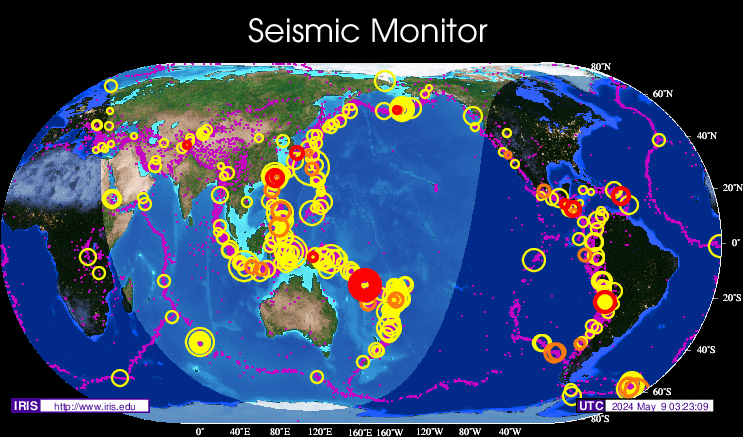
Seismic Map
What They Say About SDA
"Smalldeadanimals doesn't speak for the people of Saskatchewan" - Former Sask Premier Lorne Calvert
"I got so much traffic after your post my web host asked me to buy a larger traffic allowance." - Dr.Ross McKitrick
Holy hell, woman. When you send someone traffic, you send someone TRAFFIC.My hosting provider thought I was being DDoSed. - Sean McCormick
"The New York Times link to me yesterday [...] generated one-fifth of the traffic I normally get from a link from Small Dead Animals." - Kathy Shaidle
"You may be a nasty right winger, but you're not nasty all the time!" - Warren Kinsella
"Go back to collecting your welfare livelihood." - Michael E. Zilkowsky


But…but…he’s supposed to be brilliant! (sarc)
PS–Speedy recovery to you Kate!
You’d think that at some point, someone in his social circle would’ve shown him how to hold a wine glass.
But you can’t tell experts anything.
Maybe I could send him a fax…. If either of us still had a machine.
I have nothing to say!
A small sip for a small mind. That matrix construct is obsolete.
Think Google!
Famous last words, which shows just how much the predictions of economists are worth, particularly outside their profession. The corner store psychic with a cracked crystal ball could probably do at least as well and cost a lot less.
I seem to recall reading about someone saying the telephone would just be a passing fad too. Some people, trying to be/sound intellectual, are doomed to the abyss of wrongness. Oh well, not all of us can be right all of the time.
What do we say when Krugman says this was a joke-type piece?
It just gets funnier every day. 🙂 In a few years I’ll be gone and I’m honestly gonna miss it.
In honest defence, he is right. “most people have nothing to say to each other”.
He missed out in saying ‘of substance’.
That said, volume quickly fills the void.
Ergo…. The Internet: it fills the void.
Could somebody please be gracious and tell us what substantive contribution to the art of economics was made by this champagne sucking idiot that even the ignorant and easily bought Nobel Committee would deem worthy of an award?
internet is largely entertainment with a large dose of EGO. These futuristics just don’t understand that the unknown is unknown, and there fore will reveal it’s self as time passes. As to more “free” time, well that has been more than achieved, just that it’s distribution in society is a determent to society. It has created too many leeches, (useless pols and beaurocrats, and other welfare recipients)
The picture is perfect.
When it comes to Paul Krugman, I subscribe to “My Cousin Vinnie’s Law”.
https://www.youtube.com/watch?v=g4bftQ4xxFc
Just another tragic victim of Stoll’s Syndrome.
80% of the internet is only one question, repeated endlessly – “what’s the price for that?” You’d think an economist, of all people, would get this.
Good thing Al Gore wasn’t listening.
“most people have nothing to say to each other”
Which explains why no one ever came up with Facebook or Twitter.
The truth is not a defence, and lying or “being wrong” is an assortment of grey shades.
Welcome to Libtropolis, where is only fails if you personally feel strongly emotional that it failed.
These people must have some kind of anti embarrassment drug.
How long before we have a similar picture and statement regarding the predictions of a global warming disaster?
That one may take a number of years of continual global cooling.
“I do not believe in any kind of ism. I believe we understand very little about human nature, about psychology or about economics. I do not take seriously any of the people who claim to predict the future. I believe them even less when they claim to be accurate predictors.”
– Freeman Dyson
Predictions are rarely accurate, and even then only because given the sheer number of predictions, someone has to get something right sometime.
Anyone can make a bad prediction. Krugman’s error is being arrogant about it.
Progressives don’t look backward. Being consistently wrong from Paul Ehrlich in green doom, other Malthusians in running out of resources, the New Deal, eugenics and national socialism in the 30s to Krugman in economics (and the internet), and, disastrous foreign policy, is all just irrelevant noise. The only thing that matters is politically correct thinking and being inside the progressive bubble. Socialism always fails but that doesn’t ever stop the professoriate from pimping it.
This is how they have come to own the culture. While (non-progressive) conservatives want to correct past progressive destruction, progressives are perceived as forward looking to the uninitiated. Everything is a blank slate, thus emotions and desires appeal to the extremely limited attention span. “Government and more of it can relieve you of most adult responsibilities and give you all the free stuff you want. Debt is history, we don’t think about it so it doesn’t mater”. Trudeau is cute so……..
The mistake Kahn made in his predictions about the future was in neglecting the destructive effect of an increasingly totalitarian government and exponential growth in beaurocracy, regulation and crony capitalism. As someone, who in 1969 considered the state to be overly large, it never occurred to me that 45 years later the bulk of my time would be spent in fighting the newly formed oppressive plutocracy that currently rules the world.
One of the problems that scientists make in their predictions is ignoring the human factor and my discovery that there are truly evil people in positions of power was made relatively late in life. Just because there are few psychopaths in science doesn’t mean they don’t exist, they just all end up in politics. The 1960’s were an era of incredibly optomism and scientific progress both in the area of physical science and new pharmacologic approaches to neurophysiology. At the time it was hard to believe that we wouldn’t be living in moon bases by 2000. It would have been hard to believe to those of us who were technologic optimists in the 1960’s that in 2014 the Western world would have become a neofeudal totalitarian oligarchy; good thing we became proficient in bomb making and became armed for a conflict that never materialized back then. It would have never occurred to me that Russia and China would be the centers of innovation in 2014. Robert Heinlein was far better in his predictions as I couldn’t figure out why he had “The Crazy Years” in his future history, but he was obviously looking at humanity more broadly than those of use who were scientists did.
What this does show is the dangers of predicting what happens with complex systems. Nasim Taleb provides the best intellectual framework for anyone who’ll be dealing with the future in his The Black Swan, Fooled by Randomness, and most significantly Antifragile. Anyone who lives and a city and who reads Antifragile would be moving into the country as quickly as they could sell of their city assets as what has occurred over the last 40 years is the creation of the most fragile civilization one could have imagined. I now make a point of not visiting any large city.
For new technologies, one can’t predict a-priori how one will use them. At a friends urging, I diched my old cell phone with 32 Mb of RAM (which I thought was a marvel of engineering) and replaced it with a new Samsung S5 Galaxy which blew me away with the processing power; 2 Gb of RAM, 16 Gb of Flash, a quad core 2.7 GHz ARM processor and a faster GPU than I have on my laptop. Also the 1920×1080 pixel screen in this form factor is mindblowing. My view of this device is a supercomputer that I can carry on my belt. It allows me to create software wherever I am as well as perform ambulatory physiologic monitoring (well as soon as I find the necessary interface cables) and, for me, the phone part is superfluous as I view it as a powerful development system. For the majority of the population, they are totally ignorent of the power in their phone, have no clue about how it works or the details of the OS and use it entirely for social communication. A recent informal survey I did at the local hospital showed 80% of the people I saw in the cafeteria totally engrossed in interactions with their cell phones and I suspect none of them were coding.
I don’t do facebook or engage in any social networking sites whereas the vast majority of the population use their phones for such trivial purposes or listening to music or watching movies on. Considering that there are very few movies worth watching, the latter exercise seems particularly bizarre. For potential futurists, be aware of the primary tenet of complex systems: More is different.
“For the majority of the population, they are totally ignorent of the power in their phone, have no clue about how it works or the details of the OS and use it entirely for social communication. ”
Not in my experience!
The phones are being used to play Candy Crush and Crystal Castle.
Looking through those, did Krugman get anything right? I am not familiar with the details of the US economy so I don’t know, but none of them look like the past 16 years.
“The growth of the internet will slow drastically … most people have nothing to say to each other!”
He was right and wrong. People don’t watch on-line porn for the dialogue.
Joseph says; “Could somebody please be gracious and tell us what substantive contribution to the art of economics was made by this champagne sucking idiot that even the ignorant and easily bought Nobel Committee would deem worthy of an award?”
Believe it or not he really did do some good sound economics at one time. In the early 1990’s he created a brilliant series of papers on the value of free trade. But of course he can now be caught regularly sprouting off things that directly contradict what he used to say. I think he just sold out, simple as that. He realized he could get a lot of clout and a lot of sycophants, and be invited to the best parties by just becoming an organ of the Donkey party.
Another thing Krugman got wrong was predicting the UK economy would go into a depression caused by the government imposed austerity after the 2008 collapse
Krugman is a tax and spend kind of guy. He believes that the government should push up taxes and spend like crazy as suggested by Keynes. The UK did the opposite and it has now more or less recovered from the Great Recession. Krugman and Keynes for that matter were dead wrong. So was the IMF who subscribed to Krugman’s ideas.
As an aside here is a picture of Paul’s mansion as befits a socialist.
http://www.celebrityhousepictures.com/paul-krugman.php
proof once again that it’s a shame closed minds don’t come with closed mouths.
False prophets abound today, they have always been with us. Though in this day & age its become a plauge.
Krugman has never been right about anything with his Keynesian economic fetish.
I assume Krugman also works in a paperless office.