
In tonight’s amusement en route to the Tips, Canadian pianist Glenn Gould perches over the piano as he plays Prelude and Fugue No. 22 in B Flat Minor by Johann Sebastian Bach, who clearly had nimble fingers for a big man.
The comments are open for your Reader Tips.
Reader Tips
Reader Tips
Tonight’s amusement en route to the Tips is a short clip from the BBC Two situation comedy Saxondale in which temperamental pest-controller Tommy Saxondale (played by Steve Coogan) confronts some trespassing animal rights activists who are damaging his property. (Language warning: one swear word.)
The comments are open for your Reader TIps.
Reader Tips
Tonight’s amusement en route to the Tips is a clip from the 1960 film Ocean’s 11: here’s Dean Martin singing Ain’t That A Kick In The Head.
The comments are open for your Reader Tips.
Reader Tips
Tonight’s amusement en route to the Tips is a rewrite of the old traditional tune The Bragging Song (aka I Was Born About 10,000 years ago.) From a 1960’s television appearance, here’s the late Tommy Makem performing The Liar.
The comments are open for your Reader Tips.
Reader Tips
Reader Tips
I’m Alan Partridge is an hilarious BBC situation comedy that follows the travails of a former talk-show host named Alan Partridge, an egotistical but insecure blow-hard in love with the sound of his own voice. As the series opens the recently-divorced Partridge, who is consumed at all times by his desire to be on TV again, has been living unhappily for six months in the Linton Travel Tavern while putting in time in the humiliating 4:30 am shift at tiny Radio Norwich (“From the Ouse to the Waveney…”.)
Partridge’s long-awaited lunch meeting with the head of BBC programming proves disastrous, as his increasingly desperate litany of last-ditch pitches for another TV show (“Inner City Sumo? Monkey Tennis?”) are serially rejected by an amused, and finally annoyed, Tony Hayers. Just when his professional prospects look completely hopeless, he receives a phone call telling him the good news: Tony Hayers has fallen off his roof and died, and will be replaced by a man named Chris Feather who had historically been much more supportive of Alan’s ideas. In tonight’s amusement en route to the Tips, the utterly callous and ever ambitious Partridge, played by Steve Coogan, shows up at Tony Hayers’ funeral, not to mourn, but to schmooze with Tony Feather in the interest of cadging himself another TV show.
The comments are open for Reader Tips.
Reader Tips
The 1958 wide screen extravaganza South Pacific was an adaptation of the highly successful Rodgers and Hammerstein stage musical, set during WWII, which centered around the culturally-conflicted romance between a French Plantation owner who had fled his country and a Navy nurse from Arkansas stationed on the unnamed South Pacific island.
Tonight’s amusement en route to the Tips, a musical number from one of the film’s subplots, sees a wily, scheming, and avaricious Tonkinese peddler named Bloody Mary trying to pressure U.S. Marine Lt. Joseph Cable into marrying her daughter Liat. Bloody Mary would later attempt to emotionally blackmail Cable by informing him (in a calculated, premeditated rage, before storming off with her daughter in hand) that Liat will now have to marry an older Frenchman instead, but first she guilefully tries to appeal to his dreams of an idyllic existence on the neighbouring, mist-shrouded island of Bali Hai, where the mother and daughter live, by encouraging him to keep dreaming, to distract himself with pleasant thoughts, and to keep talking Happy Talk.
You are invited, as always, to provide your Reader Tips in the comments.
Reader Tips
There’s no beating around the bush in tonight’s amusement en route to the Tips: when our Romeo cuts straight to the chase, it’s bada bing, bada boom, mission accomplished. Playing in front of some seriously rhythmically-challenged Caucasoid dancers in a British TV studio, here’s Mississippi-born bluesman John Lee Hooker delivering the circumlocution anti-particle called Boom Boom.
The comments are open for your weekend Reader Tips.
Reader Tips
I’m not sure if tonight’s musical selection is a actually a gospel song, as some claim, or if it’s an earthbound invitation, almost an admonition, to live, and to get off one’s high horse and face the proverbial music down here on the ground. It doesn’t really matter; any way you slice it, it’s a heartfelt invitation to communion, and an affecting and very human master stroke of a song. From his 1999 album Mule Variations, here’s Tom Waits singing Come On Up to the House.
The comments are open for your Reader Tips.
Reader Tips
Who Do You Think You Are? is an ongoing BBC documentary television series that shows celebrities, most of them British, undertaking to trace their family trees using public archives, DNA testing, and information from tracked-down distant relatives. Sometimes the results are intriguing – one TV personality learned that he was a descendant of William the Conqueror – and sometimes the family tree is full of run-of-the-mill folk who left behind no real information about their lives save for their occupation. Tonight’s amusement en route to the Tips features a spoof of the show in which writer/comedian Alexander Armstrong (who in real life is the aforementioned descendant of William the Conqueror) of the comedy team Armstrong and Miller searches, with an understated combination of pride, eagerness, and trepidation, for biographical details about his ancestors.
The comments are open for your Reader Tips.
Reader Tips
Tonight’s amusement en route to the Tips is a cover of a beautiful, melancholy song written in 1945 by French Poet Jacques Prevert and Hungarian-born composer Joseph Kosma. From a 1977 recording made in Milan, Italy, here’s Jazz trumpeter Chet Baker and Ruth Young duetting on a nicely languorous version of Autumn Leaves.
The comments are open for your Reader Tips.
Reader Tips
WBC heavyweight boxing champion Vitali Klitschko, a gentle, multilingual, well-spoken man with a doctorate in sports science, is a hugely popular public figure in the Ukraine. When he began toying with the idea of running for the office ofUkrainian president, his brother Vladimir, the WBO, IBO and IBF heavyweight champion, and also a Ph.D., warned him that while everybody in the Ukraine adores him now, half of the people in the country will suddenly dislike him at the moment he runs for office.
Vladimir’s advice was sound, for nothing on earth – save certain comments threads on blogs – is a contentious as professional politics. In tonight’s amusement en route to the Tips we span the globe to look at contentious moments in parliamentary politics, starring, in no particular order, the parliamentarians of Bolivia, Mexico, Taiwan, Korea, Sri Lanka, Russia, India, and, last but not least, the Ukraine, where Vitali (aka “Dr. Ironfist”) would certainly have tipped the balance of power had he been a parliamentarian.
Kumbaya. You are invited, as always, to provide your Reader Tips in the comments.
Reader Tips
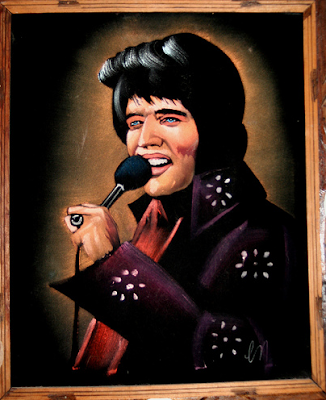
Tonight’s amusement en route to the Tips, the last installment of our summer series of songs about particular cities, celebrate’s Nevada’s desert city of non-stop twenty-four hour excitement, with its black jack, poker, roulette wheels, one-armed bandits and neon lights. From the 1964 movie of the same name, here’s early-Elvis impersonator Elvis Presley nonchalantly hamming his way through the conga-heavy hip-swiveller Viva Las Vegas.
The comments are open for your Reader Tips.

Reader Tips
Scopitones were jukebox-like machines, popular mostly in French bars and cafes for a few years in the early 1960s, that played specially-produced 16mm films of musical performers, typically pop stars. Attempts to expand the Scopitone market elsewhere met with little success, and soon the rather hefty machines, which were notoriously difficult to maintain and repair, disappeared into the hands of a few collectors.
Many of the clips, though, which were the early equivalent of MTV videos, are still around. Tonight’s amusement en route to the Tips is a Scopitone film featuring the musical stylings of a woman named Yvette Horner, a Serbian-born French accordionist who to date has sold over 30 million records. In the clip, her undeniable virtuosity combines with a lighter-than-air, inconsequential tune and oddly dream-like visuals to make for a interesting and peculiar little cultural artifact: here’s Yvette Horner performing En Glissant.
The comments are open for your Reader Tips.
Reader Tips
The Violent Femmes were a rather unorthodox, stripped-down three piece folk-punk band from Milwaukee, Wisconsin who, during their heyday in the 80s and early 90s hovered between underground cult status and mainstream success. The thematically offbeat nature of their songs is at least partially attributable to the fact that Gordon Gano, the band’s songwriter and lead singer, was (he still is) a devout Christian; while nobody could consider the Femme’s music to be religious per se (the other two band members made clear to Gano that they weren’t amicable to that) Gano’s lyrics often expressed, if obliquely, a rooted unease with mass-culture morality.
In tonight’s amusement en route to the Tips, Gano sings with a disarmingly cheerful tension about the undeniable, there-it-is fallout – the widespread joy and damage – of a society weaned on American pop culture. From a live appearance on the old Dennis Miller TV show, here are the Violent Femmes performing a song from their 1991 album Why Do Birds Sing? called American Music.
The comments are open for your Reader Tips.
Reader Tips
In a 1762 letter thanking Italian physicist Giambatista Beccaria for supporting and defending his recently published theories on electricity, Benjamin Franklin gave Beccaria permission to freely use, and instructions on how to build, one of Franklin’s new inventions:
Perhaps…it may be agreeable to you, as you live in a musical country, to have an account of the new instrument lately added here to the great number that charming science was before possessed of: — As it is an instrument that seems peculiarly adapted to Italian music, especially that of the soft and plaintive kind, I will endeavour to give you such a description of it, and of the manner of constructing it, that you, or any of your friends, may be enabled to imitate it, if you incline so to do, without being at the expence and trouble of the many experiments I have made in endeavouring to bring it to its present perfection.
The invention Franklin was describing was the glass armonica, a musical instrument that sounds like wine glasses being resonated with a wet finger, and works on exactly the same principle. The purpose-built glasses (bowls) in a glass armonica are mounted close together, though, so multiple perfectly-tuned notes are accessible within a hands-width, and since the bowls are rotated on a spindle one need only lightly touch them, as opposed to using a circular hand motion to resonate them. Tonight’s amusement en route to the Tips is almost certainly the most well-known piece of music to feature the unique and ethereal sound of the glass armonica: From Tchaikovsky’s ballet The Nutcracker, here’s William Zeitler playing Dance of the Sugar Plum Fairy.
You are invited, as always, to provide your Reader Tips in the comments.
Reader Tips
Tonight’s lighthearted amusement en route to the Tips is a short clip from the 1939 Marx Brothers movie At The Circus in which a dance-happy Groucho Marx, accompanied at one point by his brother Harpo on the bass couch, extols the high-quality, point-by-point education – in geography, history, music, and the arts – one can receive by watching the performances of Lydia the Tattooed Lady.
The comments are open for your Reader Tips.
Reader Tips
In 1982 a group of entertaining senior citizens living at The Walter Salvo House in Northampton, Massachusetts pooled their talents and put on shows under the name Young@Heart. The first performances involved singing, comedy routines, and impersonations, but over the years settled into a (mostly) choral format wherein various members of the group take the lead in singing songs, many of them – notably – contemporary songs by the likes of James Brown, Sonic Youth, and The Ramones. As the years went by, various members died and were replaced, but the show went on; in 1996, following some fruitful collaborations with outside, non-senior performers, including punk rockers and a gay men’s chorus, a fellow named Roy Faudree, who had staged their first full-blown theatre show, organized a trip to Rotterdam’s R Festival, where they unexpectedly met with such success that they ended up doing 12 – count ’em, 12 – tours of Europe, Australia, and Canada.
In 2008, British documentarian Stephen Walker released Young@Heart, which chronicled the group as they prepared for, and then staged, a concert in Massachusetts. Tonight’s clip from the film shows a member of the group giving a solo performance of what was to have been a duet with his friend, until his friend passed away shortly before the show. Backed by the Young@Heart chorus, here’s the late Fred Knittle, a former WWII machine-gunner, singing a song by British group Coldplay called I Will Try To Fix You.
The comments are open – they always are – for your Reader Tips.
Reader Tips
Over the course of his career Frank Sinatra recorded and performed numerous Cole Porter songs, most famously “I’ve Got You Under My Skin”, I Get a Kick out of You”, and “Night and Day.” Tonight’s amusement en route to the Tips, the next installment of our summer series of songs about particular cities, was recorded in 1958 as part of the sessions for the Come Fly With Me album but was not included on the original LP; in 1996, Capitol Records released it on the retrospective compilation CD Frank Sinatra Sings the Select Cole Porter. Backed by the orchestral arrangements of Billy May, here’s Frank Sinatra swinging his way through Cole Porter’s tribute to the City of Lights called I Love Paris.
The comments are open for your Reader Tips.
