
Events subsequent to the Senate lame-duck vote on the New START Treaty only serve to reinforce concerns given short shrift at the time – notably, with respect to the inadvisability of cutting and otherwise allowing the further atrophying of the U.S. nuclear deterrent, at a time when every other nuclear power, including Russia, is modernizing its arsenal.
Who is John Galt?
It’s Probably Nothing
Dollar Yen Plummets To New Post World War 2 Low
It’s Probably Nothing
According to Bloomberg and The Hill, Frank plans to submit a bill that would remove the votes of the five regional Federal Reserve presidents from the 12-member Federal Open Markets Committee (FOMC), which sets interest rates, and replace them with five appointees that would be nominated by the President and confirmed by the Senate.
Via Maxed Out Mama, who shares a preview. But read the whole thing – it’s worth signing up for.
It’s Probably Nothing
In Long Beach, the second-busiest container port by volume, August imports fell by 14.2 percent from August 2010. While the port has not yet released September volumes, a spokesman, Art Wong, said it expected about a 15 percent drop from September 2010.
The reports from the remaining container ports in the top five were equally gloomy. In New York-New Jersey, the number of incoming containers in August was about flat with last year. In Savannah, Ga., imports in August fell by 4 percent. Oakland reported that August imports were down 0.9 percent from a year earlier. And Los Angeles, the nation’s highest-volume container port, counted 5.75 percent fewer containers in August than a year earlier.
It’s Probably Nothing
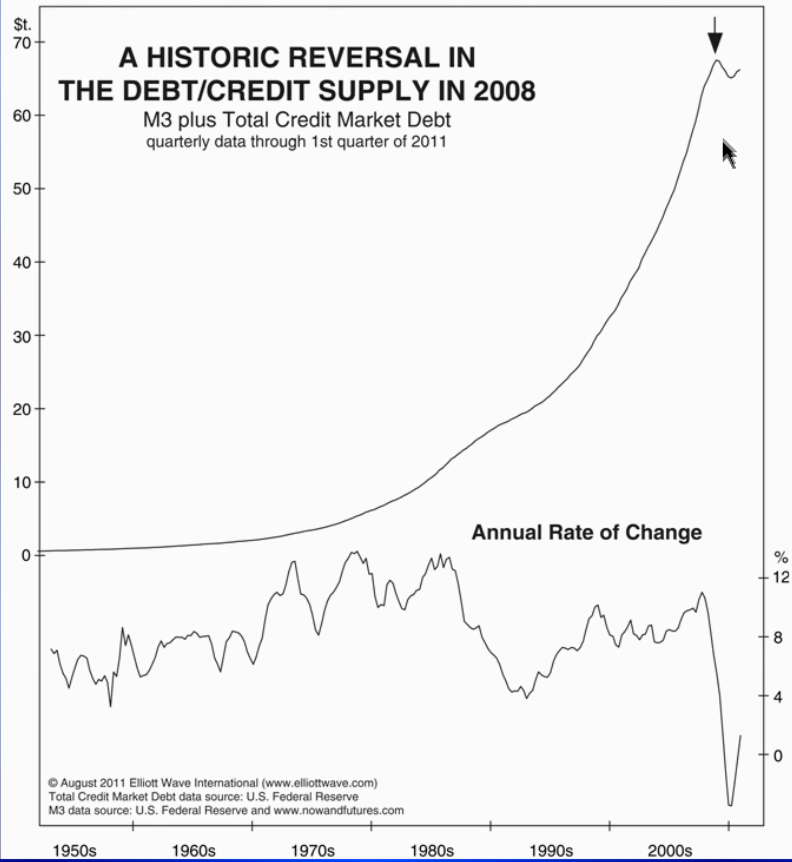
What is the problem behind the Markets/Economy? The problem is Debt began to implode in 2008. As you can see on this first chart below, debt has been growing constantly since the 1930’s, it got into a parabolic rise in the 1990’s and 2000’s and all these new dollars in terms of IOU’s are what supported the Real Estate Blowoff of ’06, the Tech Bubble ’00, and the Stock Boom in general of ’07.
That Debt/Credit supply reversed in 2008, had a slight bounce during market/economic recovery from 08′. But this trend is exhausted….
..more charts HERE
It’s Probably Nothing
No charges were filed against the Muslim who tried to break into the cockpit of American Airlines flight out of New York. If he were Christian or Jew, he’d be behind bars. More sharia. – Pamela Geller Atlas Shrugged
Saudi passenger disrupts flight bound for Indianapolis
INDIANAPOLIS – Federal authorities are probing the actions of a Saudi Arabian man who tried to get into the cockpit of an American Airlines flight to here.
Indianapolis Airport police said Abdulaziz Mubarak Alshammari, 20, was pulled away from the cabin door by another passenger a half hour before Flight 1936 from New York to Indianapolis International Airport landed at about 10 p.m. Wednesday.
Alshammari, who said he is a student at the University of Indianapolis, appeared confused when flight attendants and police questioned him, according to a police report. Investigators photocopied a note Alshammari wrote in Arabic while on the plane.
Scott Hall, a spokesman for the University of Indianapolis, said the school has no record of Alshammari being a student there.
No charges were filed.
It’s Probably Nothing
Retirement programs for former federal workers — civilian and military — are growing so fast they now face a multitrillion-dollar shortfall nearly as big as Social Security’s, a USA TODAY analysis shows.
The federal government hasn’t set aside money or created a revenue source similar to Social Security’s payroll tax to help pay for the benefits, so the retirement costs must be paid every year through taxes and borrowing.
But read the whole thing.
It’s Probably Nothing
The head of the IMF has warned that its $384bn (£248bn) war chest designed as an emergency bail-out fund is inadequate to deliver the scale of the support required by troubled states.
Related. And for those who need cheering up….
It’s Probably Nothing

It’s Probably Nothing
Not What Cracked Up to Be
Saif al-Islam Qaddafi (quote p. 2):
…
By Ben Stansall/AFP/Getty Images.
LOSING HEIR? Saif al-Islam Qaddafi, the second son of the Libyan leader Muammar Qaddafi, wrote a doctoral thesis on justice and democracy and cultivated influential friends in the West…
Until the violence erupted in Benghazi, in the days before he gave his television address, Saif had somehow managed to straddle two worlds. Occasionally his father clipped his wings: his television station, al-Libya, was reined in, and his stated desire for political reform, reflected in his Ph.D. thesis (which endorsed, ironically, the need “to hold war criminals personally responsible”), was continually under challenge. He did manage to get a few political prisoners released from Libyan jails. Some small degree of free expression entered Libyan society. To the extent that Saif was ever sincere—and this remains an open question—the problem was his father and his name: sources both of opportunity and of constraint…

Via Arts & Letters Daily.
It’s Probably Nothing
A telling sign of how bad things have gotten for the housing industry: Prices have dropped more since the recession started, on a percentage basis, than during the Great Depression of the 1930s.
Google: Friend or Foe?
Here is some very interesting insight into Google, including several things you may not have been aware of before.
Denial Disaster Destiny & The Man Behind the Curtain
The markets are having a really hard time dealing with the end of QE2. You could see a scenario where the market gaps down tomorrow, has another big loss and then starts to rally from there. Potentially even an intra-day reversal that gives you some kind of semblance of a pivot point. But I think that without the Fed in the US coming in aggressively with a QE3, that is going to be problematic, I think we have lower to go medium term.
You have two things going on. The Reality, the mathematic reality of the macro situation that the Global economy find itself in. Then there is the perception of the reality, which until the last couple of weeks has been far different than the underlying realities have been because of the ability of central banks to print money and keep stock markets, specifically stock markets from doing exactly what they are doing now. So I think there’s a reality check here and the downgrade of the US credit rating means that you are now seeing that if you pull back the curtain and expose the wizard behind pulling switches, the underlying reality is that they have not done anything to address the real problems of the macro economy. Specifically in the US and that extends out into the Globe….read more HERE
Those Algorithms That Govern Our Lives
h/t Melinda Romanoff
It’s Probably Nothing
Its Probably Nothing
A wave of violent unrest in urban areas of China over the past three weeks is testing the Communist Party’s efforts to maintain control over an increasingly complex and fractious society, forcing it to repeatedly deploy its massive security forces to contain public anger over economic and political grievances.
Expect more riots when China’s Credit Bubble pops exposing mountains of fraud
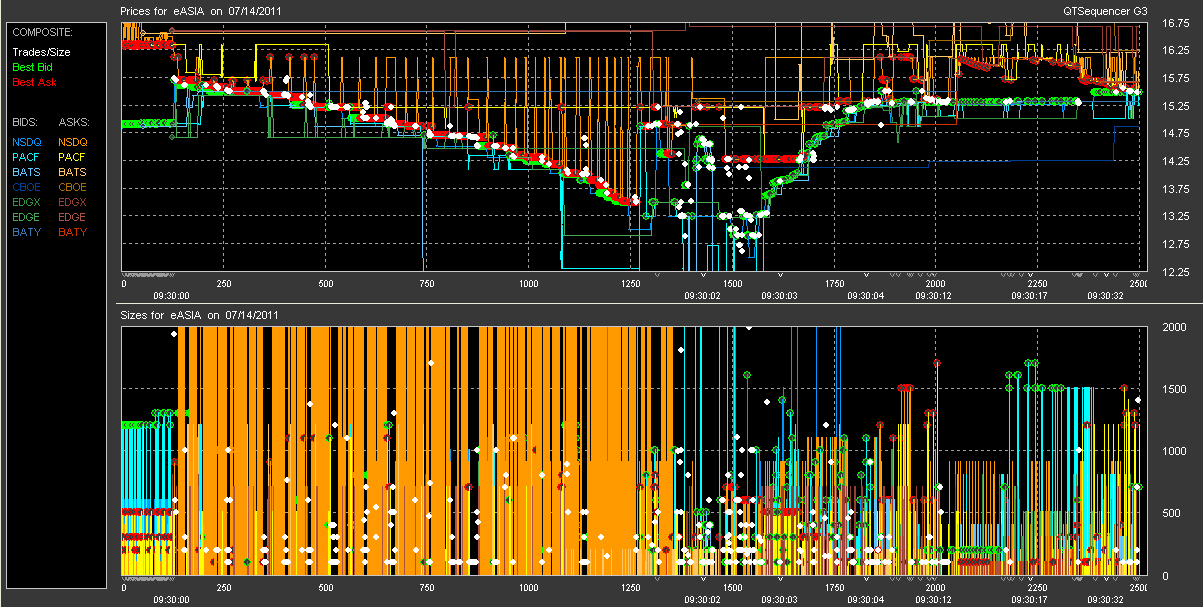
Algorithm Vs Algorithm
Via a registered investment advisor, who explains; You will want to read this, which explains exactly [the flash crash] a year ago May 6th. … If the exchanges allowed this argument to enter the mainstream press, the US stock market would be closed within a week. They are that dependent upon ‘flow’ to survive.”
Some algorithms, for example, can detect the electronic signature of a big VWAP, a process called ‘algo-sniffing’. This can earn its owner substantial sums: if the VWAP is programmed to buy a particular corporation’s shares, the algo-sniffing program will buy those shares faster than the VWAP, then sell them to it at a profit. Algo-sniffing often makes users of VWAPs and other execution algorithms furious: they condemn it as unfair, and there is a growing business in adding ‘anti-gaming’ features to execution algorithms to make it harder to detect and exploit them …
Whatever view one takes on its ethics, algo-sniffing is indisputably legal. More dubious in that respect is a set of strategies that seek deliberately to fool other algorithms. An example is ‘layering’ or ‘spoofing’. A spoofer might, for instance, buy a block of shares and then issue a large number of buy orders for the same shares at prices just fractions below the current market price. Other algorithms and human traders would then see far more orders to buy the shares in question than orders to sell them, and be likely to conclude that their price was going to rise. They might then buy the shares themselves, causing the price to rise. When it did so, the spoofer would cancel its buy orders and sell the shares it held at a profit. It’s very hard to determine just how much of this kind of thing goes on, but it certainly happens. In October 2008, for example, the London Stock Exchange imposed a £35,000 penalty on a firm (its name has not been disclosed) for spoofing.
Still, it’s probably nothing.
Update: From the comments…
I’m in software.
Years ago, I worked for a company that provided control software to the US Air Force. There were lots of papers to sign acknowledging the importance of “secrets” and we all had to sign waivers saying that we understood the penalty for divulging any material infomormation could include imprisonment in any NATO country…etc.
About two years ago, I interviewed for a job at a company that does nothing but high-speed trading algorithms.
The trading company was far more strict (and menacing) when it came to secrecy. It actually felt to me like they were some sort of cult.
I went through two interviews and, even at that point, they wouldn’t discuss the type of work they did. Instead, they’d just hint that it had something to do with the stock market. I knew who they were because a friend of mine had been through their grinder. But it was surreal…they wouldn’t even acknowledge that certain people had previously worked there.
Heck – at the end of the second interview, they weren’t even willing to name the job positions for which they were hiring.
Even the US Air Force wasn’t that super-secret.
I understand that these companies typically pay tens of millions just to buy old, plain looking brick buildings at “strategic” locations in New York, New Jersey, and Chicago – just to be physically close to the backbone of the systems on which the trades are conducted … thereby trying to gain microseconds of transaction speed over the competition.
Whatever their real impact on the markets, I am quite sure that these companies certainly see themselves as some sort of secret society.
I have no trouble believing that they have the ability to cause a flash crash. Honestly, I’m surprised we haven’t seen worse – and more often.