Category: Gopher News

Obligatory Juno Post

There really should be a rule against having nominees as hosts. It’s… awkward, at best.
A lot of volunteers put a lot of work into making this happen, and it’s unfortunate that the show itself is such a wreck. I watched it on TV while grooming dogs, the Tragically Hip coming in a distant second to the hairdryer. When one finds oneself waxing nostalgic for k.d. lang, you know things are going badly.

Here she comes, host Nelly Furtado, floating in on cables, trying to sing “I’m Like A Bird”… and suddenly you just know it’s all wrong. Nelly knocks a banner off the roof, shakes her arms, stops singing, and yells to be let down. She’s obviously more than a bit nervous, and it takes some time, but she’s finally on the stage. Come on though – can you say, “not according to plan”? She screwed that up faster than you can say YouTube. Definitely unfortunate, but did anyone really think Nelly would be a cool host? Keep singing darlin, and leave the hosting to people with personalities.

All things considered, the Saskatoon appearance by Stephane Dion, bring his “Pledge To Keep Jailing Farmers For Selling Their Own Grain” speech may have been the highpoint of the day.
And I missed that, too.

Farmers Vote To End CWB Barley Monopoly (UPDATED)

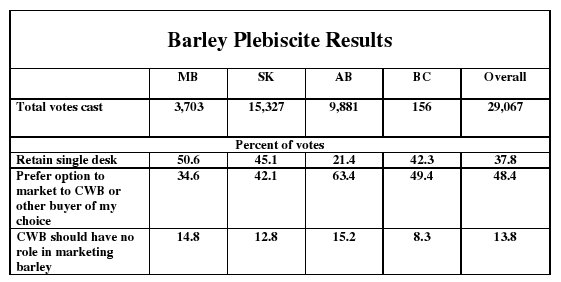
Only 38% voted to retain the status quo. More here;

A total of 62 per cent of just over 29,000 farmers who cast eligible ballots said they wanted the board out of the barley market altogether, or for the board to be maintained in a competitive market.
Another 38 per cent said they wanted to maintain the status quo.
A government spokesman said federal Agriculture Minister Chuck Strahl will now take steps to amend the Canadian Wheat Board Act to remove the barley monopoly.

Plebiscite results (PDF)
barleyvote.jpg
See the AAFC main page for more.

Update

Ralph Goodale is beaking off;

“The Conservative government does not have the mandate to dismantle the Canadian Wheat Board after concocting the results of the barley plebiscite in the government’s favour.”

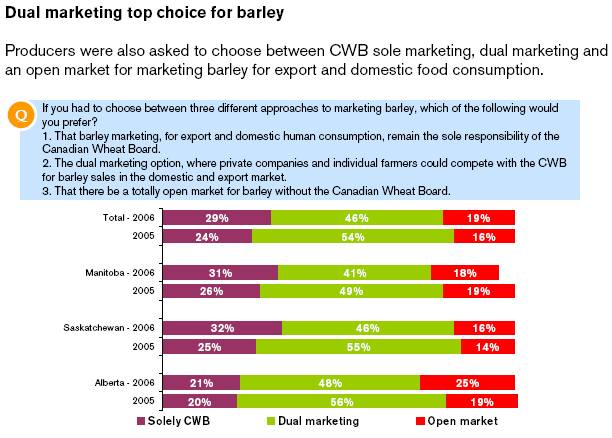
Fine, Ralph. Here are the results of the “Canadian Wheat Board’s annual producer survey, May 19, 2006.”
CWB-producer_survey-barley.jpg
That’s right – the CWB wrote the questions.

She Talks Crazy Talk (Track Two)

Hansard, March 26, 2007;

Hon. Wayne Easter (Malpeque, Lib.): Mr. Speaker, the Minister of Agriculture and Agri-Food will soon have the tainted results of his discredited plebiscite with barley producers.
KPMG is now counting the numbered ballots. However, KPMG has called some producers to see which of their ballots they want counted. Canadians should know that in this vote the ballots were numbered and traceable, there was no voters list and there were no scrutineers from opposing camps.
Will the minister explain what happens to those voters that KPMG cannot reach? Or is that just the side that favours the government approach and is it the more votes the merrier?
Hon. Chuck Strahl (Minister of Agriculture and Agri-Food and Minister for the Canadian Wheat Board, Mr. Speaker, what we do know is how the Liberal Party is going to handle this. The Leader of the Opposition was in the Prairies the other day and said he is not quite sure what he is going to do, but he has a “lot of imagination” so we should just leave it with him.
We are not leaving it with him. We are leaving it with farmers. We have asked them some clear questions in a plebiscite. Do they want barley to stay as it is? Do they want more freedom of choice?
I look forward to what they are going to have to say, because on this side of the House we respect farmers and what they have to say about the Canadian Wheat Board.
Hon. Wayne Easter (Malpeque, Lib.): Mr. Speaker, the Leader of the Opposition will allow farmers to have a voice, which that party has not done.
Let us review the process. Gag orders were placed on farmer-elected board members. Appointed board members were fired. The CEO was fired for standing up for producers. Now we have numbered and traceable ballots. Finally, the minister called a plebiscite but it has a fraudulent question.
Now there is evidence of multiple ballots and calls to voters from the returning officer, KPMG itself. Does the Prime Minister think this is a credible process?
Hon. Chuck Strahl (Minister of Agriculture and Agri-Food and Minister for the Canadian Wheat Board, CPC): Mr. Speaker, if he wants to impugn the honourable integrity of KPMG, I guess he can try.
We are in contact with farmers all the time. It is a little different from when the Liberals are in charge and the Liberals deal with the Wheat Board. Farmers who want to contact people when the Liberals are in charge have to phone their lawyers because they are in jail for trying to market their own product.

However, no transcript can do justice to Wayne Easter in the way that audio can! (1.6 megs)
(Previous)
This Just In: The Honourable Chuck Strahl, Minister of Agriculture and Agri-Food and Minister for the Canadian Wheat Board, will hold a news conference at the Chteau Laurier on Wednesday, March 28, (11:15 a.m., Ottawa time) to announce the results of the barley plebiscite.

$350,000 Of Our Tax Dollars

To advertise the Saskatchewan budget;

Television and radio advertisements on the graduate tax exemption and seniors’ prescription drug program will run for three weeks, while brochures will go to homes and ads will appear in some specialty print publications, Saskatchewan Finance spokesman Mike Woods confirmed Friday.
“There’s always some really key initiatives in the budget, and the government and the departments feel it’s in the best interest of all the taxpayers that they become aware of these programs,” Woods said.
The post-budget ads won’t feature Finance Minister Andrew Thomson like last year’s, which cost taxpayers about $450,000 and created controversy in the assembly about what the Opposition called a partisan campaign.

On the other hand, think how much they saved by not featuring Tom Cruise.

Saskatchewan ’07: Budget Deficit

Watch for David MacLean’s reaction on this baby.
Via radio : “unsustainable… it’s almost as though they’re “salting the earth” for the next government…. ”
UPDATE The CTF post is up now.
Early bullet points here and at CBC

What is expected to be the last budget before a provincial election projects $650 million in extra spending. But to stay out of the red, the province will have to draw on its reserves to the tune of half a billion dollars.
That’s because revenues are expected to be $7.87 billion while expenses are $8.35 billion.
Drawing down the rainy day fund
Finance Minister Andrew Thomson released the budget in the Saskatchewan legislature Thursday morning.
Thanks in large part to the $510-million transfer from the fiscal stabilization account — the province’s so-called rainy day fund — it’s a surplus budget by $75 million, the government says.

Note to readers: Lorne Calvert’s “fiscal stabiliation account” can be more generally described as “borrowing the money”.
Sask Party reaction;

Cheveldayoff said instead of taking advantage of an unprecedented economic boom and preparing the province for the next generation, the NDP spent its mountain of windfall money on growing government and increasing debt.
“That’s Lorne Calvert’s legacy after six years in power,” Cheveldayoff said.
“Spending is up by $2 billion or over 32 per cent, there are 1,459 new government positions during a period when the population fell by more than 10,000 people, and spending in the Premier’s office is up by 17 per cent.”

That about sums it up.
Have at ‘er.
And here’s a thought – Forget trying to keep students in Saskatchewan. That $15 cap on prescriptions for seniors may be just what the doctor ordered when it comes to attracting new residents to the province.

Environmental Think Tank: Dangerous Rise In Grain Prices

CHICAGO (Dow Jones) – The continuing diversion of grains to the production of fuel ethanol is translating into higher grain and food prices worldwide, the founder of an environmental think-tank said Wednesday. The food and energy economies, historically separate, are now merging. In this new economy, if the fuel value of grain exceeds its food value, the market will move it into the energy economy, Lester Brown explained. As the prices of oil climbs, so will the price of food, Brown added. Food prices are rising in China, India, and the U.S., countries that contain 40 percent of the world’s people. While relatively little corn is eaten directly in these countries, vast quantities are consumed indirectly in meat, milk, and eggs in both China and the U.S., Brown said. In India, the overall food price index in January 2007 was 10 percent higher than a year earlier. The price of wheat, the staple food in northern India, has jumped 11 percent, moving above the world market price, said Brown.

Larry Weber, Weber Commodities;

And you wonder why farmers are subsidized when the first time in 10 years that grains move higher – the end of the world as we know it stories like this appear.
Here is a thought Lester, wheat was $5.00 in 1972 and combines were $28,000. Today, wheat is $4.50 and combines are $450,000. Why is it not farmer’s turn?

Calvert Misleads The Legislature

A story that has been topping talk radio in the past week or two has just been ratcheted up a notch;

During question period, Saskatchewan Party MLA Ken Krawetz asked: “Was the premier ever briefed by any government official on the Murdoch Carriere investigation and the subsequent disciplinary action prior to April 1st, 2003?” Calvert said no.
But summoning reporters later in the day, Calvert said he had made a mistake and, in fact, he did know about the situation before that date, when the first media reports appeared of sexual harassment allegations against Carriere.
“I didn’t speak to that question in the house because … in the preamble to that question I wasn’t aware of what he was saying over there,” he said.
[…]
Calvert told reporters Thursday he reviewed his files and realized he did know about the Carriere situation six days before it made the news, when he had received a letter from one of the alleged victims.
Meeting sought
She told him several women had lodged sexual harassment allegations against Carriere, that a government report had determined there were grounds for the allegations and that there was an ongoing RCMP investigation.
The woman wanted to meet with Calvert because she thought Carriere’s discipline before April 2003 was too light.

Globe And Mail (CP);

Mr. Carriere is the former senior manager with Saskatchewan Environment who was fired after a media report of allegations that he harassed his female employees.
He was eventually convicted of two counts of assault, but acquitted of two counts of sexual assault. He sued the government over his dismissal, and the government, citing its own legal advice, paid him $275,000 to settle out of court.

In contrast, the silence of the nine women had already been arranged for the modest sum of $15,000 each, in a settlement arranged by a lawyer provided by the government. None recieved a copy of the agreement.
It’s a new found aversion for the courts for Calvert and Co. This is the same government that used buckets of taxpayers money in an attempt to outspend a group suing over the Spudco fiasco. It’s also the government that took an anti-cigarette “shower curtain law” to the SCOC.
Here’s the SaskParty take on the matter.
While this item has received pretty good coverage in the province, but I thought it might be useful to invite comments on it.

Agriculture Announcement

Stephen Harper and Chuck Strahl are appearing at a live news conference at a farm about 20 miles from here at the moment, covered on local radio. They are about to announce that CAIS is being retired and replaced.
Harper makes a few intro comments and

Our government recognizes more needs to be done, especially about rising costs of production… input costs have risen over 3 times faster than product prices… and that’s what brings me here today.
$1 billion in new money for income stabilization … modelled on conventional bank savings accounts … an annual cost of production benefit… inviting provinces to share in funding.

Basics are now up at the AAFC website.

The High Price Of Silence

A bureaucrat with ties to the NDP government is convicted of assault, a senior department official orders a hard drive erased and Lorne Calvert approves a $275,000 “wrongful dismissal” out of court settlement.
If I didn’t know better, I’d say someone didn’t want somebody taking the witness stand in open court.
More from “Mark”, in the
comments
;

http://www.mlt.com/people/profiles/kenny.htm
Remember him from the Channel Lake fiasco? The author of a legal opinion that purported to exonerate the NDP government from misconduct, and justify the $300,000 severance package then paid to Jack Messer?
Now, as “general counsel to members of the Public Service Commission”, he is likely the one dispensing nonsense ‘legal’ advice concerning Murdoch Carriere.
Is it any coincidence, also, that John Nilson, Minister of the Environment, also hails from the same law firm?
A bunch of coincidences, eh? This is obviously a case where the NDP is using their favourite ‘yes man’ to justify their own political goals (sinister as they are) under the guise of ‘legal advice’.

CWB: Subsidizing US Grain Companies?

Via Agriville;

So far in the 2006-07 marketing year which began last June 1; private U.S. grain companies have exported 587,000 tonnes of durum wheat. The Canadian Wheat Board’s durum exports include at least 250,000 tonnes to the U.S.
The American durum wheat harvest last fall was 1.44 million tonnes. Domestic use is 2.29 million tonnes. The U.S. agriculture department expects total 2006-07 imports, virtually all from Canada, at 1.12 million tonnes.”
Do the math. How can American grain companies export durum at the rate of 60,000 tonnes a month when the country’s total durum production is 680,000 tonnes short of its own domestic needs?
It looks like the American grain trade is buying more and re-exporting the rest at a profit, in other words at higher prices than it pays the Board.
Nobody could possibly expect that astute U.S. grain traders are buying Wheat Board durum at the premium prices the Board claims to be commanding due to its single-desk market power, then selling it offshore at a loss to undercut the premium prices the Board is supposed to be getting in those markets.
It is far more plausible that U.S. traders are buying Canadian durum cheaply and exporting it at higher prices. Exports in 2006-07 will equal 38% of domestic U.S. consumption.

The real fun begins on April 1, when the CWB will finally be subject to Freedom of Information requests.
More


In a recent article
published in the Star Phoenix and trumpeted by pro-monopoly groups, Richard Gray, U of S agricultural economist and apologist for the CWB monopoly, claims the following:
* The CWB intentionally limits sales into the U.S. malt barley market in order to keep the U.S. price artificially high.
* The CWB does this even though it knows this will force many prairie farmers to sell their malt-quality barley for feed.

Richardson Agricore

GrainNet;

Agricore United and James Richardson International Limited announced Wednesday that they have agreed to combine to create Canada’s largest grain company and a leading global Canadian agri-business.

Larry Weber;

Yesterday was a defining moment in the Canadian grain business. And it wasn’t the proposed JRI takeover of Agricore United was unexpected, you knew that they would be courting someone other than the [Saskatchewan Wheat Pool]. For me it was there was one of these deals is going to go through and change the face of the industry again. United Grain Growers, Manitoba Pool Elevators and Alberta Pool, already footnotes in the grain handling industry and relished to portrait paintings with elevators in the background, will now lose any semblance of a farmer run corporation. I don’t know if Mac Runciman is buried deep enough not to choke someone.
If the new corporation, Richardson Agricore comes to fruition, the probability of any farmers on the Board of Directors is not that high – and there won’t be delegate elections to ensure that happens. Are any of the deals good for farmers? Here are your choices: An arranged marriage or a shotgun wedding. You pick……..Times up. Rationalization was going to occur regardless – it is a fact of business.
What the media is not reporting: The Richardson family’s roots are very deep in Winnipeg grain industry. Walk into the Grain Exchange building and you will see someone from the Richardson family on almost all of the archived pictures. Hartley Richardson is Winnipeg’s biggest promoter. If the SWP bid came to fruition, there was a good chance that the power base of the Winnipeg grain industry would start to erode.
This new bid will solidify Winnipeg as the center of the grain industry in Canada forever. Deep down, I’m sure Hartley knew this and was part of the business decision. For a family that is intensely private – this was a huge step and not made lightly. Hayward will be looking for work if this deal flies. There is an opening at the CWB for a permanent CEO.

(You can subscribe to email bulletins from Weber Commodities here).

John De Pape: On CWB Barley Marketing

An interview with the Frontier Centre For Public Policy;

FC: You’ve expressed reservations about “relying too much on economists.” Don’t competent economists use real-world numbers? Shouldn’t we distinguish between good economists and poor ones?
JD: What I don’t like about econometric models is that they can’t be relied upon to take into consideration every possible influence or impact on the issues being studied. For example, no economic model addressing the market power of the CWB’s single desk has ever taken into consideration the fact that the single desk is operated by people. People who, as bright and dedicated as they are, make mistakes and poor judgment calls, use poor timing or simply miss the odd phone call.
The Recent U. of S. study uses real data to build an economic model based on market elasticities. This study tells in theory what the prices in different markets should be based on a single-desk seller and then in a multiple-seller environment. But for the CWB salespeople to act in the manner theorized, they would need to have complete and perfect information about every market they are selling into, every competitor and their possible behaviour, every possible substitution and every price elasticity of demand in every market. At all times. That is the only way the model works.
In addition, these models don’t consider things like the application of higher grades of grain in satisfaction of a sale of lower grades; this happens from time to time, yet I have not seen an economic model that considers it. Don’t get me wrong – economists do great work. Unfortunately, the CWB relies on these theoretical constructs to prove its worth instead of using real business measurements that are easily calculated. Even their benchmarking exercise was shown to be flawed.
FC: A dual market already exists in domestic feed barley, with only 20 percent of all Western Canadian barley going through the Board. Does that mean our system is better prepared for free barley than for free wheat?
JD: Absolutely. Many in this business – on both sides of the debate – acknowledge that barley is different than wheat. I would say that the time for the barley market to be free of the controls of the CWB came some time ago.
FC: The numbers you present show farmer costs for marketing canola, a non-Board crop, at roughly $40 a tonne. But Board costs for wheat come in at around $58, barley is estimated at $60 and durum at $70. That tells quite a tale about Wheat Board efficiency. Why are the Board’s services so much more expensive?
JD: There are three main factors here. First, much of what the CWB does is redundant. The grain companies market non-CWB grains to earn an elevation. The CWB markets wheat and barley at a cost, but also pay the grain companies for terminal handling and storage while grain companies also charge farmers for country elevation and cleaning. Second, the handling charges by the grain companies are greater on CWB grains than they are on non-CWB grains such as canola because they don’t have the same operational and marketing tools available to manage their space on CWB grains. And third, any costs incurred by the CWB making mistakes are passed onto the farmer. If a grain company makes a mistake, competition does not allow them to recoup the losses through charging farmers more or paying them less.

You can read the rest here.

Canadian Wheat Board: “Our apologies for the awkwardness”

Background, via a reader: “The Ag minister wrote an op-ed letter in January, wherein he made certain price comparisons on wheat. The CWB is mass mailing prairie newspapers in reply. But instead of trying to directly challenge the comments made by Strahl, the CWB is trying to “correct” the newspaper’s “erroneous price comparisons”. Here’s what happens when one editor points out that the CWB ought to state that Strahl had his numbers wrong. Enjoy!”
Correspondence with a Saskatchewan weekly newspaper from Heather Frayne, CWB Communications Consultant:

(1) Heather Frayne original letter:
Woops. Sent you the wrong letter. Here is the right one. (She had first sent the one intended for the Whitewood Herald).
Heather Frayne
CWB communications consultant (acting)
__________________

The following is a letter to the editor regarding erroneous price comparisons in an article in the January 24 issue of The ***.
It was suggested in the January 24 issue of the *** that an Ontario farmer currently selling hard red spring wheat with 13.5 per cent protein would receive $5.50 per bushel, whereas a grower on the Prairies selling 1CWRS would receive about $4.40 per bushel as a final pool return – approximately $1.10 less. The implication is that this is because of poor performance by the CWB. That implication is incorrect, because of several errors in the comparison.
To begin with, the comparison relates a spot price (the Ontario price) to a pool value (the CWB Pool Return Outlook). This is a misleading comparison. A pool value is by definition an average of prices achieved over an entire crop year. In a rising market such as we have experienced so far this crop year, a spot price is always higher than a pooled price. Is the CWB selling wheat at those “high” Ontario values and returning those dollars to farmers? Yes. In fact, CWB values are even higher, as noted below.
The Ontario farmer spot price of $5.50 per bushel is presumably a price at or near an Ontario mill. Therefore, an appropriate comparison would be the current price of CWB wheat landed at an Ontario mill. On February 5, the CWB offered eastern mills No.1 CWRS with 13.5 per cent protein for $230.47 per tonne at Thunder Bay. Add to this freight charges of $25 from Thunder Bay to the mill, and the landed price equals $255.47 per tonne or $6.95 per bushel.
The comparison, then, is between $5.50 per bushel of hard red spring wheat to the Ontario farmer and $6.95 per bushel for CWB wheat sold in Ontario. This $6.95 per bushel would be added to the pooled payments western farmers receive for wheat sold throughout the 2006-07 crop year.
Because the CWB’s Ontario sales prices are based on competitive North American values, western farmers can obtain similar cash values today under the CWB’s other pricing options such as our Daily Price Contract.
It appears that Ontario farmers are receiving prices that are significantly under current market values.
The truth, therefore, is the exact opposite: CWB prices are higher.
Sincerely,
Gord Flaten,
CWB Vice-President, Marketing

Heather Frayne
CWB communications consultant (acting)
(2) Editor’s Reply:
Hi Heather,
I looked for the article in question. The information appeared, not in an internally generated piece, but in an op-ed provided by Chuck Strahl, our minister of agriculture. As a hint, and since I know you’re sending this to everyone who runs the op-eds from Strahl, if you want editors to run your piece, you should not try to make it look like we made a mistake – since we didn’t! If you want to reword your letter to be more accurate – that being that ‘in an article by Chuck Strahl, minister of agriculture, which appeared in many publications in Saskatchewan,’ … you might actually have a shot
at getting your side in print. As it is now .. best of luck, you’ll need it.
(3) Letter from Heather Frayne:
Hi **,
I just called 306-** and left a message for you with a man whose name I didn’t catch. He said he would ask you to call when you get back in.
I appreciate your comments, and agree absolutely that more specific information would have been useful and appropriate. Unfortunately, because of the gag order and the political environment in which we’re trying to operate, I wasn’t at liberty to include those details. In other words, I’m relying on editors and publishers to understand the reference–like you, most are well aware of what they’ve published and what they haven’t–and joining the dots for their readers.
So… all the best. And my apologies for the awkwardness.
(4) Editor’s Reply:
Hello Heather,
What gag order would that be? The one that says that you cannot bad-mouth your boss – the minister of agriculture, Chuck Strahl? … I know it must be frustrating to try to mount a campaign against the guy who signs your pay checks, but I do not believe in ‘inferences.’ To run your letter without being specific, not only serves to make me look bad, it serves to make you look bad as well.
(5) Heather Frayne Reply:
You are, of course, under no obligation to correct misinformation that you have previously published.
I, like all employees of the CWB, am paid by the farmers of western Canada for whom I work, not by the Minister of Agriculture.
(6) Editor’s Reply:
I didn’t say you worked for him, I said he signed your pay checks.
You know something Heather, better still, why don’t you take this up with Chuck. He’s the one who ‘provided’ misinformation, if in fact he did, and he is the one you should be addressing – through a letter to the editor, naming him as the culprit… and as for working for the farmers of western Canada … I’m from Ontario and I know exactly who you’re working for, not having been brought up on the fairy tale.

The Barley Vote

Rolf Penner sent along the following informational links on barley, barley marketing, and the CWB, starting with two recommended pro-choice links: text and 2 minute audio
He writes;

The next set of links is to a February 1st, 2007 talk given by independent market analyst John De Pape, author of the now infamous 2004 Sparks barley report, the talk is called “Show Me The Money” and runs about an hour in length.
There are high and low speed internet versions of the video and an MP3 audio available. All of these are downloadable. The farmer on the go can download the MP3’s onto their i-Pod or MP3 player and listen while feeding their cattle, hauling their grain or whatever else they may be doing.

  • high speed video
  • low speed video
  • MP-3 audio
    If you look at nothing else you should look at the three comparison charts Mr. De Pape has on page 9 and 10 of the PDF of his PowerPoint presentation. They are particularly enlightening for those who are concerned about what kind of prices, returns and margins they are getting with their barley.
    Chart 1Chart 2Chart 3
    By the way, you can have the slides up on your screen at the same time you are watching the videos, and follow along by manually clicking the pages forward.

  • PDF of PowerPoint slides
    There will also be text of a Q and A interview with Mr De Pape up in the next little while so check back with the Frontier Centre website from time to time.
    And for the history buffs, there is also a fascinating audio interview that I did with Kevin Avram here on the origins of the CWB monopoly that runs around 30 minutes, and an article Kevin wrote on the subject here.
    Many people have said that this thing should not be decided by a vote and I agree with them. But we are having one and the more people that vote for choice the more likely it is that we will get it. So don’t just file your ballot in the garbage, fill it out properly and send it in.

  • You can email Rolf for more information.
    And don’t forget Marketing Choice and Designated Area for day to day updates and commentary on the CWB debate – like this;


    I find the things that protestors put on signs very interesting, the second one from the left especially; “Young farmers want a future, Save the CWB!” This is somewhat ironic, considering that none of the people in the photo appear to be under the age of fifty.

    (Special thanks to Larry Weber for the kind shout out to SDA a couple of weekends ago on This Week in Agriculture. I’m flattered, but doubt I’d make much of a deputy ag minister. Too much power in the hands of one with too short a temper, for starters!)

    “Sask Energy does not profit over time from the sale of gas”

    Back on September 13, I asked a simple question; with natural gas futures trading at a 20 month low…
    ngfclose.gif
    …on what basis was Sask Energy seeking a 17% natural gas rate increase?
    Well, as it turns out, that was a good question.

    Saskatchewan Residents are paying 14% more for Gas
    […]
    By taking the daily difference from Sask Energy’s price and the Spot price Sask Energy comes out $360.34 above. Averaging the difference out over the year gives us a $0.91 per Gigajoule. Based on the average spot price and the average Sask Energy price, Saskatchewan residents are paying 114% of cost for their natural gas.
    What is Sask Energy doing with the extra 14%? Would that be part of the dividends going into the General Revenue slush fund? Why are Saskatchewan residents and businesses paying this extra tax when Sask Energy explicitly said they don’t do this?
    Why are we getting ripped off?
    Why after a full spring, summer and fall of raking in money did Sask Energy get approval for another 5.4% increase?

    He has charts!

    I Smell An Election

    Is everyone keeping track?
    2% drop in sales tax – check
    New February stat holiday – check
    $1.5 million ‘!’ – check
    SGI – $180 rebate – check
    Reduced long distance rates – check
    12% SGEU payoff – check
    So what’s next? A free Saskatchegnome! for every yard?
    That’s just in the past few weeks, and I know I’ve missed a few.

    Navigation