
As the regular readers here know, I’ve been out on the road for the past two weeks attending dog shows. First – let me thank my guest bloggers for filling in. They do it as a favour and without their posts the page would go blank after a few days. I owe you guys!
I’ve a few photos to share to provide a glimpse into the type of gypsy lifestyle we’ve been leading during this trek. To give our European readers an idea of what is entailed in driving from Saskatoon to Philadelphia, I’ve overlayed a map of England over Saskatchewan, to provide a sense of scale.

The black line represents the route which took us through Fargo, Minneapolis, La Crosse (Wisconsin), Chicago to Monroe, Michigan shows for Sept 29, 30 and Oct 1, before reloading and heading to New Jersey for Morris and Essex the next Thursday, followed by Hatboro, Devon and Montgomery County Shows in the Philadelphia area. The show sites change location each day, meaning that after showing, we have to repack all the equipment, the dogs and get the stuff to the next day’s site before the premium areas were gone. Most of the trip we functioned on around 4 hours of sleep a day, plus whatever naptime could be extracted when not taking one’s turn driving.

And of course, sometimes there are glitches. (Luckily, we had it back by the end of the day.)

We did enough winning to consider the trip an overall success. I’ve gathered up a few photos – which will have to do for now. The trip home was a 40 hour run, and as most of our days started at 5 am, it’s going to take a few days to regain my blogging coherence!

Grooming area at Hatboro. On the table is the puppy, Minuteman Stray Cat Strut who was winners dog that day for 5 points.
The shows are all outdoors – in the mud, as it turned out. In fact, with a reported 8 inches of rain falling on the site, the Saturday show at Devon was cancelled. The “main event” Montgomery County was touch and go, but as luck would have it, the rain moved on by Saturday night and the site dried sufficiently to go on with the event. The pictures do not do justice to the depth of the mud, especially in the aisles where dogs were carried back and forth between the grooming tents and the rings. Several of the rings were so wet that straw was brought in and laid down over the mud.

High style in the Scottie ring at Montgomery.

“Sparring” in the Bred by Exhibitor class at MCKC. That’s me at the left with Minuteman Halcyone, who won the class and went reserve. And below with my 10 year old Veteran, Am.Can.Ch.Benalta Batman ROM.


The last four dogs shown were from our “family” – behind Batman is Am.Can.Brz.PanAm.Ch.Beauideal Minuteman Smoooth, Am.Can.Ch.ToMar’s The Fix Is In who received an Award Of Merit, and his sire Am.Ch.ToMar’s Dream Fixer.
Finally, a couple of scenery shots from the drive home – the remnants of a huge snowstorm that hit North Dakota while we were away, and flocks snowgeese – millions of them – in the Outlook, SK area.


As many times as I’ve driven across the continent on these “suicide runs”, I never tire of it.
Living Museum Pieces
The dogs of Great St. Bernard Hospice are no more.
In an age of heat sensors and helicopters, the dogs have became obsolete and the 12 pups are being raised to ensure the purity of their ancient pedigree.
“It’s a shame,” said Marie-Helene Sbai, as she and her boyfriend shook the rain off their coats in the museum’s entrance. “It’s the entire dog’s heritage that no longer exists. It’s clear that they weren’t really rescuing people anymore.”
St. Bernards, raised by the hospice’s religious order since the 17th century, are credited with saving some 2,000 pilgrims traveling between Switzerland and Italy over the centuries.
����
A St. Bernard was last used in a search around 1975, said the friars. Upkeep of the gentle, slobbering beasts was expensive and time-consuming. So the dogs were sold.
����
In April, two foundations were created to care for the dogs and build a museum in their honor. The Barry of the Great Saint Bernard Foundation, which bought the dogs, was set up in January with $656,000 donated by Christine Cerletti, a singer in the northern Swiss city of Basel. It is named after a St. Bernard that lived in the monastery from 1800 to 1812 and helped save more than 40 people.
����
A second foundation created by former Geneva banker Bernard de Watteville and his wife, Caroline, is building a museum 22 miles away in Martigny, at the foot of the pass on the Swiss side where the dogs have spent winters for the five decades since their rescue duties began to dwindle.
This is really no different from the fate of many breeds whose jobs have become obsolete. Why a museum would be necessary for the “preservation” of the monestary’s dogs is unclear, as none are required for the ex-wolf-hunting Borzoi or the Emperor-less Pekingese.
Unlike the traditional museum piece, however, dog breeds are “living history”, and while breed type and temperament traits are sometimes modified to suit demands of the show ring and modern lifestyles (as in the stabilzation of temperaments in the once “sharp” Doberman Pinscher), most breeds still bear strong resemblance, as well as uncorrupted genetic pedigrees that trace back to the times of their working ancestors.
It’s one of the reasons serious breeders in all species pay such close attention to what seem to the untrained eye to be minor “beauty” points. The small details of breed type, like set of ear and shape of eye, colour details, coat texture – are often important indicators that the genetic history of these animals has been preserved intact for another generation.
ASPCA Rescue Diary
The ASPCA blog is reporting efforts in pet rescue from the disaster zone, including the rescue of 75 dogs from the Superdome;
Don’t believe everything you hear. The ASPCA has investigated allegations that family pets in Louisiana are being taken from their owners and shot. We have found absolutely no truth to this widely circulated rumor. According to reliable sources, one dog was shot and killed after he tried to attack an officer. There is no order to shoot animals unless they are endangering law enforcement officers. You can help keep a volatile situation from becoming even worse by checking out rumors before passing them on.
You may have heard the rumor that evacuees in Louisiana are being ordered to abandon their animals. In some cases, they have had to leave their animals but there are many animal rescuers in the area. The Louisiana State University School of Veterinary Medicine has assured us that every effort is being made to reunite animals and people.

The website has contact numbers for those who have found or want to report stranded pets.
As a footnote: if you’re inclined to help, research the foundation you give to carefully – animal rights activist groups like HSUS (Humane Society of the United States) and PETA are political entities more concerned with promoting legislation and are not animal rescue or welfare providers. Private rescue can be equally dodgy. It’s probably best to stick with the ASPCA or contact your local kennel club.
Dog Show Rage
This from a friend, via an email list;
Yesterday at the World Show in Argentina rabid Dogo fans did not like the BOB selection made by the Judge. They went after him with knives(Saturday the crowd favorite who lost went up to the Judge in the ring and punched him in the nose). Two men, standing at ringside, threw two canisters of tear gas into the Dogo ring causing panic and many injuries. (The site was set up like The Garden). Many, especially Americans, thought it was a terrorist attack. You can just picture owners and handlers trying to get to their dogs to get them out of the building. To add insult to injury the police shut the main doors, locking in many people who, in panic and pain, went through the plate glass windows to get air. Many people were taken to the hospital, many dogs went to the vets, some dogs had bad eye injuries as well as lung involvement and a few dogs died at the scene.
The FCI banned the Argentinean Dogo from shows for two years and took away all awards given during this weekend. Too little too late, in my opinion. They were aware of the danger before the show but did nothing about it. Since the dog is the country’s favorite they allowed them to enter for $20.00 per entry instead of $120.00 like the rest of the dogs so over 100 were there. The fanciers are like rabid soccer fans. The FCI then went on to finish the show after airing out the building late that afternoon (under the threats of more violence) with over half the entry missing, not the proper thing to do, IMO.
We were fortunate, our handler had just returned to the grooming area so was able, with a little help, to get the dogs out without harm to their eyes, nose or lungs, she was not as lucky.
~~~~~~~~~~~~~~~~~~~~~~~~~~~~~~~~~~~~~~~~~~
“In the meantime the judge is back home safely. I think he will not forget this adventure. At home he told another judge how all this started. At the moment he announced the BOB, the losing person gave order to his dog to attack the judge. Luckily he is quite a sportive man and could jump on the judges table to protect himself and then it went on as described ….
I know this judge because he also had judged xxx some years ago and usually participates at all the shows in Austria. He is a Dogo breeder himself and the president of the Austrian Dogo club.
I went to the World Show in Rio De Janeiro last year – for a show of its size and distinction, I have never seen such a mess. Poor organization, overheated dogs dying, blatantly political judging. And I was at first astonished – then relieved – to discover that there were armed guards overseeing the show site, and that my hosts (whose personal kindness and hospitality was unmatched) had in their employ their own armed driver.
This story doesn’t actually surprise me much.
Mission Accomplished
We’re back in Saskatchewan (though I’m overnighting at the family farm and will finish the last 5 hour leg in the morning) – a round trip of over 3400 km since Wednesday, with a 5th wheel in tow.
I don’t have access to a graphics program on this computer, but if you click here and look at the map, the distance travelled began a little bit below the first “a” in “Canada” and ended just above the first “s” in “United States”.
Why? Because I needed a single point on one of my dogs to finish her American championship title and Vermillion, SD was the closest, soonest place I could find to try to win it. (Which she did, yesterday morning, with a couple to spare.)
The actual time in the ring? About 5 minutes.
So, next time someone tries to convince you that there is no greater waste of time on the planet than blogging, you can argue authoritatively that “Why yes – yes there is!”.
And that you know of someone so gifted with a talent for wasting time, that she manages to pursue both.
When Dogs Attack
Via Cosh, a bizarre blog entry from a woman who is agonizing over having put down their English Setter after it put 40 stitches in the face of her husband. The post is too lengthy to fisk in its entirety, but I’ve chosen some key points; (note: link now dead)
Since late last summer Pony snapped twice at children who approached her unexpectedly when she was lying down, and once at me when I was wrestling with her on the floor. Until the first incident last August, we had been completely certain that she was flawlessly trustworthy with children and adults alike, and we’d taken her into the homes of friends who had children and encouraged kids in the park to pet and play with her if they showed an interest.
I wish I had a quarter for every time I witnessed completely clueless people encourage strangers to approach dogs that were telegraphing that they really would rather they didn’t. If you’re a typical pet owner with your first or second dog, there’s a 95% probability that you miss or misinterpret most of your dog’s communication signals.
We told people about the breed and that Pony was tolerant and good-natured (if a bit aloof in comparison to a Retriever or a Labrador), and they should have no qualms about approaching and touching her whenever they liked. When she barked and scratched at our friend’s son last summer it was an enormous shock and completely rattled our foundation of trust in her.
The dog was an English Setter. English Setter colour is “extreme white”, with coloured ticking in a genetic pattern that resembles that of the Dalmatian. This is important – the all-white colouring is thought to be the result of a gene that creates a deficiency of neural crest cells, which differentiate to function in several ways – some important, some not. One of the important functions is the development of the brain and nervous system. The least important function is to produce melanocytes, the cells that create pigment in the skin and coat. If the neural crest cell deficiency is extreme, the dog will be unable to create significant areas of pigment, resulting in white hair coat, with pink skin underlying it.
Why is this relevant? Because if there aren’t enough neural crest cells to produce pigment creating melanocytes, there may not be enough for the development of nerves required for normal hearing. This problem is so well known that many breeders test hearing (BAER testing) as part of the veterinary screening protocol before sale. For this reason, it is suspected that (like Dalmatians, Jack Russel Terriers, white Bull Terriers, etc.) that a percentage of English Setters are deaf, or partially deaf. (Which may explain why they seem so tolerant of their own incessant barking.)
So, go back to the top and reread the comments about the dog’s snapping when being approached unexpectedly – the context changes a little. Later in the post, she describes the dog’s “hairy eyeball and some serious stubbornness”. While it’s quite possible that this dog had normal hearing, it is not unexpected behavior from a deaf dog.
Then, she made another innocent error – she consulted “dog experts”.
When Dogs Attack
Via Cosh, a bizarre blog entry from a woman who is agonizing over having put down their English Setter after it put 40 stitches in the face of her husband. The post is too lengthy to fisk in its entirety, but I’ve chosen some key points;
Since late last summer Pony snapped twice at children who approached her unexpectedly when she was lying down, and once at me when I was wrestling with her on the floor. Until the first incident last August, we had been completely certain that she was flawlessly trustworthy with children and adults alike, and we’d taken her into the homes of friends who had children and encouraged kids in the park to pet and play with her if they showed an interest.
I wish I had a quarter for every time I witnessed completely clueless people encourage strangers to approach dogs that were telegraphing that they really would rather they didn’t. If you’re a typical pet owner with your first or second dog, there’s a 95% probability that you miss or misinterpret most of your dog’s communication signals.
We told people about the breed and that Pony was tolerant and good-natured (if a bit aloof in comparison to a Retriever or a Labrador), and they should have no qualms about approaching and touching her whenever they liked. When she barked and scratched at our friend’s son last summer it was an enormous shock and completely rattled our foundation of trust in her.
The dog was an English Setter. English Setter colour is “extreme white”, with coloured ticking in a genetic pattern that resembles that of the Dalmatian. This is important – the all-white colouring is thought to be the result of a gene that creates a deficiency of neural crest cells, which differentiate to function in several ways – some important, some not. One of the important functions is the development of the brain and nervous system. The least important function is to produce melanocytes, the cells that create pigment in the skin and coat. If the neural crest cell deficiency is extreme, the dog will be unable to create significant areas of pigment, resulting in white hair coat, with pink skin underlying it.
Why is this relevant? Because if there aren’t enough neural crest cells to produce pigment creating melanocytes, there may not be enough for the development of nerves required for normal hearing. This problem is so well known that many breeders test hearing (BAER testing) as part of the veterinary screening protocol before sale. For this reason, it is suspected that (like Dalmatians, Jack Russel Terriers, white Bull Terriers, etc.) that a percentage of English Setters are deaf, or partially deaf. (Which may explain why they seem so tolerant of their own incessant barking.)
So, go back to the top and reread the comments about the dog’s snapping when being approached unexpectedly – the context changes a little. Later in the post, she describes the dog’s “hairy eyeball and some serious stubbornness”. While it’s quite possible that this dog had normal hearing, it is not unexpected behavior from a deaf dog.
Then, she made another innocent error – she consulted “dog experts”.
Scottie News
The White House has welcomed a new arrival.
|

|
Two scotties, one cat?
Uh oh…
Winner’s Weiner
NBC5.com reporting from the Nevada State Fair:
“The dachshund 50-foot sprint is an annual event. This year, there were so many entries that sponsors held a trial heat before the finals. Once they separated the dogs from the puppies, the real racing began.”
They’re off!
“The winner got $250 and a trip for two — which includes the wiener — to San Diego to compete in the national finals.”


I’d add something here, but sometimes, you just can’t improve on the original.
Feed Me
For readers who may have noticed that I’ve been blogging a lot lately;

I’ve been staying rather close to home. Mom decided that one measly pup really wasn’t worth the trouble of making milk for.
Back, With Ribbons
Just arrived home this morning from our National Specialty in Calgary, Alberta. Started to fall asleep about 2 hours from home, and finally gave in and got a motel. Still too tired to type.
But, the Big Event was a success. We won…. well everything.
Pics in a few days, I hope.
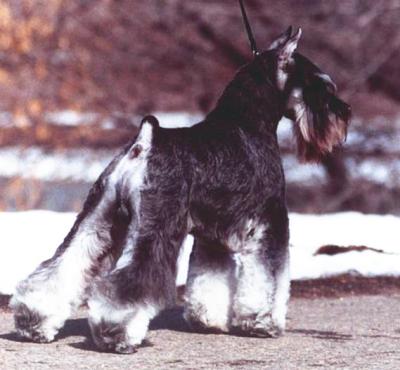
But here’s a photo I took of the National Winner a couple of years ago, “Am.Can.Ch.Reggae Indulgence”.
Frankie
Frankie
14 years ago this month, I spent a very long, tiring day and night tending to the birth of a litter of puppies. When it was finally finished, I had a male and female puppy to show for my efforts – efforts, as it turned out, that were just beginning.
The mother was an older dog, one I had leased at considerable expense from a breeder in New York. Things started out well enough, but after a few days it was clear something was wrong. The puppies refused to gain weight. Her milk had turned toxic and they had to be removed and raised on a bottle.
Bottle feeding newborns is round the clock work. Every two hours they require feeding, then burping and cleaning. Night and day. It means guarding their temperature carefully – they cannot control it on their own. It means packing them in a little beer cooler to take to work with you. And usually, it means some will not survive despite your best efforts. The male died when he was a week old.
The remaining female was thus plunged into the perfect storm of dog psychology – a hand raised “singleton”. No competition from littermates. No discipline from an experienced mother. No rough and tumble games to learn the rules of bite inhibition. A surefire recipe for creating a canine sociopath with no fear.
And, it goes without saying, absolutely no gratitude.
By the time she was 6 weeks old, “Frankie” was a beady eyed package of self-centered malevolence – utterly without respect or remorse, demanding instant gratification. A cuddle was as likely to draw teeth as it was a “kiss”. Attempting to discipline her into submission could send one to the emergency room for digit reattachment.
| This was my type of dog. And she was beautiful. |
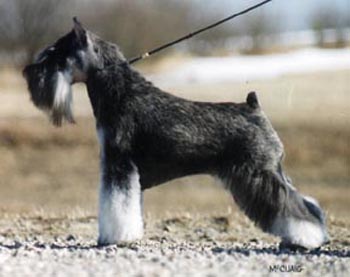 |
She became officially known as Am/Can Champion Minuteman I Eat Tigers.
Frankie had a pretty respectable show career, ending up top female in the country in 1992. She was bred and had two top producing champion sons – she has descendants all over the world now. But, unlike most of my other show dogs, she was never placed in a retirement home, and has been the bane of my existence ever since.
She’s become especially baneful as of late.

A few days short of 14, she has long ago lost her springy step, her keen sense of hearing and her teeth. She sleeps 23 hours a day, waking only to eat and pee on my floor and occasionally, wander aimlessly about. On her bad days, I am the personal servant of a four legged ill tempered boa constrictor. On her good days, I am the personal servant of a four legged ill tempered boa constrictor – the only difference being the intensity with which her gums snap together in the air as she whirls around to strike.
In the fleeting moments that she is awake, she travels in stiff-legged, drunken, random bounds that do not always direct her in a meaningful direction. She gets stuck in corners, having completely lost reverse gear. She has become known as the “pinball pogo-stick dog”.
And she has forgotten how to get home.
Yesterday, I put her outside to enjoy a bit of sun in a warm part of the yard. The gate was closed, but the yard is not secure. I brought her in a little while later.
Or I thought I had. The hours rolled by into late afternoon, and it was time to feed the dogs. As I mixed bowls, I reached for Frankie’s and as I did, realized that I had not seen her for some time. Did I bring her in? I honestly couldn’t remember. A check of the yard revealed no old dog standing around in a daze, and two surveys of the dog run area confirmed I hadn’t put her out there.
Perhaps she had gone around the end of the garden and wandered down the sidewalk. It’s happened before.
I walked out to trace her usual path – she always wanders to the light pole at the corner to check out the smells, then heads north with the down slope of the street. Path of least resistance. How far north depends upon how long she’s left to wander. She’s not a fast mover. And if she encounters something solid, she will usually just stop and lean against it.
I searched up the street and the neighbor’s yard. No Frankie. No point in calling her name, as she either can’t hear, or doesn’t care to. Time for the bicycle.
I rode up and down the streets for at least an hour, down all the back alleys, along the golf course behind my house – slowly, checking in yards, under hedges, stopping to ask people on the street. Nobody had seen a thing. Finally, I decided that it was time to check back at the house in the improbable hope that she had turned back around and headed south to come in for dinner.
No Frankie. Time to get the truck out and have a proper look. As I walked through the kitchen to get my truck keys, something caught the corner of my eye.

Like I said, she has no reverse.
Frankie isn’t going to be with me for very much longer. She has an aggressive mammary tumour and it’s grown to a size that can no longer be ignored, and that will soon become painful , so we are taking things day by day. Today was supposed to be the day, but I changed my mind.
Again.
I just thought I’d share her with you.
Wet, Cold, And Stupid
Just got home from a long weekend in Fargo, ND. I wish someone had told me the city was auditioning for the role of “Venice On The Red”
It started raining shortly after I arrived Friday night, and was still raining when I crossed the border back into Saskatchewan yesterday. I should have taken pictures, especially of the outdoor rings at the dog show. After two days, they were mud pits. So much so, that there were people showing in bare feet (shoes kept getting sucked off in the mud) and there was a hose available for people to wash the worst of the mud off before they came back into the arena (where, luckily, our little fluffy dogs were shown).
So, for Monday, the outdoor rings moved to the parking lot, and true to form, out they went in the pouring rain and wind to collect 12 cent ribbons, everyone soaked to the skin – 75 year old judges, included. I got sick just watching it. Seriously. I think I have consumption.
For this, we paid $20 per dog, per day. I think there may be a whole new field of psychoanalysis in there, somewhere.
Small Live Animals – week 10
See any cats, kid?

Small Live Animals – Wk 8
 |
“Get yer ya-ya’s out”. |
Small Live Animals – Week 6.5

The pic I wasn’t in the mood to take on Wednesday.
Small Live Animals – Week 6
No pictures today.
The puppies are the result of a test breeding for an inherited eye defect – retinal dysplasia. A recessive genetic defect, the dysplasia can be severe enough to cause blindness through retinal detachments and is present at birth.
I had the misfortune to discover this gene had been quietly introduced into a previously clear line I had been carefully building for nearly 20 years. Because it was recessive, there were no clues as to what was happening. None of my original dogs carried the gene, so the puppies continued to be born with normal eyes, though more and more were genetic carriers. By the time the first affected was born, the damage was done. Most of my top breeding dogs were carriers, or offspring of carriers, including two who have nearly 30 Best In Show wins between them.
The only silver lining is that RD is present at birth, and that makes it controllable. We can ensure that no buyer is ever sold an affected puppy through a routine opthalmologists examination.
I agreed to participate in a formal research program at the veterinary college at the University of Saskatchewan to research the defect (it was previously unrecognized as a breed related defect) and to establish the mode of inheritance. Representational differencial analysis is being used to try to locate the actual gene responsible and develop a screening test.
But that doesn’t solve the immediate problem. Which dogs to breed? Carriers are phenotypically identical to clears. Most animals carry an average of 5 defective alleles (humans included) , and purebred dogs generally carry even heavier genetic loads due to their small founder base and closed gene pools. Simply discarding high risk dogs and starting over wasn’t a rational solution. The line was very healthy in other respects, and clear of some nasty health problems that are common in other families.
The goal became to eliminate the gene itself, over the span of several generations, preserving the quality and general good health of the animals. Short form – dump the gene, save the line. Or, failing that, save the line and control the gene by planning breedings that prevent its expression.
The actual sifting process involves test matings of normal eyed dogs to mates who are homozygous affected. (The affected test dogs live normal lives as house pets, and most are sighted.) A simple, autosomal recessive trait, retinal dysplasia “takes two to tango” . The puppy must recieve two defective alleles, one from each parent, to have the defect.
If so much as a single puppy is affected, it proves the normal eyed dog is a carrier and any breeding must be carefully controlled, if he/she is bred at all.
If the puppies are all normal eyed, a mathematical probability is assigned to the dog tested. A dog with 3 normal puppies from an affected mate has a 87.5% probability of being clear of the gene – a dog with 6 puppies has a 98.5% probability clear. By using dogs with a “high probability clear”, in favour of unknowns and retiring carriers, we prevent the defect is being spread into the gene pool.
Recessive defects are particularly damaging in a closed gene pool where it is possible for one dog to sire hundreds of puppies in a relatively short time. One carrier sire can turn a rare defect into a very common one in only a few generations, especially if a few of his sons become similarly popular at stud. So, while crude, and unpleasant, a litter of affected puppies can prevent the birth of many, many more, in generations to come.
At least, that’s what we tell ourselves.
The puppies were examined today, and of the seven, five were affected with retinal dysplasia. The laws of probabilities are not kind. A large litter can be a train wreck. With a guarded prognosis and little demand for test breeding males, I left two of the male puppies behind. Their retinas were harvested to provide additional RNA for dna studies. Small dead animals.
The two who are normal will go to pet homes, and will be sterilized. The affected male puppy is going to Maryland to be used to test breed several females in kennels in the US, one of the affected females is going to a loving pet home that has had previous experience with a blind dog. The third affected female’s fate is uncertain at the moment. She may have a future as a test breeding bitch, she may not.
Me? Me thinks I need a another drink.
Small Live Animals, updated
Remember these guys?

They’ve done a little growing while we were gone.

Learning to swim …

And today! 5 weeks old.

Mom spends a lot of time trying to escape.