
Reader Tips
For tonight’s entertainment, enjoy this hilarious collection of comedy clips from Canadian Russell Peters … before he is banned by the SJW totalitarians.
Your funny, and not so funny, tips are much appreciated!
Wither Canada
Reader Tips
For your entertainment (bewilderment?) here is a 1931 cartoon promoting Oldsmobile.
Your bizarre, and not so bizarre, tips are much appreciated!
Leftist Elites: Don’t Believe Your Lyin’ Eyes
Will Leftist M.A.D. (Media-Academia-Democrats) EVER stop lying?
The Start of the Attempted Takedown of Tucker Carlson
In 2018, does a man have the right to defend the honor of his wife or his daughter? Apparently not, if the one allegedly doing the dishonoring is a gay, latino immigrant.
The Dreadful Attraction of Utopian Ideas
Toby Young and Jordan Peterson discuss the motivations of the Utopian Left.
Open Question: Are they more driven by ignorance, stupidity, or something else?
Some Old Wisdom for the Modern Age
11/11/2018
If we have no borders…
If we have no children…
If we lose our countries…
They all died for NOTHING.
— Stefan Molyneux (@StefanMolyneux) November 11, 2018
Leftism’s Culture of Silence
Grab your favourite hot beverage and watch Carl Benjamin interview Brendan O’Neill:
In the 23rd minute is this insightful gem:
Benjamin: “I can’t help but hear Friedrich Hayek whenever we’re talking about a subject like this because he was very concerned with the concept of social planning, the idea that society should be managed and planned to ensure certain kinds of outcomes. When, in his opinion obviously, he thought people should be left to their own devices and trusted to be responsible adults and manage the society in their own personal way, productively. And this is exactly the problem that he was predicting almost 100 years ago now that we are actually genuinely seeing coming to fruition: a kind of technocratic, highly educated … so many middle class people, who have gone to university, got their degree in something quite asinine and you end up creating a bureaucratic class of technocrats who think they can actually manage the world to their liking.”
O’Neill: “Yes, which is terrifying. It’s absolutely terrifying. I mean, they genuinely think they can socially re-engineer people. They genuinely think that it’s their role to make us healthier, to make us more PC, to change our attitudes, to change what we think, to change how we speak. They really believe that! I mean, it’s astonishing. Can you imagine being so colossally arrogant that you would go out into the world and think, ‘Oh I have to correct the way these people think.'”
Benjamin: “Especially in your mid-twenties.”
O’Neill: “In your mid-twenties! It’s astonishing! It speaks to an extravagant sense of entitlement.”
Benjamin: “It’s messianic, isn’t it?!”
O’Neill: “I find it chilling. I would far rather live in a world in which there were dodgy opinions, and even a few racists, and people with difficult points of view than in a world where I presumed the moral authority to tell people what to think. I find that such a horrific idea.”
For historians, 20+ years in the future, this is an important interview that clearly documents the current state of oppressive Leftists around the world in 2018.
How the Left Destroys Lives
Brett Kavanaugh isn’t the only one who has had false accusations thrown at him.
https://www.youtube.com/watch?v=c8D8ct2Lq5E
One wonders, if this story were presented to a Leftist friend or family member of yours, how would they react?
Bye, Bye Angela
Douglas Murray has written a comprehensive article about what went wrong with the “EU Vision” and what may happen now that Angela Merkel is soon gone:
But the mistake which was to prove the turning point for her chancellorship, and the European project, was the migration crisis. At its peak, in 2015, Merkel showed not only her immovability, but a unilateralism which was staggering. Throughout that period, Merkel seemed to think that she had the right to continue making decisions on behalf of an entire continent. When she unilaterally announced the suspension of normal border and asylum procedures in August that year, inviting refugees to Germany and declaring ‘We can do this’, she consulted few of her counterparts and listened to the warnings of none.
Only as Germany became overwhelmed did the Chancellor’s presumption become clear — as did the consequences. Just as Europe had in her view shared the burden during the financial crisis, so should fellow member states split the bill that Merkel had run up alone in Berlin, in her one heady moment of moral intoxication. But the rest of Europe turned away. From Westminster to Warsaw, nobody wanted to share the burden for decisions that they knew their own electorates would not forgive.
It’s All in the Name: #Acosta’d

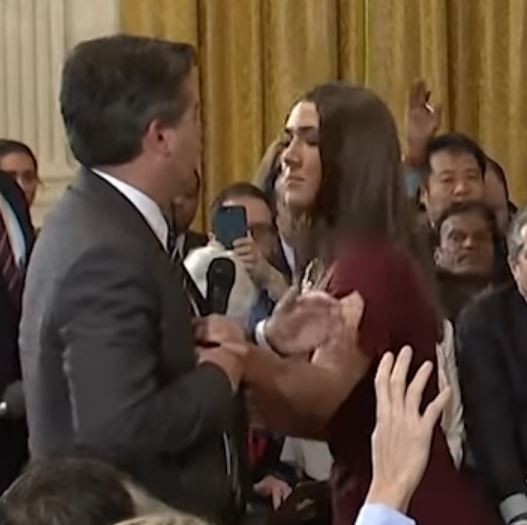
Sober Thoughts about the Midterm Elections
Some Final Thoughts Before Tuesday’s Vote
Sunday Afternoon Political Discussion
Reader Tips
For your entertainment tonight we offer you Il Divo’s rendition of Hallelujah.
Here’s hoping that you’re enjoying a restful weekend with your loved ones.
If you do have any tips to share, they would be most appreciated, as always!
Can Free Speech be Restored in America?
Ignoring Leftist Violence: Liars or Denial?
The silence and boos of the Toronto audience during this segment from the Bannon-Frum debate is deeply illustrative of the State of Denial so many Left of Center people seem to be about the “current state of friction” between the Left and the Right in America and throughout the Western World. Ask one of these folks whether more violence in recent memory stems from the Left or the Right and they will respond with the latter without a moment’s hesitation. Which begs the question, how do they explain this and this?
The unanswered question is obvious: Do these people sincerely believe that the Right is responsible for most of the violence, when there is mountains of evidence to the contrary, or are they merely NPCs whose internal scripts have been written in concrete by the M.A.D. (Media-Academia-Democrat) establishment?
A Pre-Election Moment of Reflection for American Voters
This clip is several months old but much of what Jordan Peterson says will hopefully encourage American voters to make the right choice on Tuesday:
Is it time to dismantle capitalism?
Writer Andrew Glover is skeptical of Naomi Klein’s goals:
One of the most prominent voices in this space has been Canadian writer Naomi Klein, whose 2015 book, This Changes Everything: Capitalism vs the Climate, argued that capitalism must be dismantled for the world to avert catastrophe. While I am sympathetic with some of the critiques that Klein directs at corporations and “free market fundamentalism,” her argument doesn’t hold water—because mitigating climate risks is a project whose enormous scope, cost and complexity can only be managed by regulated capitalist welfare states. Moreover, it’s difficult to see how she isn’t simply using the crisis of climate change as a veneer to agitate for her preferred utopian socio-economic system. As has been pointed out by Jonathan Chait of New York magazine, Klein appears to be adapting a mirror image of the same strategy she critiqued in her previous book, The Shock Doctrine, wherein she claimed that cynical politicians, pundits and corporations seize on crises to lock in economic restructuring along radical free market principles.