Why this blog?
Until this moment I have been forced to listen while media and politicians alike have told me "what Canadians think". In all that time they never once asked.
This is just the voice of an ordinary Canadian yelling back at the radio -
"You don't speak for me."
email Kate
Goes to a private
mailserver in Europe.
I can't answer or use every tip, but all are appreciated!


Katewerk Art
Support SDA
Paypal:
Etransfers:
katewerk(at)sasktel.net
Not a registered charity.
I cannot issue tax receipts
Favourites/Resources
Instapundit
The Federalist
Powerline Blog
Babylon Bee
American Thinker
Legal Insurrection
Mark Steyn
American Greatness
Google Newspaper Archive
Pipeline Online
David Thompson
Podcasts
Steve Bannon's War Room
Scott Adams
Dark Horse
Michael Malice
Timcast
@Social
@Andy Ngo
@Cernovich
@Jack Posobeic
@IanMilesCheong
@AlinaChan
@YuriDeigin
@GlenGreenwald
@MattTaibbi
Support Our Advertisers

Sweetwater

Don't Run

Polar Bear Evolution

Email the Author
Wind Rain Temp

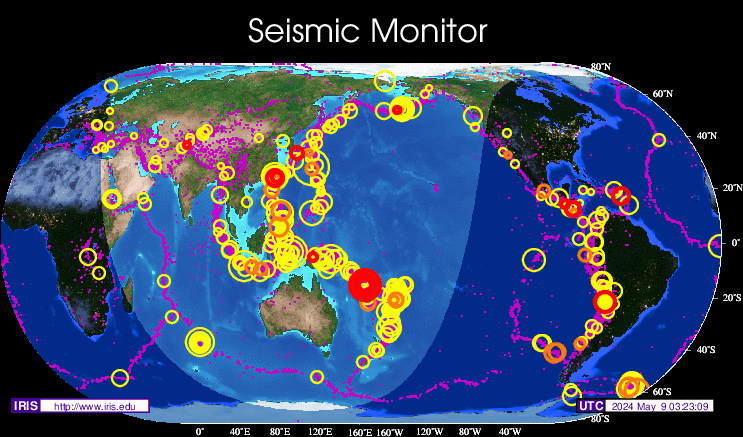
Seismic Map
What They Say About SDA
"Smalldeadanimals doesn't speak for the people of Saskatchewan" - Former Sask Premier Lorne Calvert
"I got so much traffic after your post my web host asked me to buy a larger traffic allowance." - Dr.Ross McKitrick
Holy hell, woman. When you send someone traffic, you send someone TRAFFIC.My hosting provider thought I was being DDoSed. - Sean McCormick
"The New York Times link to me yesterday [...] generated one-fifth of the traffic I normally get from a link from Small Dead Animals." - Kathy Shaidle
"You may be a nasty right winger, but you're not nasty all the time!" - Warren Kinsella
"Go back to collecting your welfare livelihood." - Michael E. Zilkowsky

Several years after Hurricane Katrina, I was working for a dredging company hired to help build a seawall and set of locks near New Orleans. This was part of a US Army Corps of Engineers project to close the Mississippi River Gulf Outlet Canal (MRGO). The MRGO is a 76 mile channel constructed in the 1960s by the Army Corps to provide a significantly shorter route than the Mississippi River for ships travelling back & forth between the Gulf of Mexico and New Orleans. It was being closed because Katrina’s storm surge had raced up the MRGO, smashed into the levees, and caused them to collapse.
Our portion of the project involved dredging a small channel through the marsh for about a mile, for the foundation of the seawall and lock system. But prior to dredging we had to construct a ‘spoil disposal area’, an enclosure surrounded by levees, where the slurry of dredged sediment would pumped and held until the sediment settled out and the clear water could be released.
Spoil disposal areas are typically constructed by digging a ditch and stacking the excavated mud to form levees. On this project however, there was an issue. Instead of stacking up, the excavated mud oozed like melting ice cream and refused to cooperate. And because I had a geology degree, I was given the task of trying to figure out what was going on. When I analyzed samples of the ‘mud’ under a microscope, I discovered it wasn’t what one would normally think of as mud (a fairly cohesive mixture of sand, shell, and clay). Instead it consisted of fine to very fine particles of decomposing marsh grass – nearly 100%. There was almost no sand, shell, or clay. It looked and behaved very much like saturated coffee grounds. And because it was unsuitable for building levees, we brought in enormous bales of wheat straw and stacked them like bricks to build our spoil disposal area.
Later, while having lunch with the Corps Manager overseeing our part of the project, (an older gentleman nearing retirement), I was suddenly struck by a perplexing thought: “Where was all the material excavated back in the 60s to make the MRGO?” When originally constructed, the channel was 650’ wide, 36’ deep, and over 75 miles long. There should have been dozens, if not hundreds of spoil piles down the length of the canal. Yet for as far as the eye could see, there wasn’t a single one. And as I was considering this, I looked quizzically at the Corps Manager and asked: “Where’s all the mud from the MRGO? What did they do with it? Where did it all go?”
The Manager instantly froze, and his eyes darted to the large levee that had failed. Now, this levee is a mound of material 30’ to 35’ high and over 100’ wide at its’ base that extends around the entire city of New Orleans. When he looked back, and I could tell the Corps Manager wished I hadn’t seen his reaction. But it was obvious he knew that I had, and it was obvious that he regretted it. He began to perspire. After looking down at his food for almost a minute, he stammered: “Well, uh, well, you know it was designed to withstand a 28’ storm surge with uh, 10’ waves… and we covered it with 6” of compacted clay; so it wasn’t supposed to fail.” And then he changed the subject.
So there it is, now you know. One of the reasons the levees ‘protecting’ New Orleans failed during Hurricane Katrina is because in the 1960s the Army Corps of Engineers constructed a significant chunk of them out of essentially… coffee grounds.
Yes, I remember reading about this after the devastating damage in 2005 BUT the article also stated that the federal government had given New Orleans a large sum of money to repair and fix the levees. Instead New Orleans spent the money on social programming and neglected the maintenance of the levees.
Sadly, many modern governments do the same thing, lots of social engineering programs, but the core services of utilities, road maintenance and new construction are pushed off to “next year” which of course, never comes.
so basically a shmoe with a garage and some sheets of plexiglas figures out why 100s of billions in damage in good ol’ NOLA?
murphy’s law big time. or another example of buck passing, ‘ees no my yob’ syndrome
just variations on a theme. making a dyke around your city with coffee grounds. way to go. and a big high five for Dubya’s version of FEMA, peter principle triumphs.
same thing Iraq war 2.0 eh dubya??
and hey we’re not being ‘left out’ we’se got our own 1 – 2 punch going on as well.
ah, who would that be?
and the mining industry has a bad reputation …
‘The Mind Blowing Flaw That Flooded New Orleans”
Well, maybe don’t build a city of 627,000 people below sea level in a hurricane alley for starters. Oh sorry, that was 1960 – there are only 362,000 today as of 2025.
Maybe some know what Mango Thonotosassa wrote above and are fleeing.
So you’re saying that in New Orleans… there aren’t nigh as many as there was a while a ago? I’ve heard that said before:
https://youtu.be/9CnPv_1SVh0?si=SKSLZnUVEMCaA0t6
Fascinating video with some fine takeaways;
(paraphrased)
21:51
… “only through previous engineering failures, does the science of engineering evolve”
Unlike big Left government failures, where nothing is learned, but merely taxed.
18:16
… “viewed through a long long-term perspective, without New Orleans 1960’s levees
the damage and risk of damage from flooding over many decades would be much lower
because designs did not account for all available data”
That’s human failure, and the story of big government;
ie innocent people built lives in high risk areas (inevitable flood zone) yet government is unanswerable
People let their guard by down when they place too much trust in government ‘workers’.
An historic human dilemma which, given time, engineering via honest science seeks to address.
16:12
… “One of the investigation reports stated clearly: “if a more rigorous analysis had been performed at the time of design, the potential problem would have been predicted and corrective action taken.”
Thanks Mango.
exactamundo.
l owned a total of 5 houses. all located in areas that met the following criteria.
-non busy side street.
-high and dry nowhere near any lake, waterway, creek etc that could in extreme circumstance flood my basement.
ummmm, that’s about it. my brother in Kamloops had a job in a trailer park.
aaaaaaand where was the trailer park? behind a dyke in the flood plain area of the Kamloops river. and then the day came the dyke broke, he noticed in time had just enough time to gun the engine of his truck and clear out.
l found the story:
https://cfjctoday.com/2017/06/02/45-years-later-a-look-at-the-flood-of-1972/
again, *who in their right mind makes a home in a flood plain dam or no dam???*
apparently the 670,000 in NOLA at the time.
what dumbyrekucf
My new screenplay, “The Blind Flowing Maw That Ate New Orleans”.