Why this blog?
Until this moment I have been forced to listen while media and politicians alike have told me "what Canadians think". In all that time they never once asked.
This is just the voice of an ordinary Canadian yelling back at the radio -
"You don't speak for me."
email Kate
Goes to a private
mailserver in Europe.
I can't answer or use every tip, but all are appreciated!


Katewerk Art
Support SDA
Paypal:
Etransfers:
katewerk(at)sasktel.net
Not a registered charity.
I cannot issue tax receipts
Favourites/Resources
Instapundit
The Federalist
Powerline Blog
Babylon Bee
American Thinker
Legal Insurrection
Mark Steyn
American Greatness
Google Newspaper Archive
Pipeline Online
David Thompson
Podcasts
Steve Bannon's War Room
Scott Adams
Dark Horse
Michael Malice
Timcast
@Social
@Andy Ngo
@Cernovich
@Jack Posobeic
@IanMilesCheong
@AlinaChan
@YuriDeigin
@GlenGreenwald
@MattTaibbi
Support Our Advertisers

Sweetwater

Don't Run

Polar Bear Evolution

Email the Author
Wind Rain Temp
Seismic Map
What They Say About SDA
"Smalldeadanimals doesn't speak for the people of Saskatchewan" - Former Sask Premier Lorne Calvert
"I got so much traffic after your post my web host asked me to buy a larger traffic allowance." - Dr.Ross McKitrick
Holy hell, woman. When you send someone traffic, you send someone TRAFFIC.My hosting provider thought I was being DDoSed. - Sean McCormick
"The New York Times link to me yesterday [...] generated one-fifth of the traffic I normally get from a link from Small Dead Animals." - Kathy Shaidle
"You may be a nasty right winger, but you're not nasty all the time!" - Warren Kinsella
"Go back to collecting your welfare livelihood." - Michael E. Zilkowsky
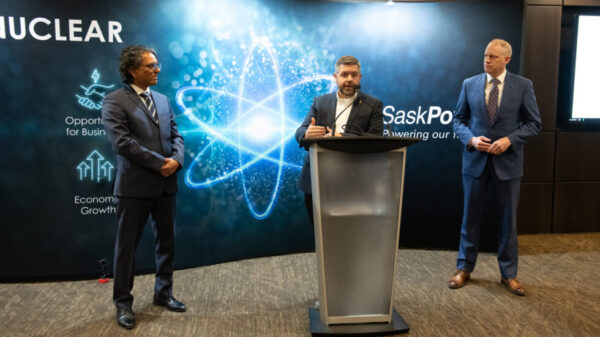

I know saskpower was looking at the Elbow area on Lake Diefenbaker for a potential smr. Makes sense because its somewhat centrally located between Regina and Saskatoon. But, with Saskatchewan and Alberta interties being near Swift Current and Medicine hat, I thought the Saskatchewan Landing area of Lake Diefenbaker would be considered. It’s also closer to USA states although I don’t think saskpower currently has interties in that area.
Perhaps Alberta might even want to invest in a full sized nuclear power plant close to their province.
Anything we do with large reactors will need some sort of collaboration with Alberta, because we will need to pull megawatts from their much larger grid to backfill when we go down for maintenance.
I included this in the story with regards to Diefenbaker:
Before the Estevan area was chosen for the first SMRs, the east side of Lake Diefenbaker was the other area of consideration for nuclear development. If you draw a 180 kilometre circle from the areas that were considered, Saskatoon, Regina, Moose Jaw, the Regina-Moose Jaw industrial corridor, and every potash mine except for Esterhazy and Rocnaville would fall within that circle. That, in turn, would dramatical reduce transmission line construction to service those load centres, as well as line loss due to resistance in the wires.
If I’m not mistaken, the line loss for 200 km AC transmission lines is about 4.5 per cent. So if you can keep your transmission to your major load centres below that, you’re really not losing much due to conductor resistance. If you wanted to get 100 megawatts from Estevan to Saskatoon, you basically have to produce 109 megawatts in Estevan. But if you did it at Elbow, you’d only need around 103.
Yes, line losses add up. The Elbow area has lots of advantages to supply the big urban communities plus mining, as you mentioned. Estevan’s advantage was that it has all of the electricity infrastructure and skilled labour in place due to the coal power plants. Also for political reasons since job losses in Estevan and Coronach will be large if/when the coal stations are decommissioned.
For a bigger nuclear power plant, being closer to export customers looking to decarbonze their electricity production or balance out their “green” intermittent production with baseload power might be a consideration. Maybe dust off the old meridian dam proposal and you get a cooling water reservoir and irrigation water for the dry palliser triangle region of Alberta and Saskatchewan. That’s a long shot proposal though.
Actually there has been consideration for large reactors on the North Saskatchewan River. But I don’t think it would be a full scale dam, but more likely a weir.
Oddly enough, 20 years ago I spilled a lot of ink writing about the then-mayor of North Battleford’s efforts to get a major dam built a few miles upstream at a place called Highgate. And it was modelled on Meridian.
I didn’t know about the north battleford proposal. There is certainly enough water (and a ski hill, IIRC) With the number of indegenous reserves in that area, it would have been difficult to move forward.
I thought the meridian proposal was interesting in many ways. I think they even floated the idea of a hydro power plant. Unfortunately, it was proposed during tough economic times in Saskatchewan.
With the way Canada’s economy is sinking, it might make a good depression era project. JK.
Nuclear Reactors, whether it’s a full meal deal or small modular ones, will never happen here, and the sooner everyone accepts this the better.
Drill baby Drill and dragline baby dragline
I might have to steal that “dragline, baby, dragline.”
Beware those confidently claiming something they can’t possibly be sure of.
The Ontario government has given approval for four new nuclear plants in Darlington, and excavation has begun. At least three other specific projects nationwide have been proposed and are in the planning and approval stages.
Canada seems to be ahead of the US in new nuclear projects, who do not have any plants currently under construction.
There are quite a few US Nuclear plants that have been decommissioned (20 of which are still in the decommissioning process) that could be pulled out of retirement since $80 Billion was just appropriated to that type power source and law changes/regulations are already through the process.
If they start yesterday, it’ll be 2050 before any reactor is finished.
Oil Pumps everywhere (zoom in):
https://geohub.lio.gov.on.ca/datasets/lio::petroleum-well/explore?location=43.141205%2C-80.229619%2C7
Oil City, Ontario smells like…oil.
https://www.google.ca/maps/place/Oil+City,+ON+N0N+1N0/@42.811468,-82.1364087,15z/data=!3m1!4b1!4m6!3m5!1s0x882f840fc927c243:0x3ef95f382837931!8m2!3d42.811469!4d-82.126109!16s%2Fg%2F1td6h3jm?entry=ttu&g_ep=EgoyMDI2MDIwMS4wIKXMDSoASAFQAw%3D%3D
Which is precisely why they are starting today.
The first reactor (a small modular raeactor) in Darlington, Ontario is estimated to take four years. It’s scheduled to be online by late 2030. Subsequent reactors in the project are estimated to take three years to build.
Even with delays, they should be complete way before 2050.
In Samsquantchewan they’re “beginning the selection process”.
Well bonne chance, mon ami.
I’m tainted, as I live in Ottawa.
Its mega-stupid here.
They have a bridge over the Ottawa river that’s literally ready to fall down and has been for a long time, but the Lgbtq+/)XYZ community has to have a say in the construction of the new one.
This is a post about an imaginary reactor in Saskatchewan, not a “do-it-as-usual-and-give-it-a-new-name” project in Ontario.
I know you have trouble with reading comprehension, but do try to keep up.
I hope the mix of large and SMR reactors Sask goes with are not with any AtkinsRealis – SNC Lavalin associated companies, Canada is in for a rough ride with a recession due shortly and the separation of Alberta will leave tier 2 Canada economically wounded.
Nuclear expertice can be had from jurisdictions which don’t hide data and their actual cash flow from the public.
Not a good idea to be making deals with a desperate partner, which everytime that things go wrong, hides the emails, deletes the memos, invokes cabinet secrecy not as means of keeping good gov’t, but of not disclosing their criminal behavor, and always with the taint of a coverup.
Citizens of Canada will never stop talking about the #Libranos malfeasance and the good people of Sask. probably don’t want to become the running joke that the federal gov’t has become.
The busiest time for American oil fields is every month that Donald J Trump is President. Elbows!
There is an astonishing aura of political unreality about the minister’s speech and presentation. He cannot really believe that the feds are not going to hamstring this project at every step of the way, and then demand that Saskatchewan choose a company from Quebec or France. Contrary to the ministerial statement, the driving issue is going to be the conflict between the federal position and Saskatchewan’s stake in Westinghouse.
Carney has bet the country on Trump losing the midterms. They’re not that far away, and I think Saskatchewan would’ve been better off waiting for the results. Yes, getting the thing underway is urgent but if Trump wins the midterms, then either Westinghouse or the company no one mentions, Rusatom, could get it built in 10 years or less. If he loses we will be stuck with candu which will turn out to be cannot do, and 20 years will go by before a shovel hits the ground.
A simple google search for Candu cost overruns gives far more links than explainations for how this happened,
and always there’s the management fees, the #Librano grift going on in the background like a virus you can’t shake…
At some point in the future an opposition MP will rise in the House and ask the minister responsible, “Mr. Speaker, How did these cost overruns get so out of hand and when is the gov’t going to tell Canadians the truth about this?”
And the response from the minister responsible will be, “Mr. Speaker the loyal opposition wants Canadians to freeze in the dark and they’re against all forms of future progress for our fellow Canadians”
And the welfare dependent eastern Canadians will vote for the #Libranos criminal orgainzation all over again.
almost any other company would be better. Japanese companies, or multiple Westinghouse SMR…
I’m not at all against nuclear power, but the most tainted water in Canada is the #Libranos talent pool.
The West, is never going to stop hammering on this malfeasance, this malignancy of the #Libranos which actively seeks to infect the western provinces. Just wait for the federal imbeciles to demand the workers are 30% from visible minorities and 20% are functionally bilingual …
“Point Lepreau Refurbishment: A major refurbishment of the Point Lepreau 1 reactor in New Brunswick, the first full refurbishment of a CANDU-6 unit, ran some C$2 billion over budget and three times over schedule (54 months instead of 18).”
“Darlington Nuclear Station Construction: The initial construction of the four-unit Darlington station in Ontario was originally estimated at C$3.95 billion in 1978 but eventually cost over C$14 billion by 1993, an increase of over 250%. This project, along with others, led to substantial debt for Ontario Hydro.”
“Advanced CANDU Reactor (ACR) Proposal: A proposal for a new ACR in Ontario was suspended in 2009 when the estimated cost for a 2,400 MW station topped $26 billion, or over $10,000 per kW, which was four times a 2005 estimate. This high cost led to the cancellation of the project.”
How many examples of cost overruns from these criminal #Librano idiots do you need? Starting to see a trend? What’s Saskatchewan’s plan for signing on to a $12 billion new Candu reactor which ends up costing the province $36 billion?
Do not hire the extended kin group that are responsible for public transit in Toronto.
Hire my next band, Kin Extension.
Given that transmission lines and associated stations are essentially 1960s technologies, we need either: to build more efficient grids; or to quit building large electricity supply projects and go for numerous local supply units with limited interconnection. One obvious benefit of the latter would be that suckers who voted for “clean” power would freeze in the dark instead of having their sorry asses saved by reliable generators.