Why this blog?
Until this moment I have been forced to listen while media and politicians alike have told me "what Canadians think". In all that time they never once asked.
This is just the voice of an ordinary Canadian yelling back at the radio -
"You don't speak for me."
email Kate
Goes to a private
mailserver in Europe.
I can't answer or use every tip, but all are appreciated!

Katewerk Art
Support SDA
Paypal:
Etransfers:
katewerk(at)sasktel.net
Not a registered charity.
I cannot issue tax receipts
Favourites/Resources
Instapundit
The Federalist
Powerline Blog
Babylon Bee
American Thinker
Legal Insurrection
Mark Steyn
American Greatness
Google Newspaper Archive
Pipeline Online
David Thompson
Podcasts
Steve Bannon's War Room
Scott Adams
Dark Horse
Michael Malice
Timcast
@Social
@Andy Ngo
@Cernovich
@Jack Posobeic
@IanMilesCheong
@AlinaChan
@YuriDeigin
@GlenGreenwald
@MattTaibbi
Support Our Advertisers

Sweetwater
Don't Run

Polar Bear Evolution

Email the Author
Wind Rain Temp
Seismic Map
What They Say About SDA
"Smalldeadanimals doesn't speak for the people of Saskatchewan" - Former Sask Premier Lorne Calvert
"I got so much traffic after your post my web host asked me to buy a larger traffic allowance." - Dr.Ross McKitrick
Holy hell, woman. When you send someone traffic, you send someone TRAFFIC.My hosting provider thought I was being DDoSed. - Sean McCormick
"The New York Times link to me yesterday [...] generated one-fifth of the traffic I normally get from a link from Small Dead Animals." - Kathy Shaidle
"You may be a nasty right winger, but you're not nasty all the time!" - Warren Kinsella
"Go back to collecting your welfare livelihood." - Michael E. Zilkowsky
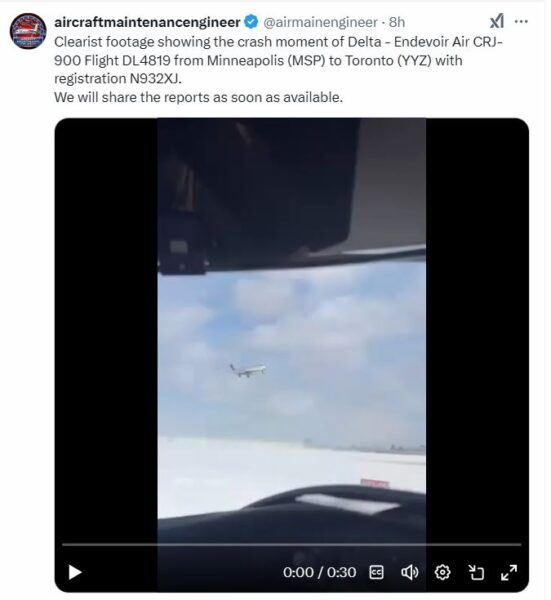

Seems to be nose down and accelerating rather than nose up to slow down. Heavy impact on the wheels for sure
Yes, it looks like the right main gear collapsed causing the right wing to strike the ground. Wing shears off and the left wing is still flying, so over it goes.
Turned out better than we feared, thankfully.
Exactly what I saw in the video as well. All the weight of the plane came down hard on the right main gear, and it collapsed causing the roll-over. Slowing the video down, I can see that right at the last couple of seconds before touchdown, the plane tilted to the right. It looked like a downdraft of some kind blasted at the right wing just before the plane touched down.
Agree. Failed to round out. Bang: right wing low, gear collapses, wing detaches, left wing pulls up and over, fuselage rotates inverted. Lucky folks as all got out thank God. Be interesting to read the CVR transcript and accident report.
I’ll wait for the ‘MAYDAY’ version.
It seemed like that to me as the aircraft shifted to the right on the runway. Just my speculation of course.
Kudos to the aircrew in calmly and quickly getting passengers out, with no loss of life, though some injuries.
According to comment by a commercial pilot with 25 years experience, he surmises there will prove to be problems with the flying records of both pilots on this Delta flight. He/they did “flare” properly, so came in much too fast and hard. I can’t find the link at the moment, but there’s a lot of discussion of this on X, and concurrence by other experienced pilots.
(“The landing flare, which is sometimes called the round-out, is when the pilot transitions from the final descent into the landing attitude. The flare is one of the hardest parts of learning to land a plane–it involves careful timing and understanding many factors affecting the plane.”)
Welcome to the skies of DEIs?
Everyone survived. Only 1 person still in hospital. A miracle really.
A whole team of guardian angels were hard at work that day. Yes, a miracle!
Another video
https://x.com/MatthewCappucci/status/1891689274682024441?
Lots of speculation from people who “know” what happened.
Pilot I know said it looked like they just stopped flying the thing 50′ above the tarmac.
Maybe the pilots were hired thru Delta – Endevoir Air DEI program to increase the airlines ESG score.
I’m thinking pilot error but what do I know. They were awfully fortunate.
No flare at all. Pilot error or another cause?
Did right main gear collapse?
Seems to be landing directly into the wind.
Is it any different from this landing?
https://m.youtube.com/watch?v=W-iWeUTNOCY
“Is it any different from this landing?”
Yes, that was a held off landing. Rotate and hold off, as should be.
The other one just kept on until it met the ground, a bit too much vertical descent rate for an “excellent landing”
(For non-pilots: a “good landing” is one where everyone walks away. An “excellent landing” is where the aircraft is also undamaged. Just aviation humor)
Yeah. Looked like a carrier landing.
You have to factor in the headwind and add that to the groundspeed. According to the latest info available, There were significant wind gusts, and there was also a significant cross wind right at the point of touchdown. Maybe too many factors for a routine landing for a pilot who may not have had the necessary flight hours’ experience.
The pilot would have to be utterly incompetent or unconscious to do this on his own.
More likely it encountered a sudden downdraft or wind shear that caused it to lose lift and descend. Airliners and jet engines are not agile and can’t react to such sudden changes so close to the ground.
All three landing segments seemed to touch down at once.
Sorry, not touch down. Slam.
IIRC, they were advised by traffic control that they might experience some “bumps” as they were on final approach. Apparently a couple of planes had landed just ahead of them and the vortex remaining behind them might cause some turbulence.
IF (and it’s a big if) the vortex remaining from the earlier aircraft was more stable than expected, and there was insufficient time/distance separation between the arriving aircraft, the CRJ could have encountered the vortex. That would result in a loss of lift and a sudden nose-down attitude without time to recover.
But that’s just conjecture. Incident investigators will eventually sort it all out, and only then will we know for sure just what happened.
Looks like he stalled it into the ground impacting on his low right landing gear. Low right wheel is normal in such a crosswind landing but the vertical speed down is very fast. I would suspect the wind stopped blowing just long enough for the aircraft to stall. When it a stall at that height there is no recovery and no flare possible.
I’m guessing the cockpit voice recorder might include “Sink Rate…VOOT VOOT…Pull Up!” To this former pilot the video shows me the right hand main gear took the full weight of the aircraft. There was no gradual “float” and flare down the runway and it seems he drove it right into the asphalt. Given a grey sky and white snow, I’d even hazard a guess that the pilot lost his depth perception.
I like airbus when it just straight up calls the pilot ‘retard’ twice right before landing.
It keeps the Karens out of the cockpit!
Democrats are busy blaming Trump and Trump supporters are ramping up speculation that Canadian ATC to blame based on no facts at all.
Shamefully pathetic reaction.
I don’t know if Vegas is taking odds, but my guess is that the right landing gear collapsed on contact, causing the right wing to touch down and get shredded. The lift from the left wing, without the right to counter balance it, caused the plane to flip.
Not sure where all the flames came from. The engines are at the tail, not on the wing.
But the fuel is in the wings.
Okay. I didn’t know that about rear-mounted engines.
But putting the fuel near the tail would unbalance the plane front to back, so it makes sense.
Aluminum scraping on tarmac generates plenty of heat and sparks, quite sufficient to ignite JetA mist.
That landing looked way too steep to me. A fighter aircraft landing on a carrier may need to land like that, but not an airliner.
The question that no one is asking:
“Why is the co-pilot of the aircraft waiting at the taxiway hold area, an area where both pilots need full concentration and situational awareness in anticipation of being released from hold and on to the departure runway, why is the copilot filming the incoming aircraft?”
I am quite confident that at the very least, company SOPs are going to dictate that what the copilot in the on-ground and filming aircraft did was strictly verboten.
Does beg the question if there were comms related to the Delta aircraft as it was inbound.
In reality, too early to speculate on pilot error.
More of a belly flop than a landing.. Fly the DEI sky’s :)..
Gusty winds (to at least 80 km/hr), ground drifting snow and not a perfect headwind (probably 20-30 deg off on average), and with gusty winds we often see rapid changes in direction moment to moment. I agree with earlier comment that depth perception could be a bit off given the glare and lack of contrast.
I agree it’s a miracle nobody was killed (and most injuries are said to be minor).