
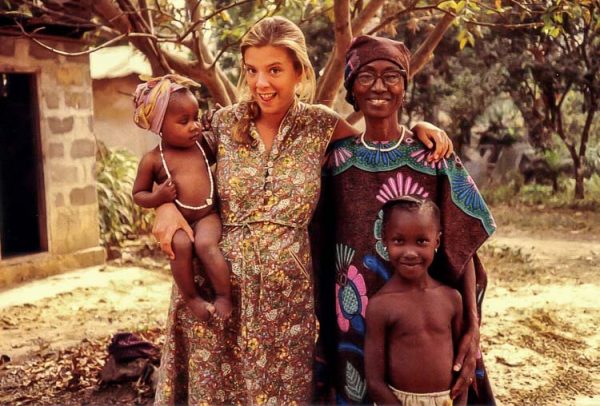
SDA regular Denise has written in with something relevant to our current times. The photo is of her and her friend, Cassandra, and her kids.
Forty years ago this month I left the comfort of Canada for the discomfort of West Africa. My remarkable Sierra Leonean host was a septuagenarian midwife named Cassandra Roques. With no electricity, Mama Cassan delivered babies by kerosene lantern and cooked our meals over an open fire. It had been years since water flowed from the government-supplied water tap in her yard, so she joked that it was a monument. A shower was a bucket of rainwater. When nature called there was a pit latrine. She was the embodiment of strength, resilience, and vitality in what was then ranked the planet’s poorest country on the UN Human Development Index. There was evidence of international aid: a barely begun hospital long abandoned; a paramount chief with an elaborate throne; government officials living the good life. Then, and now, aid flows into poor countries, but where does all that money go?
A decade after returning to Canada I met the granddaughter of Sierra Leonean ruler Siaka Stevens (1967-1985) when she was studying at London’s Western University. I said how sad I was that a horrific civil war was raging in her ancestral home, but she was nonplussed: she’d never been there. She was from Switzerland and had attended the best private schools that international aid money could buy. In The Crisis Caravan (2010), an exposé of the disturbing underbelly of humanitarian aid, Dutch journalist Linda Polman describes a festive gathering at a luxury hotel in the West African capital after the UN once again named Sierra Leone the world’s poorest country in 2001. The cream of Freetown society was jubilant: now even more aid money would flow into Sierra Leone and into the pockets of the elite and powerful.
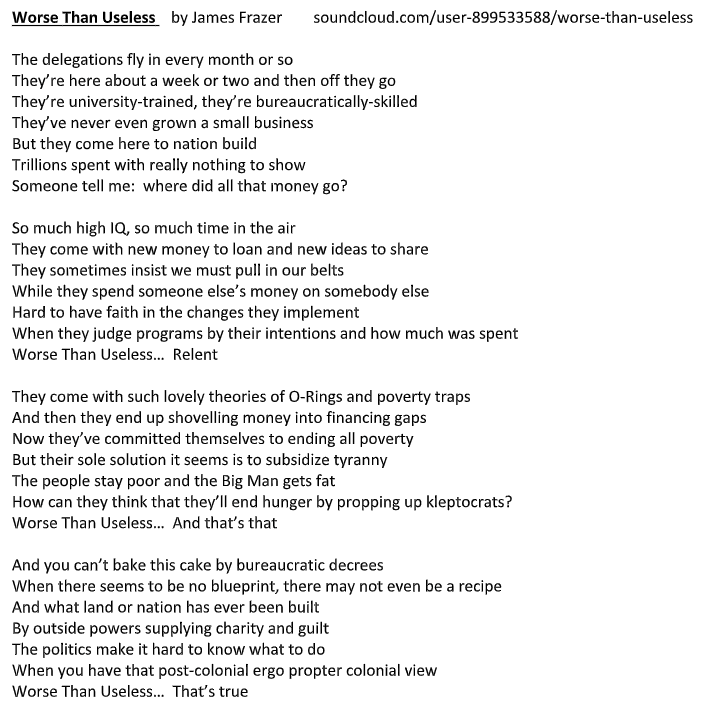
For a more succinct and amusing assessment, husband James Frazer offers Worse Than Useless, a ska-influenced musical critique of the aid industry. In a nutshell: “The people stay poor and the Big Man gets fat. How can they think that they’ll end hunger by propping up kleptocrats?” To catch all the words, you can view the lyrics here.
Well done, now do Injun Affairs canaduh or whatever it is called these days.
I get paid over $85 per hour working from home with 2 kids at home. I never thought I’d be able to do it but my best friend earns over 10k a month doing this and she convinced me to try. The potential with this is endless.
Here’s what I’ve been doing… https://earnincome00.blogspot.com/
the precise message of “Dead Aid” by Dambisi Moyo.
Another Example: PLO Chief Yasser Arafat was supposedly had billions of dollars socked away in Swiss banks. In the mean time, average Palestinians got a lot poorer when the Palestinian Authority took over the West Bank and Gaza from the Israelis.
https://nypost.com/2002/08/14/hes-billion-dollar-arafat-got-rich-on-aid-for-palestinians-israel-general-says/
Remember those Palestinian Elections?
When was the last election in Gaza or the West Bank?
One man, One Vote, Once.
‘Once people have voted, why make them go through the business of voting again?’ Paraphrased from ‘Hitler: The Last Ten days.’
Alex Guiness was amazing in this film.
Canadian taxpayer’s billions have to go somewhere, I guess. It’s not like we need them here or anything.
This is not new. It has to be 50 years ago when we were living in a mining town that we became friends with a British couple. Husband was a mining engineer and they’d lived several years in Africa before coming to Canada. Even then aid was flowing from the West to Africa, and they witnessed the corruption. Tins of food still with the donor’s label (think it was Oxfam but can’t remember), were openly sold at the local market, and there was other evidence aid money and supplies wasn’t going where supposed to.
The Equivalent of Four Marshall Plans have been dumped on Africa since 1945, with little effect, other than new palaces.
The old truism is, “Foreign Aid consist of taking money from poor people in rich countries and sending it to rich people in poor countries”.
Hayden, great saying. A former colleague who was an engineer from Somaliland said his country kicked out the NGOs who were there to “help” and reduced their government size to the bare essentials and his country prospered as a result. The NGO representatives always drove around in newer, large SUVs. A lesson for many other countries.
Somaliland is a shocking success story. Not even officially recognized and prosperous…maybe because of that. America et alia should recognize them as independent they’d be a great regional partner. Somalia and maybe Ethiopia would be sore but they’ll just have to get over.
EDIT: funny enough, Somalia is doing a lot better too. If you help their old ‘Shilling’ currency you might have made a lot of money.
UnMe. Re “Somaliland is a shocking success story. ”
Not shocking to Libertarians and small-goverment Conservatives I’m sure. A model for rest of Africa, perhaps.
Thanks for that Denise. “a hospital barely begun”. At least they tried.
Forget it, Jake. It’s Africa.
Everywhere.
It’s interesting that they had the guts to put this line in the movie. ‘Some people say, there is something wrong with my people.’ Djimon Hounsou. TIA
Thanks for this, Denise.
The real global pandemic is uncaring sociopathy in the ranks of the world’s Ivory Tower Trash.
Some of you might know who Angus Deaton is. He’s a Nobel Laureate economist at Princeton who spent a good deal of time studying the effect of foreign aid on poor countries. His focus was centered around South Africa and India. He has a rather interesting take on the matter which very much backs up the experiences Denise had.
I don’t like to link to the Washington Post, but this article left out the politics and evaluated the facts. The graphs included in the article are absolutely stunning. Those who received the most aid responded the most negatively when in comparison to those poor countries not on the receiving end.
The article is from 2015, but is very good:
https://www.washingtonpost.com/news/wonk/wp/2015/10/13/why-trying-to-help-poor-countries-might-actually-hurt-them/
I witnessed this first hand in Peru in 1971. This was one year after the devastating 1970 earthquake that killed something like 70,000 people. I was lucky to meet a British architect who had been hired by the United Nations Development Program to design low cost housing resistant to earthquakes. After one year nothing had been built nor a site selected but the UN poobahs were living gracefully in Lima (I remember meeting the director who was nattily dressed and driving an MGB about Lima). The same for a Peruvian mining engineer who had been tasked with creating a school for the local miners to improve safety and efficiency. After one year – nothing to show for it and it wasn’t for his lack of trying.
Robert / Denise
That Sound Cloud audio link doesn’t work. Maybe not embedded correctly. I’m not surprised: I tried SoundCloud for my own songs and found it so flakey I abandoned it.
A client of mine many years ago — an Indian — gave me a long lecture on the fraudulent disaster of foreign aid. Up to then I had naively believed it was for philanthropy. I like a new term to describe Bill Gates: philanthropath.
The link through the post works for me. If still problems, google James Frazer Soundcloud & should be first option – you can also check out James’ crowd favourite about our current prime minister, Little Potato. I like your new term: philanthropath — hope it becomes part of the lexicon.
Sierre Leon and the other countries of West Africa have actually been getting a lot better over the past decade and a half, largely owing to ending civil wars and embracing some degree of capitalism. Apparently Togo is emerging as something like the Singapore of the region.
Last I checked (last week) Sierra Leone was still in the bottom 5 poorest countries in the world. Another West African country – Nigeria – has seen record slaughtering of Christians. Curious if those getting better are doing it with the “help” of China. I hope you’re right that things are moving in a positive direction – economic growth and individual rights & freedom – I’m just not hopeful.