Why this blog?
Until this moment I have been forced to listen while media and politicians alike have told me "what Canadians think". In all that time they never once asked.
This is just the voice of an ordinary Canadian yelling back at the radio -
"You don't speak for me."
email Kate
Goes to a private
mailserver in Europe.
I can't answer or use every tip, but all are appreciated!

Katewerk Art
Support SDA
Paypal:
Etransfers:
katewerk(at)sasktel.net
Not a registered charity.
I cannot issue tax receipts
Favourites/Resources
Instapundit
The Federalist
Powerline Blog
Babylon Bee
American Thinker
Legal Insurrection
Mark Steyn
American Greatness
Google Newspaper Archive
Pipeline Online
David Thompson
Podcasts
Steve Bannon's War Room
Scott Adams
Dark Horse
Michael Malice
Timcast
@Social
@Andy Ngo
@Cernovich
@Jack Posobeic
@IanMilesCheong
@AlinaChan
@YuriDeigin
@GlenGreenwald
@MattTaibbi
Support Our Advertisers

Sweetwater
Don't Run

Polar Bear Evolution

Email the Author
Wind Rain Temp

Seismic Map

What They Say About SDA
"Smalldeadanimals doesn't speak for the people of Saskatchewan" - Former Sask Premier Lorne Calvert
"I got so much traffic after your post my web host asked me to buy a larger traffic allowance." - Dr.Ross McKitrick
Holy hell, woman. When you send someone traffic, you send someone TRAFFIC.My hosting provider thought I was being DDoSed. - Sean McCormick
"The New York Times link to me yesterday [...] generated one-fifth of the traffic I normally get from a link from Small Dead Animals." - Kathy Shaidle
"You may be a nasty right winger, but you're not nasty all the time!" - Warren Kinsella
"Go back to collecting your welfare livelihood." - Michael E. Zilkowsky

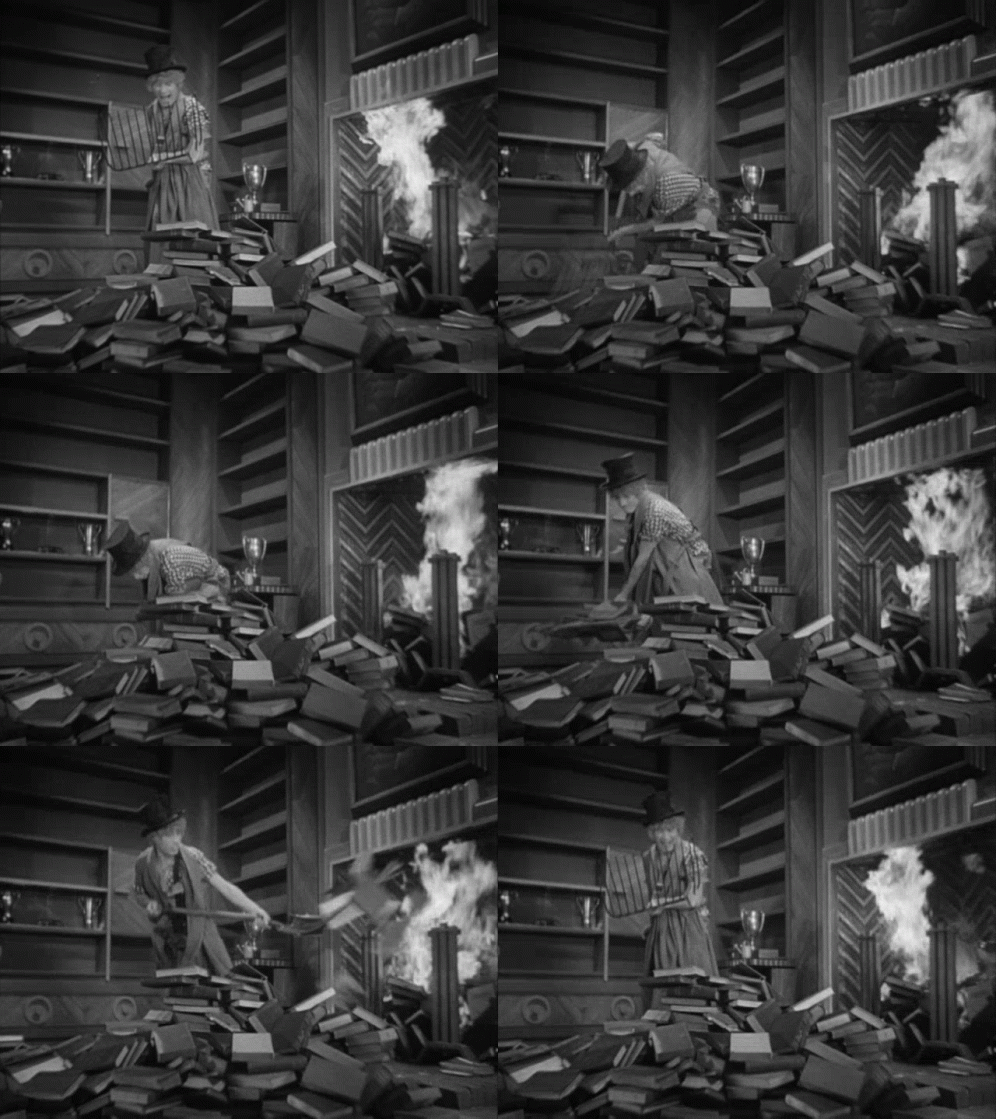

No doubt the bears are headed for the pyre. Who’s next?
Tintin
Did you know that Tintin is Greta Thunberg’s middle name?
How about Fahrenheit 451?
Too meta. They’d never get it.
Oh, total Kristallnacht on this.
You just watch.
They will come after Curious George and Snoopy then.
That is when these censors really need to be f—ed up.
Feminist crap. I refused to read it to our kids. My wife didn’t understand why, and thought my explanations were way out there.
At least sometimes the left scores own-goals.
Always with the book burning. It is like they are mindless automatons with programming from 300 BC. Haven’t had an original thought their entire lives.
There is a reason these books have been so popular for so long. It is that they work for children. In the case of Dr Suess, his playful, witty language makes him a keeper. His ability to engage children and encourage reading makes him a keeper. His uplifting messages makes him a keeper. So we will be keeping him. For those who would discard him, it is their children’s loss.
“it is their children’s loss”. Yeah, but when it reaches a corporate level, and they have the power to ban even the printing of those books, we all lose, and we no longer even have a choice in the matter. That is the greater loss. I also doubt it will ever end. It is indeed strange that we were once amused by the absurdity of such dystopian “book burning” ideas in movies such as Fahrenheit 451, and dismissed the Orwell 1984 idea as beyond any sanity or reason. It’s only books and movie’s, it’ll never happen in “real” life, right!
Yet here we are!
Keep in mind that these are the books that the people who are banning them grew up on. Maybe they didn’t do such a great job of teaching children in the first place. I suggest “Mein Kamf” as a primer for the next generation.
Mark it down, Shakespeare is next!
Everyone talks about the book burnings of the past. No one asks what books were being burned.
In the original famous book-burning, the books weren’t particularly important. Nationalist forces across the German provinces of Napoleon’s France were organising for an attempt to liberate the country, and recruited at the universities, expecting reasonably enough to find military-age men there. They developed a practise of building a bonfire while exhorting the students, then urging them to reject school symbolically by tossing their school books in the fire, and join the army. The book burning was understood and presented as something positive, as a personal sacrifice (and indeed books cost money), and as a hard-headed recognition of the important over the frivolous, and emphasized the heroism of the students.
120 years later, the Nazis certainly had a programme of purifying the culture, and when they burned books, they used the occasion to emphasize the kinds of things they were getting rid of. But that was actually secondary; they wanted to be seen burning books, any books, because they wanted to look just like those heroic students. And that’s how it was seen and understood in Germany at the time. It certainly looks different today.