Why this blog?
Until this moment I have been forced to listen while media and politicians alike have told me "what Canadians think". In all that time they never once asked.
This is just the voice of an ordinary Canadian yelling back at the radio -
"You don't speak for me."
email Kate
Goes to a private
mailserver in Europe.
I can't answer or use every tip, but all are appreciated!

Katewerk Art
Support SDA
Paypal:
Etransfers:
katewerk(at)sasktel.net
Not a registered charity.
I cannot issue tax receipts
Favourites/Resources
Instapundit
The Federalist
Powerline Blog
Babylon Bee
American Thinker
Legal Insurrection
Mark Steyn
American Greatness
Google Newspaper Archive
Pipeline Online
David Thompson
Podcasts
Steve Bannon's War Room
Scott Adams
Dark Horse
Michael Malice
Timcast
@Social
@Andy Ngo
@Cernovich
@Jack Posobeic
@IanMilesCheong
@AlinaChan
@YuriDeigin
@GlenGreenwald
@MattTaibbi
Support Our Advertisers

Sweetwater
Don't Run

Polar Bear Evolution
Email the Author
Wind Rain Temp
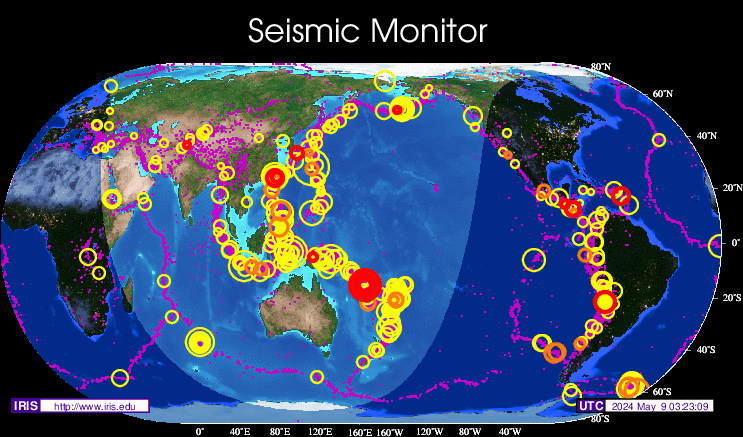
Seismic Map
What They Say About SDA
"Smalldeadanimals doesn't speak for the people of Saskatchewan" - Former Sask Premier Lorne Calvert
"I got so much traffic after your post my web host asked me to buy a larger traffic allowance." - Dr.Ross McKitrick
Holy hell, woman. When you send someone traffic, you send someone TRAFFIC.My hosting provider thought I was being DDoSed. - Sean McCormick
"The New York Times link to me yesterday [...] generated one-fifth of the traffic I normally get from a link from Small Dead Animals." - Kathy Shaidle
"You may be a nasty right winger, but you're not nasty all the time!" - Warren Kinsella
"Go back to collecting your welfare livelihood." - Michael E. Zilkowsky

Interesting video. I have driven past facilities while out west and was always amazed at the scale of the operations.
Always enjoy these inside “how do they do that” views.
Noticed that they don’t have the dangerous volatile dust to worry about like from coal.
Another rare thing is seeing an employed white male not being bashed, nice!
That was fascinating. My only previous experience with the Sakatchewan’s potash industy, apart from a couple of relatives who are executives in one of the corporations, is travelling along the Trans Canada, and noticing what was referred to at the beginning of the video as the “tailings management area”.
I suppose the huge ponds one can see around the bitumen mines of Alberta could also be called “tailings management areas”.
[The film also remains silent on the process between the removing of salt & brine from the mixture and those tailings.]
We know the problems with the bitumen ponds.
And, for example, that the government has alaready spent a billion dollars stabilizing the “tailings management area” of Giant mine at Yellowknife & will spend several millions per year in perpetuity to maintain that stability.
Are there any problems with potash leftovers?
From a quick search it might be an interesting enquiry.
Where have we heard this sort of thing before?
Global News reported that about 50 ducks were saved and several died after landing in a Mosaic Co. tailings pond in Saskatchewan.
And this cute high-school experiment —
A Study on the Effects of Potash Tailings on the Growth of Barley and Flax
I did take a tour of the mine near Vanscoy, Saskatchewan, a number of years ago and found it quite interesting.
Huh. No masks.
Dizzy
The salt you saw by the transcanada highway west of Moose Jaw is not from the Potash mines but is salt mined for use in detergents. The potash mines tailings are the huge mounds by the mines containing clay and salt.
O.K. I just assumed from the highway what the white stuff was, & a relative agreed, not really asking where I was.
But the picture I used was identified as Potash tailings on this blog.