
Baltic Exchange Dry Index*
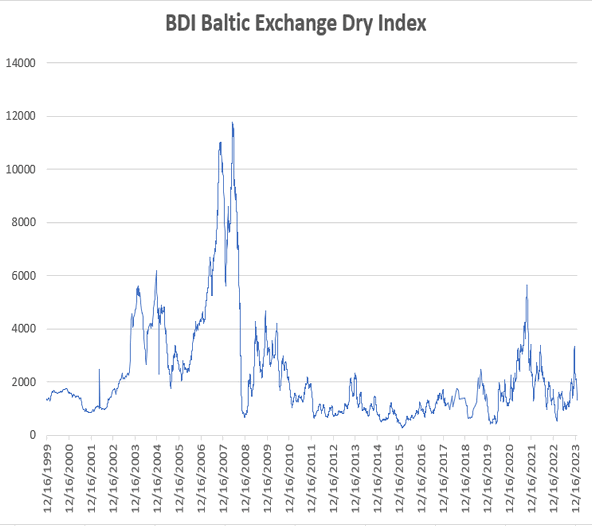
And just to help your breakfast along on that round-trip ticket;
This is the essence of AIG’s latest proposal:
Man walks into pawn broker. He says to the person behind the counter, “You know that watch I brought in two weeks ago? I know you lent me $85, but now I need another $50. And I will tell you why you will give it to me. I have a gun with me. I will blow my brains out here, right now. With your nice carpet, I guarantee it will cost you more than $50 to clean up your store. And that’s before we get into the cost of keeping your store closed while you clean my grey matter off your walls and what my suicide might do to your store’s reputation.”
Oh, and we forgot to mention that the man in the story above pulled the same trick last week and it worked like a charm.
Lots more where that came from Naked Capitalism
Depression within 6 months, war within 5 years.
On a more positive note, though way off topic, that 2004 piece you did on your dog Frankie was superb. You write well, Kate.
These bankers, CPA’s, and CEO’s should be treated as economic terrorists. Blowing up a countries economy should be treated the same as blowing up the twin towers. Inflated financials for performance bonuses and fleecing the companies of the investors cash and pension funds should be a terrorist act. Use the new laws against these criminals. No courts needed. These people like to holiday on the taxpayers dime, I sure Cuba is nice this time of year and orange is definitely their color. Next is the buying up of the agriculture land and the food supply to terrorize more nations.
We all know how this came about. Leveraging. Lots of borrowing. Poor financial allocation priorities. High pay for little or useless work (think kyotoland, think Lehmans.)
We all know that. But the trick now is to guess what is coming.
First off, perhaps it is NOT a credit crunch because of lack of funds;
[According to the most recent weekly banking data from the Federal Reserve, the Total Bank Credit of All Commercial Banks exceeded $10 trillion for the first time during the week of October 22 (see chart above, click to enlarge). Compared to mid-October 2007, total bank credit in October 2008 increased by almost 11%, and is almost $1 trillion higher ($977 billion). Compared to mid-2000, total bank credit has doubled from $5 trillion to $10 trillion. ]
IOW, gov’ts around the world are printing money. Nice.
The problem (if that is the right word here) is that the borrowers are not yet biting. Same thing has been going on in Japan for a decade already.
People, business are reluctant to buy if they have the feeling that prices may decline. (Talked to anyone lately who has delaying booking a winter vacation?) The slacking off in buying is self perpetuating.
Japan has had a hard time re-inflating their economy because they were more or less in isolation with their deflation. It is not good if you are the only country printing money because it devalues the currency compared to others. After all, it is just paper with ink on it! (Think wheel barrows of money in Germany in the 20s)
Since every thing is relative, if, now, nearly all countries of the world start printing money, all currencies would devalue at the same time and trade, competitiveness, gov’t debt issues may be muted.
Inflation, Hyperinflation even, could be the end result. In this scenario, who would benefit ? Who would suffer ?
Suffer; cash holders.
Benefit; Virtually everyone else, especially those with loans. (They get to pay back there loans with cheaper money)
What is the problem today ? Bad loans, leveraging. Clean those up and VOILA ! (Except for cash holders)
Seems that Greenspan got this whole thing ass-backwards 15 years ago. The problem in the mid nineties was too little liquidity. Cure ? Raise interest rates to discourage borrowing and encourage savings. He did the opposite. Dropped the Fed rate to 1% or so. And what are the Central Banks doing now ? You got it – dropping Interest Rates.
The Bank of Japan has been at virtually zero for a decade. Some thought it may have to go negative. What ? Yes, negative interest rates. The banks would pay YOU to take a loan – to buy a falling-in-price item (House prices in Tokyo fell 50%.
Perhaps the trick today will be to get through this trough (falling asset values) and survive to hitch a ride on the inevitable inflating balloon.
(Note: During the Great Depression of the thirties, did Central Banks print money ? No, if I remember right, the money supply contracted by about a third in the counties that mattered)
Off the top of my head, generalizations – I surely stand to be corrected.
Employment is at a 30 year low, inflation is low, interest rates are low, the government is in surplus, the banks are profitable, demand for Canada’ vast resources is increasing…remind me again how this is the worst financial crisis since the 1930s?
Sounds to me more like a shakedown than a bailout. Different situation in America; even so, I believe the government is threatening citizens into forking over hundreds of billions in bailout money via the threat of shutting down the economy.
…………..PLEASE SIR, WE NEED MORE…………..
Hood Wink Robin
Rob the poor to pay the rich.
“Congressional investigators demanded State Street Corp., Citigroup Inc., and seven other banks justify billions of dollars in pay and bonuses after they accepted $125 billion as part of a taxpayer-funded bailout.
In letters to the nine firms yesterday, Representative Henry Waxman, the chairman of the House Committee on Oversight and Government Reform, said they collectively will pay $108 billion in employee compensation and bonuses in the first nine months of 2008, almost the same amount as last year.”
“Waxman also asked for the number of employees paid or projected to be paid more than $500,000, and the total and projected compensation for the banks’ 10 highest-paid employees.”
http://www.boston.com/business/articles/2008/10/29/waxman_tells_banks_to_justify_bonuses/
Is this what the CWB fight is actually about?
“In many countries, private investors are buying up huge areas to be run as natural parks or conservation areas. And wherever you look, the new biofuels industry, promoted as an answer to climate change, seems to rely on throwing people off their land.”
“.an underlying food-for-energy swap in so far as numerous projects involve contracts to provide oil and gas supplies in return.”
Money in money out.
“The private sector rush into farmland acquisitions this year has been dizzying. Deutsche Bank and Goldman Sachs, for instance, are taking control of China’s livestock industry. While all eyes were focused nervously on Wall Street in late September 2008, these two were tucking their money away into China’s biggest piggeries, poultry farms and meat processing plants – including rights to the farmland. New York-based BlackRock Inc, one of the world’s largest money managers with nearly US$1.5 trillion on its books, has just set up a massive US$200m agricultural hedge fund, US$30m of which will be used to acquire farmland around the world. Morgan Stanley, which nearly joined the queue for a US Treasury Department bail-out, recently bought 40,000 ha of farmland in the Ukraine. This pales in comparison to the 300,000 ha of Ukrainian farmland that Renaissance Capital, a Russian investment house, has acquired rights to, but still. In fact, throughout the highly fertile belt from Ukraine across southern Russia, the competition is hot. Black Earth Farming, a Swedish investment group, has acquired control of 331,000 ha of farmland in the black earth region of Russia. Alpcot-Agro, another Swedish investment firm, has bought rights to 128,000 ha there. Landkom, the British investment group, has bought up 100,000 ha of agricultural land in Ukraine and vows to expand this to 350,000 ha by 2011. All of these land acquisitions are to produce grains, oils, meat and dairy for those in the hungry world market … that is, for those who can pay.”
http://www.grain.org/briefings/?id=212
Ron:
You seem to advocate massive debt-cancellation, which is what universal inflation amounts to. What does the aftermath look like? Do cheated creditors – that is to say, prudent individuals, businesses and governments with large dollar reserves – resume their former activities as though nothing has happened?
Can’t be true, what with the new President and all. When does his magnificence perform the promised healing?
There may be yet another shoe to drop, and if it does, it will be horrific. I’m talking about credit swap derivitives, a completely unregulated market that now totals about $62 trillion. It is clear that those who have issued these “securities” have nowhere near enough assets to pay up if they are redeemed to any large extent.
Warren Buffet refused to go anywhere near these, describing them as financial weapons of mass destruction, administered by madmen.
Buy! Just put in an order for another penny stock in the Canadian resource, (base metals, NFLD), industry.
I’m also looking at picking up some more uranium stock preferably at the early prospecting stage.
No ! Not at all. I am not advocating mass debt cancellation through inflation. Just that it has happened before and may be the Politicians way of “saving” us.
Falling demand for high seas shipping — there may be many reasons.
Looking back to June 1975, the beginning of the decade-long, strongest bull-run on food in history. (The world’s most important commodity)
[The shipowner in Copenhagen was interested. Business was in a slump, and the Russian merchant fleet had once again been grabbing contracts away from Western shipping companies by offering to haul freight at discounts. Could M. Lerbret please give at least the company name of his clients ?
“Glenas, Incorporated of Panama,” was Lerbret’s laconic reply.
[ … ]
[Representatives of charters and shipowners meet on the floor of the Baltic Exchange to confirm deals involving tens of millions of dollars with no more than a hand shake. On any given day at the Baltic, a Greek ship may find a cargo of French flour to carry to Egypt; an international copper company may locate a ship to haul its ore from Zaire to Philadelphia; an old tramp steamer out of Hong Kong may be consigned to a Japanese scrapyard; or a 50,000 ton tanker may be leased for twenty years. The Baltic is also a market place of information, one of the strategic listening posts in world trade. Economic recessions and recoveries are often first detected in the slackening or quickening of chartering activity there.] The Merchants Of Grain by Dan Morgan
Glenas Of Panama was a front for the Russian gov’t. The Russian gov’t had made a historic change in attitude. It would buy food anywhere it could instead of (hopelessly) insisting that the Communistic way could provide it. It wanted to buy as much grain as quickly as it could before the price was inevitably driven up. The Great Grain Robbery.
Could the Baltic Rate price plunge of 2008 be telling us of something more significant than just a looming recession ?
[For the first time in human history, the population has begun to experience what demographers call “negative momentum”, when a shrinking population goes into a spiral of decline. Wolfgang Lutz of the Austrian Academy of Sciences, says that Europe experienced a “flip” from positive to negative momentum in 2000 because fewer babies were being born to younger mothers. “Negative momentum has not been experienced on a large scale in world history. It is now like sailing against a current running towards population shrinkage and aging,” Dr Lutz said.
The huge social and economic costs of the shift to an aging population, where one European worker would be expected to support two pensioners by 2065] The Independent
Ron,
You are correct the money supply shrank, for two reasons
1) Banks failed with no depositor insurance so savings literally vanished into thin air
2) People removed money from banks and put it in matresses, reducing money in circulation.
We definitely have a major mess, no question. For ince I would say the British government is handling the response better than the US. Ibcredible to beleive that US government really has no idea what the bailout money is used for since they have no board seats or ownership stake. They have no ability to prevent the money from being used for compensation.
Anyway, the main point was to prevent wholesale runs on banks.
However, commodity demand seems to be dropping off…I would take this all as calm before the storm, or alternatively as the low tide that precedes the tsunami….imho
That chart looks like Sarah Palin’s popularity ratings!!
Ron, Stephen:
Many good points in your posts; the one element not mentioned, which I think is important, is the velocity of money (Vm) – that is, the number of times a single dollar is spent during a time period. In normal times, dollars turn over fairly rapidly in our system: we either spend or save our money in the bank; if we save it, the bank lends it to someone who spends it; the person he spends it with either saves it or puts it in the bank, etc., etc. ad nauseum.
However, in times like these, people stop spending. Distrustful of banks (and gee, why would anyone feel that way?!), people begin to convert cash to harder, less tradeable assets. For example, coin dealers across North America report an almost near impossibility to acquire modern gold coins (Canadian Maple Leafs, South African Krugerrands, American Eagles, etc.) as hoarding has begun. Each 1-oz coin effectively removes $750 US from the circulating money supply. People also begin to postpone major purchases, such as houses, cars, etc. Normally, this would result in higher savings, and banks, which prefer to lend money rather than hoard it, would lower rates to make loans more attractive. However, in today’s frozen economic state, banks are reluctant to lend money, and hence Vm falls.
In physics, we are all familiar with the concept of momentum – the product of mass and velocity. I have often considered whether there is an analogous quantity in economics – a “money momentum”, as it were – which would be the product of the money supply and Vm. However, given that the determinants of Vm (GDP, the price level, the number of transactions, and the money supply) are measured imprecisely at best, it is difficult to gather concrete data. Regardless, I press on..
In the physical world, momentum is conserved unless acted upon by an external force. Friction eventually brings most moving objects to a stop. Barter economies, as opposed to money economies, suffer from much higher “exchange friction” – if you’re trying to trade wheat for cloth, you either have to find someone with cloth who wants wheat, or engage in a series of intermediate transactions until you have something the cloth person wants, which can take much time and effort – and hence have very low Vm. Money economies avoid such waste, and experience much higher Vm as a result.
So the question is “What affects Vm?”. Friedman, and the entire Chicago school, hold that Vm is a function of interest rates, income, and other concrete factors. However, I believe that Keynes was on the right track when he coined the term “animal spirits”. When animal spirits rage, Vm is (I believe) high, and when animal spirits wither, Vm falls. I’m not a huge fan of FDR, but his “the only thing we have to fear is fear itself” is, in itself, correct. If fear causes Vm to contract, total output necessarily falls, even if the government attempts to counteract it by increasing the money supply (pace Japan since 1990, the US in the last year). Some economists refer to this as “pushing on a string”; in the immortal words of Monty Python, “It don’t work!”.
The big problem is that as the fear spreads through the country, individuals start to take actions (saving money, postponing purchases, hiring fewer people, cutting inventory, etc.) that make sense on the individual level, but when aggregated across the economy, result in reduced economic activity, recession, and perhaps, depression. Economists refer to this as the “fallacy of composition”.
We need to get the money flowing again. I’m not advocating a return to NINA mortgages or un-valuable CDO/CDS/ABCP instruments. But we do need to get normal, reasonable commercial transactions back to previous levels so that we can begin the process of recovery. What scares me about Obama is not that he’s a dilettante (“present!”), but that he’s raised hopes so high that when he fails to deliver (as he or McCain or anyone elected was doomed to do), the fear and dread will so dampen Vm that depression will in fact occur, and the traditional road out of that, for the US, has been war.
realistik:
For the chart, how about “likelihood of the Obama Administration on delivering all that he promises”
What I laugh about is the guys who say that capitalism hasn’t worked and we need to give govt more control over the economy. (That’s straight out of the Book of Trudeaunomics).
Actually capitalism was starting to do its job just fine but the politicians who always have exaggerated views of their abilities and powers have interfered and prevented it doing its job.
The real problem is that politicians don’t like the brutal unbiased ways that capitalism metes out the punishment to their constituents.
AIG should have been toast by now and so should have a lot of other badly run banks investments houses, etc.
Govt should just make the rules and let the chips fall where they may. But of course Paulson being an old Wall Streeter, had to buy enough time for his old buddies to get out their losing market positions before any serious meltdowns could occur.
Regarding the North American auto industry fiasco, the rest of the world has been slowly adjusting over the decades to the possibility of Peak Oil and the future price rationing of expensive oil prices.
And they are making very, very good cars in the process.
The US auto boys refused to seriously build smaller more efficient, quality cars and so the Japanese cars have come to dominate much of the world market. Does the world really need factories building 500hp cars, trucks and SUVs, ie leisure vehicles?
Hey, building the good stuff like that should left to good guys like Shelby, Foose, Roush, Penske, or Petty. Like it was in the old days.
In all likely hood, all the govt interventions and bailouts are going to do is delay any real recovery in the world economy.
Rip Van Winkle can now take a 10 year nap.
Detroit/Oshawa DOES make small cars. So what’s the real problem ?
Ask any auto recycler. They will say things such as; a GM rack and pinion steering assembly will last about 80,000kms. A Honda about 400,000kms.
Why ? In the sixties, GM put their money into tailfins and salesmen. Honda put their money into milling machines and engineers.
Unions didn’t help. They were just interested in the bottom line – of their pension plan, which is now eating the Big Three alive.
I’ve recently started re-reading Murray Rothbard’s book America’s Great Depression. I’m absolutely stunned at how our politicians are imposing exactly the same kinds of remedies for the economic problems of today that they did in the 1930’s: higher taxes, more regulation, bailouts galore, all of which did nothing but prolong and deepen the economic slump.
I highly recommend it for anyone who is interested in understanding what really went on in the 1930’s.
Basic economics: what goes up, comes down. Insanity returns to trend.
This is good for exporters who were paying ridiculous sums of money to get their goods to market. This time last year, we were reading about how the cost advantages of building things overseas was eroding due to shipping costs, but not any more.
The supply of cargo ships is generally both tight and inelastic — it takes two years to build a new ship, and ships are too expensive to take out of circulation the way airlines park unneeded jets in the California desert. So marginal increases in demand can push the index higher quickly, and marginal demand decreases can cause the index to fall rapidly.
http://en.wikipedia.org/wiki/Baltic_Dry_Index