Why this blog?
Until this moment I have been forced to listen while media and politicians alike have told me "what Canadians think". In all that time they never once asked.
This is just the voice of an ordinary Canadian yelling back at the radio -
"You don't speak for me."
email Kate
Goes to a private
mailserver in Europe.
I can't answer or use every tip, but all are appreciated!


Katewerk Art
Support SDA
Paypal:
Etransfers:
katewerk(at)sasktel.net
Not a registered charity.
I cannot issue tax receipts
Favourites/Resources
Instapundit
The Federalist
Powerline Blog
Babylon Bee
American Thinker
Legal Insurrection
Mark Steyn
American Greatness
Google Newspaper Archive
Pipeline Online
David Thompson
Podcasts
Steve Bannon's War Room
Scott Adams
Dark Horse
Michael Malice
Timcast
@Social
@Andy Ngo
@Cernovich
@Jack Posobeic
@IanMilesCheong
@AlinaChan
@YuriDeigin
@GlenGreenwald
@MattTaibbi
Support Our Advertisers

Sweetwater

Don't Run

Polar Bear Evolution

Email the Author
Wind Rain Temp

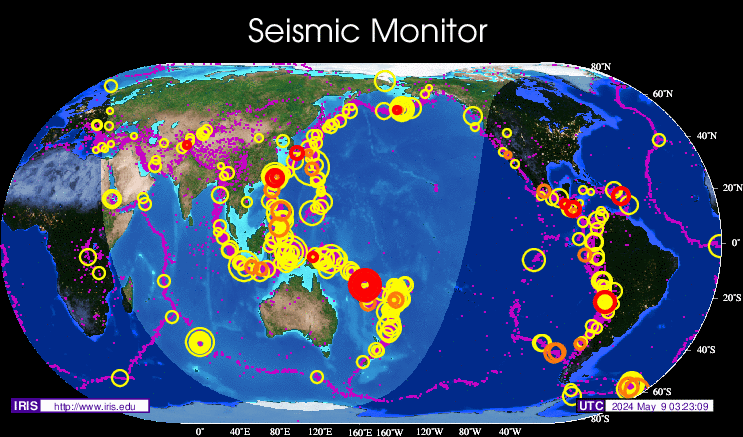
Seismic Map
What They Say About SDA
"Smalldeadanimals doesn't speak for the people of Saskatchewan" - Former Sask Premier Lorne Calvert
"I got so much traffic after your post my web host asked me to buy a larger traffic allowance." - Dr.Ross McKitrick
Holy hell, woman. When you send someone traffic, you send someone TRAFFIC.My hosting provider thought I was being DDoSed. - Sean McCormick
"The New York Times link to me yesterday [...] generated one-fifth of the traffic I normally get from a link from Small Dead Animals." - Kathy Shaidle
"You may be a nasty right winger, but you're not nasty all the time!" - Warren Kinsella
"Go back to collecting your welfare livelihood." - Michael E. Zilkowsky


dont hope for any fusion in the new future.
http://en.wikipedia.org/wiki/Tokamak
the only energy from fusion for the next few decades will be from a hydrogen bomb.
Ok Zog and Ron in K… I’ll engage you on this!
1) Subsidies – Capital project subsidies are needed to get many of the projects off the ground. This is true especially for the smaller projects such as rural communities. The other side of that is the fact that subsidies available to these communities are often not used or are used for projects with far less intrinsic value. There are enough viable projects in play to attract BILLIONS of private investor dollars.
2) Power Utility connections – These connections are still critical Yes! The other side of this is that the utilities charge a very substantial fee to the operators to have that connection whether or not the windgen operators take or provide power .
3) Regulators – MY experience with these regulators indicates anything but due diligence in their motivations. I say this not to denigrate their responsibilities but rather to question their approach to those responsibilities. The Utilities simply do not want to deal with the complications.
There are more considerations at play than simply the cost of electricity. Viable projects exist and will continue to be developed and managed.
Questioning the planning and management of these systems is probably a good thing. However, failure to adequately research, plan or manage any system in no way justifies the blanket condemnation of the technology in question.
You have to love it when the moonbats come on and invent Kates take on the links, when in fact she said nothing, simply posted the links. It is up to us – the readers – to make our own minds up. Or in the case of the moonbats, start accusing the right of being Anti-Wind. We said nothing of them – the moonbats – being in the pay of Big Wind, no one even inferred it, but they all sprang to the defense of Big Winds, methinks they protest too much!
Wind power is an interesting technology that has merit in supplementing the current production of electricity. It has been tried much longer in Europe than in North America, we should learn from their mistakes and profit from their successes. If they have found that it is not reliable or that it damages the Grid then we need to find a work around or limit its implementation to areas where it does work.
It is always amusing to watch the reactions of people like “Steve @ 2:27” and “Fellow Winston @ 3:24” and to realise that they don’t get it. All the comments up until their BDS rant where actually positive, much like their hero – DeYawn – they cannot understand the work “YES”….
Re Wind Audits…. Yes they are a real thing.
Step ONE in determining if a proposed project is viable.
Want to be a “Wind Auditor” ? Then get an engineering degree or something related in geo-science.
We start with NR-Can Studies then go and build towers to take measurements ourselves.
As for those of you who think you need to come to Kate’s defense….. she’s a grown up and she can do for herself if she chooses.
Defend myself against what precisely?
the wind turbines may kill bats but they seem to attract moonbats.
let the free market reign.
free the west.
Ommag makes some convincing points while..
Ron says.. **The point here, is that WP generation is horrendously expensive (3X, 4X or more than conventional) and is not feasible, even with huge taxpayer subsidies. **
Ron, I missed your link for that..
Kate presents both sides in the post..
** A spokesman for ScottishPower said it was believed to be the first time a turbine had collapsed in the UK. He said engineers would be trying to find out whether the faulty turbine was in operation at the time of its collapse on Thursday.
Wolf-gerrit Fruh, a senior lecturer in energy engineering at Heriot-Watt University in Edinburgh, described the incident as **EXTREMELY UNUSUAL.** [Reliable Expert?]
First hand info: A radio operator living in the coastal Oragon mountains relies on his WindGen and Battery system and is never off the air. Totally satisfied! Says he will never go back to the grid and monthly bills.
Sean makes a good point at 1:45
Cal2 at @:06 – **the costs of battery banks on anything is prohibitive.**
New power storage consists of a white building the size of a house. It contains vats that hold both anode and cathode in liquid form.. no plates sitting in acid at all. Very cheap big battery.
Legit Corporate indistrial website. I need time to find it though.
Damn, I should have bookmarked it. = TG
No, I only presented one side. Or aspect, actually. It’s what I’m best at.
This has nothing to do with anything other than piss poor engineering.
I hope the turd who put his stamp on that (assuming the engineering profession is governed somewhat similarly in Scotland as it is in Canada) is hung out to dry.
This says something about the all liquid battery. [ The Flow Liquid Battery ]
Flow liquid battery is considered to be an ideal device for the energy storage because it has high energy efficiency (over 80%) and can be used in large …
linkinghub.elsevier.com/retrieve/pii/S0378775306022956
Still looking for the industrial applied … [ Practical ] link. = TG
Thing that got built fell down.
Big news.
Would have been bigger news if it was a nuclear reactor.
Apologies to all for the NRCan Link … used to be some easily located links to data from wind survey’s on NRC site….
For example here’s the Ontario resource:
Wind Resource Atlas
Loki stated: “Environmentalists go into hysterics when a handfull of ducks are covered in oil but seem unperturbed over the hundreds to thousands more birds that are macerated by wind turbines.”
All studies I have read state that turbines have a fairly minor effect on birds – usually in the range of two bird kills per year per turbine. Anyone concerned with bird mortality should deal first with house cats, high rise buildings and electrical transmission wires.
Ron in Kelowna states: “The point here, is that WP generation is horrendously expensive (3X, 4X or more than conventional) and is not feasible, even with huge taxpayer subsidies.”
Sorry to burst your bubble. I recently discussed natural gas generation costs with an engineer with one of Canada’s largest private generators. Gas costs alone, excluding all other costs in developing new generation, are in the range of 5-6 cents per kilowatt hour. Current wind projects I expect are about 9 cents per KWHr and private industry is developing small projects in Ontario for 11 cents.
Mugs says: “Oh and the biggest solar farm in North America (McGuinty endorsed)that’s a whole other story, we had some of the most beautiful cloudy days this year lots of them, and it is going to be built right under them, and they already signed a twenty year contract at 42 cents a kilowatt.We pay six at the meter?”
Regarding the Standard Offer Contract, and I expect you are referring to the OptiSolar project near Sarnia, the total proportion of such projects relative to total electrical costs is tiny. When the proportion is broken down, it amounts to a fraction of a penny on one’s hydro bill. The SOC for solar was proposed to see what would happen and is only in place for a short time before re-evaluation. As technology proceeds, the revenue paid will decrease.
BTW – solar photovoltaics has excellent load matching characteristics and achieves maximum output at the same time demand peaks from summer air conditioning.
Regarding the farmer with the used turbine, is this the one near Forest? I’ve heard there are problems with it but I haven’t substantiated it.
TG: Regarding battery technology, check “vanadium redox battery”. This has very good potential and is being commercialized by a Vancouver company (http://www.vrbpower.com/). I first read about it a few months ago in the Financial Post. They are building a pilot project for a 33 MW Irish wind farm to shift load from evening (highest winds but low prices) to later in the morning.
wave generators were becoming popular at one time, and road gens. some guy made his house drain with a micro gen inside.
TG: Here is some more information on the vanadium redox battery and the Irish project.
http://secure.theengineer.co.uk/liChannelID/8/Articles/298818/Irish+energy+storage.htm
John- yes the turbine I was talking about is by Forest closer to Arkona actually. Last I heard it wasn’t working out to bad for them.
My hydro bill is still pretty wild, and I’m one of the people that was buying fluorescents when they where 25 bucks a piece, I think there are way to many fractions of a penny on my bill already from mismanagement – expand the coal plant.
John I’ll believe it when I see it for some reason I can see 400 acres of broken run down solar farm in twenty years or less, and a candle factory in its place. 🙂
OMMAG
“”””There are enough viable projects in play to attract BILLIONS of private investor dollars.””””
ever hear of tax write offs:-))))
and as far as batteries go, try a fly wheel
haha..oh jesus..now Kate takes on wind power probably for no other reason than that she sees it as a construct of left leaning people and God knows that everything is completely black and white…Even more hilarious is that she doesn’t attack it’s viability as an alternative, but rather it’s safety record. ~ steve
Ya gotta admire Kate. Just the fact that she posts an interesting article is enough to get leftie steve all in a tither. ~ Texas Canuck
Surely no one is saying that the wind turbine projects are a waste of time or money!! ~ OMMAG
You have to love it when the moonbats come on and invent Kates take on the links, when in fact she said nothing, simply posted the links. It is up to us – the readers – to make our own minds up. ~ commsguy
Defend myself against what precisely? ~ Kate
So we’ve got “lefties” disagreeing with what they’ve read between the lines on this post, some supporters coming to Kate’s defense, other supportive readers concurring with the lefties for once, and yet more supporters denying that there are even lines to read between.
I’m curious, Kate: what was your point in this post? I’d love to hear you come out and say it just once. Personally, since you contrasted blurbs like “Wolf-gerrit Fruh, a senior lecturer in energy engineering at Heriot-Watt University in Edinburgh, described the incident as “extremely unusual” with multiple photos of fallen turbines, I suspect the truth is closer to “steve” than to, say, “commsguy.” But that’s just me. What say you? =)
“now Kate takes on wind power probably for no other reason than that she sees it as a construct of left leaning people and God knows that everything is completely black and white”
I just assumed she has an oil furnace and gets Haliburton to ship her a barrel or two of oil every winter for certain considerations 🙂
John B, Thank you.. I*ll follow up. The Van-Redox is in the top of the mix. The sites you point to are new to me. thanks.
The Fox is in the hen house.
In the first quarter of this video he plays along with the host re Al Gore and the N. Prize, but gets into How to get America off oil. PEV the grid, and he*s right on. David Sandalow / Freedom from Oil – Author [Top Creds]
http://www.eenews.net/gw/
Snooty site though:
Academic institutions that have institution-wide access to our services include:
* MIT
* Stanford University
* Georgetown University
* Williams College
* Yale University
* Colby College
* University of Wyoming
* Vermont Law School
* New York Law School
* Carnegie Mellon
* Harvard University
* Indiana University
* University of Michigan
* U.C. Santa Barbara
===== They offer a two week trial to their site.
I*ll wait until I really need it… maybe.
Students get a patronizing message. Yuk! = TG
OMMAG, still ignoring the sheer cost per kilowatt of wind generators (no cheating, you’ve got to calculate total cost of ownership), AND the fact that their intermittent nature means they can never be anything other than a supplement to fossil fuel or nuclear generation.
Same goes for solar and for wave generators. Intermittent, supplementary, extremely expensive.
Should fossil fuel become so hideously expensive that these kinds of supplementary generators become cost competetive, then you know what? They will be economically attractive, and there will be one on every bump in the landscape.
Oh, and our lives will SUCK, because for wind power to look good, one hell of a lot of people are going to be freezing in the dark up here in Kanuckistan.
Gets cold here in the winter dude, or had you forgotten that part?
I bet the Windmills were backed up by good old reliable coal. I wonder if the UK will meet their Kyoto targets with the whole wind farm down.
For anyone contemplating leasing their land to a wind power company, this is the most important clause of all;
[Decommissioning cost (if capitalized). (FYI, I generally urge that landowners insist that decommissioning costs be covered by cash bonds held by independent third parties because many wind farm “owners” turn out to be LLCs with few assets. Because tax breaks for wind are heavily front-loaded (depreciation – 5-6 years; production tax credit – 10 years), there are huge incentives for sales of facilities after tax breaks are used, or for abandonment if costs of maintenance, repair and/or replacement rise substantially. There is little protection for landowners from surety bonds that depend on premium payments or cash bonds held by an LLC-owner – in case of insolvency or abandonment.)] Minnesotans For Sustainability©
Link for the true cost of WP ?
From; Minnesotans For Sustainability©
A. True Cost of Electricity from Wind
1. Capital costs, which are generally specific to equipment, site and owner
2. O & M, Repair and Replacement
3. Income Taxes
4. Cost per kilowatt-hour (kWh)
a. Capacity Factors
b. Useful life of turbines
5. Extra costs of electricity from wind because of intermittence, variability, unpredictability and uncontrollability of electricity output from wind turbines
a. Cost of backup generation
b. Transmission costs
c. Extra grid management burden
d. Arbitrary assignment of costs
e. Penalties in competitive markets
f. Who bears the costs?
g. Shifting of costs from “wind farm” owners to electric customers by regulation
6. Tax breaks and subsidies for “wind farm” owners
a. Tax breaks
1) The Federal Production Tax credit
2) Five-year double declining balance accelerated depreciation (5-yr., 200% DB).
3) Reduction in state corporate income tax due to federal accelerated depreciation
4) Reduction in state and local property, sales, and other taxes
b. Subsidies for the wind industry
1) Federal subsidies
2) State subsidies
3) Renewable portfolio standards – an insidious subsidy
4) “Green” energy programs
B. Availability, Capacity Factors and “Homes Served”
1. Availability factors
2. Capacity factors
3. “Homes served”
http://www.mnforsustain.org/windpower_schleede_costs_of_electricity.htm
Did you know that if the city of Toronto was converted to wind power, the windmill farm would take up the same amount of land as big as the province of PEI. Now who would want that.
Everyone seems to forget that buffering takes care of on – off winds.
Ron, That list is a fraction of the Nuke-Gen list. = TG
OMMAG et al:
Wind power is a distraction to the issue that really matters – base/peak load generation.
If the peak demand for an area is say 1000 MW, then 1000 MW has to be provided by either of the following: Coal, Oil, Biomass, Biogas, Hydro, Nuclear or Natural Gas. Period.
Wind and solar are not reliable enough to be counted on to be a part of the base load supply. They are a nuisance and a distraction to what should be the singular task at hand – providing base/peak load supply at the absolute lowest cost possible as reliably as is reasonable from acost standpoint.
Of the above, coal is currently hands-down the cheapest provider. To say that wind or solar are only a multiple of the cost of coal completely misses the above point – wind power is INFINITELY more expensive than the above alternatives because it ISN’T an alternative. Wind and solar subsidies are a complete waste of money as they only reduce the cost efficiency of coal and other similar generation methods that have significant power output when idling that is sold for less when wind power is a competitor.
Subsidies – capital subsidies via short-term generation subsidies for renewable base/peak load generation – (biomass, biogas and hydro) makes perfect sense as once thay have paid off the capital cost the generated power cost is usually very low – particularly Hydro –
(provided, of course that the subsidy is repaid to the subsidizing entity).
And for those reading this who are aghast at my supporting ‘dirty’ coal, please be advised that zero airborne emissions coal power is less than a decade away from widescale commercialization. At that point coal will be the cheapest, safest AND CLEANEST power choice with reserves of at least 400 years in N.A.. By then fusion – which the first pilot project in Europe (http://en.wikipedia.org/wiki/ITER) is due to be completed in 30 years – will be able to replace it.
P.S. – it should be noted that Wind and solar can be a part of peak/base load capacity if it is coupled with a pump hydro storage facility (i.e. water is pumped up the hill during lower demand periods). (http://en.wikipedia.org/wiki/Pumped_storage_hydroelectricity) But I haven’t heard or read much discussion of this option, unfortunately.
Gord Tulk — exactly.
Patrick Moore has been saying much the same thing.
So, tell me — why does Suzuki get all the headlines ??
Ron:
because “green” is about fashion, not facts. Remember just a few years ago the same “green” media stars were smoking cigars and just a few years before that they were starring in movies about the corrupt practices of the tobacco industry.
Ron:
It should be noted that Patrick Moore thinks Nukes are the answer – the traditionally designed kind not this much safer option:(http://en.wikipedia.org/wiki/Pebble_bed_reactor), not ‘clean’ coal – something he should reconsider.
Gord and Ron …. I run up against people who put up these same objections all the time. Of course if anyone has unreasonable expectations about the outcome of such things as wind power generation, then they will end up very unhappy. That does not mean that people give up and go home. What we do is adjust our expectations and work toward realistic goals while addressing problems that can be mitigated or better eliminated.
The simple answer is that a properly conceived and planned project will be successful.
You are correct in many of your observations but incorrect in thinking that they can be applied broadly and in all cases.
One huge assumption almost everyone leaps to is that windgen will be used in massive applications. Not so! We already know the pitfalls and limitations. Another is costs to implement the systems. Current and soon to be available hardware is and will continue to be less costly and more reliable. Oh yes …all sources of energy are going to coast more.
Other sources of energy as you note are cheaper and some will continue to be cheaper. ALL energy sources will increase in cost.
Guess which ones will increase at the greatest rate!
But I tell you this with confidence and the sure knowledge that BILLIONS of private investment capitol are being allocated for windgen projects right here in Canada …. you’re going to see more towers somewhere in the very near future. Take that to the bank.
Europeans aren’t taking it to (taking from) the bank anymore —remember, when it comes to being “green”, they are ahead of us.
[Despite their being cited as the shining example of what can be accomplished with wind power, the Danish government has cancelled plans for three offshore wind farms planned for 2008 and has scheduled the withdrawal of subsidies from existing sites. Development of onshore wind plants in Denmark has effectively stopped. Because Danish companies dominate the wind industry, however, the government is under pressure to continue their support. Spain began withdrawing subsidies in 2002. Germany reduced the tax breaks to wind power, and domestic construction drastically slowed in 2004. Switzerland also is cutting subsidies as too expensive for the lack of significant benefit. The Netherlands decommissioned 90 turbines in 2004. Many Japanese utilities severely limit the amount of wind-generated power they buy, because of the instability they cause. For the same reason, Ireland in December 2003 halted all new wind-power connections to the national grid. In early 2005, they were considering ending state support. In 2005, Spanish utilities began refusing new wind power connections. In 2006, the Spanish government ended — by emergency decree — its subsidies and price supports for big wind. In 2004, Australia reduced the level of renewable energy that utilities are required to buy, dramatically slowing wind-project applications. On August 31, 2004, Bloomberg News reported that “the unstable flow of wind power in their networks” has forced German utilities to buy more expensive energy, requiring them to raise prices for the consumer.] Eric Rosenbloom
“ALL energy sources will increase in cost” ? Sure about that ?
[RIYADH — The world’s biggest oil producer thinks the price of crude should be closer to $60 (U.S.) a barrel than $100, pointing specifically to the cost of production in Alberta’s oil sands as a likely long-term benchmark for the commodity.
“The price today really has no relation whatsoever with the fundamentals. The fundamentals do not support the current price,” Ali al-Naimi, Saudi’s Arabia’s powerful Oil Minister, said Tuesday.
Mr. al-Naimi’s expansive thoughts on the volatile oil market – for which he blamed “pessimists,” “gurus” and “experts” preaching Peak Oil that are “agitating the speculators” – were one of several factors that sent oil tumbling $3.45 or 3.6 per cent to $91.17 Tuesday after nearly hitting $100 last week.] Globe Investor
http://www.globeinvestor.com/servlet/story/RTGAM.20071113.wenergyopec1113/GIStory/
“Billions of private investment capital will be invested.”
The interesting thing here is — by whom ??
Why are the Power Companies (Manitoba Hydro, ect) so willing to let “investors’ in-on-the-deal if there is so much money to be made ?
When the music (subsidies) stop (as already in some European countries) it will be time to head for the hills !! — ones still free of windmills 🙂
OMMAG:
And not one of those towers would be built if there weren’t for subsidies upon subsidies – from direct per kW payments to aggressive capital writedowns – money that could go towards developing REAL alternatives and technology.
Until it can provide peak/base load the net effect of windpower is more expensive power and arguably less reliable / poorer quality power.
Gord, at 10:27 you said,. . .
** coal power is less than a decade away from widescale commercialization. At that point coal will be the cheapest, safest AND CLEANEST **
Correct, except that *dirty* coal-gen is widescale today with hundreds of new plants being built worldwide including Canada and USA.
Correct. Coal is a most abundant and inexpensive energy source.
It is also the world*s most predominant dirty pollution generator.
Clean coal tech is a human moral obligation, yet because it is very expensive, governments continue to build Coal- Gen WITHOUT clean coal tech.
Somehow, ** cheapest, safest and cleanest ** looks difficult when you include the costly Clean Tech part. Governments don*t want to.
Do you see economy of scale? volume?
Tends to keep wind-gen in the mix.. eh?
I*m with you though. Nothing I would like more. = TG
for every kw generated by wind or solar you have to have a reliable source of generated power not just backup batteries. a real hard wired plant, oil, coal, gas or hydro or nuke. other tech will not keep the lights on dependently.
TG et al,
As I said before, wind power can augment but never replace the conventional power sources, at least in the forseeable future. As to the storing this energy for less windy days, the cost of this storage is very high and not exactly “green”. If you check on the world’s largest battery (okay 13,000+) in Alaska that is to help the Alaska power grid for short outages, you will see that even that is designed to give 40Megawatts for all of 7 minutes. I think the wind stops for longer than that, except in Saskatchewan. The mining, refining and chemical production to make all those ni-cad batteries and subsiquent disposal of them would keep a greenie up all night.
like finding a cure for cancer, there is no one single answer out there.
I agree with comments above, wind generation is good for small, closed applications like remote farms and cottages. Large scale systems connected to the grid are vastly overrated.
The problem is that electricity cannot be stored. Once generated, it has to be consumed. In a previous life, I worked as an industrial engineer for a few power utilities in Ontario. If a large transmission line feeding off one of our nuclear plants would go down, all those megawatts would have nowhere to go and bounce back, causing major damage. You’d have only a fraction of a second to shut down, and it would be a major operation to restart it.
With wind, you need a back-up power source: nuclear, hydro, thermal. Since these cannot be shut down at a whim, the wind farms end up producing superfluous power.
Three more protesters and not one verifying link?
Texas Canuk thinks MegaWatts are stored in NiCads. Check this thread.. Flow Liquid storage!
GreenNeck the engineer working in the tech wonderland of Ontario says electricity can not be stored.
Never heard of the Edison battery bank system where battery equipped public buildings are charged at night with energy used during the following business day.
Wonder why engineers elswhere persist in adding Wind-Gen projects. Just learners, I guess. = TG
TG, batteries? “Buffer” systems? Yes, such things are -possible-… but have you considered the cost of building a buffer system sufficient to feed Toronto on wind and solar, 24/7? Plus the cost of maintaining it. Oh, and plus the cost of replacing it when it wears out
Ok, never mind Toronto. How about Stelco? Tell me about running Stelco on batteries. Or compressed air. Or water pumped uphill. By a windmill.
Please don’t forget that Stelco has to SELL that steel they make in the same market as Chicoms who burn brown coal and don’t care how many babies they suffocate.
Ain’t. Going. To. Happen.
“GreenNeck the engineer working in the tech wonderland of Ontario says electricity can not be stored.”
TG, I should have been more specific. Cannot be stored on a large scale basis. One car, one house, one building… sure. A whole city? Good luck.
Storage issues is what plagues the electric car. Typically a fully-charged battery set is good for 200 km, and won’t last more than 5 years.
FYI, I am off-grid at my location (Algonquin Park) and have both wind and solar. And I do use batteries. I’m not really a granola, I’m more of a gulcher (Ayn Rand fans will know what that means). I just got tired of paying through the nose for electricity that was not even reliable.
Posted by: Kate at November 14, 2007 4:02 PM
“My lefties are so cute when they get riled up like that.”
If they don’t get riled then you are not doing your job. Then again, it’s so easy that you should be ashamed of yourself for taking advantage.
If not for the existence of the moonbat lefties one would not recognize the boundaries of reasonable sanity, civility and personal responsibility. Yet, if they were to suddenly become reasonable wind turbines might be endangered by squadrons of flying pigs.
Gord: “Wind and solar are not reliable enough to be counted on to be a part of the base load supply”
Correct, but solar does have very good load matching characteristics with respect to peak demand (which nuclear does not). Ironically, if anyone is interested in solar power, it’s most economic application is very low tech – hot water heating. Solar pool heaters have a payback of 1 to 2 years and domestic water heaters are marginally economic at current electricity rates.
BTW – I’m not anti-nuke, but just what is the full cost of nuclear power? Living in Ontario, I’ve been burned by OPG (formerly Ontario Hydro) who are incapable of giving an honest assessment of costs or timetables. I would also be more confident in nuclear power if the industry wasn’t limited to a maximum liability of $75 million.
http://www.energyprobe.org/energyprobe/index.cfm?DSP=content&ContentID=9611
http://laws.justice.gc.ca/en/showdoc/cs/N-28/bo-ga:l_II//en#anchorbo-ga:l_II
GreenNeck,
I appreciate your calmness. Good that you are happy being free of the old fashioned grid like my QSO contact in Oregon.
Auto battery packs are warranty protected in most states for 8 eight years and in a few states for 10 ten years.
AutoBlogGreen.com
Battery packs lose their required *auto-zip* at about 80%. They are not scrap at that stage however. 80% packs are traded in for use in public buildings *buffer* power systems.
That*s where the untilities like Edison get them. [same link or EDTA ] = TG
TG, the megawatts I was refering to is an actual facility that opened up in alaska a little while ago. Those were actual outputs and time duration I quoted. My question about disposing of used materials is still valid like the costs of replacing the batteries on those electric cars… and don’t say they last forever.
John:
I live in Red Deer AB area. Tghis time of year solar definitely does NOT match the load.
As for nukes, all of the traditional systems that use water as the heat transefer medium and mechanical methods to control the core’s activity while cost effective on paper, are fraught with cost and safety issues.
The CANDU system is the worst of the worst as it uses heavy water as the cooling media which is enormously expensive to replace if it gets contaminated.
And the environmental remediation costs of the facilities after they have reached their useful life expectancy (or in the case of Pickering prematurely reach it) are almost incalculable – well into the hundreds of billions in Ontario certainly.
TG:
The first zero airborne emissions coal plant is due to go online in 2012. http://www.futuregenalliance.org/
Once proven, the technology is generally transferable to existing facilities. Thus it is most sensible to be building coal gasification facilites which are essentially as clean as natural gas and not prohibitively expensive compared to the traditional systems, and then add-on the injection technology once it is ready. Dalliance with wind and solar is drawing funding away from this process and thus slowing it down.
Gord,
Excellent post. I read about that and there is a smaller proto-type on the go at some University or research site. [lost link]
Expensive at first. Let*s hope they can retro-fit existing Coal-Gen at reasonable cost eventually.
TC,
OK, I will not say battries last forever.
They do trade in with rebate at 8 years or 10 years, depending on the state.
New Lithium Polymer are non-toxic, so that*s kinda nice,… eh? = TG
Gord: While I can’t speak for Alberta, in Ontario peak loads occur during summer due to air conditioning. Twenty or more years ago peak loads were during the winter due to electric heating.